Twenty-two years after Sarbanes-Oxley changed the corporate landscape forever, artificial intelligence is writing the next chapter in financial governance.
Remember 2002? It was the year of corporate scandals, shattered investor confidence, and the birth of the Sarbanes-Oxley Act. Fast-forward to today, and we're witnessing another transformation—one where artificial intelligence isn't just changing how we work, but fundamentally reshaping how we ensure financial integrity.
The SOX Foundation: Built to Last, Ready to Evolve
The Sarbanes-Oxley Act of 2002 established the foundational framework for internal controls over financial reporting through its Section 404 mandate. Over two decades later, this framework remains the backbone of corporate financial governance, but the growing complexity of real-time global transactions, massive data volumes, and sophisticated fraud schemes is driving the need for technology-enhanced control systems.
The Sarbanes-Oxley Act didn't just create compliance requirements; it established a culture of accountability that has protected investors for over two decades. Section 404, with its mandate for internal controls over financial reporting (ICFR), became the backbone of corporate financial governance. However, the scale and speed of modern financial operations have created gaps that the original framework did not anticipate.
Today's CFOs and audit committees face challenges that would make their 2002 counterparts dizzy: real-time transactions across global networks, massive data volumes, and increasingly sophisticated fraud schemes. Traditional manual controls, while still essential, face scalability limitations in environments with high transaction volumes and complex data flows.
How AI Strengthens Internal Controls
Artificial intelligence strengthens SOX compliance through three key capabilities: continuous 24/7 transaction monitoring that flags anomalies in real time rather than during periodic review cycles, pattern recognition across millions of transactions to detect sophisticated fraud schemes invisible to manual review, and predictive control assessment that identifies potential failures before they occur.
Artificial intelligence is not replacing SOX compliance—it is augmenting it. AI introduces capabilities that were not available when SOX was first drafted, addressing gaps in speed, scale, and pattern detection.
Continuous Monitoring That Never Sleeps
Traditional internal controls operate on periodic cycles—monthly closes, quarterly reviews, annual assessments. AI-powered systems monitor transactions 24/7, flagging anomalies the moment they occur. Instead of discovering a control failure weeks later during month-end procedures, AI can alert controllers within hours or even minutes.
Consider this scenario: A mid-level manager attempts to override approval limits on vendor payments late Friday afternoon. Traditional controls might catch this during the next week's review cycle. An AI system flags it immediately, triggers additional approvals, and logs the attempt for investigation—all before the weekend begins.
Pattern Recognition Beyond Human Capability
Humans excel at understanding context and making judgment calls, but we're limited in processing vast amounts of data simultaneously. AI systems can analyze millions of transactions, identifying subtle patterns that might indicate fraud, error, or control weaknesses.
These systems don't just look for obvious red flags like duplicate payments or missing approvals. They can detect more sophisticated schemes: unusual timing patterns in journal entries, subtle changes in vendor payment behaviors, or anomalous expense allocations that might signal earnings manipulation.
Predictive Control Assessment
A notable capability is AI's ability to predict where control failures might occur before they happen. By analyzing historical control testing results, transaction patterns, and organizational changes, AI can help audit teams focus their testing on the highest-risk areas.
This predictive capability transforms the traditional "test and remediate" approach into a "predict and prevent" strategy. Instead of waiting for annual testing to reveal control deficiencies, organizations can proactively strengthen controls before problems emerge.
Real-World AI Applications Transforming SOX Compliance
AI is transforming three critical areas of SOX compliance. In revenue recognition, AI systems analyze customer contracts and flag ASC 606 issues in real time, reducing manual review time by up to 75%. In journal entry testing, machine learning algorithms analyze 100% of entries instead of small samples. In segregation of duties, AI monitors actual user behavior to detect control circumvention.
Revenue Recognition Automation
Revenue recognition has always been complex, but new accounting standards like ASC 606 have made it even more challenging. AI systems can now analyze customer contracts, identify performance obligations, and flag potential revenue recognition issues in real-time.
One Fortune 500 company implemented an AI system that reviews every customer contract for revenue recognition compliance. The system has reduced manual review time by 75% while improving accuracy and ensuring consistent application of accounting standards across global operations.
Journal Entry Testing 2.0
Manual journal entry testing typically involves sampling a small percentage of entries based on risk factors or materiality thresholds. AI can analyze 100% of journal entries, using machine learning algorithms to identify high-risk postings that warrant human review.
These systems learn from historical testing results, continuously improving their ability to identify problematic entries. They can detect not just obvious anomalies, but also subtle patterns that might indicate bias or manipulation in financial reporting.
Segregation of Duties Monitoring
Traditional segregation of duties controls rely on system access controls and periodic access reviews. AI takes this further by monitoring actual user behavior, identifying instances where users might be circumventing controls through collaboration or process workarounds.
The Human-AI Partnership in Financial Controls
Effective AI-enhanced internal controls require a partnership where AI handles data processing and pattern recognition while humans provide contextual interpretation, root cause analysis, strategic decision-making about control improvements, and stakeholder communication. This combination delivers analytical power to monitor vast transaction volumes paired with the judgment needed to interpret results and take appropriate corrective action.
The most successful AI implementations don't replace human judgment—they enhance it. While AI excels at data processing and pattern recognition, humans remain essential for:
- Contextual interpretation of AI findings
- Root cause analysis of identified issues
- Strategic decision-making about control improvements
- Stakeholder communication about risks and remediation efforts
This partnership combines AI's capacity to monitor vast amounts of data with human judgment to interpret results and take appropriate action.
Challenges and Considerations
Organizations implementing AI-powered SOX controls face three primary challenges: ensuring data quality through robust governance and integration, maintaining explainability and auditability so external auditors can understand AI decision-making processes, and managing organizational change including training finance teams on new technologies and updating control procedures to incorporate AI-generated findings.
Data Quality: Garbage In, Garbage Out
AI systems are only as good as the data they analyze. Organizations must ensure clean, complete, and consistent data feeds to maximize AI effectiveness. This often requires significant upfront investment in data governance and integration.
Explainability and Auditability
External auditors and regulators need to understand how AI systems reach their conclusions. "The AI said so" isn't sufficient documentation for SOX compliance. Organizations must implement AI systems that provide clear audit trails and explainable decision-making processes.
Change Management and Skills Development
Implementing AI-powered controls requires significant organizational change. Finance teams need training on new technologies, and control procedures must be updated to incorporate AI findings. This transformation takes time and requires sustained leadership commitment.
The Regulatory Landscape: Embracing Innovation
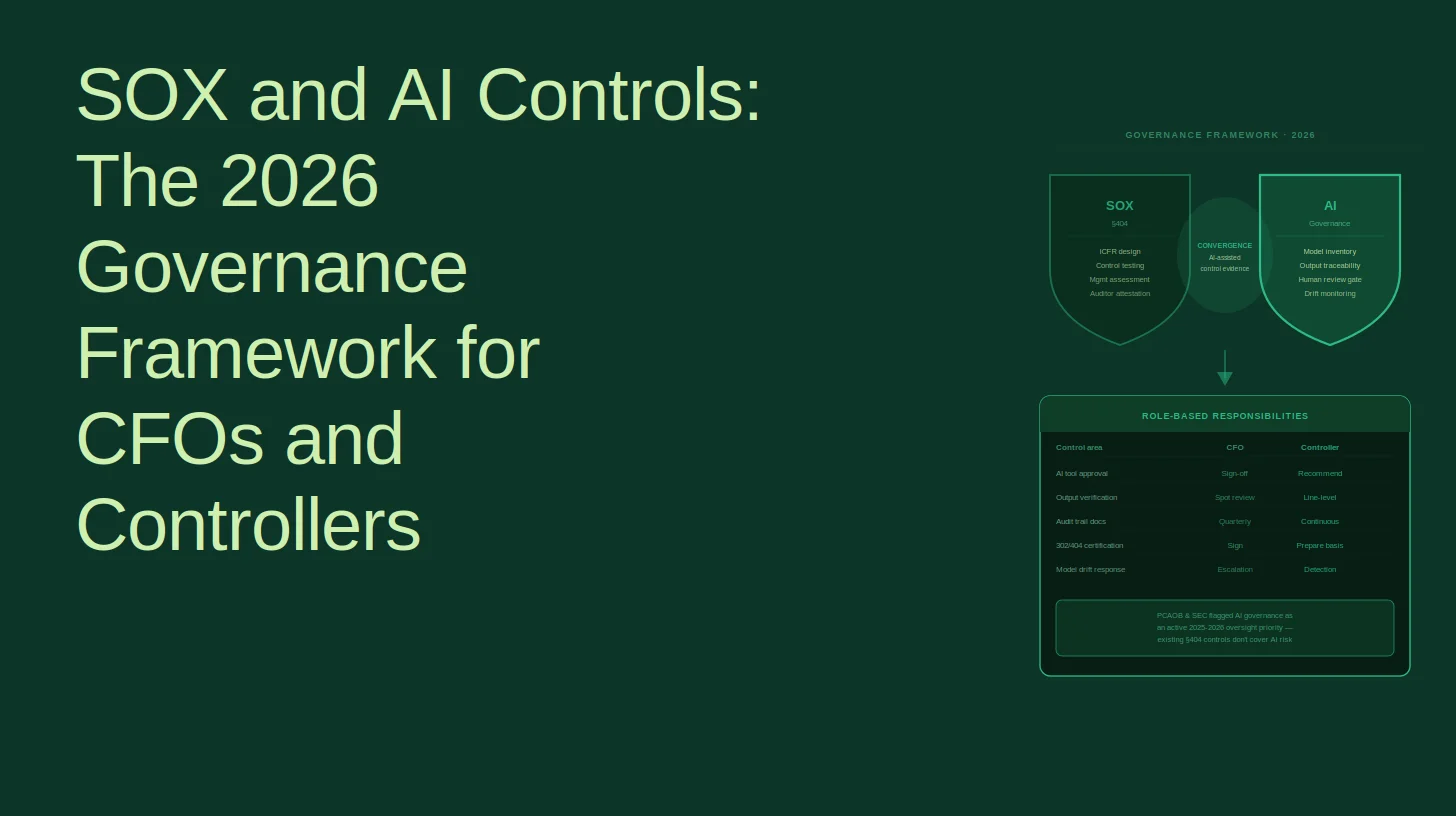
Regulatory bodies are actively adapting to AI in financial controls. The PCAOB has issued guidance on auditing AI systems, and the SEC has acknowledged AI's role in improving financial reporting quality. However, regulatory expectations are evolving rapidly, requiring organizations to stay current with emerging guidance and ensure their AI-powered control systems meet new compliance standards as they develop.
Regulators are increasingly recognizing AI's potential to strengthen financial controls. The PCAOB has issued guidance on auditing AI systems, while the SEC has acknowledged AI's role in improving financial reporting quality.
However, regulatory expectations are evolving rapidly. Organizations implementing AI-powered controls must stay current with guidance and ensure their systems meet emerging regulatory requirements.
Looking Ahead: The Future of AI-Enhanced SOX Compliance
Emerging AI technologies promise further advances in SOX compliance. Natural language processing will enable analysis of unstructured data like emails and contracts for control-relevant information. Advanced analytics will provide deeper risk insights for more sophisticated compliance approaches. Automated remediation will allow AI systems to implement corrective actions within predefined parameters without human intervention.
AI adoption in financial controls is still in its early stages. Emerging technologies point to further measurable improvements:
Natural Language Processing will enable AI systems to analyze unstructured data like emails, contracts, and board minutes for control-relevant information.
Advanced Analytics will provide deeper insights into business risks and control effectiveness, enabling more sophisticated risk-based approaches to compliance.
Automated Remediation will allow AI systems to not just identify control issues, but also automatically implement corrective actions within predefined parameters.
Getting Started: A Practical Roadmap
Organizations can implement AI-enhanced internal controls through a three-phase approach: first, assessing the current control environment and data quality while developing an AI governance framework; second, piloting AI on high-volume routine processes like journal entry testing; and third, expanding AI capabilities to additional control areas while integrating findings into broader risk management processes.
For organizations ready to embrace AI-enhanced internal controls, consider this phased approach:
Phase 1: Assessment and Planning
- Evaluate the current control environment and identify AI opportunities
- Assess data quality and integration requirements
- Develop an AI governance framework and policies
Phase 2: Pilot Implementation
- Start with high-volume, routine processes like journal entry testing
- Implement robust monitoring and validation procedures
- Train key personnel on AI system operation and interpretation
Phase 3: Expansion and Optimization
- Extend AI capabilities to additional control areas
- Refine algorithms based on operational experience
- Integrate AI findings into broader risk management processes
Embracing the New SOX Era
The Sarbanes-Oxley Act fundamentally changed how organizations approach financial reporting and internal controls. Today, artificial intelligence is driving the next evolution in this critical area.
Organizations that successfully integrate AI into their SOX compliance programs can meet regulatory requirements more efficiently while also improving risk management, financial insight, and operational effectiveness.
AI adoption in internal controls over financial reporting is already underway across major enterprises, and regulatory bodies are adapting their guidance accordingly.
As we enter this new era of AI-enhanced compliance, one thing remains constant: the fundamental goal of SOX compliance—protecting investors through accurate, reliable financial reporting. AI simply gives us better tools to achieve this critical objective.