SpaceX filed its S-1 registration statement with the SEC on May 20, 2026. The filing is publicly available on EDGAR under CIK 0001181412. The company plans to list on Nasdaq under the ticker SPCX, with the roadshow expected to begin June 8, 2026 and trading as early as late June 2026.
The headline numbers are significant: $18.674 billion in 2025 consolidated revenue, a targeted valuation of $1.75 trillion to $2 trillion, and a planned raise of approximately $75 billion to $80 billion, which would be the largest IPO in history. But the numbers only tell part of the story.
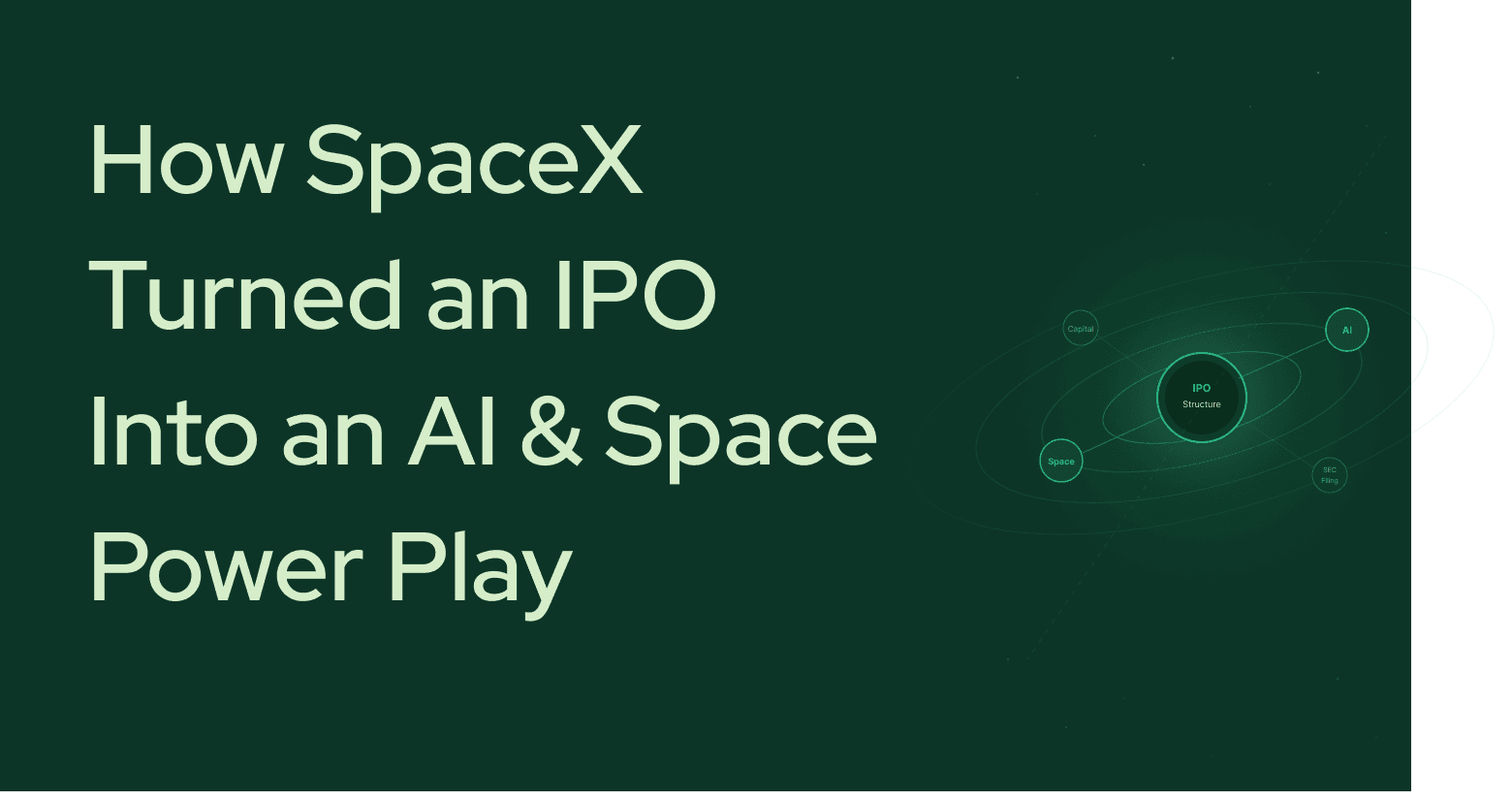
What the S-1 actually reveals is how SpaceX spent 24 years building a vertically integrated infrastructure business, then in a 90-day window in early 2026, merged two separate companies into itself under common-control accounting and presented the result to public markets as a single entity targeting the intersection of aerospace, satellite connectivity, and artificial intelligence. The corporate structure that arrived at the IPO is not the company SpaceX was 18 months ago. Understanding what changed, how it was presented in the S-1, and what the financial statements actually show about each component is the work this post does.
Why Did SpaceX Choose to Go Public in 2026 After 24 Years as a Private Company?
SpaceX was founded in 2002 and spent over two decades as one of the largest and most consequential private technology companies in the world without accessing public capital markets. The question of why 2026 is the right moment requires understanding what changed rather than what stayed the same.
The Starlink inflection point. The Connectivity segment, driven by Starlink satellite internet, reached $11.387 billion in 2025 revenue, growing approximately 50% year over year, with consumer broadband at $7.2 billion and enterprise and government at $4.2 billion. At $7.2 billion in segment EBITDA at 63% margins, Starlink is now a large, profitable, cash-generating business with a growth profile that supports a standalone public market story. A company with $11 billion in recurring revenue growing at 50% per year has a natural IPO moment, and 2026 represents that inflection.
The xAI merger created an urgency to capitalise. SpaceX announced the merger of xAI with SpaceX in February 2026 at a combined valuation of $1.25 trillion. xAI was valued at approximately $80 billion in the transaction. The merger was between entities under common control, so the financial statements were recast retroactively to include xAI and X Holdings (formerly Twitter, acquired by xAI in March 2025). xAI's AI infrastructure the Colossus and Colossus II data centres in Memphis, housing 220,000 Nvidia GPUs across 300MW of power is burning cash at an extraordinary rate. In Q1 2026 alone, xAI's capex was $7.7 billion. The company lost $2.47 billion on $818 million in revenue in Q1 2026. Financing that investment rate from private sources at reasonable cost becomes harder as the numbers grow. Public markets, with the $75 billion raise planned, provide the capital base that sustains the investment trajectory.
The Anthropic deal validated the infrastructure monetisation thesis. In May 2026, SpaceX signed Cloud Services Agreements with Anthropic for access to Colossus and Colossus II at $1.25 billion per month through May 2029 approximately $15 billion per year, $45 billion over the full term. That contract, disclosed in the S-1, gives the AI infrastructure business an anchor customer relationship it can present to public investors. The fact that Anthropic is a direct competitor to Grok (xAI's AI product) in the foundation model market makes the deal commercially unusual, but from a capital markets perspective it is a significant third-party validation of the infrastructure's market value.
The orbital data centre thesis needs patient capital. The S-1 discloses that SpaceX expects to begin deploying orbital AI compute satellites as early as 2028 — satellites in sun-synchronous orbit that can handle energy-intensive AI workloads at far greater scale and efficiency than terrestrial alternatives, connected to users through Starlink. This programme, if it succeeds, represents the next capital expenditure cycle after the current terrestrial Colossus buildout. The S-1 projects this as a defining strategic capability. Financing a multi-decade infrastructure investment programme is better structured around a permanent public capital base than sequential private funding rounds.
What Are the Three Businesses Inside the SpaceX S-1?
The consolidated entity that filed the S-1 contains three operating segments with fundamentally different financial profiles, growth rates, and risk characteristics. Understanding each separately is the prerequisite for evaluating the consolidated filing.
Segment 1: Connectivity (Starlink)
The Connectivity segment is the financial foundation of the entire enterprise. In 2025, Connectivity generated $11.387 billion in revenue, growing approximately 50% year over year. At segment EBITDA of $7.2 billion and margins of 63%, it is the only segment generating cash at scale.
Starlink operates as a satellite-based internet service provider with approximately 10 million subscribers at the time of the S-1 filing, at an average revenue per user of approximately $81 per month on the consumer side. The revenue gap between the $9.7 billion implied by consumer subscriptions at that ARPU and the $11.387 billion reported reflects hardware sales and enterprise and government contracts, both of which are growing.
The Connectivity segment is doing three jobs simultaneously: generating the operating cash that funds the capital-intensive Space and AI segments, building the connectivity infrastructure that will link orbital AI satellites to end users, and establishing the subscriber base that validates the total addressable market for satellite internet globally.
Segment 2: Space (launch services)
The Space segment, SpaceX's original business, generated $4.1 billion in 2025 revenue, growing approximately 8% year over year, and represents approximately 22% of consolidated revenue. The launch business operates Falcon 9, the most frequently flown orbital rocket in history, and is in active development of Starship, which if it reaches operational status would change the economics of access to orbit in the same way Falcon 9 changed them relative to the prior generation.
The Space segment paradox is visible in the S-1: the launch business is increasingly used to put up Starlink and AI satellites, which do not show up as Space segment revenue — they are intra-segment transfers that benefit Connectivity and AI but leave the Space segment appearing slower-growing than the underlying launch cadence suggests. In Q1 2026, Space generated $619 million in revenue with a $662 million operating loss and adjusted EBITDA loss of $351 million. The operating loss reflects the Starship development investment running through the segment P&L.
Segment 3: AI (xAI and X)
The AI segment is the newest, the largest consumer of capital, and the most uncertain. In 2025, xAI generated $3.2 billion in revenue against $6.36 billion in operating losses a loss rate that reflects aggressive GPU acquisition, data centre construction, and model development costs. In Q1 2026, xAI generated $818 million in revenue against a $2.47 billion operating loss.
The AI segment contains two distinct businesses: xAI proper, which develops the Grok foundation model and operates the Colossus AI infrastructure, and X (formerly Twitter), which was acquired by xAI in March 2025. X's financials are consolidated into the AI segment. The S-1 does not separately disclose X's revenue and losses within the AI segment total, which is a disclosure limitation that analysts have noted.
The AI segment's strategic thesis, as articulated in the S-1, is that SpaceX's reusable rockets and global connectivity network create a unique capability to deploy orbital AI compute data centres in space powered by solar energy, connected to users through Starlink that no terrestrial competitor can replicate. The orbital AI satellite programme, expected to begin deployment in 2028, is the long-duration bet the AI segment is financing.
How Was the Corporate Structure Built and What Does the S-1 Require It to Disclose?
The entity that filed the S-1 is the product of two rapid structural decisions made in early 2026, both of which significantly affected the financial statements presented to investors.
The xAI merger (February 2, 2026). SpaceX acquired X.AI Holdings Corp. on February 2, 2026. Because Musk controls both SpaceX and xAI, this was a transaction between entities under common control under ASC 805-50. Under common-control accounting, the acquirer must recast all prior period financial statements as if the entities had always been combined. The S-1 therefore presents revenue and loss data for 2023, 2024, and 2025 that includes xAI and X even though the legal merger occurred in early 2026. This retrospective recast is required by GAAP but has a specific presentation consequence: it makes the historical consolidated results look larger but also more loss-intensive than SpaceX's standalone historical results would have shown.
The X Holdings merger (March 28, 2025). xAI acquired X Holdings Corp. on March 28, 2025, which was itself a common-control transaction because Musk owned both xAI and X. This transaction is also recast retroactively in the financial statements. The result is that the S-1 presents a consolidated entity that, for financial statement purposes, has always included X (formerly Twitter) even though that acquisition occurred less than 14 months before the IPO filing date.
The 5-for-1 stock split (May 4, 2026). SpaceX completed a five-for-one stock split on May 4, 2026. All share and per-share information in the S-1 is presented on a post-split basis.
The governance structure. The S-1 creates two classes of common stock: Class A (one vote per share, offered to public investors) and Class B (ten votes per share, held by Musk). Following the IPO, Musk will hold approximately 85.1% of combined voting power through his ownership of Class A and Class B shares, with approximately 93.6% of his voting power coming from Class B shares. SpaceX qualifies as a controlled company under Nasdaq's governance rules and has opted out of Nasdaq's independent board requirements on that basis.
The practical governance consequence is that public shareholders in SPCX will have economic exposure to the business but no effective influence over any board election, strategic decision, or management change. Musk simultaneously serves as CEO, CTO, and Chairman and will retain those roles post-IPO. The S-1 discloses this arrangement with specificity, as SEC rules require for controlled companies.
What Does the Balance Sheet and Capital Structure Reveal?
The balance sheet disclosed in the S-1 reveals the scale of the AI infrastructure investment and the capital structure required to finance it.
In Q1 2026, SpaceX's capital expenditures were $10.1 billion in a single quarter. The full-year 2025 capex was $20.7 billion, broken down as $12.7 billion in the AI segment (Colossus buildouts), $4.2 billion in Connectivity (satellite manufacturing and launch capitalisation), and $3.8 billion in Space (primarily Starship development). The balance sheet as of March 31, 2026 carries $23.85 billion in servers and networking, $2.97 billion in data centre infrastructure, and $14.05 billion in construction in progress the last figure reflecting the Colossus II buildout and the Terafab chip manufacturing facility that SpaceX has announced as a joint project with Tesla and Intel, though the S-1 notes that neither Tesla nor Intel are legally obligated to remain part of the project.
The $10.1 billion Q1 2026 capex against the $6.584 billion 2025 adjusted EBITDA indicates the business is consuming cash faster than it generates it. The gap between capex and operating cash flow has been funded through debt and preferred equity raises. The S-1 discloses a March 2026 bridge loan from Morgan Stanley and interest expense of $1.9 billion in 2025. The $75 billion to $80 billion IPO raise is the mechanism for closing this gap and funding the next phase of the AI and orbital infrastructure investment cycle.
One unusual balance sheet item worth noting: the S-1 discloses a Bitcoin treasury position. SpaceX holds BTC as a treasury reserve asset, consistent with Musk's public advocacy for Bitcoin. The position and its accounting treatment under ASC 350-60 (the 2023 FASB ASU on digital assets, which requires fair value measurement through earnings) are disclosed in the financial statements.
What Are the Principal Risk Factors Disclosed in the SpaceX S-1?
The risk factors section of an S-1 is the most legally precise section in the document. It is where the company discloses, under antifraud liability, the specific material risks that could adversely affect the investment. The SpaceX S-1 risk factors cover five categories worth examining carefully.
Founder concentration and key person risk. Musk holds 85.1% of voting power and serves simultaneously as CEO, CTO, and Chairman of SpaceX while also running Tesla, X, xAI as a standalone development entity, The Boring Company, and his DOGE advisory role. The S-1 discloses this concentration and identifies it as a key person risk. The company's NASA contracts, Department of Defence Starshield business, and strategic relationships are all built around SpaceX as an organisation, but the public perception of SpaceX is inseparable from Musk personally. Departure, incapacitation, or significant regulatory sanction against Musk represent risks to all three segments simultaneously.
The Terafab contingency. The orbital AI satellite programme depends in part on the Terafab chip manufacturing facility, described as a $20 billion to $25 billion project. The S-1 states explicitly: "Neither Tesla nor Intel are obligated to remain a part of the project, and we may not enter into any such definitive agreements." This disclosure means the orbital AI compute thesis described in the business section has a critical enabling component that, as of the filing date, is not legally committed. Analysts who have described this as a framework agreement rather than a confirmed project are reading the risk factor correctly.
**The Anthropic contract termination right. **The $1.25 billion per month Anthropic compute contract, while headline-generating, carries a 90-day mutual termination right for either party. The S-1 characterises this correctly as a Cloud Services Agreement. If Anthropic builds its own infrastructure, reduces compute demand, or chooses a different provider, the contract can be terminated in 90 days. The revenue is real and current, but it is not a long-term committed revenue stream in the same sense as a multi-year take-or-pay agreement.
xAI competitive position. xAI's Grok model competes directly with OpenAI's GPT series, Anthropic's Claude, and Google's Gemini. The S-1 acknowledges that xAI's revenue growth is dwarfed by OpenAI and Anthropic. In a market where model quality and developer adoption are the primary competitive variables, xAI's position as a third or fourth player creates customer acquisition and retention risk that the financial statements will need to demonstrate resolution of over the first several post-IPO reporting periods.
Regulatory exposure across segments. Each segment carries distinct regulatory risk. The Space segment operates under FAA launch licences that can be delayed or conditioned. The Connectivity segment requires Starlink spectrum rights across every country where it operates, and those rights are subject to revocation or restriction by local regulators. The AI segment operates Colossus in Memphis under energy and data centre permitting frameworks that can create operational constraints. The combination of aerospace, telecommunications, and AI in one entity creates a regulatory surface area larger than any single-sector technology company has historically managed.
How Should the $1.75 Trillion Valuation Be Evaluated Against the Disclosed Financials?
At $18.674 billion in 2025 consolidated revenue and a targeted $1.75 trillion valuation, the implied revenue multiple is approximately 94x. At $6.584 billion in Adjusted EBITDA, the implied EBITDA multiple is approximately 265x. These are not multiples that can be supported by the current period financial statements on any conventional framework. The S-1 implicitly acknowledges this the current period financials are the foundation for the valuation story, not the justification for it.
The case for the $1.75 trillion valuation requires believing three forward-looking propositions simultaneously: that Starlink continues its 50% annual growth trajectory and reaches a subscriber base and revenue level consistent with a global internet infrastructure provider; that xAI's AI infrastructure business reaches sufficient scale and margin to justify the $12 to $15 billion in annual capital it is currently consuming; and that the orbital AI satellite programme either reaches commercial viability after 2028 or the option value it represents is worth paying for now.
At 10x 2025 revenue, a conventional tech revenue multiple, SpaceX would be worth approximately $187 billion approximately 90% below the targeted valuation. The gap between $187 billion and $1.75 trillion is entirely attributable to the orbital and AI growth options embedded in the valuation, not to the current operating business.
This is not an unusual structure for a technology IPO at the frontier of a new infrastructure category Amazon in 2001, Tesla in 2010, and Palantir in 2020 all priced at multiples that could not be supported by contemporaneous financial statements. What the SpaceX S-1 does, with unusual transparency, is disclose the specific programmatic dependencies (Terafab, orbital AI, Grok competitive position) that must be resolved for those growth options to be worth what the valuation implies. Investors who buy SPCX are explicitly buying those options, in a vehicle where they have no governance influence over the decisions that determine whether the options are exercised successfully.
Frequently Asked Questions
Why is SpaceX going public in 2026 after 24 years as a private company?
The timing reflects four converging factors disclosed in the S-1: Starlink reached $11.4 billion in 2025 revenue at 63% EBITDA margins, creating a business that can stand on its own in public markets; the xAI merger in February 2026 created a capital-intensive AI infrastructure business burning $7 to $10 billion per quarter in capex; the Anthropic compute deal validated the Colossus infrastructure at market rates; and the orbital AI satellite programme requires a permanent public capital base to fund the 2028 deployment timeline. The $75 to $80 billion planned raise is the mechanism for closing the gap between current operating cash flow and the investment rate the combined entity requires.
What are the three segments in the SpaceX S-1 and which one is profitable?
The three segments are Connectivity (Starlink), Space (launch services), and AI (xAI and X). Only Connectivity is profitable: $11.4 billion in 2025 revenue at $4.4 billion in operating income, representing 63% EBITDA margins at the segment level. The Space segment generated $4.1 billion in revenue but an operating loss reflecting Starship development costs. The AI segment generated $3.2 billion in revenue and a $6.36 billion operating loss in 2025, with losses accelerating in 2026 as xAI's capex reached $7.7 billion in Q1 alone. Starlink's operating income is the cash engine that partially offsets the investment burn in Space and AI at the consolidated level.
What is the xAI and X Holdings merger and how does it affect the financials in the S-1?
SpaceX acquired xAI on February 2, 2026, and xAI had previously acquired X (formerly Twitter) on March 28, 2025. Both were transactions between entities under common control, which requires retrospective recast of all prior period financial statements under ASC 805-50. The S-1 therefore presents 2023, 2024, and 2025 results as if all three companies had always been combined. This makes historical consolidated results larger but also more loss-intensive than SpaceX's standalone results would have shown.
What is the Anthropic compute deal and what risk does it carry?
SpaceX signed Cloud Services Agreements with Anthropic in May 2026 for access to its Colossus and Colossus II data centres at $1.25 billion per month through May 2029, approximately $45 billion over the full contract term. Either party can terminate with 90 days' notice. The deal validates the Colossus infrastructure at market rates and is currently SpaceX's largest disclosed AI compute customer. However, the 90-day termination right means the revenue is not locked in and should be treated as revocable capacity monetisation rather than a committed long-term contract.
What governance rights do public shareholders have in SPCX?
Limited effective governance rights. The dual-class share structure gives Class B shares 10 votes each. Musk holds 93.6% of Class B shares and 85.1% of total voting power post-IPO. SpaceX qualifies as a controlled company under Nasdaq rules and has opted out of the independent board requirements. Public Class A shareholders have one vote per share, economic participation in company performance, and the ability to trade their shares. They have no ability to influence board composition, management selection, or strategic decisions through normal shareholder processes. This is disclosed explicitly in the S-1 and in the risk factors.
What does the Terafab facility disclosure mean for the orbital AI thesis?
Terafab is a planned $20 to $25 billion chip manufacturing facility described as a partnership with Tesla and Intel. The S-1 explicitly discloses: "Neither Tesla nor Intel are obligated to remain a part of the project, and we may not enter into any such definitive agreements." The orbital AI satellite programme, which the S-1 positions as a defining long-term capability, is dependent in part on Terafab for the chip supply required to build AI satellites at scale. As of the filing date, Terafab is a framework agreement, not a committed project. Investors should treat it as an option, not a certainty.
Key Takeaways
- SpaceX filed its S-1 on May 20, 2026, planning to list on Nasdaq under SPCX targeting a $1.75 trillion to $2 trillion valuation in the largest IPO in history. The filing covers three segments: Connectivity (Starlink, $11.4B revenue, the only profitable segment), Space (launch services, $4.1B revenue, operating loss), and AI (xAI and X, $3.2B revenue, $6.36B operating loss in 2025).
- The corporate structure was built through two rapid mergers in early 2026. xAI was merged into SpaceX in February 2026 and X Holdings into xAI in March 2025. Both were common-control transactions requiring retrospective recast of all prior period financials, which makes historical results look larger and more loss-intensive than SpaceX standalone would have shown.
- The Anthropic compute contract ($1.25 billion per month through May 2029, terminable on 90 days' notice) validates the Colossus infrastructure at market rates. The 90-day termination right means it is revocable capacity monetisation, not a committed long-term revenue stream.
- At $20.7 billion in 2025 capex against $6.584 billion in Adjusted EBITDA, SpaceX is investing at more than three times its EBITDA generation rate. The $75 to $80 billion IPO raise is structurally necessary to sustain this investment rate, not discretionary capital above operating needs.
- The $1.75 trillion valuation implies approximately 94x 2025 revenue. At a conventional 10x multiple, the business would be worth approximately $187 billion. The gap is entirely attributable to the value of the orbital AI, Grok competitive position, and Starship growth options options that are real but contingent on programmatic execution including the unconfirmed Terafab facility.
- Public shareholders have no effective governance influence. Musk holds 85.1% of voting power post-IPO through a dual-class structure. SpaceX has opted out of Nasdaq's independent board requirements as a controlled company. Buyers of SPCX are acquiring economic exposure to the growth options in a vehicle where the governance structure concentrates all decision-making in the founder.