The cryptocurrency revolution has moved from the margins to the mainstream. As institutional adoption accelerates and regulatory frameworks solidify globally, finance teams face a transformative challenge that extends far beyond simple asset management. Project Crypto represents a fundamental restructuring of treasury operations, cross-border payment systems, and financial reporting standards. The question is no longer whether your organization will engage with digital assets, but how prepared your finance team is to manage them effectively, compliantly, and strategically.
1
Establish a Comprehensive Regulatory Framework
Finance teams preparing for cryptocurrency operations must build regulatory frameworks that address current requirements and anticipate emerging standards across multiple jurisdictions. This includes conducting regulatory audits, implementing blockchain-specific KYC and AML protocols, classifying crypto asset types, establishing dedicated compliance functions, and engaging proactively with regulatory authorities shaping digital asset standards.
The regulatory environment for digital assets continues to evolve rapidly, creating a complex compliance landscape that varies significantly across jurisdictions. Finance teams must develop sophisticated frameworks that address not only current regulatory requirements but also anticipate emerging standards in anti-money laundering, securities classification, and consumer protection.
Understanding the nuances between different regulatory regimes is critical for organizations operating internationally. The SEC's framework for analyzing digital assets uses the Howey test to determine whether crypto assets qualify as securities, while the EU's Markets in Crypto-Assets (MiCA) regulation establishes a comprehensive framework for the European market. SEC Chair Gary Gensler stated that "the vast majority of crypto tokens are securities, and the investing public is entitled to the same protections as in other securities markets." The consequences of non-compliance extend beyond financial penalties to include reputational damage and operational restrictions.
STRATEGIC IMPLEMENTATION PRIORITIES
- Conduct comprehensive regulatory audits across all jurisdictions where your organization operates or plans to engage in crypto activities
- Implement robust Know Your Customer (KYC) and Anti-Money Laundering (AML) protocols specifically designed for blockchain transaction monitoring
- Establish a dedicated compliance function with expertise bridging traditional financial regulation and digital asset innovation
- Develop clear internal classification systems for different crypto asset types (payment tokens, utility tokens, security tokens, stablecoins)
- Build proactive relationships with regulatory authorities and participate in industry working groups shaping future standards
2
Upgrade Your Technology Infrastructure
Organizations adopting cryptocurrency must overhaul their technology infrastructure to support decentralized validation, cryptographic security, and near-instantaneous settlement. Key upgrades include deploying enterprise-grade crypto accounting platforms that integrate with existing ERP systems, implementing segregated hot and cold wallet custody solutions, and establishing multi-signature protocols with comprehensive disaster recovery procedures for private key management.
Traditional financial systems were architected for centralized, permission-based networks with clear intermediaries and standardized settlement periods. Cryptocurrency operates on fundamentally different principles—decentralized validation, cryptographic security, and near-instantaneous settlement. This paradigm shift necessitates a comprehensive technology overhaul that extends across custody solutions, accounting systems, and transaction monitoring capabilities.
The security requirements alone represent a departure from conventional practices. While traditional banking relies on institutional safeguards and regulatory backstops, cryptocurrency custody demands that organizations become their own security architects, implementing multi-signature protocols, hardware security modules, and sophisticated key management systems that eliminate single points of failure.
INFRASTRUCTURE MODERNIZATION ROADMAP
- Deploy enterprise-grade crypto accounting platforms such as Cryptio, Bitwave, or Lukka that integrate seamlessly with existing ERP systems
- Implement segregated custody solutions distinguishing between hot wallets for operational needs and cold storage for long-term holdings
- Establish automated reconciliation protocols that can handle the high transaction volumes and fractional denominations typical in crypto operations
- Integrate blockchain analytics capabilities for real-time transaction monitoring, address screening, and risk scoring
- Develop comprehensive disaster recovery procedures specifically addressing cryptocurrency's unique characteristics, including private key backup and recovery protocols
3
Develop Robust Accounting and Tax Strategies
Cryptocurrency accounting requires specialized approaches to fair value measurement, impairment testing, and income recognition across volatile digital asset markets. Most jurisdictions treat cryptocurrency as property rather than currency, triggering capital gains calculations on every transaction and requiring granular cost-basis tracking for events like hard forks, airdrops, staking rewards, and DeFi transactions under GAAP, IFRS, or local standards.
Cryptocurrency accounting presents challenges that extend well beyond traditional asset management. The classification of digital assets remains subject to interpretation across different accounting standards, with significant implications for balance sheet presentation, income recognition, and impairment testing. Organizations must navigate questions of fair value measurement in highly volatile markets, revenue recognition for crypto-denominated transactions, and the appropriate treatment of emerging asset classes such as NFTs and tokenized securities.
Tax considerations add another layer of complexity. In most jurisdictions, cryptocurrency is treated as property rather than currency, triggering capital gains calculations on every transaction—including routine operational activities. This creates substantial record-keeping requirements and necessitates sophisticated cost-basis tracking methodologies that can handle complex scenarios such as hard forks, airdrops, staking rewards, and decentralized finance transactions.
ACCOUNTING FRAMEWORK ESSENTIALS
- Establish clear valuation methodologies aligned with applicable accounting standards (GAAP, IFRS, or local equivalents), addressing both measurement at initial recognition and subsequent reporting periods
- Implement granular cost-basis tracking systems capable of managing multiple acquisition dates, prices, and transaction types across potentially thousands of individual units
- Develop comprehensive impairment testing procedures for crypto assets, recognizing that current accounting standards may require write-downs that cannot be subsequently reversed
- Create specialized processes for recognizing and measuring income from diverse sources including trading gains, mining operations, staking rewards, and DeFi yield farming
- Build tax strategies addressing jurisdiction-specific rules for different transaction types, including wash sale considerations, like-kind exchange limitations, and loss harvesting opportunities
- Establish relationships with auditors possessing deep cryptocurrency expertise and staying current with evolving guidance from standard-setting bodies
4
Implement Comprehensive Risk Management Protocols
Cryptocurrency risk management must address unique threats that legacy financial frameworks were not designed to handle, including irreversible transactions, catastrophic private key loss, exchange platform failures, and price volatility exceeding 20% in single trading sessions. Effective protocols require multi-signature wallet architectures, position sizing limits, specialized vendor assessments, incident response playbooks, and digital asset insurance coverage.
The risk profile of cryptocurrency operations differs fundamentally from traditional financial activities, introducing exposure categories that legacy risk frameworks were never designed to address. Operational risks include the irreversibility of transactions, the catastrophic impact of private key loss or compromise, and the dependency on external infrastructure such as blockchain networks and exchange platforms over which organizations have limited control.
Market risks in cryptocurrency extend beyond typical volatility concerns. Digital assets can experience price movements of 20% or more in single trading sessions, liquidity can evaporate rapidly during market stress, and correlation patterns with traditional assets remain unstable and difficult to predict. These characteristics demand risk management approaches that combine quantitative rigor with qualitative judgment about an asset class still defining its role in the broader financial system.
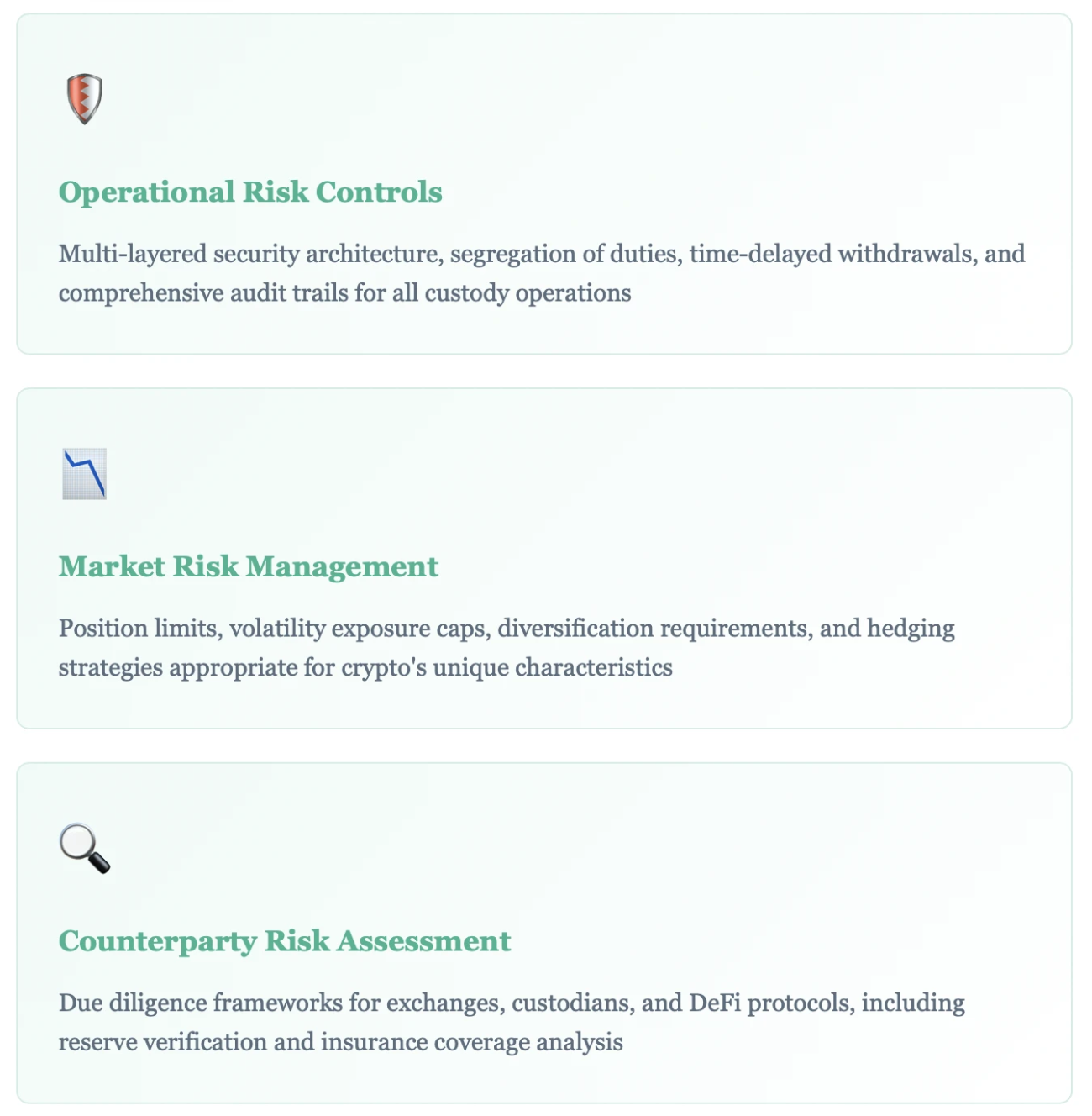
Establish multi-signature wallet architectures requiring consensus among multiple authorized individuals for all material transactions, eliminating single points of failure
Implement position sizing rules that limit cryptocurrency exposure relative to total treasury holdings, with clear escalation procedures for exceeding established thresholds
Develop comprehensive vendor assessment frameworks specifically addressing the unique risks of cryptocurrency service providers, including proof-of-reserves verification and insurance coverage evaluation
Create detailed incident response playbooks covering scenarios such as exchange failures, smart contract vulnerabilities, private key compromises, and extreme market volatility
Secure specialized insurance coverage for digital assets, recognizing that traditional crime and fidelity policies typically exclude cryptocurrency-related losses
Establish governance structures defining clear approval authorities for different transaction types, investment decisions, and risk limit modifications
5
Invest in Education and Talent Development
Effective cryptocurrency management requires knowledge spanning blockchain technology, cryptographic principles, decentralized finance, and evolving regulations that traditional finance education does not cover. Organizations should pursue a dual strategy of upskilling existing finance staff through professional certification programs while recruiting experienced cryptocurrency professionals who bring specialized expertise in areas like smart contract auditing and DeFi protocol analysis.
The sophistication required to manage cryptocurrency operations effectively cannot be acquired through conventional finance education alone. Blockchain technology, cryptographic principles, decentralized finance mechanisms, and the rapidly evolving regulatory landscape represent a knowledge domain that intersects technology, finance, and law in ways that traditional finance roles rarely encounter.
Organizations face a fundamental choice: develop internal expertise through intensive training programs or acquire talent from the cryptocurrency industry. The optimal approach typically involves both strategies—upskilling existing team members who understand the organization's operations, risk appetite, and culture while simultaneously bringing in specialists who can provide depth in specific areas such as blockchain architecture, smart contract auditing, or DeFi protocol analysis.
CAPABILITY BUILDING STRATEGY
- Sponsor team members to complete professional certification programs in blockchain technology and digital asset management from recognized institutions
- Recruit experienced cryptocurrency finance professionals for senior positions, ensuring they possess both technical blockchain knowledge and traditional financial expertise
- Establish advisory relationships with specialized consulting firms that can provide guidance on complex technical, regulatory, and strategic questions
- Create internal knowledge-sharing mechanisms such as lunch-and-learn sessions, crypto working groups, and documentation repositories that democratize specialized knowledge across the finance function
- Invest in attendance at major blockchain and cryptocurrency conferences, ensuring team members maintain awareness of emerging trends, technologies, and regulatory developments
- Develop mentorship programs pairing cryptocurrency-experienced professionals with traditional finance staff, facilitating knowledge transfer and building organizational capability
- Establish relationships with academic institutions and research organizations conducting current research in blockchain economics and digital asset markets
Moving Forward: From Preparation to Implementation
Project Crypto is not a theoretical exercise or a distant possibility—it represents the present reality for an increasing number of organizations across industries. Those that approach digital asset integration thoughtfully and systematically will discover opportunities for treasury optimization, operational efficiency gains, and competitive differentiation that were simply unavailable in the traditional financial system.
The five strategic imperatives -- regulatory frameworks, technology infrastructure, accounting and tax strategies, risk management, and talent development -- provide a foundation, but successful implementation requires adaptation to your organization's specific circumstances, risk tolerance, and strategic objectives. Begin with pilot programs that allow controlled experimentation and learning. Establish clear success metrics that extend beyond simple return calculations to include operational effectiveness, compliance quality, and capability development.
Most importantly, recognize that cryptocurrency adoption is a journey of continuous learning and adaptation rather than a one-time project with a defined endpoint. The technology will continue evolving, regulations will mature and shift, and market structures will develop in ways we cannot fully predict today. Organizations that build adaptive capabilities, maintain epistemic humility, and invest consistently in their teams will be best positioned not just for Project Crypto, but for the broader digital transformation reshaping the global financial architecture.
The critical question facing your finance team: Which capability gap will you address first, and how will you measure progress toward cryptocurrency readiness?