For foreign companies trading on U.S. stock exchanges, few documents carry as much weight as the SEC Form 20-F. This annual report isn't just paperwork—it's the lifeline that keeps foreign private issuers (FPIs) connected to American investors and capital markets. But what happens when companies fail to file this critical document? The consequences can be swift, severe, and sometimes irreversible.
Understanding Form 20-F: The Gateway to U.S. Markets
Form 20-F is the annual report that foreign private issuers must file with the SEC to maintain their listing on U.S. stock exchanges. It functions as the international equivalent of the domestic 10-K, providing American investors with audited financial statements, business descriptions, and risk disclosures required under U.S. securities law.
Form 20-F serves as the equivalent of the domestic 10-K filing for foreign companies. Under SEC Rule 13a-1 and Form 20-F instructions, the SEC requires foreign private issuers to provide U.S. investors with comprehensive information about financial condition, business operations, and risk factors.
According to the SEC, approximately 500 foreign private issuers from over 40 countries file Form 20-F annually (SEC, 2024). As former SEC Chair Jay Clayton stated, "Foreign private issuers are a vital part of our capital markets, and their disclosure obligations serve the same investor protection purposes as those of domestic filers."
The form must be filed within four months after the end of the company's fiscal year, making timing critical. Missing this deadline is a compliance failure with cascading consequences.
The Immediate Consequences: When the Clock Runs Out
Foreign private issuers that miss the Form 20-F filing deadline face immediate SEC enforcement actions including cease and desist orders, civil monetary penalties, and restrictions on issuing new securities. Delinquent filers lose access to shelf registration statements and certain exempt transactions, effectively freezing their ability to raise capital in U.S. markets.
1. Late Filing Penalties and SEC Enforcement
The Securities and Exchange Commission treats filing failures as serious violations. Under Section 13(a) of the Securities Exchange Act of 1934 and related SEC rules, U.S. public companies and foreign private issuers are subject to substantial disclosure requirements, and violations can trigger enforcement actions. The SEC's Division of Enforcement brought 784 enforcement actions in fiscal year 2023, resulting in $4.9 billion in financial remedies (SEC, 2023).
Companies that miss their Form 20-F deadline immediately become "delinquent filers," exposing themselves to:
- Cease and desist orders
- Civil monetary penalties
- Potential criminal referrals for willful violations
- Enhanced SEC scrutiny on all future filings
2. Market Access Restrictions
Late filers face immediate practical consequences in accessing capital markets. They cannot:
- Issue new securities until current with all filings
- Participate in certain exempt transactions
- Use shelf registration statements
- Take advantage of various SEC safe harbors
The Domino Effect: Long-Term Consequences
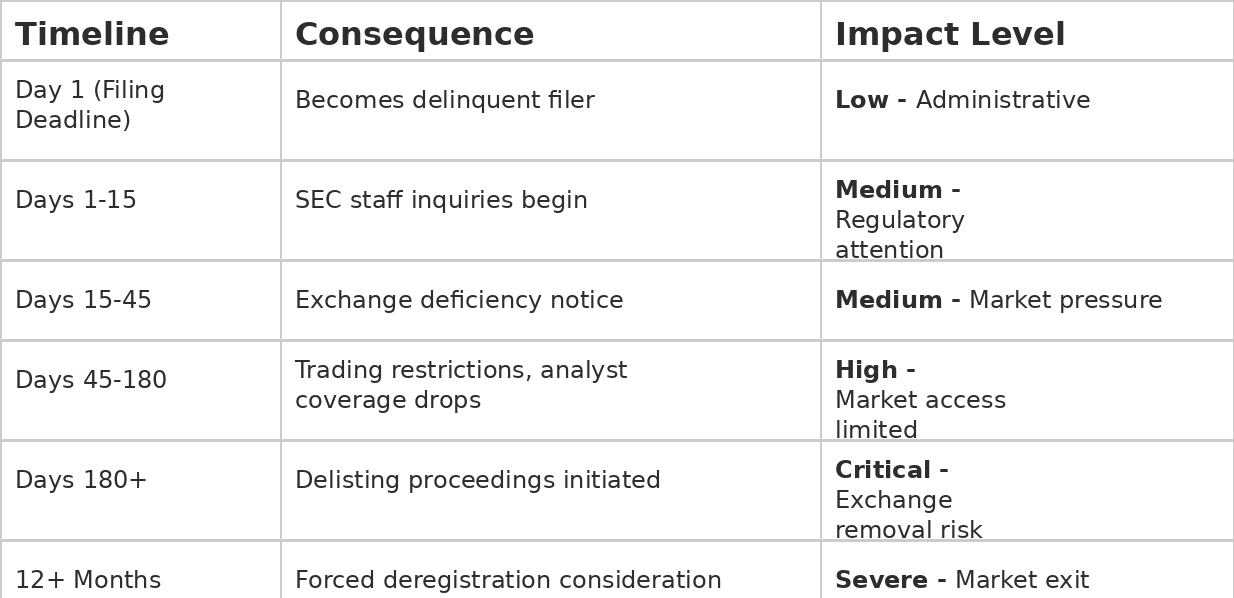
Persistent Form 20-F non-compliance triggers a chain of long-term consequences starting with exchange deficiency notices and culminating in delisting from NYSE or NASDAQ. Delisted companies are relegated to over-the-counter markets, lose institutional investor support, see analyst coverage withdrawn, and experience significant valuation discounts compared to compliant peers.
Exchange Delisting: The Ultimate Price
One of the most severe consequences of persistent Form 20-F non-compliance is delisting from major U.S. exchanges. Both NYSE Listed Company Manual Section 802 and NASDAQ Listing Rule 5250(c) impose strict continued listing requirements that include timely SEC filings. According to research from the Harvard Law School Forum on Corporate Governance, companies that are delisted experience an average stock price decline of 30-50% relative to their last traded price on the exchange (Harvard Law School, 2022).
When companies fall significantly behind on their 20-F filings:
- Warning Phase: Exchanges typically issue deficiency notices
- Cure Period: Companies receive a limited time (usually 6 months) to become current
- **Delisting Determination: **Failure to cure results in delisting proceedings
- Final Delisting: Removal from the exchange and relegation to over-the-counter markets
The Compliance Cascade: A Visual Breakdown
Investor Confidence Erosion
Beyond regulatory consequences, failing to file Form 20-F sends a troubling signal to the market. Institutional investors, who form the backbone of most foreign companies' U.S. shareholder base, often have mandates preventing investment in non-compliant companies. A CFA Institute survey found that 73% of institutional investors would reduce or eliminate positions in companies with delinquent regulatory filings (CFA Institute, 2023). This leads to:
- **Institutional Selling Pressure: **Large shareholders may be forced to divest
- Analyst Coverage Withdrawal: Research analysts typically drop coverage of delinquent filers
- Liquidity Deterioration: Reduced trading volume and wider bid-ask spreads
- **Valuation Discounts: **Non-compliant companies trade at significant discounts to peers
The Hidden Costs: Beyond the Obvious
Beyond regulatory penalties, Form 20-F filing failures generate substantial hidden costs including emergency audit fees, expedited legal review expenses, crisis communications spending, and potential shareholder litigation. The compliance crisis also diverts management attention from core business operations, forcing leadership to spend months on regulatory remediation instead of strategic growth initiatives.
Legal and Professional Fees
Companies scrambling to address Form 20-F delinquencies often face escalating professional costs:
- Emergency audit procedures to finalize financial statements
- Expedited legal review and SEC correspondence
- Crisis communication and investor relations expenses
- Potential litigation from shareholders claiming damages
Business Operation Disruptions
The compliance crisis often diverts management's attention from core business operations. Leadership teams may spend months focused on regulatory remediation rather than growth initiatives, competitive positioning, or strategic planning.
Real-World Stakes: Why Compliance Matters More Than Ever
Form 20-F compliance has become more critical as SEC regulations grow increasingly stringent. New clawback rules now require foreign private issuers to implement compensation recovery policies for executive officers following financial restatements, adding another layer of disclosure obligations that make timely annual filings essential for maintaining good standing.
The regulatory environment has grown increasingly stringent. The SEC's clawback rules adopted under Exchange Act Rule 10D-1 require FPIs to implement and enforce policies to recover certain compensation received by current or former executive officers during a three-year lookback period after certain restatements of financial information. SEC Chair Gary Gensler noted at the time of adoption that these rules "strengthen the transparency and quality of corporate financial statements, and the accountability of corporate executives." These evolving requirements make staying current with Form 20-F filings critical for maintaining good standing.
The Path Forward: Prevention and Remediation
Foreign private issuers can prevent Form 20-F delinquencies by implementing year-round preparation processes, maintaining strong auditor and legal counsel relationships, and monitoring regulatory changes continuously. Companies already delinquent should engage proactively with SEC staff, file Form 12b-25 for extensions when possible, and communicate transparently with exchanges about remediation timelines.
For companies currently in compliance, the key is establishing robust filing processes:
Best Practices for Compliance:
- Implement year-round preparation processes rather than last-minute scrambles
- Maintain strong relationships with auditors and legal counsel
- Establish backup plans for unexpected delays
- Monitor regulatory changes and new disclosure requirements
For Delinquent Companies:
- Engage with SEC staff proactively to discuss remediation plans
- Consider filing Form 12b-25 for limited extensions when possible
- Communicate transparently with exchanges about cure timelines
- Implement governance changes to prevent future delinquencies
Conclusion: The Cost of Non-Compliance
Failing to file Form 20-F isn't just about missing a deadline—it's about risking everything a foreign company has built in the U.S. capital markets. The consequences ripple through every aspect of a company's relationship with American investors, from immediate regulatory penalties to long-term market access restrictions.
In today's interconnected global economy, maintaining access to U.S. capital markets is essential for many foreign companies' growth strategies. The U.S. equity markets represented approximately $46 trillion in total market capitalization as of 2024 (World Federation of Exchanges, 2024). The Form 20-F filing requirement represents more than regulatory compliance; it is the price of admission to these capital markets.
For foreign private issuers, Form 20-F compliance preserves the trust, market access, and investor relationships that form the foundation of their U.S. market presence.
Companies facing Form 20-F compliance challenges should consult with experienced securities counsel and accounting professionals. Early intervention can often prevent minor delays from becoming major crises.