The Policy Theory Behind the INVEST Act's Deregulation Push
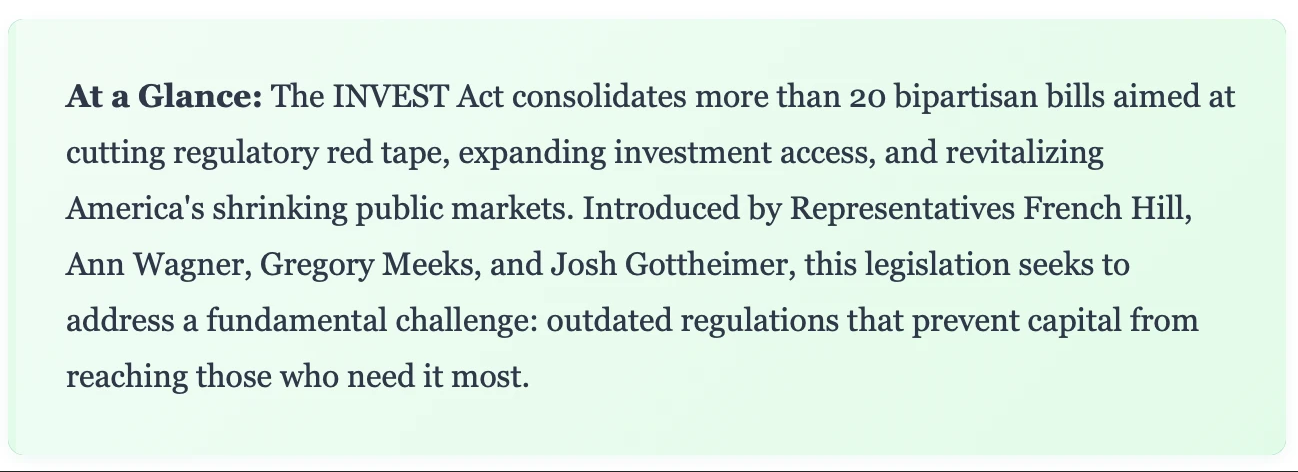
In the corridors of Capitol Hill, a bipartisan legislative effort is taking shape. The Incentivizing New Ventures and Economic Strength Through Capital Formation Act—better known as the INVEST Act—represents a broad attempt to restructure how America's capital markets serve entrepreneurs, small businesses, and everyday investors.
The Problem: A Capital Formation Crisis
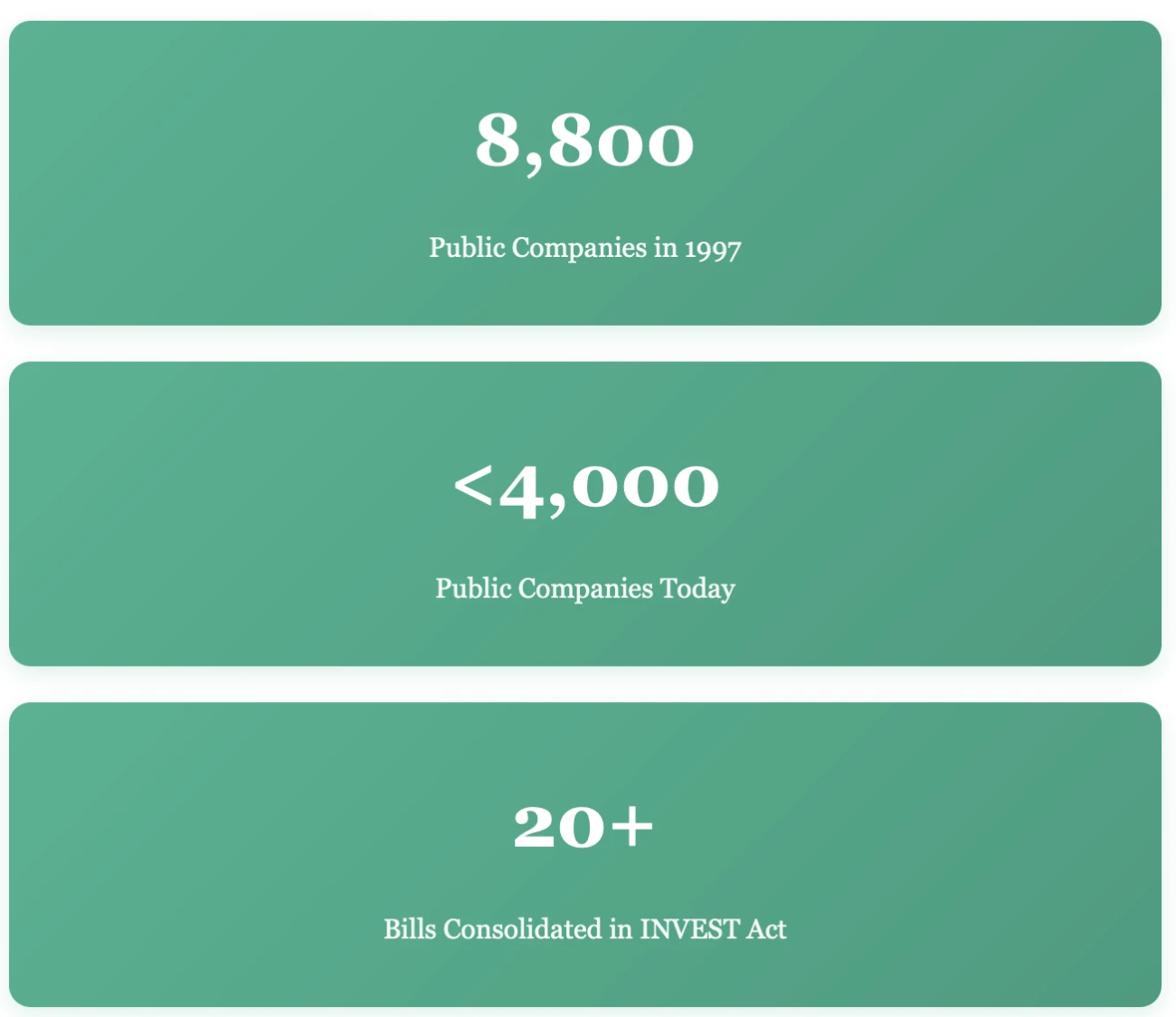
Meanwhile, venture capital and private equity funding flows predominantly to a handful of coastal cities, leaving entrepreneurs in the Midwest, South, and rural America struggling to access the capital necessary for growth and job creation. This geographic disparity isn't just inefficient—it's fundamentally at odds with the American promise of opportunity for all.
The Philosophy: Smart Deregulation, Not Reckless Abandonment
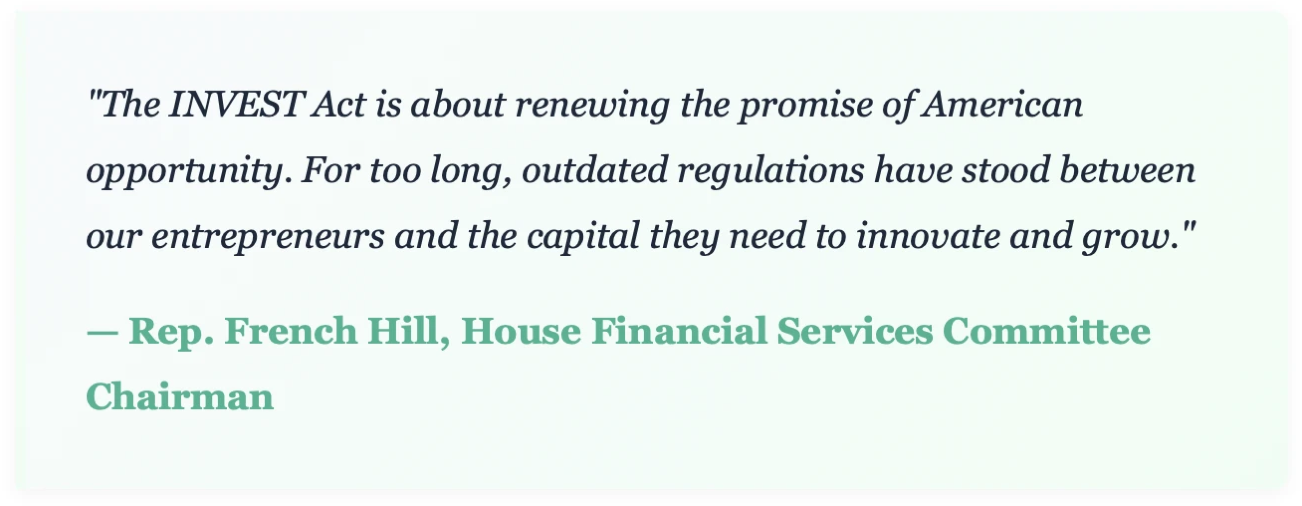
This approach reflects a growing consensus that regulatory frameworks established in the aftermath of the 1929 market crash and refined over decades may have overshot their mark, creating barriers that harm more than they help. A Harvard Law School Forum on Corporate Governance analysis estimated that the average cost of an IPO increased by over 50% in the two decades following Sarbanes-Oxley, with smaller companies bearing a disproportionate share of compliance expenses (Harvard Law, 2022). The key insight: not all companies pose the same risks, and regulations should reflect these differences.
The Three Pillars of Reform
The INVEST Act is structured around three pillars: Title I removes capital access barriers for small businesses and startups by expanding SEC advocacy, relaxing solicitation rules, and raising crowdfunding thresholds under Regulation CF. Title II democratizes investment access by expanding the accredited investor definition beyond wealth to include knowledge-based qualifications. Title III revitalizes public markets by reducing compliance burdens that disproportionately discourage smaller companies from listing. According to the SEC, Regulation Crowdfunding issuers raised approximately $1.5 billion in 2023, demonstrating strong demand for small-business capital formation pathways (SEC, 2024).
Title I: Empowering Small Business and Startups
The first pillar focuses on removing obstacles that prevent small businesses and startups from accessing capital markets. Key provisions include:
Expanding SEC Advocacy
Broadening the Office of the Advocate for Small Business Capital Formation to include rural entrepreneurs and creating dedicated Small Business offices within key SEC divisions.
Relaxing General Solicitation Rules
Allowing startups to present to states, public agencies, angel investors, universities, and accelerators without violating federal restrictions.
Raising Crowdfunding Thresholds
Increasing the accountant review threshold from $100,000 to $250,000 (with discretion up to $400,000), making crowdfunding more viable for growing businesses.
Expanding Venture Capital Access
Doubling the investor cap for qualifying venture capital funds from 250 to 500 people and raising their capital limit from $10 million to $50 million.
Title II: Democratizing Investment Access
Perhaps the most philosophically interesting aspect of the INVEST Act is its reconceptualization of who should be allowed to invest in private markets. Currently, the "accredited investor" definition relies almost entirely on wealth thresholds—you need a net worth exceeding $1 million or annual income above $200,000.

The INVEST Act addresses this by expanding the accredited investor definition to include individuals with professional brokerage or investment adviser licenses, relevant financial education or job experience, and those who pass a newly created SEC certification exam. This knowledge-based approach could open private market investing to millions of Americans currently excluded.
Additional provisions in this section include:
- Allowing 403(b) retirement plans—used primarily by teachers and nonprofit employees—to invest in the same products as 401(k) plans, including collective investment trusts
- Establishing a Senior Investor Taskforce at the SEC to combat fraud targeting Americans over 65
- Enabling electronic delivery of investor documents as the default, reducing costs while preserving paper options
Title III: Revitalizing Public Markets
The third pillar tackles the decline in public company listings by reducing compliance burdens that disproportionately affect smaller firms. These reforms recognize that excessive disclosure requirements can actually harm investors by discouraging companies from going public, thereby reducing investment options.
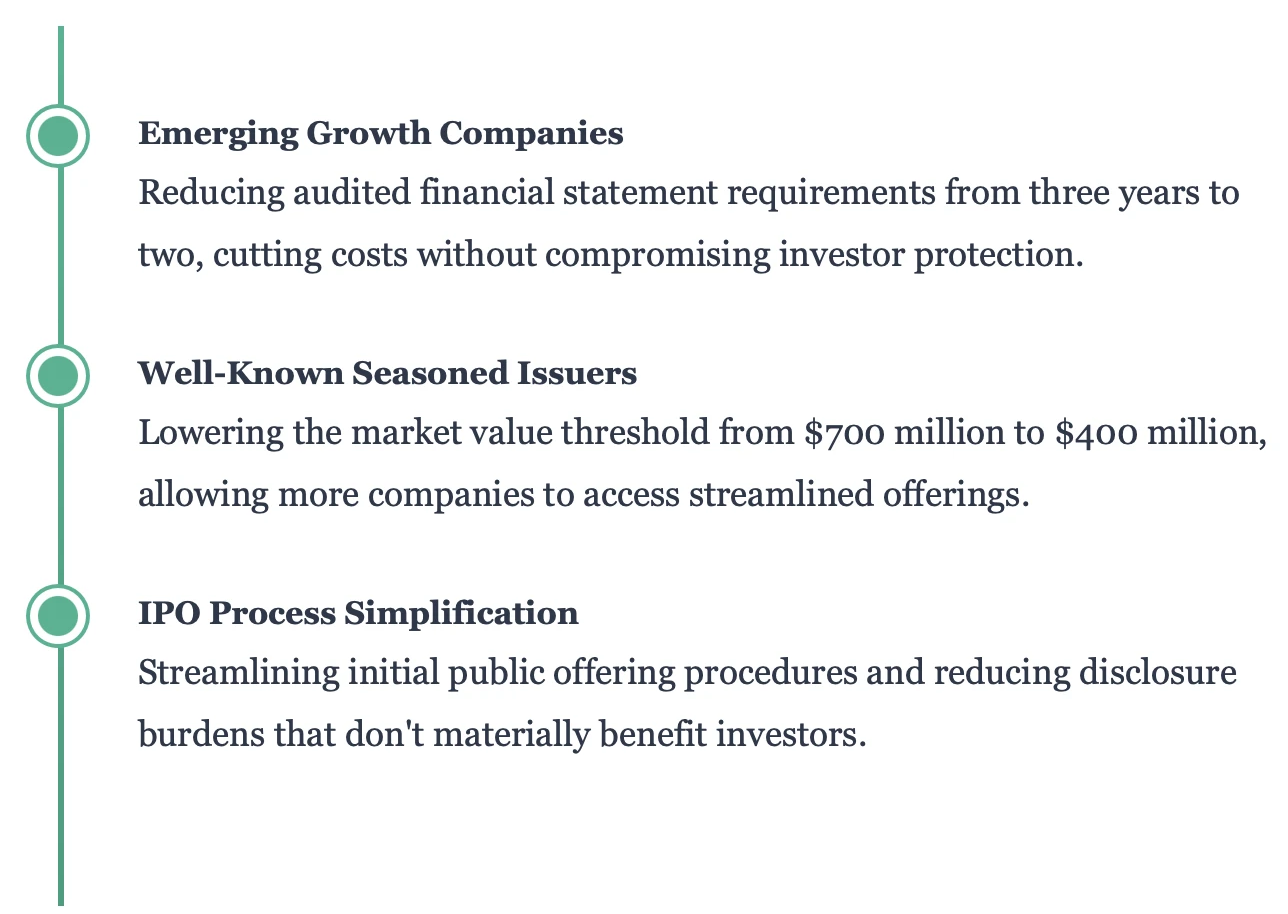
The Theoretical Foundation: Proportionality and Materiality
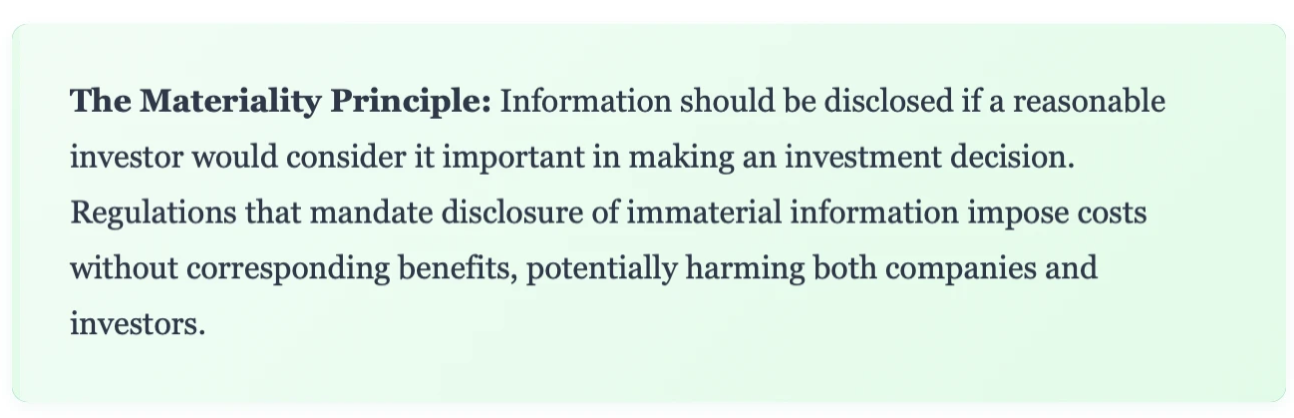
The INVEST Act rests on two foundational principles. Proportionality holds that regulatory requirements should scale with company size, so a five-person startup does not face the same disclosure regime as a Fortune 500 corporation. This principle aligns with FASB's ongoing simplification initiatives, which have sought to reduce unnecessary complexity in accounting standards for private and smaller public companies (FASB, 2023). Materiality insists that disclosure should focus on information genuinely relevant to investment decisions, as SEC Chairman Paul Atkins has argued that requirements unmoored from materiality create costs that divert resources without benefiting investors.
At its core, the INVEST Act rests on two interrelated principles that deserve deeper examination.
Proportionality holds that regulatory requirements should scale with company size and complexity. A startup with five employees and $2 million in revenue shouldn't face the same disclosure regime as a Fortune 500 corporation. This principle acknowledges that one-size-fits-all regulation often fails both small businesses (which are over-regulated) and large corporations (which may be under-regulated in specific areas).
Materiality insists that disclosure requirements should focus on information that genuinely affects investment decisions. SEC Chairman Paul Atkins recently articulated this concern, noting that disclosure regimes requiring information "unmoored from materiality" do not actually benefit investors. Instead, they create compliance costs that divert resources from productive activities while overwhelming investors with irrelevant data.
The Bipartisan Appeal: Finding Common Ground
The INVEST Act has attracted support from both progressive Democrats and conservative Republicans by framing capital market reform as an issue of economic fairness rather than partisan ideology. According to Federal Reserve Survey of Consumer Finances data, approximately 58% of American households held stocks directly or indirectly through retirement accounts in 2022 (Federal Reserve, 2023). Supporters argue that true investor protection means ensuring broad participation in wealth creation rather than limiting access based solely on wealth thresholds.
One of the most remarkable aspects of the INVEST Act is its genuine bipartisan support. In an era of intense political polarization, this legislation has attracted backing from both progressive Democrats and conservative Republicans—a testament to its careful balancing of competing interests.
Representative Gregory Meeks, a Democrat from New York, emphasized the legislation's potential to help ordinary Americans: "Today, more than half of American households have exposure to the stock market, not as day-traders or large-scale market players, but as teachers, firefighters, nurses, and workers saving for the future through mutual funds, pensions, and retirement plans like 401(k)s and IRAs. These reforms are a meaningful step toward addressing the affordability crisis and empowering people to secure their financial futures."
This framing rejects the false dichotomy between investor protection and market access. The INVEST Act's supporters argue that true investor protection means ensuring Americans can participate in wealth creation opportunities, not paternalistically limiting their choices.
Potential Challenges and Criticisms
Critics of the INVEST Act raise four primary concerns: that reduced disclosure requirements may expose less sophisticated investors to unacceptable risks, that loosened restrictions could create opportunities for fraud targeting inexperienced investors, that an influx of smaller public companies might increase market volatility, and that knowledge-based accreditation may create new barriers favoring those with access to financial education rather than truly democratizing investment. The CFA Institute has cautioned that any expansion of investor access must be paired with robust investor education and fraud prevention measures (CFA Institute, 2023). Former SEC Chair Gary Gensler also expressed concern about maintaining appropriate investor protections, stating that "our markets work best when there is a level playing field and all investors have access to reliable information" (SEC, 2022).
No significant policy change comes without legitimate concerns, and the INVEST Act is no exception. Critics have raised several important questions:
- Investor Protection Trade-offs: Will reducing disclosure requirements and expanding investment access expose less sophisticated investors to unacceptable risks?
- Fraud Prevention: Could loosening restrictions create opportunities for bad actors to exploit less experienced investors?
- Market Stability: Might an influx of smaller, less-established companies in public markets increase volatility?
- Unintended Consequences: Will knowledge-based accreditation actually democratize investing, or simply create new barriers favoring those with access to financial education?
These concerns deserve serious consideration. However, proponents argue that the status quo also imposes costs—in the form of reduced economic dynamism, limited investment opportunities for middle-class Americans, and geographic inequality in capital access.
The Broader Context: Deregulation in the Trump Era
The INVEST Act sits within a broader deregulatory agenda under the Trump administration that spans energy, manufacturing, and financial sectors. The legislation attempts to distinguish itself from wholesale deregulation by targeting specific, well-identified inefficiencies in capital formation rules rather than eliminating oversight entirely, raising questions about how to separate beneficial regulatory modernization from harmful rollbacks of essential investor protections. The SEC's Office of the Investor Advocate has noted the importance of maintaining core disclosure protections while modernizing outdated requirements (SEC, 2024).
The INVEST Act arrives amid a broader push for deregulation under the Trump administration. President Trump has publicly emphasized cutting regulations across energy, manufacturing, and financial sectors, arguing that reducing bureaucratic hurdles fosters economic growth, creates jobs, and enhances American competitiveness.
This broader context raises important questions about how to distinguish between beneficial regulatory modernization and potentially harmful rollbacks of essential protections. The INVEST Act attempts to thread this needle by targeting specific, well-identified inefficiencies rather than wholesale elimination of oversight.
Reimagining American Capitalism
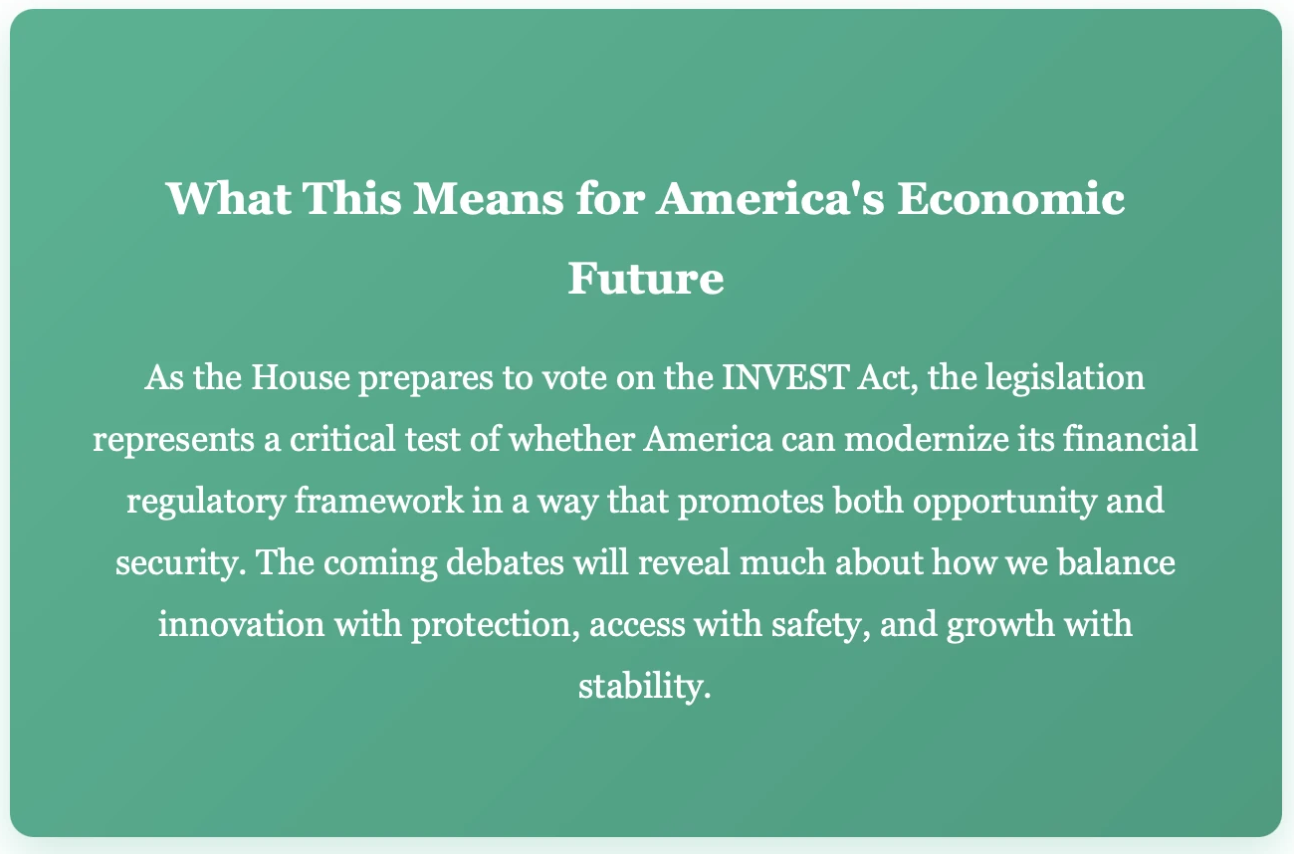
The INVEST Act is more than a collection of technical regulatory adjustments. It represents a fundamental reconsideration of how America's capital markets should function in the 21st century. At stake is whether the United States can maintain its position as the world's premier destination for entrepreneurship and innovation, or whether regulatory ossification will gradually erode that competitive advantage.
The legislation's emphasis on geographic equity—ensuring that entrepreneurs in Des Moines and rural Mississippi have access to capital comparable to their counterparts in Silicon Valley and Manhattan—speaks to deeper questions about American opportunity and economic fairness. Similarly, its reconceptualization of investor accreditation challenges us to think more carefully about the relationship between wealth, knowledge, and autonomy.
Whether the INVEST Act succeeds will depend not just on its passage, but on implementation. Will the SEC embrace its spirit of proportionality and materiality? Will the new pathways to accredited investor status genuinely democratize access, or will new gatekeepers emerge? Will reduced disclosure requirements lead to better or worse investment outcomes?
These questions cannot be answered in advance. What we can say is that after decades of incremental regulatory additions, the INVEST Act represents a serious attempt to step back, reassess, and modernize—to ask not just what regulations we have, but what regulations we actually need.
In that sense, the INVEST Act embodies the American spirit at its best: a willingness to question inherited wisdom, a commitment to expanding opportunity, and a faith that with appropriate guardrails, innovation and enterprise can improve lives across society. Whether that faith is justified remains to be seen, but the debate itself is vital and overdue.