
The strategic imperative behind staying ahead of regulatory timelines
When regulatory deadlines get extended, there's a tempting tendency to breathe a collective sigh of relief and shift focus elsewhere. But here's the uncomfortable truth: a delayed deadline is not a hall pass to postpone preparation. In fact, it might be the competitive edge you didn't know you needed.
The financial services industry is witnessing one of its most significant transformations in decades. Market structure modernization isn't just another compliance checkbox—it's a fundamental reimagining of how markets operate, how trades are executed, and how transparency is maintained. Yet many firms are treating deadline extensions as opportunities to delay rather than opportunities to excel.
The Procrastination Paradox
When the SEC extends a regulatory deadline, firms that treat the extension as breathing room consistently face higher implementation costs, more operational disruptions, and greater compliance risk than early movers. Data from prior regulatory transitions shows that last-minute implementers spend significantly more on technology, talent, and testing than firms that begin preparation immediately after the rule is finalized.
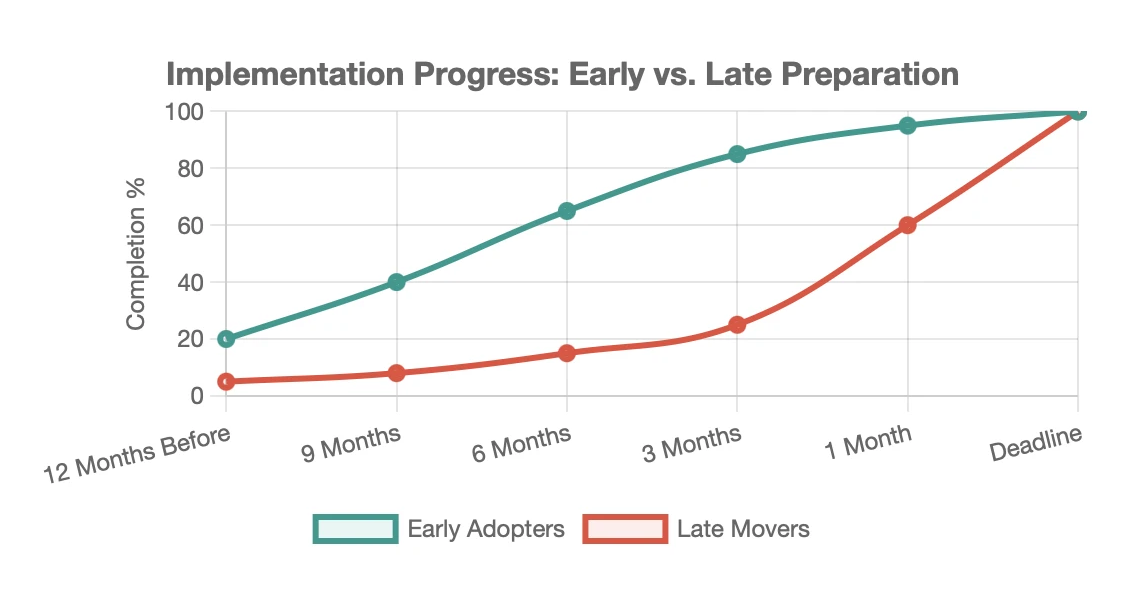
The data tells a concerning story. Firms that wait until the last minute consistently face higher implementation costs, more operational disruptions, and increased risk of non-compliance. Meanwhile, early adopters are already operating with improved systems and processes.
The Real Cost of "Waiting"

Delaying regulatory preparation creates four compounding costs: technology vendor bottlenecks as all firms rush to the same providers near the deadline, talent scarcity as experienced professionals become unavailable, inadequate testing windows that produce costly errors in production environments, and lost strategic advantage because compliance urgency crowds out opportunities for competitive differentiation through superior implementation.
Consider what happens when you delay preparation:
Technology vendors get overwhelmed: As the deadline approaches, everyone rushes to the same solution providers, creating bottlenecks and resource constraints.
Talent scarcity intensifies: Experienced professionals who understand both the old and new frameworks become increasingly difficult to hire or retain.
Testing time evaporates: Rushed implementations mean inadequate testing, leading to costly errors in live environments.
**Strategic advantages disappear: **You're so focused on compliance that you miss opportunities to gain competitive advantages through superior implementation.
The Early Mover Advantage
Firms that begin regulatory implementation early gain four distinct advantages: more time to build analytics capabilities that convert compliance data into market intelligence, the ability to optimize legacy systems beyond minimum compliance requirements, stronger client confidence through demonstrated readiness, and regulatory goodwill that proves valuable in future interactions with oversight bodies.
According to a Deloitte survey on regulatory change management, firms that begin regulatory implementation within 60 days of rule finalization report 40% lower total compliance costs than firms that wait until the final quarter before a deadline (Deloitte, 2024).
Firms that start early aren't just checking compliance boxes—they're strategically positioning themselves for the future. Here's what market structure modernization preparation enables:
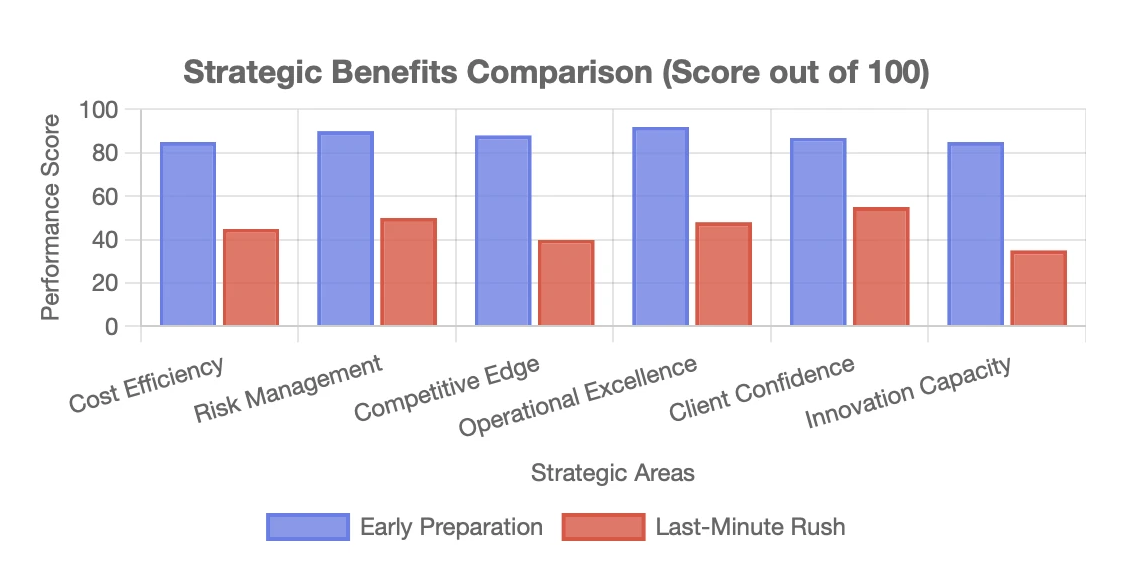
Enhanced market intelligence: New reporting requirements and transparency measures generate substantially more data than prior frameworks. Early adopters have more time to build analytics capabilities that turn compliance data into competitive intelligence.
Operational efficiency: Modernization often requires upgrading legacy systems. Starting early allows you to optimize processes beyond mere compliance, reducing long-term operational costs.
Client confidence: Demonstrating readiness well before deadlines signals stability and sophistication to clients and counterparties.
**Regulatory goodwill: **Regulators notice and appreciate firms that take implementation seriously. This goodwill can prove valuable in future interactions.
What "Preparation" Actually Means
Effective regulatory preparation follows a phased six-month approach: gap analysis and impact assessment in months one and two, comprehensive implementation roadmap in month three, vendor evaluation and technology upgrades in month four, pilot programs and testing in month five, and staff training and process refinement in month six. This phased structure spreads costs, minimizes disruption, and allows course corrections.
Preparation isn't about having everything perfect immediately. It's about taking strategic, progressive steps:
🎯 Your 6-Month Action Plan
- Month 1-2: Conduct gap analysis and impact assessment
- Month 3: Develop comprehensive implementation roadmap
- Month 4: Begin vendor evaluations and technology upgrades
- Month 5: Initiate pilot programs and testing
- Month 6: Train staff and refine processes
This phased approach allows you to spread costs, minimize disruption, and course-correct based on learnings—luxuries that vanish when you're racing against a deadline.
Learning from History
Major regulatory transitions like MiFID II and Dodd-Frank consistently demonstrate the same pattern: firms that begin preparation immediately after rules are finalized use the changes as catalysts for broader operational transformation, while firms that wait until deadlines approach face higher costs, more disruptions, and weaker competitive positioning. Each prior regulatory overhaul reinforces that early movers emerge stronger from the transition.
The financial industry has experienced this pattern before. The implementation of MiFID II in 2018 saw European financial firms spend a combined estimated EUR 2.5 billion on compliance (McKinsey, 2017), with firms that started preparation early reporting significantly lower per-firm costs. Similarly, Dodd-Frank Act implementation stretched over several years after its 2010 enactment. Each major regulatory overhaul has had its deadline extensions, and each time, the pattern repeats: firms that prepare early emerge in stronger competitive positions.
The firms that excelled during these transitions didn't just meet compliance requirements—they used the changes as catalysts for broader transformation. They upgraded technology, streamlined operations, and emerged stronger and more competitive.
The Leadership Imperative
Executives who delay regulatory preparation signal to their organizations that compliance is optional until urgent, undermining the planning culture needed for successful transitions. Effective leadership treats deadline extensions as opportunities to allocate resources during lower-pressure periods, when implementation teams can do their most thorough work rather than scrambling under deadline-driven constraints.
As SEC Commissioner Hester Peirce has observed, firms that treat regulatory change as a strategic opportunity rather than a burden emerge strongest from transitions. Here is an important question for executives: **What message does delayed preparation send to your organization? **That regulatory compliance is optional until it isn't? That strategic planning is less important than reactive firefighting?
Leadership means recognizing that deadline extensions are opportunities for excellence, not excuses for complacency. It means allocating resources now, even when the pressure isn't intense, because that's precisely when you can do the best work.
Time Is Your Competitive Advantage
Market structure modernization represents a fundamental shift in how financial markets operate. The firms that will thrive aren't those that scramble to meet the minimum requirements at the last possible moment. They're the ones that recognize a delayed deadline as what it truly is: a gift of time to prepare thoughtfully, implement strategically, and build stronger operational foundations.
According to KPMG's 2024 Regulatory Outlook, 83% of financial services firms cite regulatory change management as a top-five operational priority (KPMG, 2024). The question is not whether firms will eventually comply, since compliance is mandatory. The question is whether firms will use this time to merely survive the transition or to build the systems and processes that produce lasting operational advantages.