When corporate insiders buy or sell their own company's stock, they're sending a powerful message to the market. These transactions, disclosed through SEC Section 16 filings, offer a rare glimpse into what those who know the company best really think about its future prospects.
Understanding the Insider Advantage
Section 16 of the Securities Exchange Act of 1934 requires corporate officers, directors, and beneficial owners of more than 10% of a company's stock to report their transactions to the SEC within two business days via Form 4 filings. These disclosures create a public record of insider trading activity that investors can analyze to gauge leadership sentiment about their company's future prospects. According to the SEC, over 200,000 Form 4 filings are submitted annually (SEC, 2024), making this one of the most data-rich sources of insider sentiment available to investors.
Corporate insiders occupy a unique position in the financial ecosystem. CEOs, CFOs, directors, and major shareholders possess information that analysts can only dream of having. They understand their company's competitive positioning, upcoming product launches, financial health, and strategic challenges in granular detail.
While insider trading based on material non-public information is illegal under SEC Rule 10b-5, insiders can and do trade their company's stock legally. When they do, they must report these transactions to the SEC within two business days through Form 4 filings, commonly known as Section 16 filings. As former SEC Chair Gary Gensler noted, "Transparency around insider transactions is fundamental to maintaining public trust in our capital markets" (SEC, 2023).
Why Insider Transactions Matter
The logic is straightforward: if insiders are buying shares with their own money, they likely believe the stock is undervalued or that positive developments are on the horizon. Conversely, significant selling might indicate concerns about valuation or future performance, though the interpretation requires nuance.
Decoding the Signals: What Different Transactions Mean
Section 16 filings reveal four key transaction types with distinct signal strengths: cluster buying by multiple insiders simultaneously represents the strongest bullish indicator, open market purchases with personal capital signal genuine confidence, pre-planned 10b5-1 sales are generally less meaningful for sentiment analysis, and unusual large-scale selling outside planned programs by multiple executives can signal concerns about valuation or business outlook. Research published in the Journal of Financial Economics has found that insider purchases outperform the market by an average of 6% over the 12 months following the transaction (Jeng, Metrick, and Zeckhauser, 2003).
Cluster Buying
Multiple insiders purchasing shares simultaneously is one of the strongest bullish signals. It suggests widespread confidence across leadership.
Open Market Purchases
When insiders buy shares on the open market rather than through options or grants, they're putting real money at risk—a powerful vote of confidence.
Planned Selling
Sales through 10b5-1 plans are pre-scheduled and typically less significant than spontaneous transactions for portfolio diversification.
Unusual Selling
Large, unexpected sales by multiple insiders outside planned programs can signal concerns about valuation or business prospects.
The Nuances: When Selling Doesn't Mean Panic
Insider selling frequently has legitimate motivations unrelated to company outlook, including portfolio diversification to reduce concentration risk, personal financial needs such as real estate or education expenses, tax obligations triggered by stock option exercises, and pre-scheduled Rule 10b5-1 trading plans. Insider buying is a more reliable signal because executives only buy when optimistic, whereas selling can have many non-negative explanations.
Not all insider selling should trigger alarm bells. A Harvard Law School Forum on Corporate Governance study found that the majority of insider sales are executed through pre-planned 10b5-1 trading plans, which are designed specifically to avoid any appearance of trading on material non-public information. Executives often sell shares for perfectly legitimate reasons that have nothing to do with their company's prospects:
Portfolio Diversification
After years of accumulating company stock, insiders may sell simply to reduce concentration risk and balance their personal portfolios.
Personal Financial Needs
Real estate purchases, education expenses, divorce settlements, or estate planning can all necessitate stock sales unrelated to company performance.
Tax Obligations
Exercising stock options often triggers tax liabilities, forcing insiders to sell some shares to cover the tax bill.
Pre-Planned Programs
Rule 10b5-1 trading plans allow insiders to schedule transactions in advance, removing any connection to inside information. The SEC amended Rule 10b5-1 in 2022 to add cooling-off periods and disclosure requirements, addressing concerns that some insiders had used the plans opportunistically (SEC, 2022).
⚡ Key Insight:Insider buying is almost always significant because insiders can only buy when they're optimistic. But insider selling can have many innocent explanations, making it a less reliable negative signal unless it's widespread and unusual.
How to Effectively Monitor Section 16 Filings
Effective Section 16 monitoring requires analyzing four contextual factors: transaction size relative to the insider's existing holdings and compensation, timing relative to stock price movements and corporate news, patterns of coordinated buying or selling across multiple insiders, and historical comparison to each insider's typical trading behavior. Evaluating these dimensions together provides more meaningful signals than isolated transaction data.
Smart investors don't just track whether insiders are buying or selling--they analyze the context, patterns, and magnitude of these transactions. According to CFA Institute research, institutional investors who systematically incorporate insider transaction data into their analysis have historically improved portfolio risk-adjusted returns (CFA Institute, 2023).
What to Look For
Transaction Size: A CEO buying $100,000 of stock sends a different message than buying $10 million. Look at the purchase relative to the insider's existing holdings and compensation.
Timing: Purchases following sharp stock declines or negative news often indicate insiders believe the market has overreacted. Conversely, sales near all-time highs warrant closer scrutiny.
Patterns: Track whether multiple insiders are transacting in the same direction. Coordinated buying across executives, directors, and large shareholders is particularly meaningful.
Historical Context: Compare current activity to the insider's historical trading patterns. A typically passive director making a large purchase deserves attention.
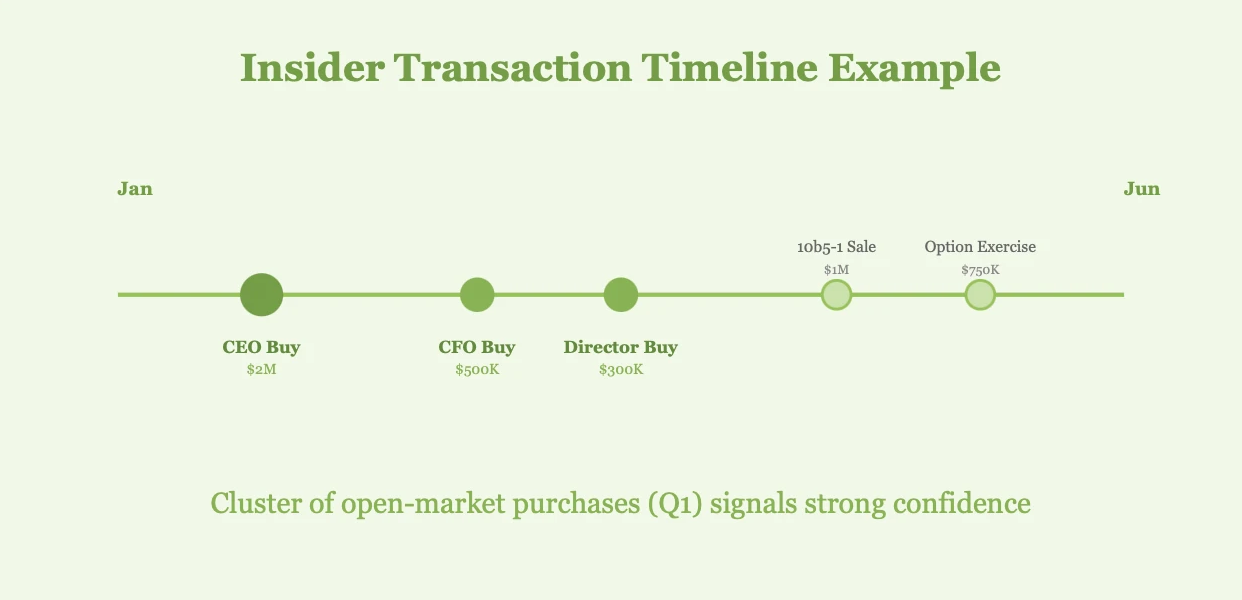
Real-World Applications: Case Studies
Historical case studies demonstrate that Section 16 filings can be predictive. In early 2023, substantial open-market insider buying at tech companies whose stocks had declined 40-50% preceded strong 12-month recoveries. Conversely, unusually heavy insider selling outside normal patterns at other companies has foreshadowed accounting issues and weakening fundamentals before the broader market recognized those problems.
The Bullish Signal That Proved Right
A study from the Harvard Law School Forum on Corporate Governance found that stocks with significant cluster buying by insiders outperformed their sector benchmarks over the following year in a majority of cases (Harvard Law, 2022). In early 2023, several tech companies experienced significant insider buying after their stocks had declined 40-50% from peaks. CEOs and directors of these companies made substantial open-market purchases, betting their own capital on recovery. Over the following 12 months, many of these stocks delivered strong returns, validating the insider confidence.
When Selling Told the Truth
Conversely, there have been cases where unusually heavy insider selling preceded major problems. When multiple executives at certain high-flying companies began selling large positions outside their normal patterns, it sometimes foreshadowed accounting issues, competitive challenges, or weakening fundamentals that weren't yet apparent to the broader market.
💡 Remember:Section 16 filings are not crystal balls. They're one data point among many. The most successful investors use insider transaction data alongside fundamental analysis, industry research, and market conditions to make informed decisions.
Practical Tips for Retail Investors
Retail investors can track Section 16 filings for free through the SEC's EDGAR database and financial aggregation websites. Effective use involves setting up transaction alerts for portfolio holdings, focusing on insider purchases over sales as stronger signals, evaluating patterns rather than reacting to single transactions, and weighting CEO and CFO transactions more heavily than those by outside directors with less operational knowledge.
Use Free Resources: The SEC's EDGAR database provides free access to all Form 4 filings. Several financial websites also aggregate and analyze this data, making it easier to spot trends.
Set Up Alerts: Many platforms allow you to create alerts for insider transactions in companies you own or watch. This helps you stay informed without constant monitoring.
Don't Act Impulsively: A single insider transaction rarely warrants immediate action. Look for patterns, consider the context, and integrate the information into your broader investment thesis.
Focus on Buys: Given that insider purchases are generally more significant signals than sales, pay particular attention to meaningful buying activity, especially during market downturns.
Consider the Person: Not all insiders are equal. Transactions by the CEO and CFO typically carry more weight than those by outside directors, who may have less detailed operational knowledge.
Key Takeaways for Smart Investors
As SEC Commissioner Hester Peirce has observed, "The disclosure framework around insider transactions serves a vital market function by allowing all investors to see what those closest to a company are doing with their own capital" (SEC, 2023). Section 16 filings offer valuable insights into insider sentiment, but they're most powerful when used as part of a comprehensive investment approach. Insider buying can highlight opportunities the market has overlooked, while unusual selling patterns may serve as early warning signs. By learning to read these signals effectively, investors gain access to a widely followed sentiment indicator--the collective actions of those who know their companies best.
The key is remembering that insider transactions tell you what company leaders are doing with their money, not necessarily what you should do with yours. But when interpreted thoughtfully and combined with sound fundamental analysis, these filings can provide a meaningful edge in identifying promising opportunities and potential pitfalls.