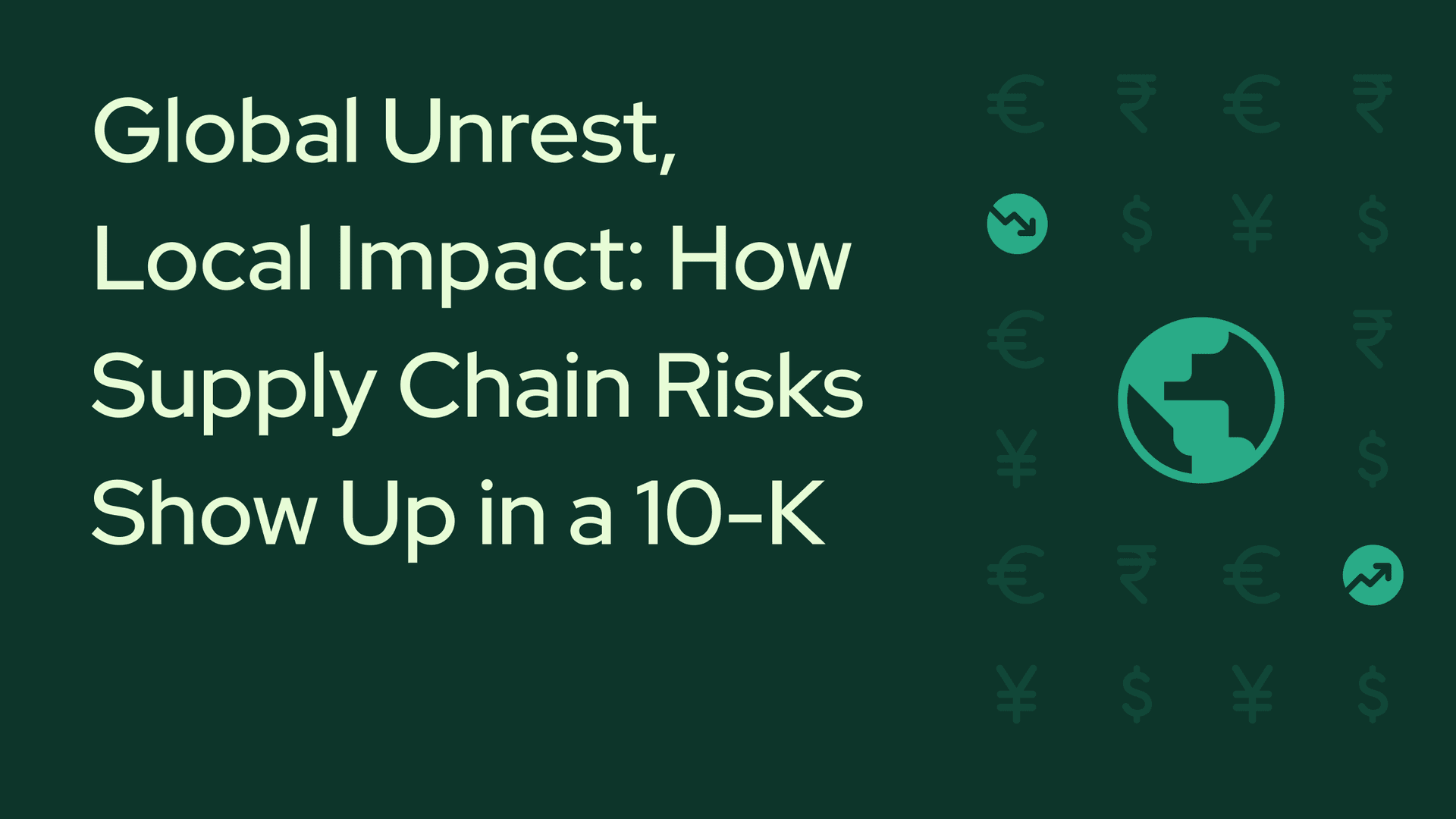
How distant geopolitical events can affect corporate financial disclosures and investor risk
You're checking your investment portfolio when your tech stock suddenly plummets. The cause? A factory shutdown in Southeast Asia due to political tensions that barely made the evening news. This is the interconnected world of global supply chains, where distant events can trigger financial hurricanes closer to home.
For investors and business leaders, understanding how global unrest translates into corporate risk isn't just academic—it's essential. And there's no better place to find these warning signs than in a company's 10-K filing, the annual report that publicly traded companies must file with the SEC.
The Hidden Language of Corporate Anxiety
The Risk Factors section of a 10-K filing is where companies must legally disclose material threats to their business, including supply chain vulnerabilities tied to geopolitical instability. Key warning phrases include references to political instability in operating regions, reliance on suppliers in trade-restricted areas, and exposure to foreign exchange volatility in unstable markets. These disclosures signal genuine corporate concern about global disruption risks.
While CEOs might sound confident during earnings calls, their 10-K filings tell a different story. These documents are where companies must legally disclose material risks to their business under SEC Regulation S-K, Item 105. According to EY's 2024 annual corporate reporting survey, the average number of risk factors disclosed in 10-K filings increased by 18% between 2020 and 2024, with supply chain risks among the fastest-growing categories.
What to Look For: The Risk Factors Section
The "Risk Factors" section of a 10-K is where companies lay their cards on the table. Here's where you'll find phrases that should make any investor pause:
Red Flag Phrases:
- "Political instability in regions where we operate"
- "Disruptions to our supply chain due to geopolitical tensions"
- "Reliance on suppliers in regions subject to trade restrictions"
- "Exposure to foreign exchange fluctuations in volatile markets"
These aren't just boilerplate legal language -- they're indicators of genuine corporate concern. As former SEC Chair Gary Gensler emphasized in 2023, "risk factor disclosures should be specific to the company, not generic language that could apply to any registrant." The SEC's Division of Corporation Finance has issued comment letters to companies whose supply chain risk disclosures lack specificity.
Real-World Translation: From Boardroom to Bottom Line
Global supply chain risks manifest in 10-K filings through specific disclosures about geographic dependencies. Companies like Apple and NVIDIA detail their reliance on TSMC in Taiwan for semiconductor fabrication, while renewable energy and defense firms disclose dependence on rare earth minerals sourced from politically unstable regions. These disclosures translate geopolitical tensions into quantifiable business vulnerabilities for investors.
Let's break down how global events cascade through corporate America:
The Semiconductor Squeeze
When tensions rise in East Asia, companies like Apple, NVIDIA, and Intel don't just mention "supply chain risks" in passing. They dedicate entire paragraphs to explaining how their dependence on Taiwan Semiconductor Manufacturing Company (TSMC) could affect their business if geopolitical tensions escalate. According to the Semiconductor Industry Association, TSMC manufactures over 90% of the world's most advanced semiconductors (SIA, 2024), making this concentration risk material for a significant portion of the technology sector.
What it looks like in a 10-K:* "Our business depends on third-party foundries, primarily located in Asia, including Taiwan. Any disruption to these facilities due to natural disasters, political instability, or military conflict could materially impact our ability to meet customer demand and could result in significant revenue loss."*
Translation: If something happens in Taiwan, we're in trouble.
The Rare Earth Reality Check
Companies in renewable energy, defense, and technology sectors are increasingly vocal about their dependence on rare earth minerals, many of which come from politically unstable regions or countries with strained relationships with the United States. The U.S. Geological Survey reports that China controls approximately 60% of global rare earth mining and 90% of rare earth processing capacity (USGS, 2024).
The 10-K language: "We source critical materials from a limited number of suppliers, many located in regions subject to political and economic instability. Trade restrictions or supply disruptions could significantly increase our costs or halt production."
Translation: We need these materials to exist, and we can't get them anywhere else.
How Local Problems Become Global Headaches
Local disruptions become global supply chain crises through three primary channels: transportation chokepoints like the Suez Canal where blockages halt worldwide shipping, labor and manufacturing hub shutdowns in countries like Bangladesh or Vietnam that feed multinational production lines, and currency devaluations triggered by political instability that make international operations suddenly unprofitable for companies with exposure.
Transportation Chokepoints
The Ever Given's blockage of the Suez Canal in 2021 gave a concrete preview of how quickly local disruptions can go global. According to McKinsey's 2023 global supply chain analysis, the six-day blockage disrupted an estimated $9.6 billion in daily trade and affected over 400 vessels. Companies now specifically call out their exposure to key shipping routes in their 10-K filings. As SEC Chief Accountant Paul Munter has noted, companies should consider whether known supply chain vulnerabilities constitute "known trends or uncertainties" requiring MD&A disclosure.
Labor and Manufacturing Hubs
When protests shut down factories in Bangladesh or Vietnam, it's not just local news—it's material risk for any company with significant manufacturing operations in these regions.
Currency and Capital Flight
Political instability doesn't just disrupt physical supply chains; it can trigger currency devaluations and capital flight that make international operations suddenly unprofitable.
Reading Between the Lines: What Companies Really Mean
Corporate 10-K language uses carefully crafted phrasing that often understates the severity of supply chain risks. Before a crisis, phrases like "diverse supplier relationships" and "strategic inventory levels" signal contingency planning. After disruptions hit, language shifts to "temporary supply chain disruptions" and "supply chain diversification strategies," which typically indicate significant financial losses and urgent scrambling for alternative sources.
Corporate lawyers craft risk factor language to balance transparency with liability management. A Harvard Law School Forum on Corporate Governance analysis found that companies facing active supply chain disruptions tend to shift from future-tense risk language to past-tense impact language in subsequent filings. Here's how to decode their language:
Before the Crisis
- "We maintain diverse supplier relationships" = We're trying not to put all our eggs in one basket
- "We continuously monitor geopolitical developments" = We're worried but don't know what to do about it
- "We maintain strategic inventory levels" = We're stockpiling just in case
After the Crisis Hits
- "We experienced temporary supply chain disruptions" = Our customers are furious and we lost money
- "We're implementing supply chain diversification strategies" = We're scrambling to find new suppliers
- "Market conditions remain challenging" = This is not going away anytime soon
The Investor's Toolkit: Questions to Ask
Investors reviewing 10-K supply chain disclosures should evaluate five key dimensions: geographic concentration of operations and suppliers, the number and location of critical suppliers, whether the company maintains elevated inventory buffers, specific mitigation steps being taken to reduce disruption risk, and whether the company has quantified potential financial losses from supply chain interruptions in dollar terms.
When reviewing a 10-K, ask yourself:
- Geographic Concentration: Does this company have too many eggs in one geopolitical basket?
- Supplier Dependence: How many critical suppliers do they have, and where are they located?
- Inventory Strategy: Are they maintaining higher inventory levels as a buffer against disruptions?
- Mitigation Efforts: What specific steps are they taking to reduce supply chain risks?
- **Financial Impact: **Have they quantified potential losses from supply chain disruptions?
The New Normal: Supply Chain Stress Testing
Forward-thinking companies now stress test their supply chains by modeling extreme scenarios including complete loss of suppliers in specific countries, extended shipping route closures, currency crises in key markets, and trade war escalations. Companies that plan for multiple disruption scenarios rather than only the most likely outcomes are better positioned to maintain operational continuity during geopolitical events.
Forward-thinking companies are now conducting stress tests on their supply chains. According to Deloitte's 2024 Chief Procurement Officer Survey, 67% of large enterprises now conduct formal supply chain stress testing, up from 35% in 2020. These stress tests model scenarios like:
- Complete loss of suppliers in specific countries
- Extended shipping route closures
- Currency crises in key markets
- Trade war escalations
The companies that survive and thrive are those that plan for multiple scenarios, not just the most likely ones.
Looking Ahead: The Evolution of Corporate Disclosure
Corporate supply chain disclosures are evolving in three ways: companies are providing more specific disclosures naming individual countries, suppliers, and products at risk rather than using generic language; progressive firms are beginning to quantify potential disruption impacts in dollar terms; and some companies now include multiple scenario analyses in their risk discussions to help investors understand varying levels of potential financial exposure.
As supply chain risks become more prominent, corporate disclosure practices are evolving. The FASB's Accounting Standards Codification (ASC 820 and ASC 450) provides the framework for measuring and disclosing loss contingencies related to supply chain disruptions:
More Specific Disclosures
Gone are the days of generic "global economic conditions may affect our business" statements. Companies are getting granular about specific countries, suppliers, and products at risk.
Quantified Impacts
Progressive companies are starting to put dollar figures on potential supply chain disruptions, giving investors a clearer picture of what's at stake.
Scenario Planning
Some companies now include multiple scenarios in their risk discussions, helping investors understand different levels of potential impact.
What This Means for Investors
In today's interconnected world, no company—no matter how domestic it seems—is immune to global supply chain risks. The key is identifying which companies are aware of their vulnerabilities and taking active steps to address them versus those that are sleepwalking into potential disasters.
When you're reading that next 10-K, remember: the most dangerous risks are often hiding in plain sight, wrapped in corporate speak and buried in the middle of dense paragraphs. But for the savvy investor willing to dig deeper, these disclosures can provide invaluable insights into which companies are prepared for our increasingly uncertain world.
The next time you see headlines about unrest in a far-off country, don't just scroll past. Ask yourself: which companies in my portfolio might be affected? The answer might be hiding in their latest 10-K filing, waiting for someone curious enough to connect the dots.