If you are a CFO at a public company with a market float somewhere between $75 million and $2 billion, the SEC's May 19, 2026 proposal on public company reporting framework simplification is directly about your company. It proposes to collapse most of the current filer category system into two categories, raise the large accelerated filer threshold from $700 million to $2 billion, eliminate the SOX 404(b) auditor attestation requirement for every non-accelerated filer, and extend a five-year IPO on-ramp to all new public companies regardless of float.
The proposal would extend disclosure scaling and other accommodations to approximately 81% of all current public companies. For most mid-cap companies, this is a material change in what they are required to disclose, how they are required to disclose it, and what their external audit obligations include.
The source document is the SEC's May 19, 2026 press release and the accompanying proposed rule release 33-11419 (Public Company Reporting Framework). The public comment period is open for 60 days following publication in the Federal Register. Based on the May 19 announcement, comments are due approximately July 20, 2026.
What Does the Current Filer Category System Look Like and Why Is It Being Proposed for Change?
Under the current framework, public companies are categorised for disclosure purposes into four categories based primarily on their public float and annual revenue: Large Accelerated Filer (LAF), Accelerated Filer (AF), Non-Accelerated Filer (NAF), and Smaller Reporting Company (SRC). These categories are not purely sequential a company can qualify as an SRC while also being an Accelerated Filer, creating overlapping obligations and accommodations that are genuinely difficult to navigate.
The large accelerated filer threshold the float level above which a company must comply with the full set of Regulation S-K disclosure requirements, obtain an auditor attestation on ICFR under SOX Section 404(b), and file on the shortest permitted deadlines is currently $700 million in public float. That threshold has not been changed since the SEC's 2018 filer status amendments.
The SEC's own data confirms that the compliance cost structure of this system is regressive. According to the GAO's 2025 study on SOX compliance costs (GAO-25-107500), nonexempt companies pay 19% more in audit fees than exempt smaller and emerging growth companies. The largest compliance cost differential is the SOX 404(b) auditor attestation, which can add $500,000 to over $2 million in annual external audit fees for a mid-cap company depending on the complexity of its operations and internal control environment.
The May 19 proposal restructures this system to reduce that cost differential for a broader population of companies.
What Exactly Does the SEC Propose to Change for Filer Categories?
The proposed rule release 33-11419 contains three substantive changes to the filer category framework. Each is distinct and affects different companies.
Proposed change 1: Raise the large accelerated filer threshold from $700 million to $2 billion.
Under the proposal, a company would not become a large accelerated filer until it reaches $2 billion in public float. At the current $700 million threshold, a company crossing that float level becomes a large accelerated filer and loses the scaled disclosure accommodations available to smaller companies, becomes subject to SOX 404(b) external auditor attestation on its internal control over financial reporting, and must comply with the shortest filing deadlines 60 days for the 10-K and 40 days for the 10-Q.
Raising the threshold to $2 billion means every public company with a float below $2 billion remains a non-accelerated filer under the proposed framework and retains access to scaled disclosure accommodations. According to the SEC's May 19 press release, the proposed amendments would extend disclosure scaling and other accommodations to approximately 81% of all current public companies.
Proposed change 2: All non-accelerated filers exempt from SOX 404(b) auditor attestation.
Under the current framework, SOX 404(b) exemption is available to non-accelerated filers and to SRC filers with less than $100 million in annual revenues. Many companies in the $100 million to $700 million float range are currently required to obtain an external auditor attestation on their ICFR.
The May 19 proposal would exempt all non-accelerated filers from the SOX 404(b) auditor attestation requirement. If the large accelerated filer threshold moves to $2 billion, this exemption would apply to every public company with less than $2 billion in float. The management's assessment of ICFR under SOX 302 and 906 continues to apply to all public companies regardless of filer category. Only the external auditor attestation is affected.
Proposed change 3: A five-year IPO on-ramp regardless of float, plus a small non-accelerated filer subcategory with extended filing deadlines.
Under the current EGC framework, companies benefit from scaled disclosure accommodations for up to five years after their IPO, but EGC status terminates early if the company's public float crosses $700 million (the large accelerated filer threshold). Under the proposal, a company would not become a large accelerated filer for at least 60 months following its IPO regardless of its public float. This gives new public companies a predictable five-year period of scaled accommodations even if they grow rapidly.
Additionally, the proposal establishes a subcategory of small non-accelerated filers representing the smallest 18% of public companies by assets that would receive an additional 30 days to file their Form 10-K annual reports and an additional five days to file their Form 10-Q quarterly reports.
Which Companies Gain the Most From This Proposal?
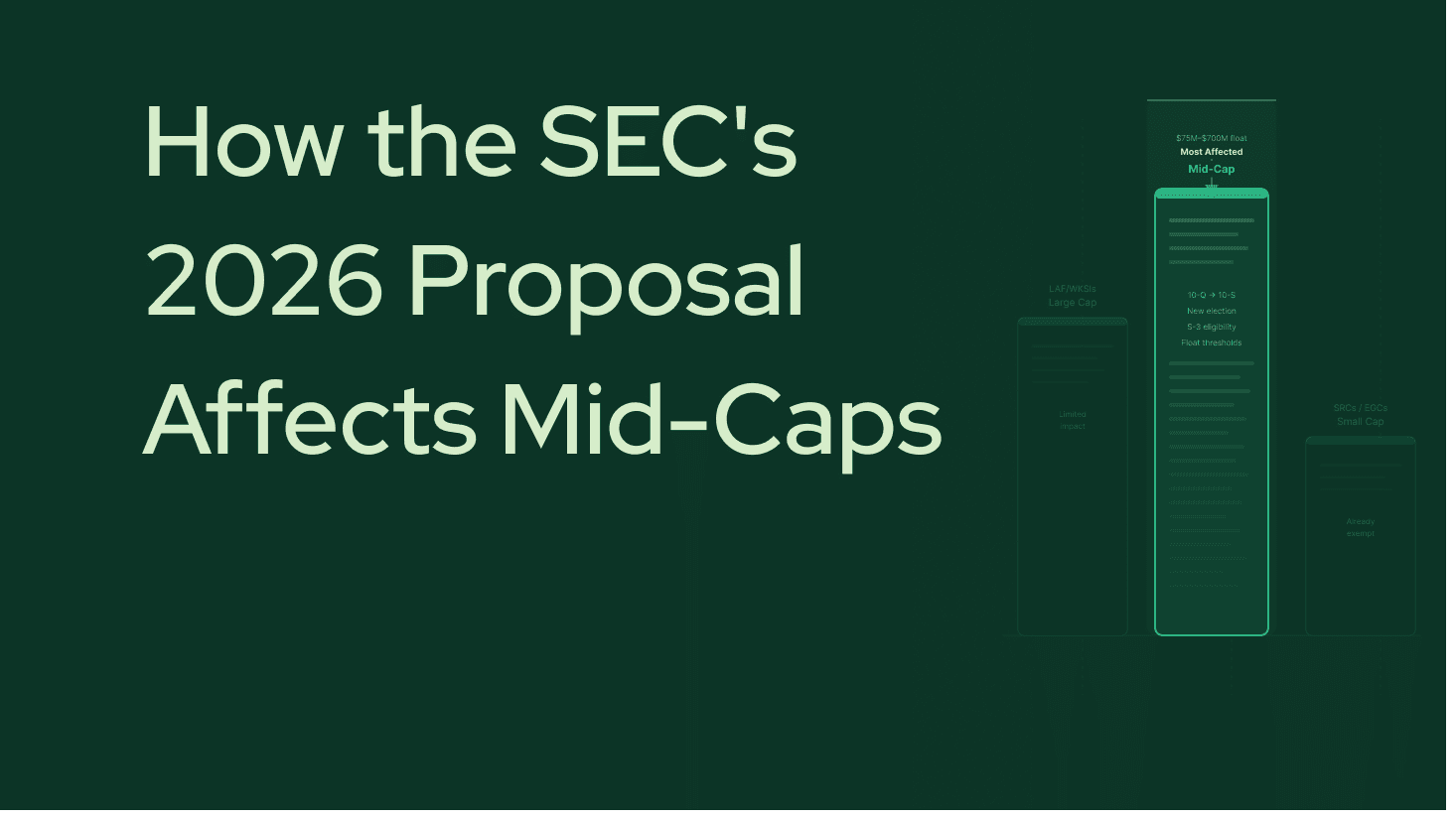
The companies that gain the most under the proposed framework are those currently caught between the existing thresholds specifically, companies with public floats between $700 million and $2 billion that are currently categorised as large accelerated filers.
Under the current rules, a company that crosses $700 million in public float becomes a large accelerated filer and faces three simultaneous changes: it loses SRC and EGC scaled disclosure accommodations, it becomes required to obtain a SOX 404(b) external auditor attestation, and it moves to the shortest filing deadlines. For a company that grew through the $700 million threshold, this represents a step-change increase in compliance cost and disclosure burden that arrives at a moment of growth rather than maturity.
Under the proposed framework, those same companies would remain non-accelerated filers with scaled disclosure accommodations and SOX 404(b) exemption until their float reaches $2 billion. The compliance cost savings from the SOX 404(b) exemption alone can be material. External auditor attestation fees for a mid-cap company in this float range typically run $500,000 to $2 million annually depending on the size and complexity of the company's internal control environment. Those fees would no longer be required under the proposal for any company below the new $2 billion threshold.
The second group that gains significantly is new public companies. A company that conducts its IPO under the proposed framework would receive a guaranteed 60-month period of non-accelerated filer status regardless of how quickly its float grows. Under the current EGC framework, a company that grows rapidly a technology company whose stock price appreciates quickly after listing can lose EGC accommodations within one or two years. The proposed 60-month floor removes that uncertainty.
What Does This Proposal Mean for Your 10-K and 10-Q Specifically?
The disclosure scaling accommodations available to non-accelerated filers are not minor. They cover a range of Regulation S-K items that affect how your annual and quarterly reports are prepared.
Non-accelerated filers currently benefit from scaled versions or complete exemptions from the following: the pay-versus-performance disclosure table required under Item 402(v), which requires tabular disclosure of compensation actually paid versus company performance metrics and requires XBRL tagging of every data point; the CEO pay ratio disclosure required under Item 402(u), which requires a ratio of median employee compensation to CEO compensation and the methodology supporting it; certain executive compensation narrative and tabular disclosures under Item 402 that apply in full only to non-SRC filers; and certain risk factor disclosure length limitations and structure requirements.
SOX 404(b) is the single largest cost item in this list. It requires the company's external auditor to assess and opine on the effectiveness of the company's internal control over financial reporting. The management assessment under SOX 302 continues regardless of filer status the CFO and CEO continue to certify the effectiveness of disclosure controls and the fairness of the financial statements. Only the external auditor's separate attestation is eliminated for non-accelerated filers under the proposal.
The filing deadline implications are less significant for companies in the $700 million to $2 billion float range because they currently file on accelerated filer deadlines (75 days for 10-K, 40 days for 10-Q). Under the proposed framework, non-accelerated filer deadlines apply (90 days for 10-K, 45 days for 10-Q). For a CFO managing a tight close-to-filing timeline, an additional 15 days on the 10-K and five days on the 10-Q is a material operational benefit.
What Does the Proposal Not Change?
Understanding what the proposal leaves unchanged is as important as understanding what it changes.
Management's ICFR assessment continues. SOX Sections 302 and 906 require the CEO and CFO to certify the effectiveness of disclosure controls and procedures and, for annual reports, the effectiveness of internal control over financial reporting. These certifications apply to all public companies regardless of filer category. The proposal exempts non-accelerated filers from the external auditor's separate attestation under Section 404(b). It does not reduce management's own assessment obligation or the disclosure of any material weaknesses identified through that assessment.
10-K and 10-Q disclosure obligations for most items continue. The scaling accommodations address specific Regulation S-K items. The core financial statement content, MD&A, risk factors, legal proceedings, and properties disclosures remain applicable to non-accelerated filers. What changes is the extent and format of certain executive compensation disclosures and the removal of the external auditor ICFR attestation.
**The proposal is not yet a rule. **The May 19, 2026 release is a proposed rule with a 60-day comment period. Final rules, if adopted, would follow a subsequent rulemaking process that could take 12 to 24 months. Companies should not begin planning their disclosure programme around the proposed thresholds until final rules are published. The proposed thresholds and accommodations could change materially based on comment letter feedback.
Exchange listing requirements are separate. The SEC filer category framework governs disclosure obligations under the Securities Exchange Act. Exchange listing standards — minimum float, minimum market value, minimum revenue are set by Nasdaq and NYSE independently and are not affected by the SEC's filer status proposal.
What Should a Mid-Cap CFO Do Before the Comment Period Closes?
The comment period on proposed rule release 33-11419 closes approximately July 20, 2026. Three actions are worth taking before that date.
Determine which proposed category your company would fall into under the new thresholds. Calculate your company's current public float on the most recent measurement date. If your float is below $2 billion, your company would be a non-accelerated filer under the proposed framework. Confirm whether you currently have a SOX 404(b) requirement and quantify the annual cost of that attestation. This is the most direct measure of the financial benefit the proposal would provide to your company if adopted.
Assess the disclosure changes that would affect your next 10-K cycle. If your company currently files pay-versus-performance disclosure or a CEO pay ratio, identify the cost and time associated with preparing those disclosures. Understand which executive compensation items would change under the scaled non-accelerated filer framework. This gives you a complete picture of the annual compliance cost reduction the proposal would produce.
Consider submitting a comment letter if the proposal materially affects your company. The SEC's comment process is the formal mechanism through which public companies can influence whether and how a proposed rule is adopted. If the proposed $2 billion threshold would materially reduce your company's annual compliance cost, or if you believe the threshold should be set differently, a comment letter addressing your company's specific experience is the appropriate way to engage. Comments are submitted through the SEC's online comment system and become part of the public rulemaking record.
Frequently Asked Questions
What is the SEC's May 19, 2026 filer status proposal and who does it affect?
The SEC proposed rule release 33-11419 (Public Company Reporting Framework) would raise the large accelerated filer threshold from $700 million to $2 billion in public float, exempt all non-accelerated filers from the SOX 404(b) external auditor attestation requirement, establish a minimum 60-month IPO on-ramp before a new public company can become a large accelerated filer, and create a subcategory of small non-accelerated filers with extended filing deadlines. The proposal would extend disclosure scaling accommodations to approximately 81% of all current public companies. It affects every public company with a public float below $2 billion.
What is the SOX 404(b) auditor attestation and why does the proposal to exempt it matter?
SOX Section 404(b) requires a public company's external auditor to separately assess and opine on the effectiveness of the company's internal control over financial reporting. This attestation is separate from management's own assessment required under SOX 302 and 906, which continues for all public companies under the proposal. The 404(b) attestation adds $500,000 to $2 million or more in annual external audit fees for a mid-cap company. Under the proposal, all non-accelerated filers every company below $2 billion in float would be exempt from this requirement.
Does the proposal eliminate management's ICFR assessment?
No. SOX Sections 302 and 906 require the CEO and CFO to certify effectiveness of disclosure controls and internal control over financial reporting. These certifications apply to all public companies regardless of filer category. The proposal eliminates only the external auditor's separate 404(b) attestation for non-accelerated filers. Management's own assessment and the disclosure of any material weaknesses identified through that assessment are unchanged.
What is the proposed 60-month IPO on-ramp and how does it differ from the current EGC framework?
Under the current EGC framework, a new public company loses EGC accommodations when its public float crosses $700 million, among other triggers. This means a fast-growing company can lose scaled disclosure accommodations within one or two years of its IPO. The proposed 60-month minimum means a new public company would not become a large accelerated filer until at least 60 months after its IPO regardless of how quickly its float grows. This gives companies with strong post-IPO growth a predictable five-year period of scaled accommodations.
When does the comment period close and how do you submit a comment?
The comment period is open for 60 days following publication of the proposing releases in the Federal Register. Based on the May 19, 2026 announcement, comments are due approximately July 20, 2026. Comments are submitted through the SEC's online comment system at sec.gov. They become part of the public rulemaking record and are reviewed by SEC staff before any final rule is adopted.
Key Takeaways
- The SEC's May 19, 2026 proposal would raise the large accelerated filer threshold from $700 million to $2 billion in public float. Every public company below $2 billion would be a non-accelerated filer under the proposed framework, with access to scaled disclosure accommodations.
- All non-accelerated filers would be exempt from the SOX 404(b) external auditor attestation requirement under the proposal. Management's ICFR assessment under SOX 302 and 906 continues for all public companies. Only the external auditor's separate attestation is eliminated.
- The proposal would extend disclosure scaling accommodations to approximately 81% of all current public companies, up from the roughly 60% that currently qualify as SRC or NAF filers.
- New public companies would benefit from a minimum 60-month IPO on-ramp before becoming a large accelerated filer, regardless of public float growth. This removes the current uncertainty for fast-growing companies that can lose EGC status early under the existing framework.
- The proposal is not yet a rule. The comment period closes approximately July 20, 2026. Final rules could take 12 to 24 months to adopt and could differ materially from the proposed thresholds.
- Mid-cap CFOs should calculate their company's current float against the proposed $2 billion threshold, quantify the annual cost of their SOX 404(b) attestation, and assess the disclosure items that would change under non-accelerated filer status before deciding whether to submit a comment.