Imagine driving a car while only looking at the rearview mirror. You would know exactly where you have been, but you would have no idea what is coming next. That is precisely how many organizations operate when they rely solely on lagging indicators like quarterly revenue or annual profit margins.
The business landscape is shifting. In an era where market conditions can pivot overnight and customer preferences evolve rapidly, waiting for last quarter's results to inform next quarter's strategy is an increasingly risky approach. This is where artificial intelligence enters the picture, not as a crystal ball, but as a sophisticated navigation system that helps identify the patterns that precede success.
The Problem with Looking Backward
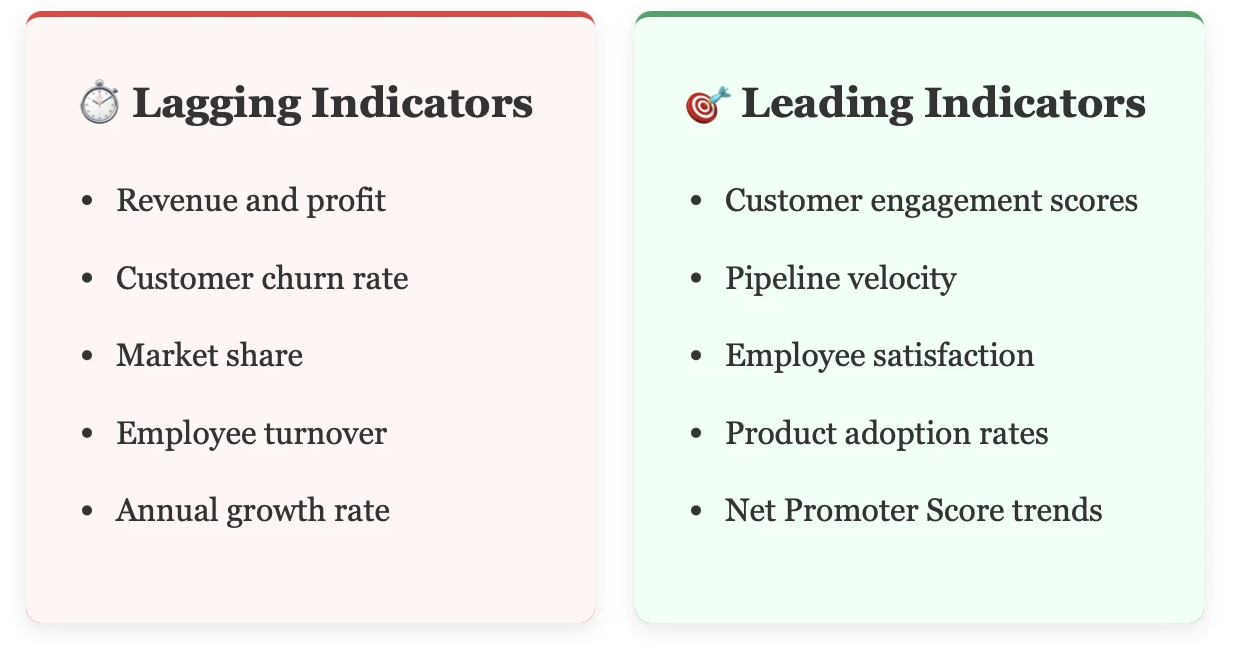
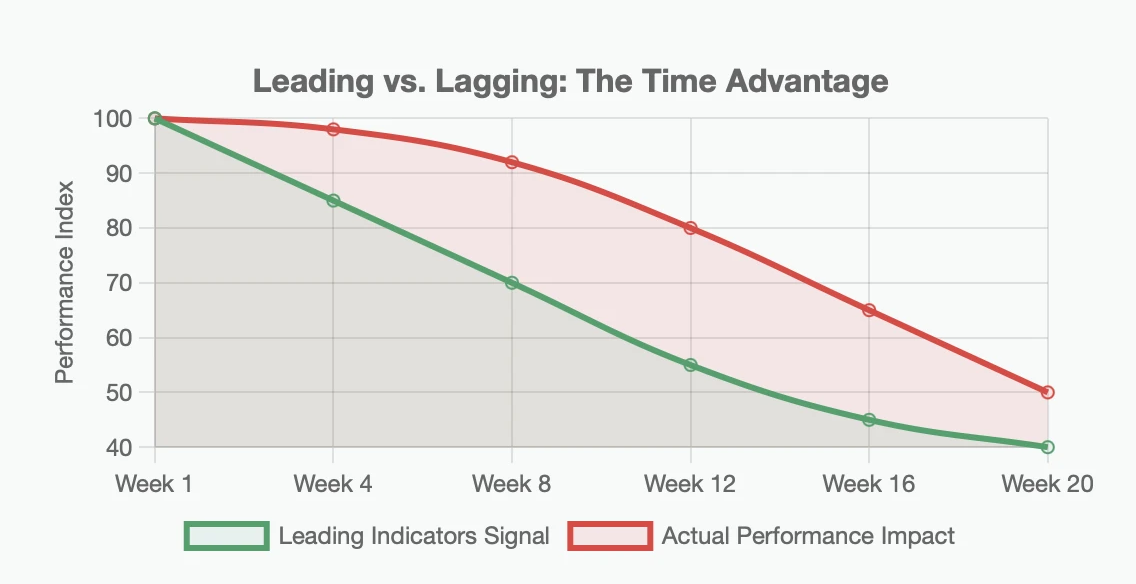
Lagging indicators such as quarterly revenue, annual profit margins, and historical sales data reveal what already happened but fail to explain causation or predict future outcomes. By the time financial reports confirm a trend, the early warning signals -- declining customer engagement, rising support tickets, or shifting market sentiment -- have already passed, leaving organizations unable to course-correct in time.
Traditional performance metrics tell us what happened, but they are limited at explaining why it happened or predicting what comes next. When sales dip, the financial report confirms it three months later. By then, the early warning signs -- declining customer engagement, increased support tickets, or shifting market sentiment -- have already passed.
According to a Harvard Business Review analysis, companies that rely exclusively on lagging financial indicators are 2.5 times more likely to miss emerging competitive threats compared to those that integrate leading indicators into their strategic planning (Harvard Business Review, 2023).
Research from McKinsey & Company found that organizations using predictive analytics to supplement traditional KPIs outperformed industry peers by 5-6% in total shareholder returns over a five-year period (McKinsey, 2023). Former Federal Reserve Board Governor Lael Brainard noted that "forward-looking indicators provide essential context for understanding economic conditions that backward-looking data alone cannot capture."
Enter AI: Your Strategic Early Warning System
AI serves as a strategic early warning system by simultaneously monitoring thousands of data points and identifying subtle correlations that predict future business performance. By analyzing patterns across customer behavior, operational metrics, and market signals, AI can detect emerging trends weeks or months before they appear in traditional financial reports, enabling proactive strategy adjustments.
Artificial intelligence excels at finding patterns in complex datasets. While humans can track a handful of metrics, AI can simultaneously monitor thousands of data points, identifying subtle correlations that predict future performance.
Real-world example: A major e-commerce company used AI to analyze customer browsing patterns, cart abandonment timing, and customer service interactions. The system predicted a 23% drop in Q4 sales six weeks before it happened, based on micro-changes in user behavior. This early warning allowed them to pivot their strategy and ultimately minimize the loss to 8%.
According to Gartner's 2024 Data & Analytics survey, 65% of organizations that implemented AI-powered predictive analytics reported identifying business risks at least 30 days earlier than through traditional reporting methods (Gartner, 2024). Andrew Ng, co-founder of Google Brain and a leading AI researcher, has observed that "AI is the new electricity. Just as electricity transformed every major industry 100 years ago, AI is now poised to do the same, especially in how organizations understand and predict performance."
How AI Transforms Indicator Tracking
AI transforms indicator tracking through three core capabilities: pattern recognition at scale that maps causal relationships between interconnected metrics, predictive modeling that forecasts outcomes like customer churn based on leading indicator thresholds, and real-time benchmarking that compares company performance against competitors while adjusting for market conditions and seasonal variations.
1. Pattern Recognition at Scale
AI does not just track metrics; it understands the relationships between them. It recognizes that when employee satisfaction scores dip in your product development team, innovation metrics tend to fall three months later, which impacts revenue six months down the line. Research from the MIT Sloan Management Review found that AI-driven pattern recognition identified 3-4x more actionable correlations between business metrics than traditional statistical methods (MIT Sloan, 2023).
2. Predictive Modeling
Machine learning algorithms can build models that forecast outcomes based on leading indicators. If your customer engagement score drops below a certain threshold, AI can predict with measurably higher accuracy what your churn rate will look like next quarter.
3. Real-Time Benchmarking
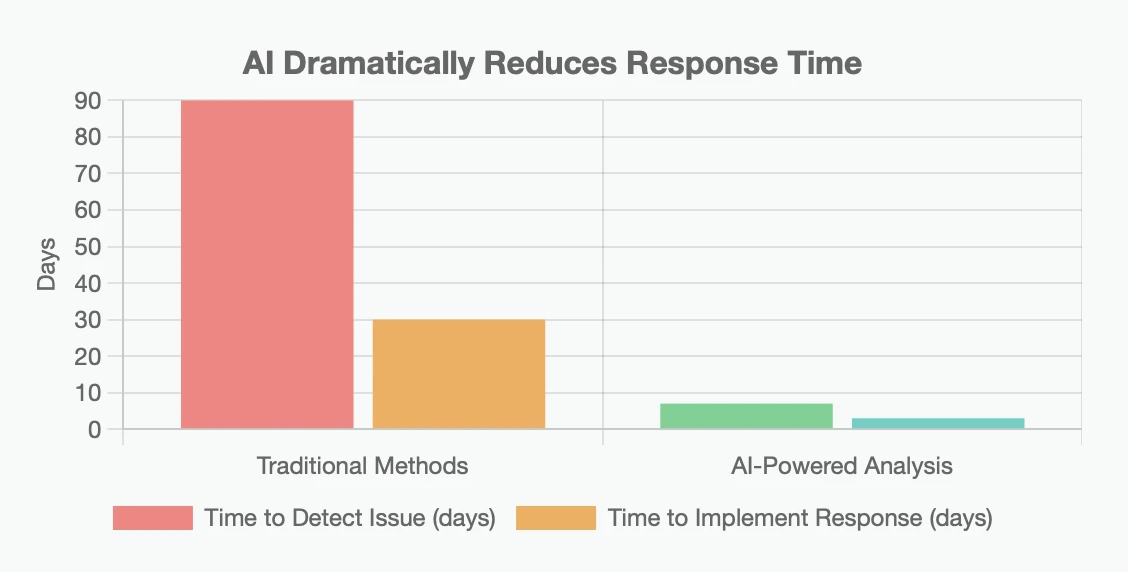
Traditional benchmarking compares your last year to industry standards. AI-powered systems compare you to competitors in real-time, adjusting for market conditions, seasonal variations, and emerging trends. According to Bain & Company, real-time competitive benchmarking enabled by AI reduces the average strategic decision cycle from 4 weeks to under 1 week (Bain, 2024).
Building Your AI-Powered Performance System
Building an AI-powered performance system involves four steps: identifying three to five north star outcome metrics, mapping the causal chain backward from lagging to leading indicators, integrating diverse data sources including customer behavior, operational metrics, and market intelligence, and creating feedback loops where prediction outcomes are tracked to continuously improve model accuracy over time.
Implementing AI for strategic performance is not about replacing human judgment; it is about augmenting it. Here is how forward-thinking organizations are making this transition:
Start with Your North Star Metrics
Identify the three to five outcomes that truly matter to your business. Do not try to track everything; AI is powerful, but focus creates clarity.
Map the Causal Chain
Work backward from your lagging indicators. What behaviors, activities, or conditions typically precede good results? These become your leading indicator candidates.
Feed the Machine
AI thrives on data diversity. Integrate customer data, operational metrics, market intelligence, employee feedback, and even external factors like economic indicators or social media sentiment. According to a Deloitte AI Institute study, the most successful AI implementations combine at least five distinct data sources, with each additional source improving prediction accuracy by an average of 8-12% (Deloitte, 2024).
Key Insight: The most successful AI implementations do not just collect more data; they collect more diverse data. A SaaS company found that combining product usage data with customer service sentiment analysis and market trend data improved their churn prediction accuracy from 67% to 94%.
Create Feedback Loops
AI systems improve through learning. When the system makes predictions, track the outcomes and feed them back. Over time, your AI becomes increasingly attuned to your specific business dynamics.
The Human Element: AI as Co-Pilot, Not Autopilot
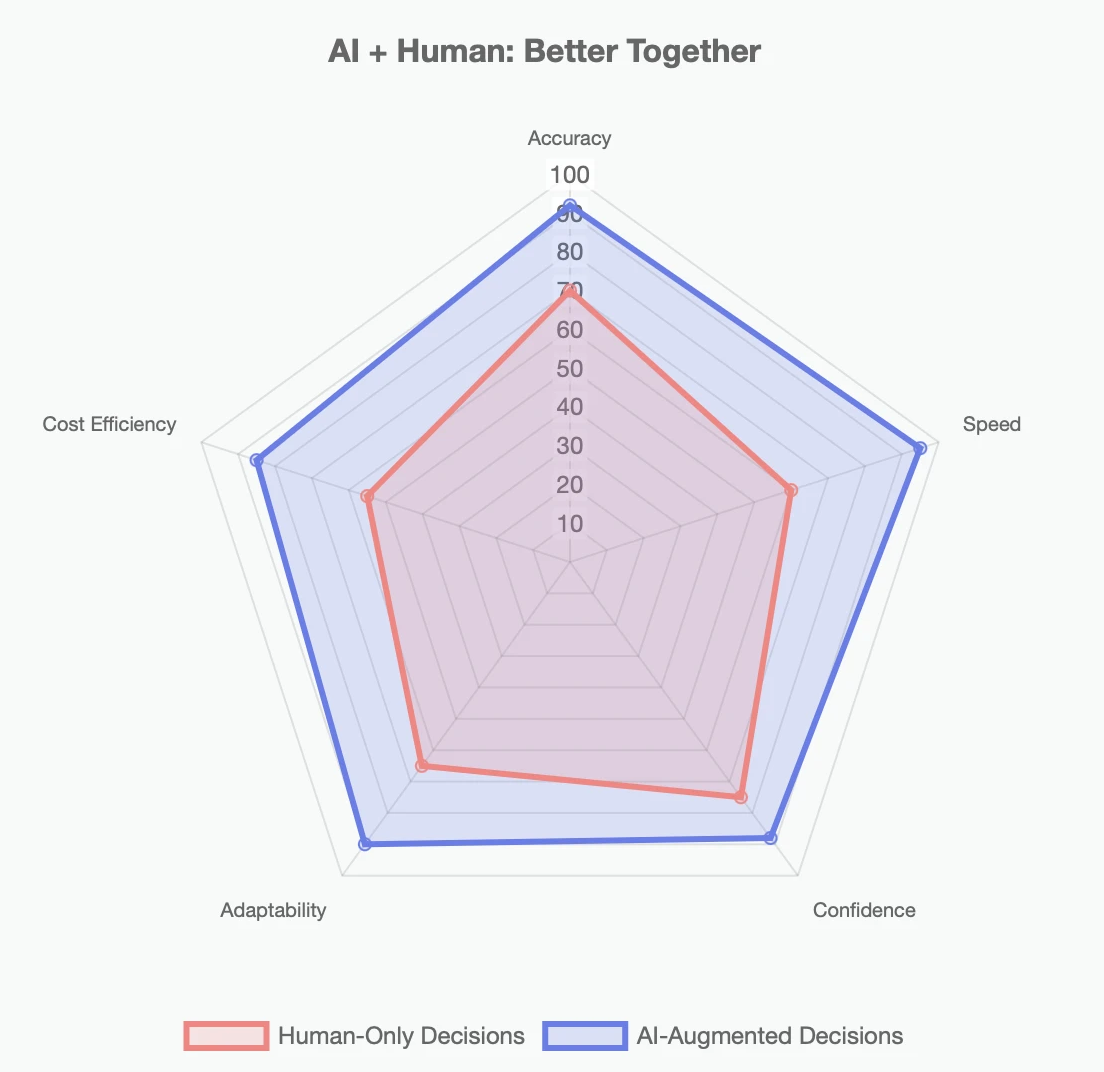
AI in strategic performance management works best as a decision-support tool rather than an autonomous decision-maker. The technology identifies anomalies and patterns in data, while human analysts provide the contextual understanding needed to interpret those signals correctly. This combination of machine pattern recognition and human judgment produces more reliable strategic insights than either approach alone.
Here is what often gets lost in discussions about AI: the technology does not make decisions; it informs them. The real power comes when human intuition and experience combine with AI's pattern recognition and predictive capabilities.
Consider a retail chain that noticed its AI system flagging unusual patterns in its top-performing stores. The metrics looked concerning, but they did not match traditional trouble indicators. A human analyst investigated and discovered these stores were experimenting with a new customer service approach that temporarily disrupted conventional metrics but was actually driving long-term loyalty. The AI spotted the anomaly; humans understood the context.
Tom Davenport, a professor at Babson College and co-author of "Competing on Analytics," has written that "the organizations that get the most value from AI are those that view it as a tool for augmenting human intelligence, not replacing it." This principle is central to effective AI-powered performance management.
Common Pitfalls to Avoid
The three most common pitfalls in AI-powered performance tracking are analysis paralysis from monitoring too many indicators, the black box problem where predictions lack explainability and transparency, and ignoring context by relying solely on historical data without human oversight for unprecedented events. Successful implementations prioritize a focused set of explainable metrics with active human review.
Analysis Paralysis
Just because you can track 500 indicators does not mean you should. Too much data creates noise. Use AI to identify the vital few, not monitor the trivial many.
The Black Box Problem
Insist on explainable AI. You need to understand why the system makes certain predictions, not just what it predicts. Transparency builds trust and enables learning. The European Union's AI Act, which began phased implementation in 2024, establishes transparency requirements for AI systems used in decision-making, reflecting growing regulatory emphasis on explainability.
Ignoring Context
AI models trained on historical data can miss unprecedented events. Always maintain human oversight for contextual factors that the algorithm might miss.
The Future Is Already Here
Organizations that master the shift from reactive to predictive performance management gain a significant and compounding advantage. They see opportunities while competitors see only reports. They address problems while others are still gathering the quarterly data to confirm there is a problem.
The question is not whether AI will transform strategic performance management; it already is. According to the International Data Corporation (IDC), global spending on AI systems reached $154 billion in 2023 and is projected to exceed $300 billion by 2026, with performance analytics representing one of the fastest-growing segments (IDC, 2024).
Action Step: Pick one critical performance metric, identify three potential leading indicators, and explore how AI tools can help you track the relationship between them. Transforming an entire analytics infrastructure is not necessary at the outset; a single metric-to-indicator mapping is enough to begin shifting from hindsight to foresight.
The rearview mirror will always have its place. But in a world moving at digital speed, the organizations that thrive will be those that learn to look forward, guided by AI-powered insights that turn leading indicators into competitive advantages.