How artificial intelligence is reshaping SEC compliance workflows
The notification hits your inbox late afternoon: your company just announced a major acquisition. The clock starts ticking immediately. You have less than four business days to draft, review, approve, and file an 8-K with the SEC. Your legal team is scrambling, your finance department is pulling numbers, and you are coordinating with external counsel. Sound familiar?
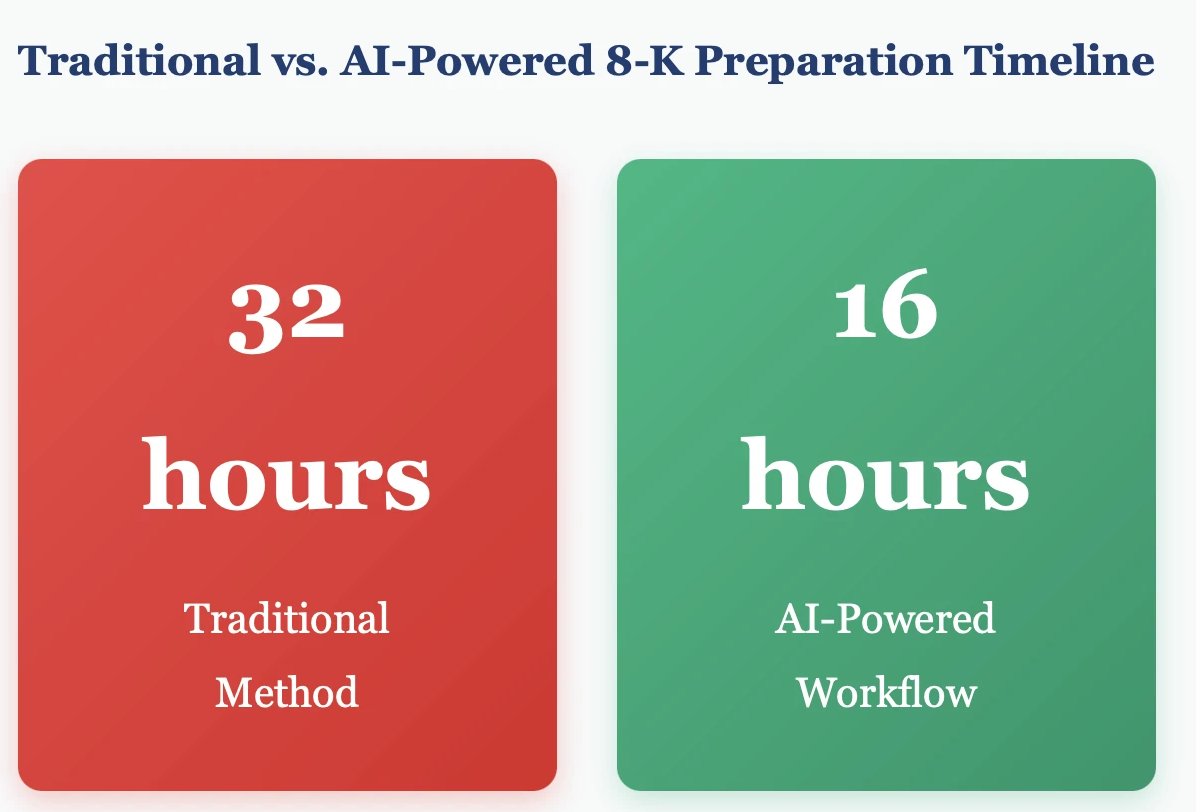
For decades, this has been the reality for corporate compliance teams. The 8-K filing -- the SEC's mandatory current report for material corporate events -- has been a source of stress, late nights, and tight deadlines. Artificial intelligence is now changing this process: compliance teams using AI-powered workflows report reducing preparation time from roughly four business days to approximately two.

The Traditional 8-K Nightmare
Traditional 8-K preparation typically consumes four full business days, involving multiple departments, extensive email coordination, version control challenges, and manual compliance checks. The process requires legal, finance, and executive teams to work under intense time pressure, with the SEC mandating filing within four business days of a material corporate event.
Preparing an 8-K has historically been resource-intensive. The traditional workflow involves multiple departments, extensive email threads, version control challenges, and the constant risk of missing a critical disclosure requirement.
According to SEC Regulation FD and Form 8-K requirements, companies must file an 8-K within four business days of a material event. The SEC processes over 50,000 8-K filings annually (SEC EDGAR data, 2024). Each filing represents a multi-departmental effort under time pressure.
A 2024 survey by EY's Center for Board Matters found that 68% of corporate legal teams cited the 8-K filing process as one of their most time-pressured compliance obligations (EY, 2024). The challenge is not just speed -- it is accuracy under pressure, where a missed disclosure requirement can lead to SEC comment letters or enforcement action.
The AI-Powered Workflow: A Step-by-Step Breakdown
An AI-powered 8-K workflow automates event classification, initial draft generation, compliance cross-referencing, and EDGAR formatting. The system identifies the correct SEC item numbers, generates disclosure language based on historical filings, flags potential compliance gaps, and produces XBRL-tagged documents ready for review, reducing the end-to-end preparation cycle from four days to approximately two.
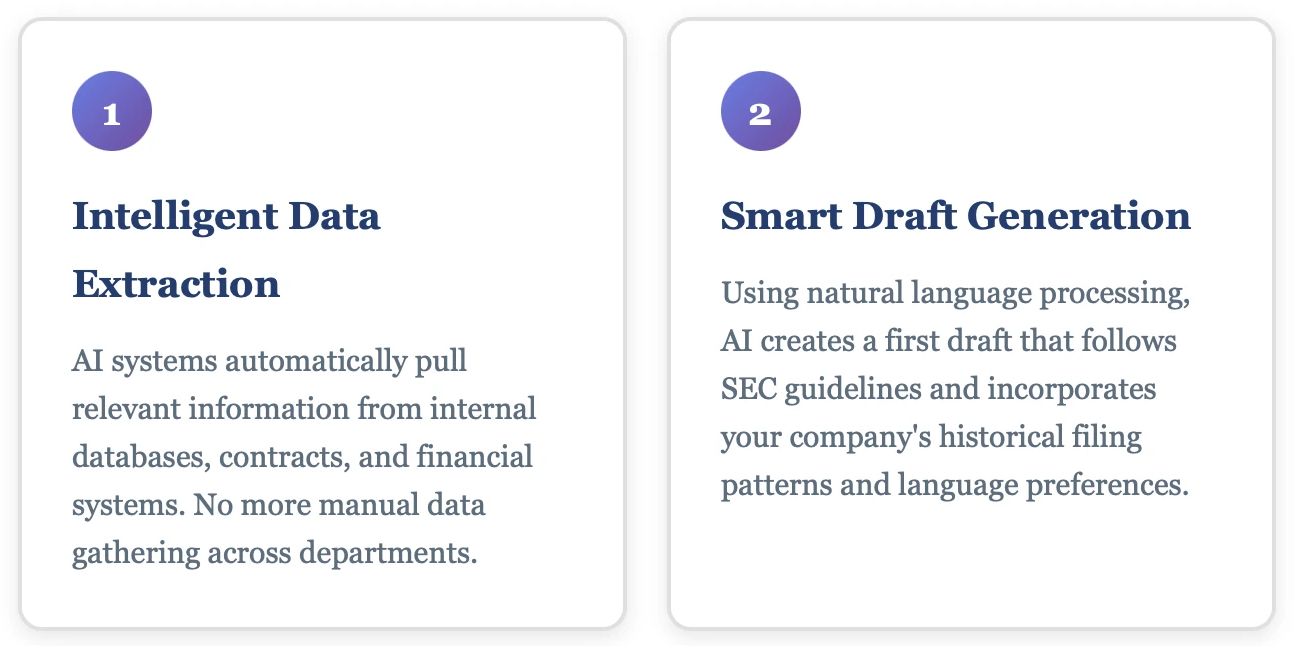
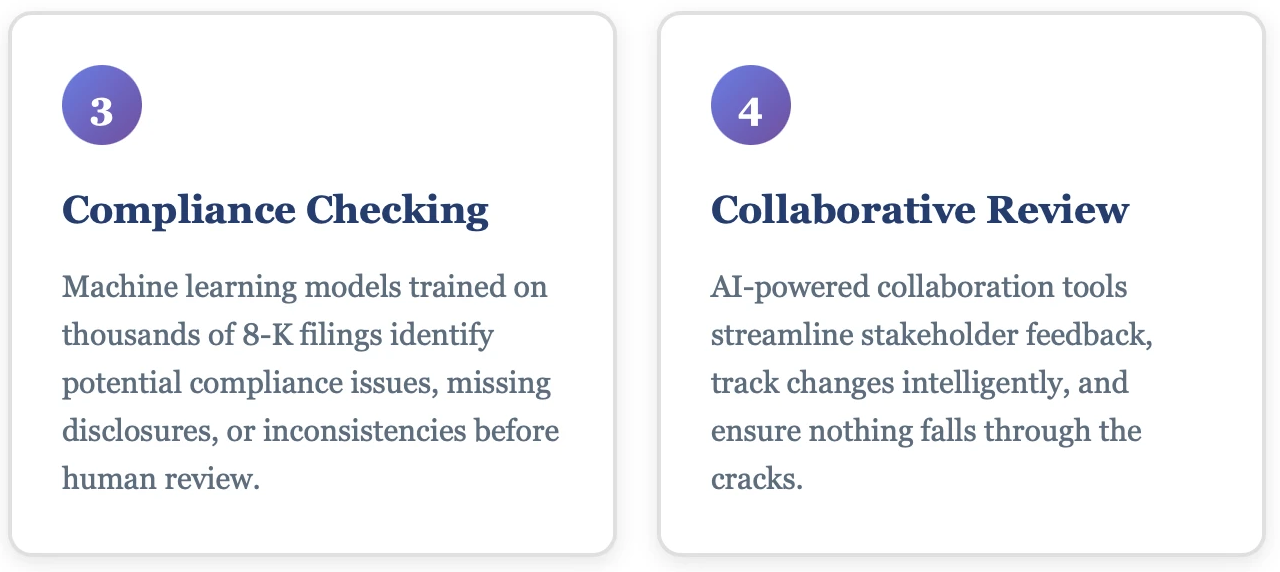
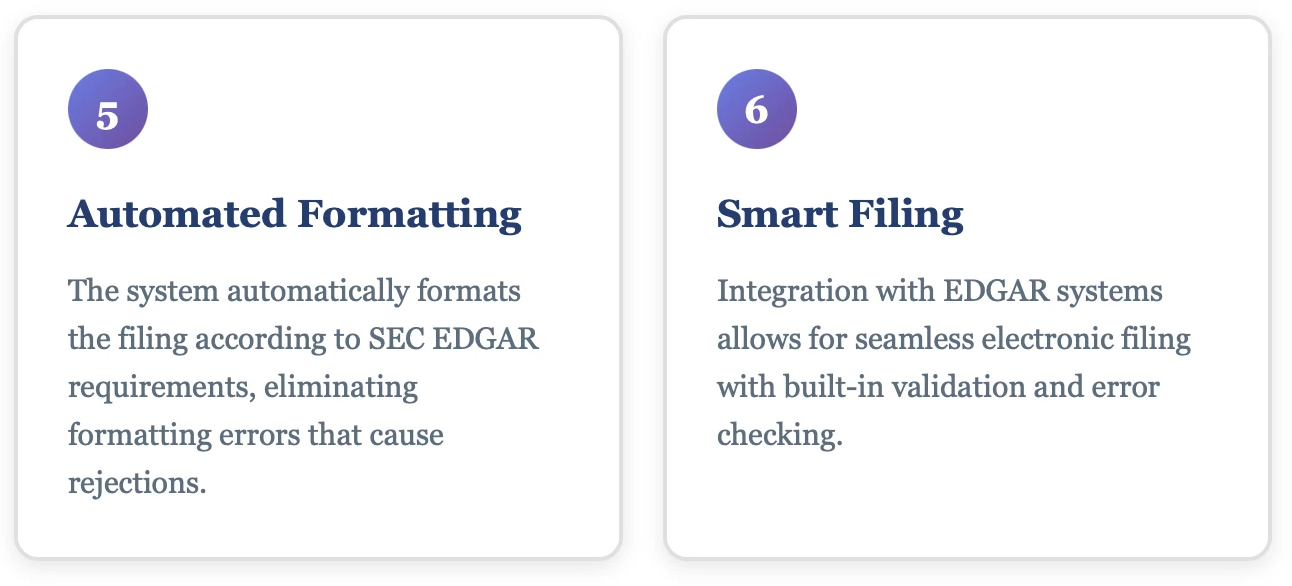
The SEC's EDGAR system has specific formatting and XBRL tagging requirements that must be met for successful submission. AI-powered workflows automate compliance with these technical specifications, which the SEC has progressively expanded since mandating inline XBRL for operating companies beginning in 2020.
As former SEC Commissioner Allison Herren Lee stated, "Technology, including artificial intelligence, has the potential to improve the quality and efficiency of regulatory compliance, but it must be deployed with appropriate human oversight."
The Real-World Impact
AI-powered 8-K workflows deliver measurable improvements beyond speed, including reduced compliance risk through consistent automated checks, significant cost savings in external legal fees, and steadily improving filing quality as the system learns from each submission. Some Fortune 500 companies report saving over $2 million annually in external legal fees after implementation.
Beyond time savings, the AI workflow delivers tangible benefits that transform how compliance teams operate:
Reduced Risk
AI systems maintain consistent performance regardless of time pressure. Machine learning models catch inconsistencies and potential compliance issues that even experienced attorneys might miss under deadline pressure. According to Deloitte's State of AI in the Enterprise survey, organizations using AI for compliance functions reported a 25% reduction in compliance errors (Deloitte, 2024).
Cost Efficiency
When you cut preparation time in half, you save significant costs in legal fees, overtime, and opportunity costs. One Fortune 500 company reported saving over $2 million annually in external legal fees alone after implementing an AI-powered 8-K workflow. KPMG estimates that AI-assisted compliance can reduce external counsel costs by 30-40% for routine SEC filings (KPMG, 2024).
Pro Tip: The most successful implementations do not try to eliminate human judgment -- they augment it. AI handles the tedious, time-consuming tasks, freeing your team to focus on strategic decision-making and nuanced legal analysis.
Consistency and Quality
Every 8-K you file becomes training data for your AI system. Over time, the quality improves, the language becomes more consistent with your company's voice, and the process becomes smoother.
Overcoming Implementation Challenges
The three primary challenges in implementing AI for 8-K preparation are data security concerns, change management for legal teams unfamiliar with AI tools, and accuracy oversight requirements. Successful implementations address these through enterprise-grade encryption, intuitive user interfaces with comprehensive training, and human review checkpoints at critical stages of the workflow.
Adopting AI is not without challenges. The most common concerns raised by compliance teams are:
- Data Security: Corporate disclosure information is sensitive. Modern AI solutions address this with enterprise-grade encryption, on-premise deployment options, and strict access controls. The AICPA's SOC 2 framework provides guidelines for evaluating vendor data security practices.
- Change Management: Legal teams need solutions with intuitive interfaces and comprehensive training. Most teams are operational within weeks of implementation.
- Accuracy Concerns: AI should not be treated as a "set it and forget it" solution. The workflow still includes human review at critical stages. As SEC Chief Accountant Paul Munter has emphasized, "The use of technology does not diminish management's responsibility for the accuracy and completeness of financial reporting."
Looking Ahead: The Future of SEC Compliance
The next wave of AI in SEC compliance includes predictive analytics that flag potential material events before they trigger disclosure obligations, real-time monitoring systems that continuously assess 8-K filing requirements, and integrated compliance suites that automate preparation across 8-Ks, 10-Qs, 10-Ks, and proxy statements within a single platform.
AI adoption in 8-K preparation is still in its early stages. According to Gartner's 2024 Legal Technology survey, only 15% of corporate legal departments have implemented AI for SEC filing workflows, but that figure is projected to reach 45% by 2027 (Gartner, 2024). Some organizations are already exploring:
- Predictive analytics that flag potential material events before they require disclosure
- Real-time monitoring systems that continuously assess whether activities trigger 8-K obligations
- Integrated compliance suites that handle not just 8-Ks, but 10-Qs, 10-Ks, proxy statements, and more
The Bottom Line
As SEC filing volumes and complexity increase, AI-powered workflows are becoming a standard part of the compliance toolkit. Organizations adopting these tools report measurable reductions in preparation time, lower compliance risk, and reduced external legal costs, while freeing legal and compliance professionals to focus on strategic thinking and nuanced judgment.
The SEC's Division of Corporation Finance continues to raise the bar on disclosure quality through comment letters and enforcement actions. Companies that invest in technology to meet these expectations will be better positioned to maintain compliance while managing costs effectively.