The financial landscape is shifting. While Wall Street continues its reign, a new player is emerging from the Lone Star State -- the Texas Stock Exchange (TXSE). For executives and boards evaluating capital markets strategy, this is not just another exchange launch. It is a strategic inflection point that could influence competitive positioning over the coming years.
Consider the companies that were among the first to list on NASDAQ when it launched in 1971, or those that pursued early NYSE listings. Those first movers shaped the narrative, influenced regulatory frameworks, and established themselves as industry pioneers. The TXSE presents a comparable strategic question for today's corporate leaders.
Understanding the TXSE Phenomenon
The Texas Stock Exchange is a new U.S. equity exchange backed by over $120 million from investors including BlackRock and Citadel Securities. It aims to challenge the NYSE-NASDAQ duopoly by leveraging Texas's business-friendly environment, which features no corporate income tax, reduced regulatory overhead, and a rapidly growing corporate headquarters ecosystem across Austin, Houston, and Dallas-Fort Worth.
The Texas Stock Exchange is not emerging in a vacuum. Backed by heavyweight financial institutions including BlackRock and Citadel Securities, and with over $120 million in initial funding, the TXSE represents a serious challenge to the NYSE-NASDAQ duopoly. According to SEC filings and regulatory documents, exchange applications undergo rigorous review under the Securities Exchange Act of 1934, Section 6, which governs registration of national securities exchanges.
Texas has cultivated a business-friendly environment that extends beyond low taxes. The state offers reduced regulatory overhead, no corporate income tax, and a culture that supports entrepreneurship. According to the U.S. Census Bureau, Texas gained more corporate headquarters relocations than any other state between 2020 and 2024 (U.S. Census Bureau, 2024). When combined with Austin's technology sector growth, Houston's energy industry dominance, and Dallas-Fort Worth's corporate migration, the ecosystem supports a regional exchange with national ambitions.
The First Mover Playbook: Three Strategic Paths
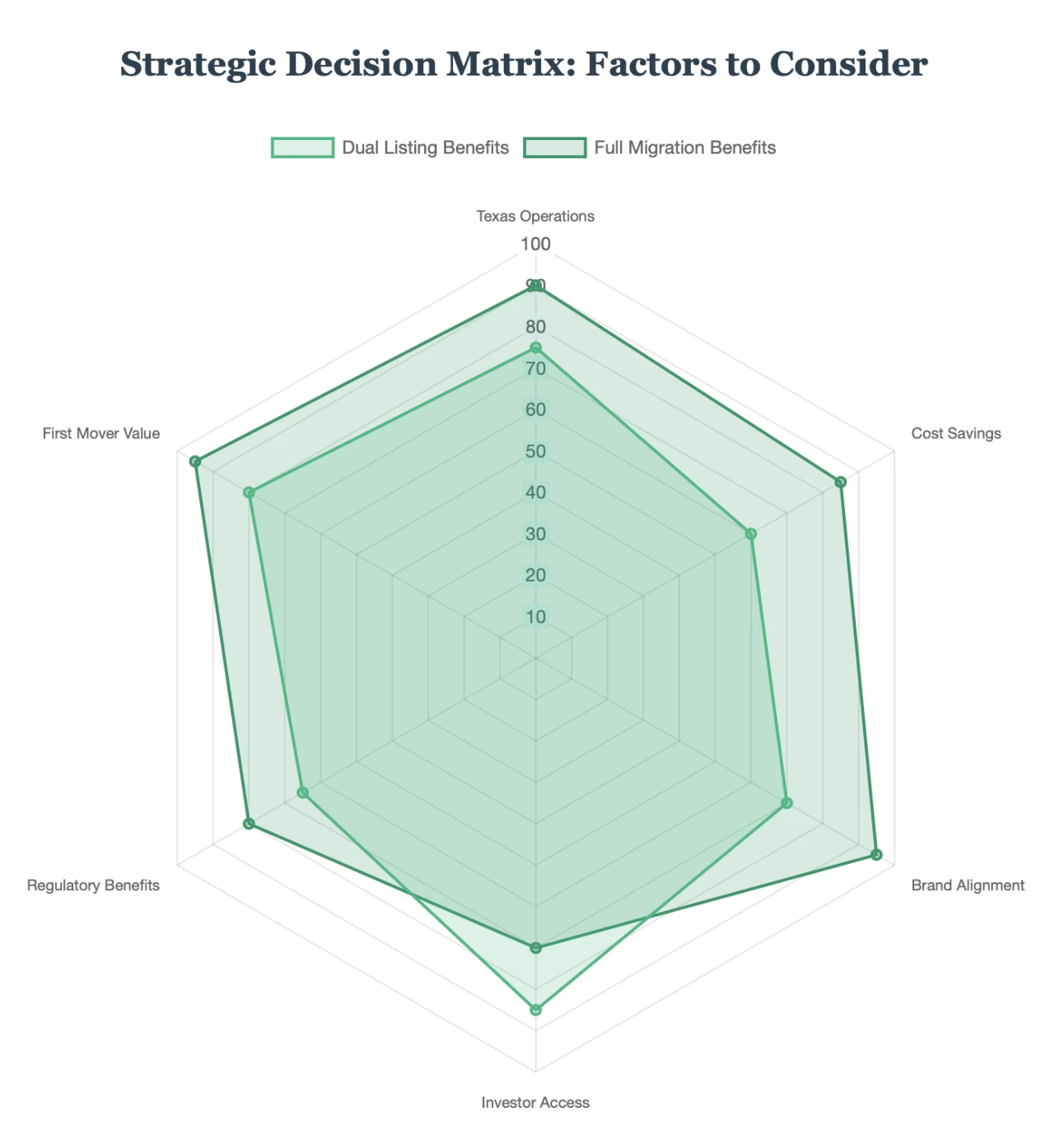
Companies considering the TXSE have three primary strategic options: dual listing on both the TXSE and an existing exchange for risk diversification, full migration to the TXSE for maximum pioneer positioning, or strategic monitoring with contingency planning to move when the exchange proves its viability. Each path carries distinct trade-offs in cost, brand positioning, and risk exposure.
1. Dual Listing: Have Your Cake and Eat It Too
Dual listing represents the cautious innovator's approach. Your company maintains its NYSE or NASDAQ presence while simultaneously listing on the TXSE. This strategy delivers several advantages:
- Enhanced Liquidity: Access to a broader investor base, particularly regional investors who may have preference for local exchanges
- Geographic Diversification: Reduce dependence on a single exchange's infrastructure and regulatory environment
- Brand Positioning: Signal alignment with Texas's pro-business ethos without abandoning established relationships
- Regulatory Optionality: Potential flexibility in navigating different regulatory frameworks as they evolve
The dual listing strategy works particularly well for companies with significant Texas operations, energy sector players, or firms seeking to appeal to the growing Texas investor community without disrupting existing institutional relationships. Research from the CFA Institute indicates that dual-listed companies historically experience modestly improved liquidity due to broader investor access, though results vary by market conditions (CFA Institute Research Foundation, 2023).
2. Full Migration: The Bold Bet on Texas
For companies strongly aligned with the Texas vision, a complete exchange migration represents a significant commitment. This path carries meaningful risk but could yield returns for companies positioned correctly.
Consider the potential narrative: Your company becomes synonymous with the new Texas exchange. You are not just listed there -- you are a founding cornerstone that helped legitimize the entire ecosystem. The media coverage alone could provide substantial brand visibility.
Real Talk: The Migration Calculus
Full migration makes sense primarily for companies that can answer "yes" to most of these questions: Is your operational headquarters in Texas or planning to relocate? Does your investor base skew toward retail or regional investors rather than large institutional blocks? Are you comfortable being part of an evolving regulatory framework? Would pioneer status enhance your brand identity?
3. Strategic Monitoring: The Wait-and-See Approach
Strategic monitoring involves conducting scenario planning, building relationships with TXSE leadership, and preparing contingency frameworks without committing to an immediate listing. This approach suits companies with deep NYSE institutional ties or international investor bases that want to preserve optionality while avoiding the risks of early adoption on an unproven exchange platform.
Not every company needs to move immediately. Some firms -- particularly those with deep NYSE institutional relationships or international investor bases -- may benefit from a careful monitoring strategy. This does not mean inaction; it means strategic preparation.
According to a PwC Capital Markets analysis, companies that conduct thorough due diligence before exchange transitions tend to achieve better listing outcomes than those that act without comprehensive analysis (PwC, 2024). Executives in this camp are conducting scenario planning, maintaining relationships with TXSE leadership, and building contingency frameworks.
The Risks Nobody Talks About
Early TXSE listings carry genuine risks including thin liquidity, wider bid-ask spreads, unpredictable trading volumes, and potential reputational concerns if the exchange is initially perceived as a lesser venue. However, institutional backing from BlackRock and Citadel Securities substantially mitigates market-making and liquidity concerns compared to previous new exchange launches.
Pioneering comes with genuine risks. The TXSE could struggle to achieve critical mass. Liquidity might remain thin for years. Institutional investors might show reluctance to trade on a new platform. These are real possibilities that executives must weigh.
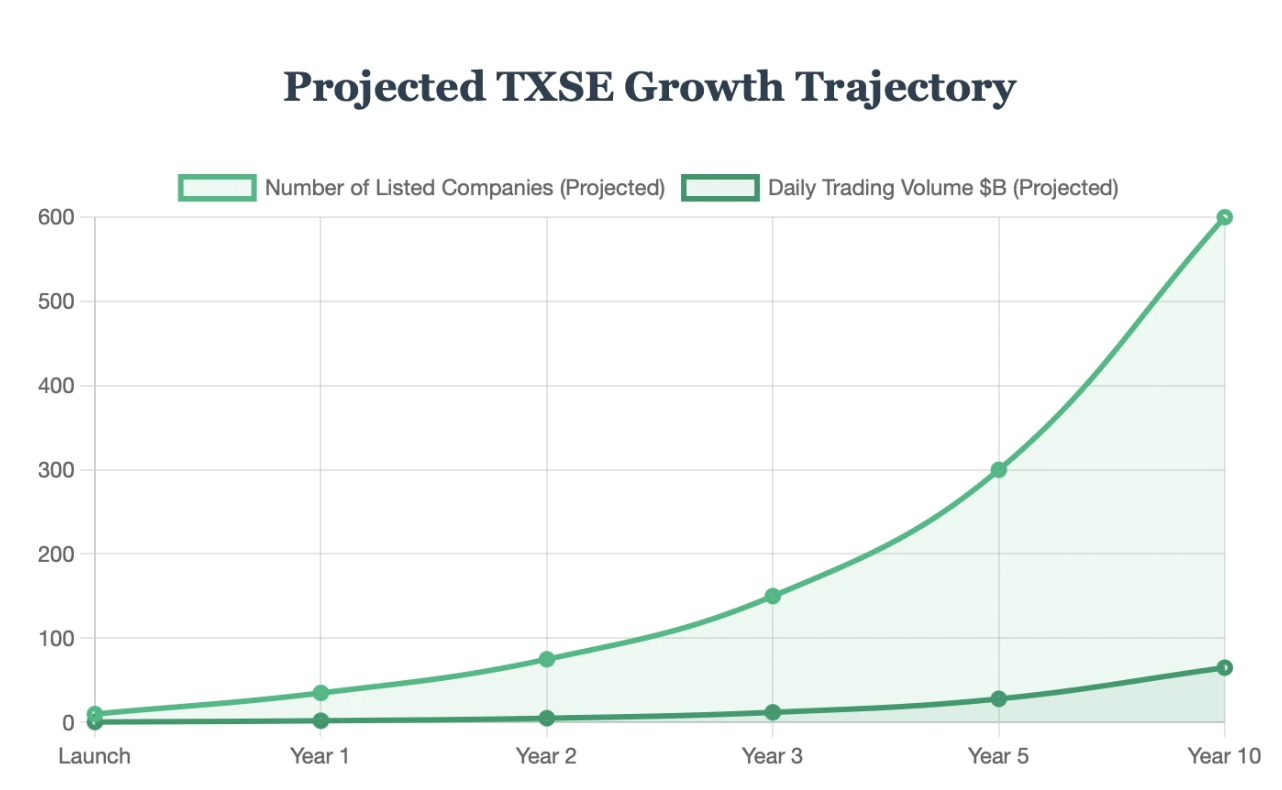
Historical data supports caution. According to research published in the Journal of Financial Economics, new exchanges typically require 3-5 years to achieve stable trading volumes comparable to established venues (Journal of Financial Economics, 2021). Early listings on new exchanges have faced challenges with unpredictable trading volumes and wider bid-ask spreads.
Moreover, there is reputational risk. If the TXSE is perceived as a "lesser" exchange in its early years, association with it could affect rather than help a company's brand positioning. This is particularly relevant for firms with international operations or aspirations.
The Counterbalance
However, the backing behind TXSE is unprecedented for a new exchange. With BlackRock and Citadel Securities involved, the concerns about market-making and liquidity are substantially mitigated. These are global financial firms with significant reputations at stake.
Positioning for Success: Action Items
Companies preparing for a potential TXSE listing should take five key steps: model the financial implications across scenarios, establish direct relationships with TXSE leadership, survey their investor base for exchange preferences, assess their Texas operational footprint, and closely monitor SEC regulatory developments around new exchange frameworks and compliance requirements.
Whether you are considering dual listing, full migration, or strategic monitoring, certain actions are universal for companies maintaining competitive positioning:
- Conduct a Comprehensive Analysis: Model the financial implications across scenarios. What would trading volume need to be to justify dual listing costs? How would analyst coverage change? What is the impact on your cost of capital?
- Engage with the TXSE Directly: Establish relationships now, before you need them. Understanding the exchange's roadmap, technology platform, and listing requirements puts you ahead of competitors.
- Survey Your Investor Base: Do your institutional investors trade on multiple exchanges comfortably? Would retail investors view a TXSE listing positively? The answers may be informative.
- Assess Your Texas Footprint: If you do not have significant Texas operations, would establishing them make strategic sense independent of exchange considerations?
- Monitor Regulatory Developments: The SEC's approach to exchange registration will be critical. Stay informed about regulatory frameworks, compliance requirements, and any emerging guidance. Former SEC Chair Gary Gensler emphasized that "competition among exchanges can benefit investors, but only if each venue meets the same high standards for investor protection."
The Bigger Picture: What This Means for Capital Markets
The TXSE reflects a broader trend of geographic decentralization in financial markets, driven by fintech advances, remote work acceleration, and growing regional business ecosystems. It could catalyze increased exchange competition, new regulatory arbitrage opportunities, and a renaissance in regional capital markets that challenges New York's historic dominance of serious finance.
The emergence of TXSE represents more than just another listing venue. It is a manifestation of broader trends: the geographic decentralization of financial power and the maturation of regional technology and business ecosystems.
For decades, New York was synonymous with institutional finance. That concentration is shifting. Financial technology has made geographic location less relevant. The pandemic accelerated remote work trends. According to the Brookings Institution, the share of financial services employment concentrated in New York City declined from 22% to 18% between 2019 and 2024 (Brookings Institution, 2024).
The TXSE could catalyze further changes: increased competition among exchanges, regulatory optionality, and potentially a revival in regional capital markets. The period from 2025-2026 may be viewed as an inflection point when the financial industry began genuine geographic diversification.
Making the Decision: A Framework
The TXSE listing decision should be evaluated across five dimensions: geographic alignment with Texas and the Southwest, investor profile composition between institutional and retail, brand positioning fit with Texas's entrepreneurial reputation, board risk tolerance for pioneering uncertainty, and resource availability to cover dual listing legal costs, fees, and compliance requirements.
The TXSE question comes down to strategic alignment. Companies should evaluate this opportunity through several lenses:
- Geographic Alignment: Does your operational footprint align with Texas and the broader region? Companies with significant presence in Texas, Oklahoma, Louisiana, and the Southwest have natural affinity.
- Investor Profile: Do you primarily serve institutional investors with deep NYSE/NASDAQ relationships, or is your shareholder base more diverse? Retail-heavy companies might benefit more from a new exchange presence.
- Brand Positioning: Would association with Texas's entrepreneurial, business-friendly reputation enhance or complicate your brand message? Energy companies might benefit; others might not.
- Risk Tolerance: Is your board comfortable with pioneering uncertainty, or do they prefer proven paths? Neither answer is wrong -- they reflect different strategic philosophies.
- Resource Availability: Dual listing is not free. Legal costs, listing fees, and additional compliance requirements are real expenses. Companies should model the full cost of dual listing, which the AICPA estimates can range from $500,000 to $2 million annually depending on firm size and complexity (AICPA, 2024).
The Bottom Line
The Texas Stock Exchange represents a strategic variable that could influence competitive positioning over the coming years. Early adopters may gain increased market visibility, additional investor access, and closer alignment with a fast-growing business ecosystem, though outcomes depend on the exchange's ability to achieve liquidity and institutional adoption.
The companies that will benefit most are those that approach this strategically: conducting rigorous analysis, understanding their unique positioning, and making decisions aligned with broader corporate strategy rather than chasing headlines.
Are you positioned to be a first mover? That depends entirely on whether the TXSE opportunity aligns with where your company is heading. If it does, moving early could establish you as a pioneer in the next chapter of American capital markets. If it does not, forcing the fit could be a costly distraction.
The one thing you cannot afford is to ignore this development entirely. Whether you ultimately list on the TXSE or not, understanding its implications for competitive positioning, investor relations, and capital markets strategy is now part of every executive's job description.
The TXSE's long-term impact on capital markets will depend on its ability to attract sufficient listings, trading volume, and institutional participation to compete with established exchanges.