Decoding the narrative hidden in plain sight
Imagine this: A company announces a CEO departure in March. In May, they disclose a major customer loss. By July, there's a debt covenant waiver filing. August brings asset sales. Each filing seems routine on its own, but together? They tell the story of a company in distress.
Welcome to the art of reading 8-K filings—not as isolated events, but as chapters in an unfolding corporate narrative. While most investors scan these regulatory filings for quick headlines, the real alpha lies in connecting the dots across multiple disclosures to understand what's really happening beneath the surface.
What Makes 8-K Filings Special?
Form 8-K is the SEC's "current report," filed whenever a material event occurs at a public company, including executive changes, acquisitions, contract terminations, and bankruptcy warnings. Unlike 10-Qs and 10-Ks that follow predictable schedules, 8-Ks provide real-time disclosure, making them the earliest public signal of developing corporate narratives for investors who track them systematically.
Unlike quarterly 10-Qs or annual 10-Ks that arrive on predictable schedules, Form 8-K is the SEC's "current report" -- filed whenever something material happens. Think of it as a company's real-time newsflash to investors. According to the SEC's EDGAR filing statistics, public companies filed over 120,000 Form 8-K current reports in fiscal year 2024, making it the most frequently filed disclosure document. These filings cover everything from executive changes and acquisitions to bankruptcy warnings and contract terminations.
But here's what makes them powerful: 8-Ks reveal the company's story as it happens, not weeks or months later. They're the breadcrumbs that lead astute investors to opportunities—or warn them of dangers—before they become obvious to everyone else.
The Pattern Recognition Game
Analyzing a sequence of 8-K filings from a single company reveals patterns invisible in individual filings. A distress pattern might show a CFO departure followed by going concern doubts, customer losses, debt covenant waivers, and asset sales over several months. A transformation pattern might show an activist investor joining the board followed by new leadership, divestitures, and strategic acquisitions.
Individual 8-K filings are like pixels on a screen. One pixel tells you nothing. But step back and look at the whole image, and suddenly patterns emerge. As former SEC Chair Mary Jo White emphasized, "the disclosure system works best when investors look at the totality of a company's communications, not just individual filings." Let's explore how a series of filings can reveal different corporate narratives.
Case Study: The Distress Pattern
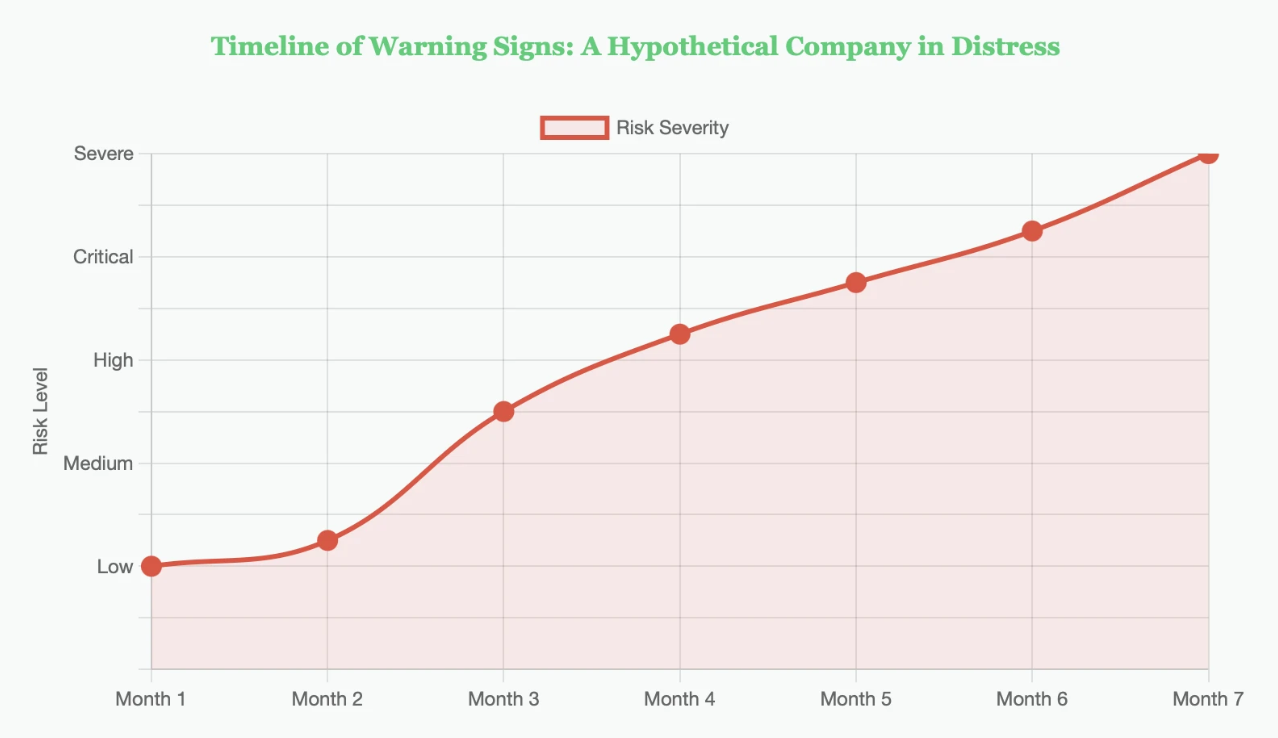
Month 1: CFO departure announced (Item 5.02) – Could be routine, but worth noting.
Month 3: Auditor raises going concern doubts (Item 4.02) – Red flag intensifies.
Month 4: Major customer contract terminated (Item 1.02) – Revenue pressure confirmed.
Month 5: Debt covenant waiver requested (Item 1.01) – Financial stress evident.
Month 6: Asset sale to raise capital (Item 2.01) – Company scrambling for liquidity.
Month 7: Notice of delisting from exchange (Item 3.01) – The story reaches its inevitable conclusion.
No single filing screamed "danger!" but together, they painted an unmistakable picture of a company spiraling toward financial distress. Research published in the Harvard Law School Forum on Corporate Governance has shown that companies that file three or more 8-Ks involving officer departures and covenant modifications within a six-month period are significantly more likely to face formal SEC investigation. An investor tracking these dots could have exited positions or shorted the stock months before the broader market caught on.
The Transformation Pattern
Not all patterns signal decline. Sometimes, a series of 8-Ks reveals a company reinventing itself. Consider this sequence:
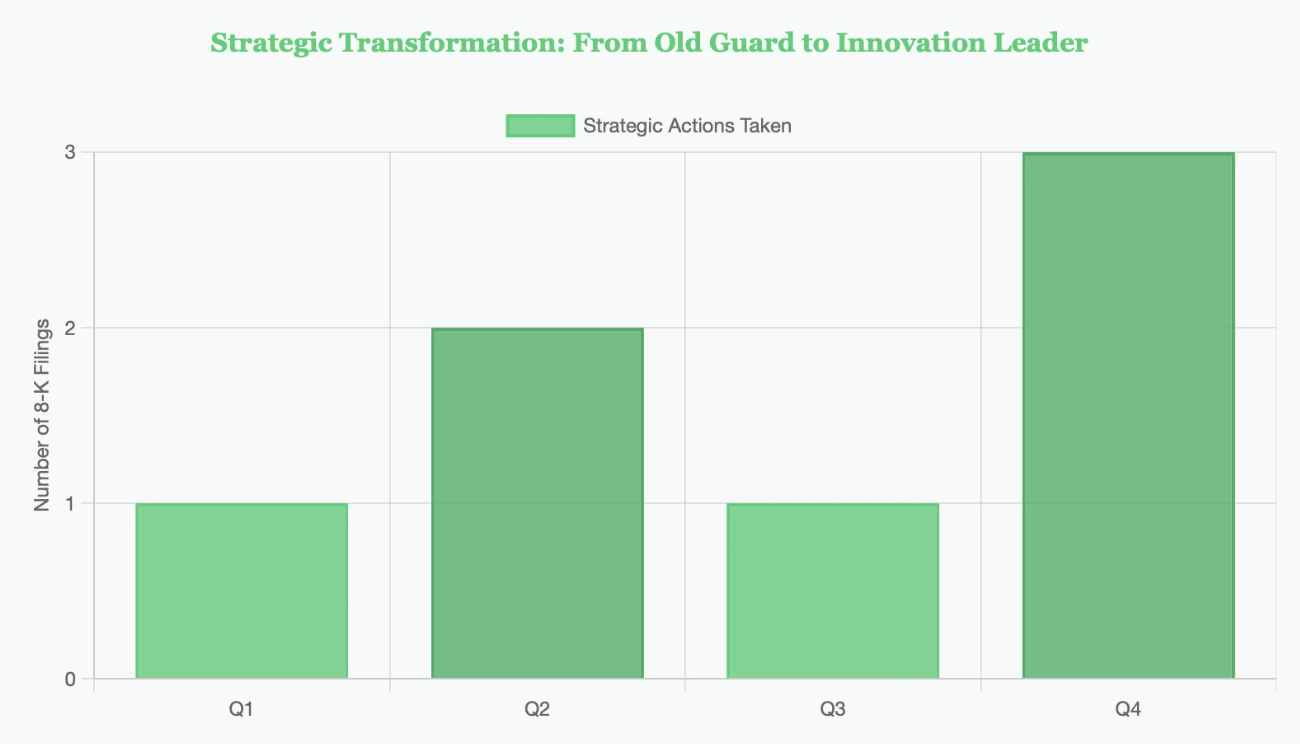
Q1: Activist investor joins board → Catalyst for change
Q2: New CEO with tech background appointed → Strategic direction shift
**Q2: **Underperforming division sold → Portfolio rationalization
Q3: Acquisition of AI startup → Future capabilities acquired
Q4: Major partnership with tech giant announced → Validation of new strategy
Q4: Board compensation restructured with performance metrics → Alignment of incentives
This pattern tells a story of strategic renewal. Each filing is a deliberate step in a transformation journey. Investors who recognized this narrative early could position themselves ahead of the market's eventual rerating of the stock.
The Items That Matter Most
The highest-impact 8-K items for pattern recognition are Item 1.01 (material agreements), Item 1.02 (termination of material agreements), Item 2.01 (acquisition or disposal of assets), Item 4.02 (accountant changes indicating potential reporting issues), Item 5.02 (officer and director changes), and Item 8.01 (other events), which serves as a catch-all that sometimes contains critical disclosures.
Not all 8-K items carry equal weight. The SEC's rules on Form 8-K specify the exact triggering events that require disclosure. Here are the sections that most frequently contribute to pattern recognition:
🎯 High-Impact 8-K Items to Track
- Item 1.01 (Material Agreements): New contracts, amendments, terminations—the building blocks of revenue
- **Item 1.02 (Termination of Material Agreements): **Often overlooked but can signal major business disruptions
- Item 2.01 (Acquisition/Disposal of Assets): Shows strategic direction and capital allocation priorities
- Item 4.02 (Accountant Changes): Can indicate accounting disagreements or financial reporting issues
- Item 5.02 (Officer/Director Changes): Leadership stability or turmoil—context is everything
- **Item 8.01 (Other Events): **The catch-all that sometimes contains hidden gems
How to Actually Do This: A Practical Framework
Building an 8-K pattern recognition system involves four steps: creating a watch list of companies in transition or facing challenges, maintaining a timeline database logging each filing's date, item numbers, and interpretation, identifying clusters and sequences of related events, and comparing the 8-K pattern against management's public statements on earnings calls to spot divergences.
Reading individual 8-Ks is straightforward. Building a pattern recognition system requires discipline. According to a CFA Institute survey, over 65% of professional investors who systematically track regulatory filings report identifying material developments earlier than those who rely on quarterly earnings alone (CFA Institute, 2023). Here's a framework that works:
Step 1: Create Your Watch List
Focus on companies where understanding the narrative matters—those in transition, competitive industries, or facing challenges. You can't follow everyone, so prioritize.
Step 2: Build a Timeline Database
Use a simple spreadsheet or note-taking system to log each 8-K filing with: date, item numbers, brief description, and your initial interpretation. The magic happens when you review this timeline regularly.
Step 3: Look for Clusters and Sequences
Are multiple executive departures happening close together? Are asset sales following debt covenant issues? Is the company making several small acquisitions in a new sector? Clusters and sequences reveal intentionality—or desperation.
Step 4: Compare Against Guidance and Public Statements
Do the 8-K patterns align with what management says on earnings calls? Divergence is fascinating. A CEO talking about "business as usual" while 8-Ks reveal major operational changes signals either poor communication or something more concerning.
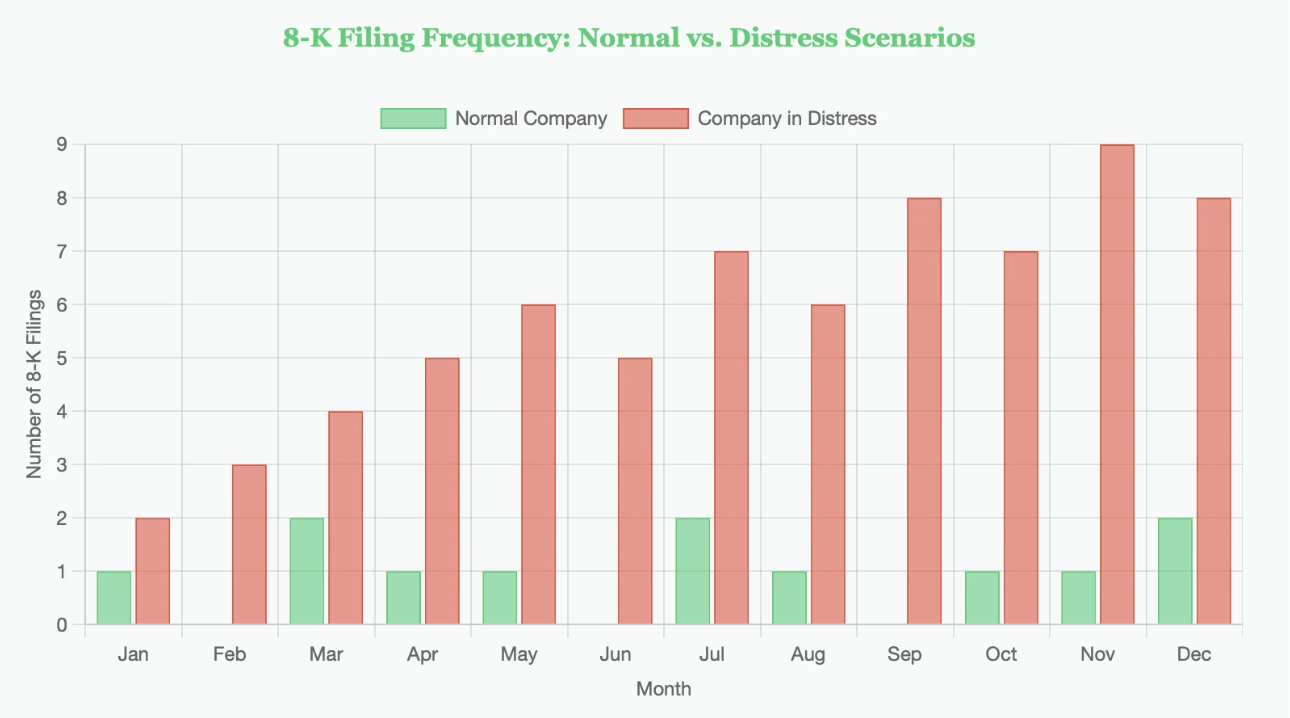
8-K pattern analysis serves different investor types in distinct ways. Long-term investors use it to identify value traps and genuine business improvements. Active traders use 8-K sequences to spot inflection points before they appear in quarterly earnings. Risk managers monitor filing frequency and clustering around debt, accounting, or governance issues as an early warning system for portfolio positions.
For Long-Term Investors
Pattern recognition helps you avoid value traps. A stock may look cheap on traditional metrics, but a series of customer losses, facility closures, and executive departures suggests the "value" is justified -- or worse, insufficient. According to EY's 2024 Corporate Reporting Survey, institutional investors increasingly cite real-time filing analysis as a primary factor in portfolio allocation decisions. Conversely, a seemingly expensive stock might be reasonably priced if 8-Ks reveal systematic business improvements.
For Active Traders
8-K patterns can signal inflection points before they appear in quarterly results. The market often reacts to quarterly earnings, but the informed trader who tracked the 8-K breadcrumbs saw it coming and positioned accordingly.
For Risk Managers
A sudden increase in 8-K filing frequency—especially around debt, accounting, or governance issues—can be an early warning system for portfolio positions that need closer scrutiny or tighter stops.
The Narrative Themes to Watch For
Five recurring narrative patterns emerge from 8-K series analysis: turnaround stories with new leadership and focused divestitures, growth-at-all-costs patterns marked by serial acquisitions and rising debt, governance breakdowns featuring board conflicts and executive departures, strategic pivots through R&D partnerships and acquisitions in a new sector, and managed declines with facility closures, workforce reductions, and eventual dissolution.
📖 Common Narrative Patterns in 8-K Series:
The Turnaround Story: New leadership → strategic review → divestitures → focused investments → operational improvements
The Growth-at-All-Costs Story: Multiple acquisitions → debt raises → more acquisitions → integration challenges → eventual reckoning
**The Governance Breakdown: **Board conflicts → executive departures → shareholder lawsuits → restatements → crisis management
The Strategic Pivot: R&D partnerships → small acquisitions in new area → larger acquisition → rebranding → full transformation
The Managed Decline: Facility closures → workforce reductions → debt restructuring → asset sales → eventual acquisition or dissolution
Common Pitfalls to Avoid
The four main pitfalls in 8-K pattern analysis are over-interpreting individual filings when a single event may be routine, confirmation bias that causes investors to see every filing as supporting a pre-existing thesis, ignoring industry context where high turnover or frequent acquisitions may be sector norms, and neglecting the time dimension since six executive changes over six years differs significantly from six in six months.
Over-interpreting individual filings: Sometimes a CEO departure is just a retirement. Not everything is significant. The SEC's guidance on materiality (SAB 99) provides a useful framework for assessing significance. The pattern matters more than any single event.
Confirmation bias: If you're bearish on a stock, you'll see every 8-K as confirming your thesis. Stay objective. Let the full pattern speak, not cherry-picked filings.
Ignoring industry context: High executive turnover is normal in some industries. Multiple acquisitions might be standard consolidation strategy in others. Know your sector norms.
Neglecting the time dimension: Six executive changes over six years is very different from six changes in six months. Velocity matters.
Tools and Resources
Key tools for 8-K pattern tracking include the SEC's free EDGAR database for filing access, company-specific RSS feeds for real-time notifications, screening platforms that filter 8-K filings by item type, spreadsheet-based timeline tracking for manual pattern analysis, and pattern recognition software for programmatic identification of filing clusters and sequences across large watchlists.
The SEC's EDGAR database is free and searchable, but it's not user-friendly for pattern analysis. As SEC Chair Gary Gensler stated in 2023, the SEC is working to "modernize EDGAR to make it more accessible and useful for investors." Consider these approaches:
- RSS feeds: Set up company-specific feeds to get notified of new 8-Ks immediately
- Screening tools: Several platforms offer 8-K screening by item type
- Spreadsheet tracking: Sometimes the simplest solution is best—maintain your own timeline
- Pattern recognition software: More sophisticated investors use custom tools to identify filing patterns programmatically
💡 Pro Tip: The Weekend Review
Dedicate 30 minutes every Sunday to review the week's 8-Ks for your watch list companies. Update your timelines. Look for emerging patterns. This consistent practice builds the pattern recognition muscle that separates good investors from great ones.