
There's no single best AI tool for technical accounting research. Pick by whose guidance you need: your auditor's library, a publisher's or an AI that cites the standard itself. If you also need to see how peers disclosed the same issue, pick one that reads SEC filings too.
This guide compares 16 accounting research tools in four lanes. Free tools come first, then Big 4 and publisher libraries, accounting AI tools and Finrep. We also asked three of them the same four questions and checked every paragraph they cited.
All three tools applied the current standard on all four questions. Every paragraph Finrep cited said what its answer claimed. ChatGPT and Claude each cited at least one lease paragraph for a rule that sits elsewhere.
Those checks matter because the standards keep moving. The FASB issued 15 Accounting Standards Updates from January 2025 to September 2026. An AI answering from memory may not know which paragraphs they touched.
Our explainer on ASU 2025-12's codification improvements shows how far one update can reach.
Which AI tool is best for technical accounting research?
Start with the guidance your auditor reads, then add AI where it saves reading time. The table matches nine common situations to a first tool.
| If you… | Start with | Why |
|---|---|---|
| are audited by Deloitte | DART with DARTbot | Your auditor's guidance with AI on top; $2,400 a concurrent user a year |
| want Big 4 guidance for free | PwC Viewpoint, Deloitte's Roadmaps, KPMG Financial Reporting View | Free to read; no AI documented on the free tiers |
| research tax and accounting together | Checkpoint Edge with CoCounsel, Bloomberg Tax, CCH AnswerConnect | Publisher libraries with AI; prices on request |
| follow AICPA guidance | AICPA Josi | AI over the AICPA library; $495 to $550 a seat a year |
| have no budget | FASB Codification and Viewpoint, then ChatGPT or Claude | Free, if you check every paragraph |
| need a memo from a contract | TAbot or Gaapio | Built to draft the memo |
| automate lease and revenue schedules | Trullion | A workflow tool that answers mainly from your uploads |
| already run your close in Numeric | Numeric's Technical Accounting Assistant | It sits inside the close platform |
| want the standard plus how peers disclosed it | Finrep | Codification and SEC filings in one cited answer |
Two patterns stand out. Among the four big audit firms, only Deloitte documents an AI research assistant in its client library, for subscribers only. The AI-first tools cite paragraphs, yet TAbot and Gaapio don't say publicly which firms' guides they hold.
Searches for accounting research software show the same split: libraries you read and assistants you ask.
What is technical accounting research?
Technical accounting research is working out what the standards require for a transaction, then writing down why. It starts at the Codification paragraph and the interpretive guides. Then it checks how peers handled the same facts and ends in a memo your auditor will read.
Technical accounting is the team that makes those calls, from revenue contracts to stock awards. It usually sits under the controller or chief accounting officer, and the auditor reviews its memos.
That definition rules out most of what ranks for "best AI for accounting". In October 2026, Google's AI Overview for that search cited bookkeeping and close tools and no research library. Those tools work on your own ledger data, while research works on the standards.
Numeric shows the split inside one company, because its core product runs the month-end close. On April 1, 2026 it released a Technical Accounting Assistant that answers standards questions. We list that assistant below as a research tool and leave the close software out.
We asked three tools four technical accounting questions
Finrep and ChatGPT cited a core Codification paragraph on all four questions, and Claude on three. Every paragraph Finrep cited checked out, while ChatGPT and Claude each cited at least one that doesn't support its point.
The four topics track what the SEC staff asks about most, and segment expenses lead by an order of magnitude.
SEC staff comment letters dated 2025 raised ASU 2023-07 segment expenses in at least 94 letters. Principal versus agent came up in at least 10, and embedded leases and stock-comp modifications in at least one each. Our guide to SEC comment letters explains where the letters live.
The four questions were:
- Revenue. An online marketplace that never holds inventory: principal or agent under ASC 606?
- Leases. A supply agreement for one named production line: does it contain a lease under ASC 842?
- Segments. A single-segment SEC registrant: which ASU 2023-07 disclosures, from which period?
- Stock comp. Repricing unvested underwater options, then lengthening vesting: what does ASC 718 require?
We wrote the answer key first, from the ASU text and four Big 4 guides per question. Each tool then got each question once, in a new chat, with no files and no follow-up. We publish three checks anyone can repeat and no overall score.
We ran ChatGPT (GPT-6 Pro, thinking, on the Pro plan) and Claude (Opus 5.5, high effort) with web search on. Finrep ran with it off. Claude's answers were copied by hand, so its source links weren't captured; its paragraph numbers sit in the text.
Finrep ran its own product, and outside reviewers haven't graded these results yet.
We tested only tools whose terms allow it without a subscription, a sales call or a trial sign-up. That left ChatGPT, Claude and Finrep, so every other tool on this page rests on public information only.
| Check | Finrep | ChatGPT | Claude |
|---|---|---|---|
| Q1. Revenue: principal or agent (ASC 606) | |||
| (a) Cited a core paragraph | ✓ 606-10-55-36 to 55-39A | ✓ 606-10-55-36 to 55-39A | ✓ 606-10-55-36 to 55-40 |
| (b) Every cited paragraph exists and is on point | ✓ Yes | ✓ Yes | ✓ Yes |
| (c) Reflected the current standard | ✓ ASU 2016-08 control test | ✓ ASU 2016-08 control test | ✓ ASU 2016-08 control test |
| Q2. Leases: lease in a supply agreement (ASC 842) | |||
| (a) Cited a core paragraph | ✓ 842-10-15-3 to 15-26 | ✓ 842-10-15-2 to 15-26 | ✓ 842-10-15-3 to 15-26 |
| (b) Every cited paragraph exists and is on point | ✓ Yes | Partly: 842-10-55-30, cited for take-or-pay minimums, covers lease incentives | Partly: 15-24 and 15-21 cited for rules in 15-25 and 15-23 |
| (c) Reflected the current standard | ✓ ASC 842, not the ASC 840 price test | ✓ ASC 842, not the ASC 840 price test | ✓ ASC 842, not the ASC 840 price test |
| Q3. Segments: one reportable segment (ASU 2023-07) | |||
| (a) Cited a core paragraph | ✓ 280-10-50-20, 50-26A, 50-32(ee) | ✓ 280-10-50-20, 55-15D, 50-26A, 50-32(ee) | None cited; the question didn't ask for paragraph numbers |
| (b) Every cited paragraph exists and is on point | ✓ Yes | ✓ Yes | Not applicable |
| (c) Reflected the current standard | ✓ 2024 10-K and Q1 2025 10-Q | ✓ 2024 10-K and Q1 2025 10-Q | ✓ 2024 10-K and Q1 2025 10-Q |
| Q4. Stock comp: repricing options (ASC 718) | |||
| (a) Cited a core paragraph | ✓ 718-20-35-3(a) and (b) | ✓ 718-20-35-3(a) and (b), 55-98 to 55-101 | ✓ 718-20-35-3 |
| (b) Every cited paragraph exists and is on point | ✓ Yes | ✓ Yes | ✓ Yes |
| (c) Reflected the current standard | ✓ Post-ASU 2017-09 modification test | ✓ Post-ASU 2017-09 modification test | ✓ Post-ASU 2017-09 modification accounting |
Question 1: principal or agent
The facts point to agent, so the marketplace books only its commission as revenue. The deciding paragraphs are ASC 606-10-55-36 to 55-39A, as ASU 2016-08 rewrote them around control.
A stale answer treats credit risk on the customer's payment as a sign of principal, an indicator ASU 2016-08 removed. Our guide to ASC 606 revenue recognition covers the wider model.
All three tools cited 606-10-55-36 to 55-39A and Example 45. Every paragraph they cited said what the answer claimed.
Question 2: the lease hidden in a supply deal
The named line is an identified asset. The buyer takes all its output and decides whether, when and how much it runs. That makes the contract contain a lease under ASC 842-10-15-3 to 15-26.
The per-unit price is a variable payment, so it stays out of the lease liability under 842-10-30-5. An answer that asks whether the price is fixed per unit applies the old ASC 840 test. Our guide to the differences between ASC 842 and ASC 840 explains the change.
All three cited 842-10-15-3 to 15-26 and 842-10-30-5. ChatGPT cited 842-10-55-30, which covers lease incentives, for take-or-pay minimums.
Claude placed the list of decision rights in 15-24 and protective rights in 15-21; they sit in 15-25 and 15-23. It also said Example 8's factory isn't specified, while 842-10-55-104 calls it an identified asset.
Question 3: segment expenses for one segment
A single-segment registrant gives the full ASC 280 package. Significant segment expenses and other segment items applied from the 2024 Form 10-K and the Q1 2025 Form 10-Q. Our ASC 280 segment reporting walkthrough covers the disclosures.
The trap is DISE, the expense disaggregation rule in ASU 2024-03. For public business entities it starts with annual periods beginning after December 15, 2026. An answer that borrows those dates is wrong.
Finrep and ChatGPT gave the ASU 2023-07 dates and cited 280-10-50-20, 50-26A to 50-26C and 50-32(ee), all on point. Claude gave the same dates and disclosures without paragraph numbers, which this question didn't ask for.
Question 4: repricing underwater options
Repricing raises fair value, so the ASC 718-20-35-2A exception doesn't apply and modification accounting follows under 718-20-35-3. The incremental fair value joins the unrecognized original cost over the remaining service period.
If vesting is also extended, the four firms describe two policy choices. Either way, the original grant-date cost stays as a floor. Our ASC 718 disclosure checklist covers what to disclose.
All three measured the extra cost at the modification date and cited 718-20-35-3, each on point. Finrep and ChatGPT also named the 35-2A test. Claude skipped it and went straight to modification accounting, the right result here.
How the accounting research tools compare
The biggest difference between these tools is the library each AI answers from. Price comes second, because several of the best libraries are free to read.
Finrep makes one of these tools. No vendor paid to be listed. We checked every fact against public pages, mostly vendors' own, on October 19, 2026.
The tables hold what we could document for each tool. "Not documented" means we searched the vendor's public pages and didn't find it, which doesn't mean the feature is missing.
Sources and AI
| Tool | What it answers from | AI assistant | Citations | Memo drafting | IFRS |
|---|---|---|---|---|---|
| Finrep | ✓ Codification and IFRS at paragraph level, SEC rules, EDGAR filings and comment letters | ✓ Ask Fina, cited answers | ✓ Paragraph level, opens the source passage | ✓ Cited memos | ✓ IFRS at paragraph level |
| FASB Codification | ✓ All authoritative US GAAP, plus selected SEC material | None documented by the FASB | ✓ It is the paragraph | Not documented | US GAAP only |
| ChatGPT | Model, web search and your uploads | ✓ General assistant | Web sources; OpenAI says they can be incorrect | General drafting | Not documented |
| Claude | Model, web search and your uploads | ✓ General assistant | Web sources with every searched answer | General drafting | Not documented |
| Deloitte DART | ✓ Deloitte publications, US GAAP guidance, SEC rules | ✓ DARTbot, for US GAAP licence holders | Points to sources; format not public | Not documented | iGAAP library sold separately |
| PwC Viewpoint | ✓ PwC guides, SEC material, the Codification | None for clients documented | No AI documented | Not documented | Paid licence for non-US content |
| KPMG FRV and ARO | KPMG handbooks; ARO adds KPMG interpretations (2015 brochure) | None documented | No AI documented | Not documented | ARO emphasizes IFRS (2015 brochure) |
| EY Atlas Client Edition | EY manuals, the Codification, SEC rules (premium) | None documented | No AI documented | Not documented | ✓ International GAAP PDF, free |
| AICPA Josi | ✓ AICPA library of 40,000+ items, plus the Codification | ✓ Josi is the AI | Not documented | Not documented | Not documented |
| Checkpoint Edge with CoCounsel | ✓ FASB, GASB, AICPA, IFRS, Catalyst and PPC guides | ✓ CoCounsel Audit & Accounting | ✓ Cites its sources | Not documented | ✓ IFRS content since November 2025 |
| Bloomberg Tax & Accounting | ✓ Codification, accounting portfolios, EDGAR search | AI Assistant, documented for tax | Cited sources, tax examples | Not documented | Not documented |
| CCH AnswerConnect | ✓ FASB, SEC, AICPA, GASB and IFRS libraries | AI search, documented for tax | Not documented | Not documented | ✓ IFRS library listed |
| TAbot | ✓ ASC guidance, Big 4 manuals (unnamed), SEC guidance | ✓ Yes | ✓ Each statement links to its source | ✓ Memos in your format | ✕ US GAAP focus; TAbot says confirm IFRS first |
| Gaapio | ✓ The Codification, SEC guidance and letters | ✓ Yes | ✓ Specific Codification section | ✓ Memos with sign-offs | Not documented |
| Numeric | ✓ Standards, Big 4 publications, SEC filings | ✓ Technical Accounting Assistant | ✓ ASC and Big 4 citations | ✓ Quick answer or full memo | ✓ US GAAP, IFRS, UK GAAP |
| Trullion | Mainly your uploaded documents | ✓ Trulli | ✓ Links to the exact section | Not documented | ✓ GAAP and IFRS |
Access and price
| Tool | Free to read? | Who can buy | Public price | Trial | In our four-question test |
|---|---|---|---|---|---|
| Finrep | 14-day free trial | ✓ Any team, self-serve trial | ✓ 14-day free trial, then on request | ✓ 14 days, no sales call | ✓ Yes, four questions |
| FASB Codification | ✓ Free since February 27, 2023 | ✓ Anyone, free account | ✓ $0 | Not needed | Public information only |
| ChatGPT | ✓ Free plan | ✓ Anyone | ✓ Free; Plus $20 a month; Business from $20 a user | Free plan | ✓ Yes, four questions |
| Claude | ✓ Free plan | ✓ Anyone | ✓ Free; Pro $17 to $20 a month; Team from $20 a seat | Free plan | ✓ Yes, four questions |
| Deloitte DART | ✓ Roadmaps free, no login | ✕ Deloitte public audit clients should get audit committee pre-approval | ✓ US GAAP $2,400 a concurrent user a year | ✓ 30 days, premium content | Public information only |
| PwC Viewpoint | ✓ US content free with an account | ✓ Anyone | ✓ US free; non-US licence $1,125 a user | Not documented | Public information only |
| KPMG FRV and ARO | ✓ Handbooks free, no login | ARO: other accounting firms not eligible (2015) | ARO last listed $1,780 (2016 prices) | Not documented | Public information only |
| EY Atlas Client Edition | ✓ International GAAP PDF free | ✕ Premium for EY clients only | US GAAP $2,000 a year (December 2021 brochure) | 30-day free trial (page summary) | Public information only |
| AICPA Josi | Paid seats | ✓ Firms buy seats; membership not required | ✓ $550 a seat a year; $495 for members | ✓ Free prompts to try | Public information only |
| Checkpoint Edge with CoCounsel | Paid | Sales contact | On request | ✓ Checkpoint Edge, 7 days | Public information only |
| Bloomberg Tax & Accounting | Paid | Demo form | On request | Not documented | Public information only |
| CCH AnswerConnect | Paid | Quote request (archived page) | On request | Free trial on request (archived page) | Public information only |
| TAbot | Trial only | ✓ Self-serve | ✓ $200 a user a month | ✓ 14 days, no card | Public information only |
| Gaapio | Platform paid; comment letter explorer free | Contact form | Contact for pricing | No self-serve trial documented | Public information only |
| Numeric | Paid | Order form | On request | At Numeric's discretion | Public information only |
| Trullion | Not documented | Demo | Not published | Not documented | Public information only |
Free tools: the FASB Codification, ChatGPT and Claude
The Codification is the free primary source, and ChatGPT and Claude are free ways to ask questions about it. Use the first to check the other two.
1. FASB Accounting Standards Codification
The Codification is the official source of US GAAP for nongovernmental entities. The FASB publishes it, and the Financial Accounting Foundation owns it.
What it answers from
All authoritative US GAAP, plus selected SEC staff material for reference. It holds no governmental standards and no interpretive guidance from the audit firms.
Price and access
Free. On February 27, 2023 the Financial Accounting Foundation opened an enhanced free version and ended the paid Professional View.
Best for
Checking every paragraph any other tool cites.
Watch out for
- No interpretation. It states the rule but not how auditors read it, so judgment calls still need a Big 4 guide.
- No AI documented by the FASB. You search by topic and paragraph number, which is slow for a first pass.
2. ChatGPT
ChatGPT is OpenAI's general assistant. It answers from its model and from web search when that's on. It also reads files you upload.
What it answers from
Whatever its search finds, plus training data. Whether search can read the FASB Codification site or subscription Big 4 content is not publicly documented.
Price and access
Free, with Go at $8 and Plus at $20 a month and Pro from $100. Business costs $20 a user billed annually, or $25 monthly.
Best for
A fast first framing of an issue you'll verify yourself. Our roundup of ChatGPT and Claude for SEC filing research covers the filings side.
Watch out for
- Citations need checking. OpenAI says search results and citations "can be incomplete, outdated, or incorrect." Open every source before you rely on it.
- Training on consumer plans. Free and Plus chats can train OpenAI's models unless "Improve the model for everyone" is off. Keep client contracts out of personal accounts.
3. Claude
Claude is Anthropic's general assistant. It answers from its model, web search and web fetch. It also reads files and connectors you add.
What it answers from
Search results and training data. As with ChatGPT, access to the Codification site or Big 4 subscription content is not publicly documented.
Price and access
Free, with Pro at $17 a month billed annually or $20 monthly. Max starts at $100, and Team costs $20 or $25 a seat.
Best for
Reading long contracts or memos you upload, then asking where the standard applies.
Watch out for
- Same verification job. Anthropic says every searched answer carries citations "so you can easily verify sources yourself." That job is still yours.
- Consumer plans train by default. Free, Pro and Max use chats for training unless you opt out, while Team and Enterprise don't by default.
Which Big 4 and publisher libraries have AI?
Five of these eight libraries now sell an AI assistant, though two document theirs only for tax. All of them hold the interpretive guidance auditors read.
4. Deloitte DART and DARTbot
DART, the Deloitte Accounting Research Tool, is Deloitte's online accounting library, updated every business day. It holds FASB, EITF, AICPA, PCAOB and SEC material next to Deloitte's own manuals and Roadmaps.
What it answers from
DARTbot, its AI assistant, draws on "Deloitte publications, US GAAP guidance, and SEC rules and regulations," Deloitte says. Its citation format isn't publicly documented.
Price and access
Deloitte's Roadmaps load free with no login, though copying and printing need a subscription. DARTbot needs a US GAAP licence, $2,400 per concurrent user a year, with a free 30-day premium trial.
Best for
Deloitte-audited teams that want their auditor's interpretations at a published price.
Watch out for
- Audit committee first. Deloitte's public audit clients should get audit committee pre-approval to subscribe, so buying can wait a meeting cycle.
- No AI on the free tier. Readers of the free Roadmaps get no DARTbot.
5. PwC Viewpoint
Viewpoint is PwC's global accounting knowledge platform. PwC's US GAAP guides, SEC material and the FASB Codification all sit behind a free account.
What it answers from
PwC's accounting and reporting guides, from revenue to leases, plus SEC rules and interpretive guidance. No AI assistant for clients is documented on Viewpoint's pages. PwC's ChatNational tool is for its own staff, Accounting Today has reported.
Price and access
US content is free with a registered account, which PwC calls Premium. Non-US content needs a paid licence, for example $1,125 a year for one user of the IFRS content.
Best for
Free, deep US GAAP reading for any team.
Watch out for
- A library without AI. You search and read, so the first pass is all reading.
- One chapter at a time. Guides over 250 pages download a chapter at a time, which slows offline review.
6. KPMG Financial Reporting View and Accounting Research Online
KPMG runs two products. Financial Reporting View is a free hub of handbooks and updates, and Accounting Research Online is its paid research library.
What it answers from
The free handbooks cover topics such as revenue, leases and share-based payment. A 2015 brochure says Accounting Research Online includes the Codification with KPMG's interpretations built in.
Price and access
The handbooks load free with no login. The last public Accounting Research Online price was $1,780 per concurrent user. That list was marked "Prices effective February 2016," and today's price is not published.
Best for
Free KPMG handbooks for anyone, and IFRS-heavy teams that want KPMG's views online.
Watch out for
- Thin current documentation. The research site is a login page, so content, price and AI can't be checked before a sales call.
- No AI assistant documented for either product.
7. EY Atlas Client Edition
EY Atlas Client Edition is EY's research platform for clients, reached through a My EY account.
What it answers from
The free channel offers EY's International GAAP as a PDF. The premium US subscription adds EY's accounting manual, the FASB Codification, SEC rules and AICPA guides. No AI assistant is documented.
Price and access
EY sells premium content only to EY clients. Its pricing brochure, dated December 2021, lists US GAAP at $2,000 a year for one user.
Best for
EY audit clients who want the manuals their audit team uses.
Watch out for
- Clients only. For most readers, EY Atlas is a free IFRS PDF, not a US GAAP library.
- Old price list. The only public prices date from December 2021, so ask before you budget.
8. AICPA Josi
Josi is the AICPA's generative AI research tool, launched on October 27, 2025.
What it answers from
Only the AICPA's online professional library of more than 40,000 items. That library also gives access to the FASB Codification and PCAOB standards. SEC rules and Big 4 guides aren't on its content list.
Price and access
$550 a seat a year for non-members and $495 for AICPA members, for up to five seats. You can try it with free prompts first.
Best for
Small and mid-size firms researching AICPA audit, attest and quality management standards.
Watch out for
- Thin on SEC work. Without SEC rules or Big 4 guides, it fits a public registrant's questions poorly.
- Output needs a reviewer. The AICPA's terms say output "requires validation by a qualified professional," and the AICPA owns it.
9. Thomson Reuters Checkpoint Edge with CoCounsel
Checkpoint Edge is Thomson Reuters' tax and accounting research platform. Its AI for accounting is sold as CoCounsel Audit & Accounting.
What it answers from
CoCounsel Audit & Accounting draws on FASB, GASB, AICPA and IFRS content, Checkpoint Catalyst and PPC guides, with citations. Thomson Reuters added the FASB, AICPA, GASB and IFRS content rights on November 5, 2025.
Price and access
Prices aren't published. Thomson Reuters offers a free 7-day trial of Checkpoint Edge.
Best for
Firms already on Checkpoint or PPC guides for audit and accounting work.
Watch out for
- Two product names. The library and the AI carry different names, so confirm which one a quote covers.
- New content rights. Reviews written before November 2025 describe a narrower set of sources.
10. Bloomberg Tax & Accounting
Bloomberg Tax Research includes a financial accounting area with the FASB Codification, accounting portfolios and EDGAR search.
What it answers from
Bloomberg launched Bloomberg Tax Answers and an AI Assistant on March 10, 2025, at no extra cost to subscribers. Its AI marketing covers tax research, and whether the assistant answers from the accounting content is not documented.
Price and access
Prices aren't published, and Bloomberg offers a demo.
Best for
Tax and accounting teams, especially on ASC 740, that already read Bloomberg's portfolios.
Watch out for
- Tax-first AI. Test it on a US GAAP question before you treat it as an accounting assistant.
- Old claim. Its "Big Four positions" collection was described in 2019, so confirm it still exists.
11. CCH AnswerConnect (formerly Accounting Research Manager)
CCH AnswerConnect is Wolters Kluwer's tax, accounting and audit research product. Wolters Kluwer says it is "now home to all of the content previously available" in CCH Accounting Research Manager.
What it answers from
Libraries for public companies (FASB, SEC, AICPA), private companies, government (GASB) and IFRS, plus disclosure checklists. Its AI search launched on May 6, 2024. Every documented example is a tax question.
Price and access
Prices aren't published. These facts come from archived Wolters Kluwer pages, because the live site blocks automated reads.
Best for
Firms that want tax and US GAAP libraries in one CCH subscription.
Watch out for
- Old name, same content. Accounting Research Manager still has a login page, so don't buy it as a separate product.
- Tax-framed AI. Test it on an ASC 842 or SEC question before you rely on it.
Which AI tools draft technical accounting memos?
These four start with AI, cite paragraphs and usually end in a memo. Only Numeric says publicly that it covers all four big audit firms' guidance.
12. TAbot
TAbot sells AI contract review and US GAAP research to accounting teams. Harton Wong, a former Google search AI engineer, founded it with Nina Zhao, a CPA. Everything below comes from TAbot's own pages, read on October 19, 2026.
What it answers from
ASC guidance and Big 4 manuals, plus SEC guidance for public companies and your own policies. "Each statement links to the ASC paragraph or Big 4 guidance it relies on," TAbot says, and it drafts memos in your format.
Price and access
$200 per user per month, or $2,000 a year, with a free 14-day trial and no card.
Best for
Contract-level US GAAP work, mainly revenue, leases and complex debt or equity agreements, that ends in a memo.
Watch out for
- US GAAP focus. TAbot's own list tells IFRS reporters to "confirm coverage first."
- Unnamed guides. It doesn't say which Big 4 manuals it holds, so you can't tell if your auditor's is there.
- No refunds. Its terms say "All payments are final," so a paid year can't be recovered.
TAbot also publishes a ranking of four tools, updated September 29, 2026. It discloses that it wrote it.
13. Gaapio
Gaapio is an AI technical accounting platform from Gaapio, Inc., founded in 2023.
What it answers from
Gaapio answers from the FASB Codification. It adds SEC guidance, comment letters and selected accounting firm guidance. Answers cite the specific Codification section, and memos carry version history and sign-offs.
Price and access
Gaapio lists "Contact for pricing," and no self-serve trial is documented. Its free comment letter explorer is covered in our guide to SEC comment letter research software.
Best for
Teams that want research, memos and disclosure checklists in one documented workflow.
Watch out for
- Unnamed firm guidance. Gaapio doesn't name the audit firms whose guides it includes, so ask whether your auditor's is there.
- No published price. Comparing cost means a sales conversation.
14. Numeric Technical Accounting Assistant
Numeric sells month-end close software, and its Technical Accounting Assistant runs inside that platform.
What it answers from
Numeric says it draws on accounting standards, Big 4 publications and SEC filings. It covers US GAAP, IFRS and UK GAAP, with guidance from any Big Four firm. It asks clarifying questions, picks a quick answer or a full memo and links comparable companies' SEC filings.
Price and access
Numeric's pricing page shows no prices and quotes each customer. Trials run through an order form at Numeric's discretion.
Best for
Close teams that already run Numeric and want quick technical answers in the same place.
Watch out for
- Tied to the close platform. The assistant isn't documented as a standalone product, so you buy into Numeric's modules.
- A starting point. Numeric itself says "The output is rarely the finished product." Plan a technical review.
15. Trullion
Trullion is an AI accounting platform for accounting and audit teams. It automates lease accounting, revenue recognition and audit workflows, with an assistant called Trulli.
What it answers from
Mainly the standards, policies and documents you upload. Trullion says Trulli is trained on GAAP and IFRS. Each answer links to the exact section it drew from.
Price and access
Prices and trials aren't published; Trullion offers a demo.
Best for
Recurring lease and revenue work at volume. Our guide to AI lease accounting software compares it with lease tools.
Watch out for
- Only as good as your uploads. A question about guidance you haven't loaded may have no cited source.
- Old public terms. Only 2023 website terms are public, so product terms wait for a sales process.
Also seen. Quillon, formerly Acclara AI, traces answers to US GAAP and IFRS paragraphs and connects to EDGAR, by request only. Bizora adds audit research to its tax platform. Oscar AI leads with your audit firm's guidance. Folio drafts ASC 842 and 606 memos for $15,000 a year in early access. Intelligize+ AI lists the Codification, ASUs and Big Four guidance in its SEC library.
Standard plus what peers disclosed: Finrep
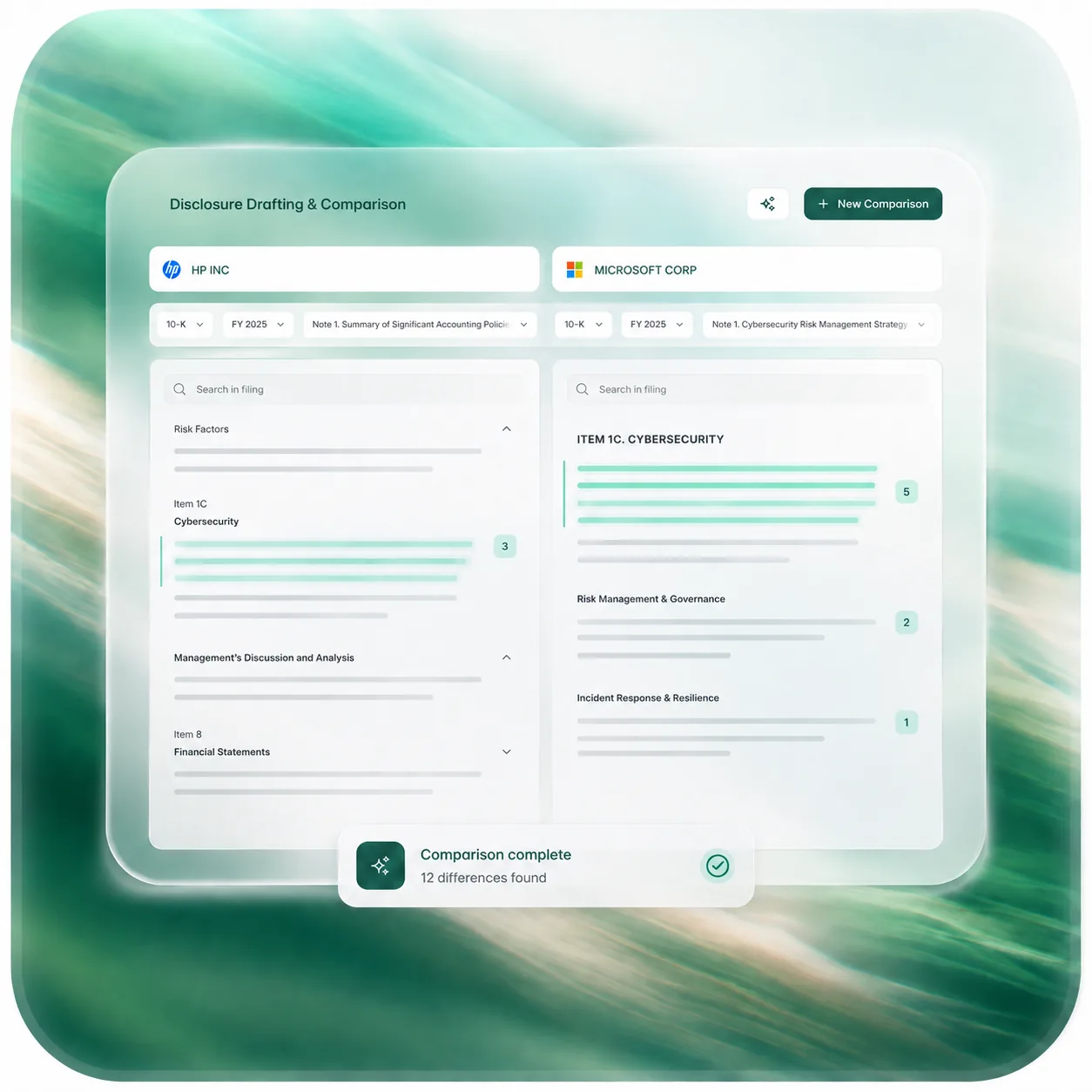
Finrep fits when the question is both what the standard says and how other registrants applied it. It answers from the Codification and IFRS at paragraph level, SEC rules, EDGAR filings and comment letters.
16. Finrep
Finrep is an AI research platform for SEC reporting and technical accounting teams. Its assistant, Ask Fina, takes a fact pattern and answers with citations, as the authoritative guideline interpretation workflow shows.
What it answers from
The Codification and IFRS at paragraph level, SEC rules, EDGAR filings and comment letters. Finrep's pages put it plainly: "Open the source behind any sentence and read the paragraph it came from."
- Cited memos. Research a fact pattern, then write the memo "with the paragraph references already in place." See the policy memo workflow.
- Peer treatment. Revenue and lease analyses pull how peers treated similar arrangements from EDGAR, with their disclosure language. See lease contract analysis.
- ASU applicability. For a new ASU, it returns a cited memo with the effective date, transition options and a disclosure checklist. See ASU applicability.
- Guidance monitoring. It filters FASB, IASB and SEC staff output to the topics you hold positions in. See guidance monitoring.
Finrep states its own limit: "Answers are a first draft for a professional to review, not a signature."
Price
Best for
SEC reporting and technical accounting teams whose question is both what the standard says and how peers disclosed it. In our four-question test, every paragraph Finrep cited existed and supported its point.
When to skip Finrep
Skip Finrep if your auditor wants research done in its own firm's library, such as DART for a Deloitte-audited team. Skip it too if most of your questions are tax. And if you only need to read one Codification paragraph, the free FASB Codification site does that.
How do you check an AI answer against the Codification?
Open every paragraph the answer cites on the free Codification site and read it in context. Five steps cover it, and the first one catches invented citations.
The steps work for any tool on this page, Finrep included. Our guide on how to compare AI tools for SEC reporting teams turns them into a worksheet for vendor calls.
Common questions
Which AI tool is best for accounting?
It depends on the job. For bookkeeping and the close, tools built into your ledger or close platform fit best. For technical accounting research, pick a tool that cites Codification paragraphs and the guides your auditor reads.
Is there a ChatGPT for technical accounting?
Several tools aim to be one: TAbot, Gaapio and Numeric's assistant cite the Codification. DARTbot, Josi and CoCounsel answer from their publishers' libraries. ChatGPT answers too, but OpenAI warns its citations can be incomplete, outdated or incorrect.
Can ChatGPT write a technical accounting memo?
It can draft one, but the conclusion is yours. Check every paragraph it cites, add the facts of your contract and record your own judgment. Our guide to drafting a technical accounting memo that survives audit and SEC review covers the structure.
How do I check AI citations against the standard?
Open each cited paragraph on the free FASB Codification site and read the subtopic around it. Then check later ASUs for amendments and one Big 4 guide for the interpretation. If a paragraph doesn't exist or doesn't say what the answer claims, drop the answer.
Is Deloitte DART free?
Partly. Deloitte's Roadmaps are free to read on DART without a login, but copying and printing need a subscription. DARTbot needs a US GAAP licence at $2,400 per concurrent user per year.
Is PwC Viewpoint free?
Yes, for US content. A free registered account opens PwC's US GAAP guides and the FASB Codification. Non-US content needs a paid licence, such as $1,125 a year for one user of the IFRS content.
Is the FASB Codification free?
Yes. The Financial Accounting Foundation made an enhanced Codification free on February 27, 2023 and ended the paid Professional View. It includes search, printing and copy-paste.
Which tools cover IFRS as well as US GAAP?
Finrep, Numeric's assistant, Trullion and CoCounsel Audit & Accounting document IFRS next to US GAAP. PwC sells IFRS content on Viewpoint, and EY gives its International GAAP PDF away free. Deloitte sells an iGAAP library on DART, and TAbot says it focuses on US GAAP.