How to Draft a Technical Accounting Memo That Survives Audit and SEC Review
A technical accounting memo is the written record that stands between your accounting position and an auditor's pushback, or an SEC comment letter. Get it right and it becomes a first-line defense. Get it wrong, or skip it entirely, and you reconstruct your analysis under adversarial conditions, which is the worst possible time to do it.
This guide covers the precise anatomy of a memo that satisfies both external auditors (under PCAOB AS 2301 and AS 2810) and SEC staff scrutiny, how to cite the authoritative literature correctly, why the alternatives analysis is the section most commonly omitted and most frequently demanded, and how AI-assisted drafting fits into a defensible workflow.
Key takeaway: A technical accounting memo is not internal housekeeping. It is a primary audit deliverable and a potential exhibit in an SEC comment letter exchange. Draft it contemporaneously, cite the literature in hierarchy order, and never omit the alternatives analysis.
What Is a Technical Accounting Memo and Who Needs One?
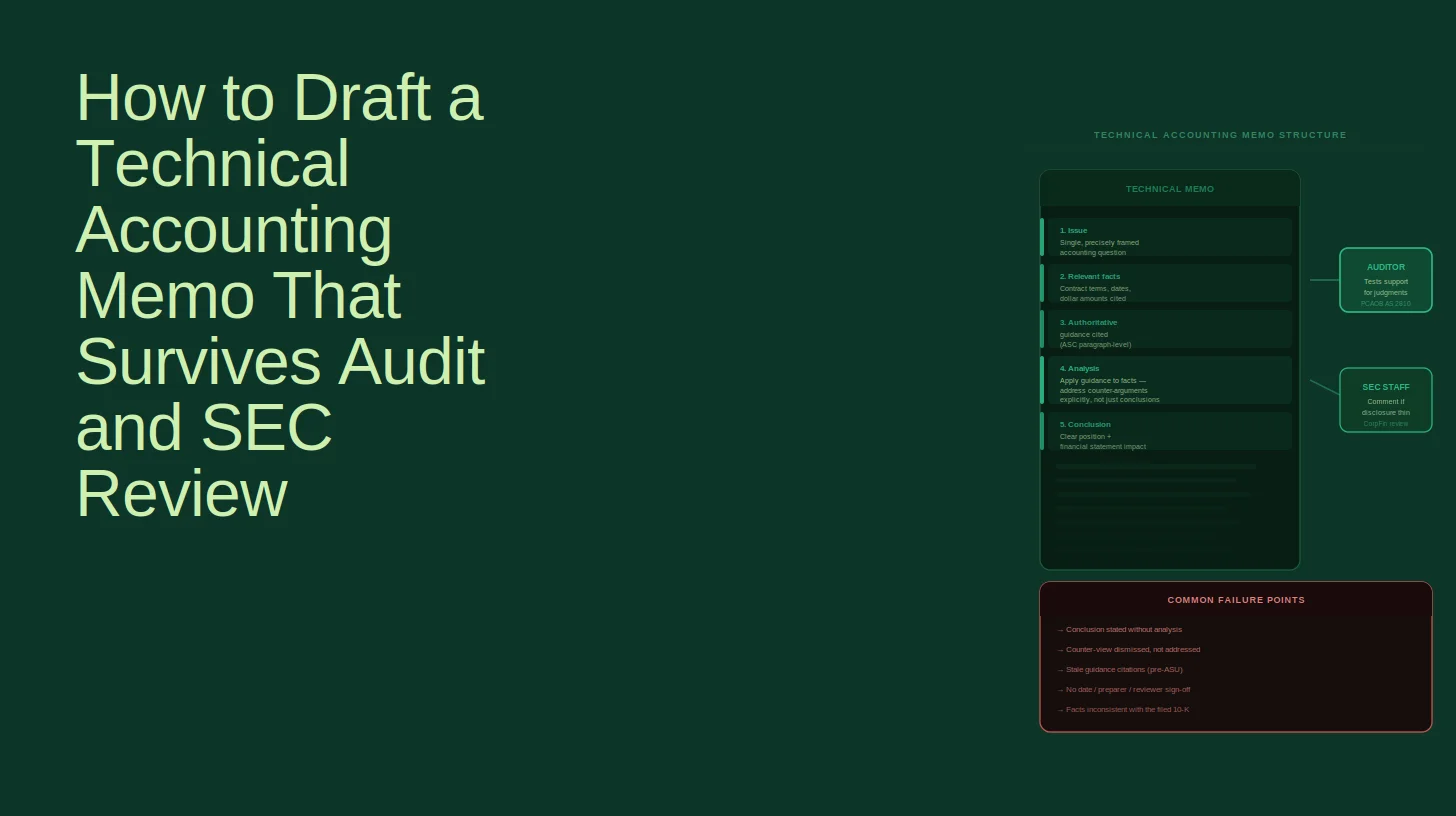
A technical accounting memo is a structured written analysis that documents how a specific accounting question was resolved, which authoritative literature governed the answer, and why alternative treatments were rejected. It differs from a general business memo in one fundamental way: it follows an analytical framework that regulators and auditors recognise and expect.
Controllers, senior accountants, accounting managers, and Big-4 staff and managers are the primary preparers. CFOs own the outcome. Any company that files with the SEC, undergoes a PCAOB-inspected audit, or applies complex standards (ASC 606, ASC 842, ASC 805, ASC 350) to material transactions should be producing these memos contemporaneously.
The memo serves three audiences simultaneously:
- The preparer's own review trail and internal sign-off chain
- External auditors who must evaluate the sufficiency of management's analysis under AS 2301 and AS 2810
- SEC staff who may request supporting documentation during a comment letter review
A thin memo forces auditors to do more work and ask management to supplement it. A missing memo forces the SEC to ask you to reconstruct your analysis in a public EDGAR filing.
The Eight Required Sections of a Technical Accounting Memo
Every defensible technical accounting memo includes these discrete sections, in this order. Omitting any one of them, especially section six, is the most reliable way to draw auditor or SEC pushback.
- Header (date of preparation, preparer name and title, reviewer/approver name and title, entity name, period covered, subject line stating the specific accounting question, document version/control number)
- Purpose/Objective (one paragraph stating exactly what the memo documents, mirroring the TPI Composites model: "The purpose of this memo is to document our consideration of...")
- Background and Facts (the specific facts and circumstances of the transaction: who, what, when, dollar amounts, contractual terms, key assumptions)
- Issue(s) Presented (the precise accounting question(s) to be resolved, numbered if there are multiple)
- Applicable Authoritative Literature (the relevant standards cited in hierarchy order, see below)
- Analysis (applying the literature to the facts, criterion by criterion, with paragraph-level ASC citations)
- Alternatives Considered and Rejected (the most commonly omitted section, and the most frequently demanded by auditors)
- Conclusion (the accounting treatment selected, with explicit reference back to the analysis)
The preparer and reviewer sign-off with dates closes the memo. Version control is not optional: auditors need to confirm they are reviewing the final approved version, not a draft, and the sign-off trail matters for SOX purposes.
Key takeaway: The "Alternatives Considered and Rejected" section is the single most frequently omitted element and the single most frequently requested by auditors. A memo that reaches a conclusion without showing what was rejected is conclusory, not analytical.
How to Cite the Authoritative Literature Correctly
The GAAP literature hierarchy is established by ASC 105-10, and every technical accounting memo must navigate it in order. Citing sources out of sequence, or citing superseded standards, is a common and serious error.
For US GAAP preparers, work through the hierarchy in this order:
PrioritySourceNotes1FASB Accounting Standards CodificationThe single authoritative source for nongovernmental US GAAP2SEC rules and regulations (Reg S-X, S-K)For SEC registrants only3SEC Staff guidance (SABs, Staff Statements, C&DIs)Authoritative for registrants; SAB 99 on materiality is evergreen4FASB Concepts StatementsFor analogical reasoning when the Codification has a gap5AICPA guidance (Practice Aids, TQAs)Non-authoritative but widely accepted
The critical discipline is paragraph-level citation. Citing "ASC 606" is not enough. Citing "ASC 606-10-25-1, which requires an entity to identify the contract with a customer" is what distinguishes a defensible memo from a superficial one. The FASB TRG Memo No. 8 on Capitalized Interest is the clearest public model of this discipline: it cites "326-20-30-5 states..." and works through each paragraph against the specific question.
For SEC registrants, SAB 99 on materiality must be addressed in any memo touching a quantitative threshold. The SEC staff has been explicit since August 1999: "Exclusive reliance on [a 5% numerical] threshold has no basis in the accounting literature or the law." A memo that documents only a quantitative materiality conclusion without qualitative analysis is vulnerable to SEC challenge.
For IFRS preparers, the equivalent hierarchy sits in IAS 8: (1) the specific IFRS standard or interpretation, (2) the IASB Conceptual Framework, (3) most recent pronouncements of other standard-setting bodies as a non-authoritative reference. An IFRS memo must document this hierarchy explicitly when addressing a gap in the standards.
How Detailed Does the Fact Pattern Need to Be?
The fact pattern section must be specific enough that a reader with no prior knowledge of the transaction can understand exactly what happened and why the accounting question arose. Generic descriptions fail this test.
For a revenue recognition memo, this means: the names of the deliverables, the contract term, the payment structure, the standalone selling prices, and the basis for any variable consideration estimate. The TPI Composites ASC 606 memo addressed six distinct performance obligation questions simultaneously, covering blades, molds and tooling, engineering services, blade storage, production transition, and warranty, because the contract required it. A memo that collapses those into "we sell products and services" is not a memo; it is a placeholder.
For a lease classification memo under ASC 842, the facts must include: the lease term, the economic life of the asset, the incremental borrowing rate used, the present value of lease payments, the fair value of the asset, whether a purchase option exists, and whether any variable lease payments affect classification. Each of the five classification criteria must be addressed against those specific inputs.
The depth of the fact pattern should also be calibrated to materiality and complexity:
- Routine, low-materiality item: a one-page memo with a brief literature citation and conclusion is appropriate
- Significant or complex transaction (business combination, VIE consolidation, complex revenue arrangement): a multi-section memo with full literature analysis, alternative treatments, and sensitivity analysis of key assumptions is required
Applying the same template regardless of complexity is a fundamental error. A $50,000 operating lease and a $500 million acquisition are not the same memo.
The Alternatives Analysis: The Section Auditors Always Ask For
The alternatives analysis documents every accounting treatment the preparer considered and explains, with specific reference to the authoritative literature, why each alternative was rejected. This is not a formality. It is the analytical core of the memo.
Auditors under AS 2301 must evaluate whether management's accounting analysis is sufficient for significant judgments. A memo that reaches a conclusion without showing what was considered and rejected gives the auditor no basis to evaluate management's reasoning. The auditor must then do that work themselves, and will ask management to supplement the memo.
For a close-call judgment, where reasonable people could disagree, the alternatives analysis carries even more weight. Document:
- The alternative treatment(s) considered
- The specific ASC paragraph(s) or IFRS provision(s) that would support each alternative
- The facts and circumstances that, on balance, support the selected treatment over the alternatives
- Whether outside advisors were consulted and their conclusion
Do not overstate certainty in the conclusion. A memo that says "we determined with certainty that X is the correct treatment" when the standard requires judgment is less credible, not more, than one that says "based on the weight of evidence in paragraphs X, Y, and Z, we concluded that treatment A is more supportable than treatment B because..."
For goodwill impairment memos specifically, the analysis must address: identification of the reporting unit, the qualitative assessment (Step 0) under ASC 350-20, the quantitative test if triggered, the key assumptions in the discounted cash flow model (discount rate, terminal growth rate, projected cash flows), sensitivity analysis, and the conclusion on whether impairment exists. Goodwill impairment is one of the highest-scrutiny areas in SEC comment letters.
When to Prepare the Memo: Timing Is a Credibility Question
Prepare the memo before or simultaneously with the journal entry, not after the audit begins. This is not a best practice suggestion; it is a credibility requirement.
A memo drafted after an auditor or regulator raises a question is inherently less credible than one prepared at the time of the decision. The SEC's Division of Corporation Finance comment letter process frequently surfaces inadequate technical accounting documentation. When the SEC issues a comment asking a registrant to "tell us how you considered" a particular standard, the registrant's response is effectively a retroactive technical memo, prepared under adversarial conditions, in a public EDGAR filing.
Registrants who have contemporaneous memos can respond quickly and confidently. Those without them must reconstruct their analysis from memory, email threads, and meeting notes, and then explain why the documentation did not exist at the time of the decision.
Contemporaneous preparation is most critical for:
- Significant estimates and assumptions
- Variable consideration under ASC 606
- Lease classification under ASC 842
- Business combination accounting under ASC 805
- Goodwill impairment assessments under ASC 350
The memo also connects directly to downstream disclosure obligations. A well-drafted memo should inform the footnote disclosure, the MD&A discussion, and any SAB 74 (Topic 11-M) disclosure of pending accounting changes, creating a traceable chain from internal analysis to public filing. Finrep's guide on disclosure evidence and audit traceability covers how to build that chain systematically.
What Auditors Are Actually Looking For
Under PCAOB AS 2301 and AS 2810, auditors must evaluate the sufficiency of management's accounting analysis for significant judgments. If management's memo is thin, the auditor must do more work. That additional work costs time and audit fees, and it often results in a request to supplement the memo before the audit can close.
As Elevance Health's management confirmed in their PCAOB NOCLAR comment letter, auditors already "obtain documentation and test our accuracy and completeness" of management's positions as a standard audit procedure. The memo is the primary document they test against.
A checklist of what auditors look for:
- [ ] Specific facts and circumstances documented (not generic descriptions)
- [ ] Authoritative literature cited at the paragraph level, in hierarchy order
- [ ] Each element of the applicable standard addressed against the specific facts
- [ ] Alternatives considered and rejected, with specific literature support for the rejection
- [ ] Materiality analysis that addresses both quantitative and qualitative factors per SAB 99
- [ ] Conclusion that flows logically from the analysis (not a conclusion that precedes it)
- [ ] Preparer and reviewer sign-off with dates
- [ ] Version control number confirming this is the final approved memo
A memo that passes this checklist reduces audit friction, reduces the risk of a waived adjustment, and reduces the likelihood of an SEC comment letter on the same topic. Finrep's guide on bridging internal and external audit for disclosures covers how to structure the handoff.
A Worked Example: ASC 606 Revenue Recognition
The TPI Composites DRSLTR filing is the clearest public example of a technical accounting memo that has actually faced SEC scrutiny. Its opening line sets the standard for Purpose sections:
"The purpose of this memo is to document our consideration of the earnings process and revenue recognition accounting and financial reporting processes for TPI Composites, Inc. upon adoption of Accounting Standard Codification Topic 606 (ASC 606), Revenue from Contracts with Customers."
What follows is a systematic walk through each performance obligation in the company's long-term supply agreements, applying the five-step ASC 606 model criterion by criterion. The memo addresses six distinct deliverable types, each with its own analysis. It cites both ASC 606 and the then-current SAB 104 in parallel, documenting both the old and new treatment and explaining the delta, which is the correct approach when transitioning between standards.
For a lease classification memo under ASC 842, the structure would look like this:
Issue: Is Lease X a finance lease or an operating lease under ASC 842-20-25-2?
Facts: 7-year lease term; economic life of asset 10 years (70% of economic life); incremental borrowing rate 5.2%; present value of lease payments $4.1M; fair value of asset $5.8M (71% of fair value); no transfer of ownership; no purchase option; asset is not specialized.
Analysis:
- Criterion 1 (transfer of ownership): Not met. No transfer clause in the agreement.
- Criterion 2 (purchase option): Not met. No purchase option exists.
- Criterion 3 (lease term vs. economic life): Lease term is 70% of economic life. ASC 842-20-25-2(c) uses "major part" as the threshold; consistent with the 75% bright line used in practice, 70% does not meet this criterion.
- Criterion 4 (PV of payments vs. fair value): PV is 71% of fair value. The "substantially all" threshold is generally interpreted as 90%; 71% does not meet this criterion.
- Criterion 5 (specialized nature): Asset is not specialized.
Alternatives: Finance lease classification was considered. Rejected because none of the five criteria in ASC 842-20-25-2 are met.
Conclusion: Operating lease. Recognized on the balance sheet as a right-of-use asset and operating lease liability per ASC 842-20-30-1.
This is the level of specificity that passes audit review. "We determined it is an operating lease" does not.
AI-Assisted Drafting: Where It Helps and Where It Fails
AI tools can materially accelerate memo drafting, but hallucinated ASC citations are a specific and serious risk that demands mandatory human review.
Glenn Hopper, Head of AI Research Development at Eventus Advisory Group, built a retrieval-augmented generation (RAG) bot using OpenAI's Assistants API, fine-tuned on the firm's existing memo library. The result: memo drafting time dropped from approximately 4 hours to approximately 30 minutes, an 87% reduction, according to the Journal of Accountancy.
The workflow: chunk existing memos, vectorize them, store in a vector database, use the bot to generate a first draft, then a human reviews and corrects. Building the bot required approximately 60 hours of senior practitioner time and costs several dollars per run beyond the base ChatGPT license.
Hopper is direct about the hallucination risk: "I think we've minimized [hallucination] a lot by giving it very specific examples to refer to, very specific instructions. That process of fine-tuning involves exposing the customized bot to hundreds of examples." Minimized is not eliminated.
A memo with a hallucinated ASC paragraph number that reaches an auditor or the SEC is worse than no memo at all. It signals that management did not actually review the authoritative literature.
The non-negotiable human review steps for any AI-drafted memo:
- Verify every ASC paragraph citation against the actual Codification text at asc.fasb.org
- Confirm that every SAB or SEC staff guidance reference is current and not superseded
- Confirm that the alternatives analysis reflects the actual alternatives considered, not AI-generated plausible alternatives
- Confirm that the fact pattern reflects the actual transaction, not a generic description the AI substituted
Finrep's broader guide on AI in the accounting close and SEC workflow covers where AI adds value and where human judgment is non-negotiable across the close cycle.
FAQ
What are the required sections of a technical accounting memo?Eight sections: header (with version control), purpose/objective, background and facts, issues presented, applicable authoritative literature, analysis, alternatives considered and rejected, and conclusion with preparer/reviewer sign-off. The alternatives section is the most commonly omitted and the most frequently requested by auditors.
How do I cite the GAAP literature hierarchy correctly in a memo?Cite in this order under ASC 105-10: (1) FASB ASC Codification at the paragraph level, (2) SEC rules and regulations for registrants, (3) SEC Staff guidance including SABs, (4) FASB Concepts Statements for gaps, (5) AICPA non-authoritative guidance. Always cite the specific ASC paragraph (e.g., "ASC 606-10-25-1"), not just the topic number.
When should a technical accounting memo be prepared?Before or simultaneously with the journal entry. A memo drafted after an auditor or the SEC raises a question is inherently less credible and forces reconstruction of the analysis under adversarial conditions.
Do I need to address alternative accounting treatments I rejected?Yes. This is the section auditors request most frequently and preparers omit most often. For each alternative, cite the specific literature that would support it and explain why the facts and circumstances support the selected treatment instead.
Can AI tools draft a technical accounting memo?AI can produce a useful first draft and cut drafting time significantly, from roughly 4 hours to 30 minutes in documented practitioner cases. The risk is hallucinated ASC citations. Every AI-generated memo requires a human to verify each paragraph citation against the actual Codification before the memo reaches an auditor or the SEC.
How does an SEC comment letter relate to a technical accounting memo?When the SEC asks a registrant to "tell us how you considered" a standard, the response is effectively a retroactive technical memo filed publicly on EDGAR. Registrants with contemporaneous memos respond quickly. Those without them reconstruct their analysis under adversarial conditions. The SEC comment letter process is a direct, practical cost of inadequate memo discipline.