For the first time in over fifty years, the SEC is proposing to change how often public companies must file financial reports. On May 5, 2026, the Securities and Exchange Commission released proposed rule amendments that would allow reporting companies to file one semiannual report on new Form 10-S instead of three quarterly reports on Form 10-Q.
The comment period closes July 6, 2026. Final rules, if adopted, could be in place by the time calendar-year companies are filing their fiscal 2026 Form 10-Ks meaning the election box could appear on a Form 10-K cover page sooner than most teams expect.
This post answers the questions your team is already asking, in the sequence you are probably asking them.
What Is SEC Form 10-S?
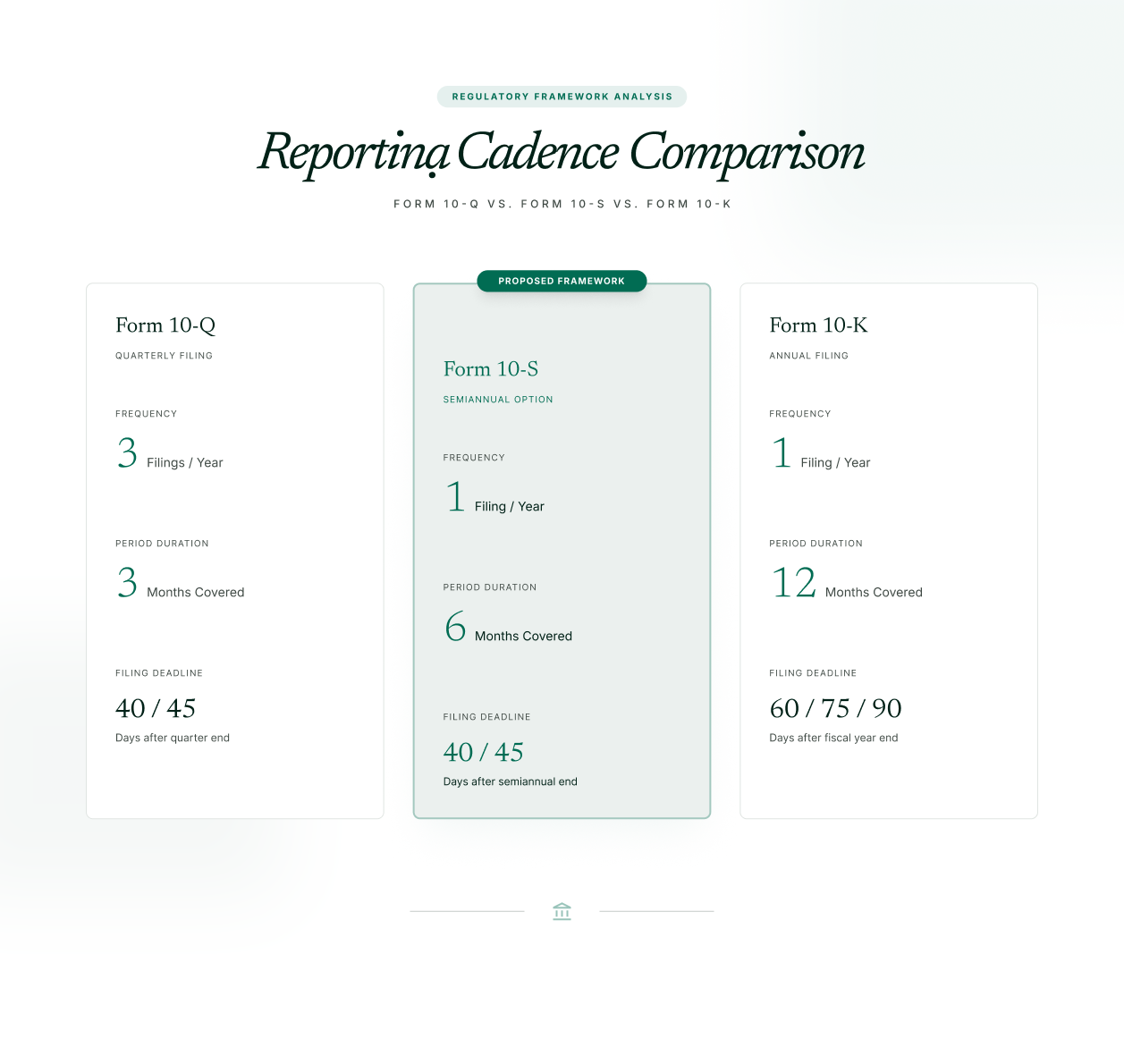
Form 10-S is a proposed new SEC filing form that would allow domestic Exchange Act reporting companies to file one semiannual report per fiscal year instead of three quarterly reports on Form 10-Q. The form covers the first six-month period of the fiscal year. The second six-month period is captured in the annual Form 10-K, as it is today.
The proposal was released on Release Nos. 33-11414; 34-105368; File No. S7-2026-15 on May 5, 2026, and published in the Federal Register on May 7, 2026, starting the 60-day public comment period.
Form 10-S would require the same types of disclosure as Form 10-Q, including Management's Discussion and Analysis (MD&A), legal proceedings updates, material risk factor updates, unregistered sales of securities, and interim financial statements. The form would also require the same Inline XBRL tagging, officer certification requirements under Sarbanes-Oxley (SOX) Sections 302 and 906, and exhibits as Form 10-Q.
The key difference is the time period covered: six months rather than a quarter. This is not a lighter-touch filing. It is the same disclosure depth, covering twice the time.
Why Did the SEC Propose Form 10-S Now?
The SEC has been fielding requests to revisit quarterly reporting since at least December 2018, when it issued a formal request for public comment on the nature, timing, and frequency of periodic reporting and earnings releases. Multiple administrations and market participants have cited concerns about short-termism, the administrative burden of quarterly reporting, and whether the quarterly cadence serves the disclosure needs of all company types equally well.
The SEC press release identifies four stated goals for the proposal: reducing compliance costs and regulatory burden, encouraging more companies to go public and remain public, promoting long-term business strategies over short-term quarterly pressures, and providing flexibility specifically to emerging growth companies (EGCs) and smaller reporting companies (SRCs).
The proposal is part of a broader SEC initiative under Chairman Atkins to modernise existing rules and reduce the fixed cost of being a public company. It is the first of several reporting framework proposals expected in 2026.
The SEC is explicit that it is not proposing to eliminate quarterly reporting. Quarterly reporting remains the default. Form 10-S is an opt-in alternative, not a mandate.
What Does Form 10-S Actually Require?
Form 10-S would require the same disclosure framework as Form 10-Q applied to a six-month period. Here is the specific content requirement for each element:
Financial statements. Balance sheets as of the end of the first semiannual period and as of the prior fiscal year-end. Statements of comprehensive income and cash flows for the semiannual year-to-date period and the comparable prior-year period. The financial statements would be subject to auditor review under the same standard that applies to Form 10-Q financial statements under Rule 10-01(d) of Regulation S-X. The proposal expressly preserves the auditor review requirement interim financial statements in Form 10-S would not be unreviewed.
MD&A.The same MD&A disclosure standards as Form 10-Q, covering results of operations for the semiannual period, liquidity and capital resources, and known trends and uncertainties that could affect future results. The period covered is six months, but the analytical depth required is unchanged.
Risk factors. Material changes from the risk factors disclosed in the most recent Form 10-K. The same standard as Form 10-Q.
Legal proceedings. Material developments in legal proceedings since the most recent Form 10-K or Form 10-S. Same standard as Form 10-Q.
Officer certifications. SOX 302 and 906 certifications by the CEO and CFO. Same as Form 10-Q.
Exhibits and XBRL. Same exhibit requirements and Inline XBRL tagging as Form 10-Q.
Filing deadline. 40 days after the end of the first semiannual period for large accelerated filers and accelerated filers. 45 days for all other registrants. These deadlines are identical to current Form 10-Q filing deadlines. For a calendar-year company, Form 10-S would be due by August 9 (large accelerated and accelerated filers) or August 14 (all other registrants) 40 or 45 days after June 30.
How Do You Elect Semiannual Reporting Under the Proposal?
The election mechanism is a checkbox on the cover page of the annual Form 10-K. A company that wants to report semiannually in a given fiscal year checks the semiannual reporting box on its Form 10-K. A company that wants to report quarterly leaves the box unchecked.
The election is made annually and is locked for the fiscal year. A company that checks the box on its Form 10-K cannot switch back to quarterly reporting in the middle of that fiscal year. The next opportunity to change is the following year's Form 10-K.
For new registrants, similar checkboxes would be added to the cover pages of registration statements on Forms S-1, S-3, S-4, S-11, and Form 10.
The election would work as follows in practice for a calendar-year company. A company files its Form 10-K for fiscal year 2026 in early 2027. On that Form 10-K cover page, it checks the semiannual reporting box. For fiscal year 2027, it then files one Form 10-S in August 2027 covering January 1 through June 30, 2027, and one Form 10-K in early 2028 covering the full year. The second half of fiscal year 2027 (July through December) is captured in the Form 10-K, as it is for all filers today.
One operational consequence for registration statements: the election determines whether quarterly or semiannual financial statements must be included in a registration statement. If a company elects semiannual reporting and wants to access the capital markets using financial statements from a period after the Form 10-S has been filed or is required to be filed, it can include Form 10-S financial statements. If it previously filed quarterly, it would use the most recent Form 10-Q financial statements.
The proposal also includes conforming amendments to Regulation S-X's "age of financial statements" rules, which govern how current financial statements must be in registration statements and other SEC filings. These amendments are designed to align the staleness thresholds with the semiannual filing cadence.
What Happens to Quarterly Earnings Releases and Form 8-K If You Switch to Form 10-S?
Switching to Form 10-S does not eliminate Form 8-K obligations. All existing Form 8-K current reporting requirements remain unchanged under the proposal. Companies that elect semiannual reporting continue to be required to disclose material events on Form 8-K on the same basis as quarterly filers.
Quarterly earnings releases are not required by SEC rules for any company they are a market practice, not a regulatory obligation. Chairman Atkins expressly stated in connection with the proposal that it would not affect the frequency of earnings releases or earnings calls, which remain within each company's discretion.
A company that elects Form 10-S could take one of three approaches to quarterly communications:
Option 1 - Full semiannual. Eliminate quarterly earnings releases, quarterly earnings calls, and quarterly guidance. File Form 10-S once per year. Retain Form 8-K current event reporting. This is the most operationally simplified approach.
Option 2 - Hybrid. Elect semiannual Form 10-S reporting while continuing to issue voluntary quarterly earnings releases furnished on Form 8-K under Item 2.02. Investors receive quarterly financial updates, but as earnings releases rather than formal SEC filings. The company retains cost savings on the formal SEC filing preparation and review process.
Option 3 - Unchanged communications, formal filing change only. Continue issuing quarterly earnings releases, holding quarterly earnings calls, and providing quarterly guidance, but file only one Form 10-S rather than three Form 10-Qs. Cost savings on filing preparation, but market-facing communications cadence is unchanged.
For companies with active sell-side analyst coverage, Norton Rose Fulbright's analysis notes that whether a semiannual filer continues to make quarterly earnings releases will depend on the company's particular characteristics, facts, and circumstances, including investor and analyst expectations, industry practices, and contractual obligations.
The critical distinction: If a company elects Form 10-S and stops issuing quarterly earnings releases, there is no Form 8-K Item 2.02 disclosure triggered for those quarters because there is no quarterly results announcement to furnish. The absence of Item 2.02 filings for Q1 and Q3 is a deliberate consequence of the semiannual reporting election, not an oversight.
Who Is Form 10-S Designed For and Who Should Probably Stay on Form 10-Q?
The proposal is framed as broadly available to all domestic Exchange Act reporting companies currently required to file Form 10-Q. In practice, the semiannual option is most likely to be relevant to a narrower set of companies.
Companies for whom Form 10-S is most likely to be a genuine option:
Smaller reporting companies (SRCs) and emerging growth companies (EGCs) for which quarterly reporting imposes relatively higher fixed costs as a percentage of total compliance resources. Development-stage or clinical-stage companies whose investors focus on operational milestones (regulatory approvals, clinical trial results) rather than quarter-to-quarter financial results. Companies with highly seasonal businesses where Q1 and Q3 results are not meaningful predictors of annual performance and are not closely watched by analysts. Companies with a small or concentrated investor base that has explicitly indicated indifference to quarterly frequency. Companies with stable, predictable businesses where the incremental information content of Q1 and Q3 Form 10-Qs is low.
Companies for whom staying on Form 10-Q is likely the correct decision:
Large accelerated filers with active sell-side analyst coverage and institutional investor bases that model quarterly estimates and use earnings surprises to make trading decisions. Companies in capital markets access mode active shelf registrant companies that regularly do follow-on offerings and need current financial statements in registration statements. Companies with material quarterly variability in results, high volatility businesses, or businesses where adverse developments can emerge and resolve within a single quarter. Companies with debt covenants requiring quarterly financial statement delivery to lenders, which are common in leveraged credit agreements and investment-grade indentures. Companies that would continue all quarterly disclosure activities voluntarily regardless of the SEC election, for whom the formal filing change saves little.
As Sidley Austin observes, a company that continues to issue quarterly earnings releases, hold quarterly earnings calls, and provide quarterly guidance after electing Form 10-S may find that the cost savings of filing one Form 10-S instead of three Form 10-Qs are smaller than expected, because the substantive preparation work driving those costs the disclosure committee process, the MD&A analysis, the controls review may continue on the same cadence regardless of the formal filing election.
What Are the Risks and Practical Concerns Your Team Should Assess?
The Form 10-S proposal introduces several operational and strategic considerations that deserve analysis before any board discussion.
Analyst coverage. Institutional research models are calibrated to quarterly earnings cycles. Companies that have active coverage and move to semiannual formal reporting face the risk that analysts reduce coverage intensity or drop coverage entirely if the quarterly information they need for model updates is no longer formally filed. This risk is most acute for smaller companies with one to three analysts for whom each coverage relationship is significant rather than for large-cap companies with ten or more analysts who will follow the company regardless.
Insider trading and trading window implications. Companies with results that vary materially quarter to quarter would likely face longer blackout periods under a semiannual regime if they also reduce the frequency of voluntary earnings releases. Material non-public information about Q1 or Q3 results would remain non-public for longer periods, requiring broader blackout windows for insiders. Morrison Foerster's analysis specifically flags the need to revisit insider trading policies if a company elects semiannual reporting.
Contractual obligations. Debt agreements, particularly leveraged credit facilities, commonly require quarterly financial statement delivery to lenders. These requirements exist independently of SEC reporting obligations. A company that elects Form 10-S but remains bound by contractual quarterly financial reporting obligations will still need to prepare quarterly financial statements for lenders eliminating much of the cost savings the election was intended to generate.
Litigation risk. A gap of six months between formal periodic reports is a longer window during which adverse material information could develop without being formally disclosed in a periodic filing. Sidley Austin's analysis notes that any delayed disclosure of adverse material information could expand the class of shareholder plaintiffs who could sue in the event of a significant stock price reaction to a disclosure. Existing Form 8-K requirements for material event disclosure remain unchanged, but the window for developments that are material but do not individually trigger a Form 8-K obligation is longer under semiannual reporting.
Capital markets access. Companies that regularly access the equity or debt capital markets need current financial statements in their registration statements and prospectuses. The Regulation S-X age of financial statements rules determine how current those statements must be. The proposal amends these rules to accommodate semiannual filers, but companies that expect to access capital markets more than once a year should assess whether the semiannual timing creates constraints on their offering windows.
Form 10-Q as a disclosure vehicle. The Form 10-Q is the principal formal disclosure vehicle for material developments that are not required to be reported on Form 8-K and are not typically included in earnings releases. Updates to material litigation, changes in risk factors, evolving liquidity concerns, and segment reporting developments are routinely disclosed in Form 10-Q but not in earnings releases. Companies that elect Form 10-S and reduce voluntary quarterly disclosures will have less formal disclosure of these developments for six-month periods. This is not necessarily a problem, but it is a governance question that the board and disclosure committee should address explicitly.
What Questions Should Your Board and Disclosure Committee Be Asking Right Now?
The comment period closes July 6, 2026. Final rules could be effective by the time calendar-year companies file their fiscal 2026 Form 10-Ks in early 2027. The board and disclosure committee questions that need answers before then are specific and time-bound.
On investor relations:
- What is the quarterly earnings expectation of our top 20 institutional shareholders? Have we surveyed them?
- Would electing Form 10-S without continuing voluntary quarterly earnings releases materially affect our analyst coverage or institutional investor relationships?
- How does our peer group approach quarterly versus voluntary disclosure? Would we be an outlier?
On capital markets:
- Do we expect to access the equity or debt capital markets in the next 12 to 24 months? What are the financial statement currency requirements for those transactions?
- If we switch to Form 10-S, what is the latest financial statement we can include in a registration statement filed in, for example, October of a given year?
On contractual obligations:
- Do any of our credit agreements, indentures, or material contracts require quarterly financial statement delivery? If so, switching to Form 10-S eliminates the SEC filing cost but not the preparation cost.
- Do any executive compensation arrangements reference the timing of Form 10-Q filings?
On insider trading and governance:
- If we elect Form 10-S and reduce voluntary quarterly communications, what are the implications for our trading windows and blackout periods?
- Does our D&O insurance carrier have a view on the litigation risk profile change associated with semiannual reporting?
On cost-benefit:
- What is the all-in cost of our current quarterly reporting process, including external auditor review fees, counsel time, disclosure committee time, and management time?
- What portion of that cost is truly eliminated by filing Form 10-S, versus what portion we would incur anyway because of voluntary communications, lender reporting, or other obligations?
Jackson Walker's practical analysis recommends that companies begin assessing cost-benefit tradeoffs now, review existing contractual obligations, gauge investor and analyst expectations, and consider whether a hybrid approach electing semiannual mandatory reporting while continuing voluntary quarterly disclosures balances cost savings with investor expectations.
How Does Form 10-S Interact With the Age of Financial Statements Rules?
The age of financial statements rules under Regulation S-X Rule 3-12 govern how current financial statements must be in registration statements, proxy statements, and other SEC filings. These rules have historically been calibrated to the quarterly reporting cadence they specify that financial statements cannot be more than 135 days stale for large accelerated filers (134 days in some contexts) at the time a registration statement is filed or becomes effective.
The proposal includes amendments to these rules to accommodate semiannual filers. The proposed amendments would consolidate the Rule 3-12 framework and align the financial statement age thresholds with either quarterly or semiannual filing deadlines depending on a company's reporting election.
For semiannual filers, the practical effect is that the most recently filed financial statements in a registration statement would be the Form 10-S semiannual statements rather than a Form 10-Q quarterly filing. This could make financial statements in a registration statement filed in the fall of a given year less current than they would be for a quarterly filer, because the most recent semiannual period (ending June 30) ended further in the past relative to the fall filing date than the most recent quarter (ending September 30) would have.
This staleness consideration is one of the most practically significant factors for companies that access capital markets with regular frequency. A company that files a shelf registration statement in November and is a semiannual filer will include June 30 financial statements financial statements that are approximately four to five months old. A quarterly filer in the same situation would include September 30 financial statements financial statements that are approximately one to two months old. The age difference is significant for companies making disclosure about material developments between the period end and the filing date.
Frequently Asked Questions
What is SEC Form 10-S?
Form 10-S is a proposed new SEC filing form that would allow domestic public companies to file one semiannual report per fiscal year instead of three quarterly reports on Form 10-Q. The SEC proposed the form on May 5, 2026 under Release Nos. 33-11414 and 34-105368. If adopted, it would be the first structural change to the U.S. quarterly reporting framework in over fifty years. Form 10-S requires the same disclosure content as Form 10-Q but covers a six-month period rather than a quarter. The filing deadline is the same: 40 days for large accelerated and accelerated filers, 45 days for all other registrants, after the end of the first semiannual period.
Is Form 10-S mandatory or optional?
Optional. The proposal would not require any company to switch to semiannual reporting. Quarterly reporting on Form 10-Q remains the default and is retained for all companies that do not affirmatively elect semiannual reporting. The election is made by checking a new box on the Form 10-K cover page. Companies that leave the box unchecked continue to file Form 10-Q as they do today. The election is annual and cannot be changed mid-fiscal year.
What is the Form 10-S filing deadline?
The same deadline as Form 10-Q: 40 days after the end of the first semiannual period for large accelerated filers and accelerated filers, and 45 days for all other registrants. For a calendar-year company, the semiannual period ends June 30. The Form 10-S deadline would be August 9 for large accelerated and accelerated filers, and August 14 for all other registrants.
Do Form 8-K obligations change if a company elects Form 10-S?
No. All existing Form 8-K current event reporting requirements remain unchanged under the proposal. Companies that elect semiannual reporting continue to be required to file Form 8-K for material events on the same basis as quarterly filers. The semiannual election affects only the periodic report filing frequency, not the event-driven reporting obligations.
Who should consider switching from Form 10-Q to Form 10-S?
The semiannual option is most likely to be a genuine improvement for smaller reporting companies, emerging growth companies, development-stage companies, and companies with highly seasonal businesses or a concentrated investor base that is focused on operational milestones rather than quarter-to-quarter financial results. For large accelerated filers with active analyst coverage, regular capital markets access, institutional investor bases that model quarterly earnings, or debt covenants requiring quarterly financials, the practical case for switching is significantly weaker. Companies should quantify the actual cost savings before electing and confirm those savings are not offset by continuing voluntary quarterly communications or contractual quarterly reporting obligations.
When does the Form 10-S comment period close?
July 6, 2026. The proposal was published in the Federal Register on May 7, 2026, starting the 60-day public comment period. Comments can be submitted at sec.gov. Final rules, if adopted, could be effective by early 2027, potentially in time for the fiscal 2026 Form 10-K filing cycle.
Key Takeaways
- Form 10-S is a proposed new SEC form that would replace three quarterly Form 10-Q filings with one semiannual report per fiscal year. It requires the same disclosure content as Form 10-Q applied to a six-month period. It is optional, not mandatory. The comment period closes July 6, 2026.
- The election is made annually via a checkbox on the Form 10-K cover page and cannot be changed mid-fiscal year. Once a company checks the box for a given year, it files one Form 10-S in August and one Form 10-K in early the following year.
- Form 8-K obligations are unchanged. Companies that elect Form 10-S continue to file current event reports on the same basis as quarterly filers.
- The practical case for switching is strongest for smaller reporting companies, development-stage companies, and companies whose investor base does not rely on quarterly financial cadence. It is weakest for large accelerated filers with active analyst coverage, frequent capital markets access, or debt covenants requiring quarterly financials.
- Companies that would continue all quarterly disclosure activities voluntarily after electing Form 10-S may find the actual cost savings smaller than expected, because the preparation work driving those costs continues regardless of the formal filing election.
- The age of financial statements rules are being amended to accommodate semiannual filers, but companies with regular capital markets access should assess the staleness implications of June 30 financial statements in registration statements filed in the fall.