
Significant Deficiency vs Material Weakness: 2026 Comparison Guide
If you've identified a control gap in your ICFR evaluation, the classification decision you make next carries real consequences: public disclosure, an adverse auditor opinion, stock price impact, and SEC scrutiny. This guide gives finance and compliance teams the precise framework to classify correctly, communicate appropriately, and remediate with the right urgency.
Key takeaway: A significant deficiency (SD) stays private; a material weakness (MW) goes public. That single asymmetry drives every downstream decision about disclosure, audit opinions, and remediation timelines.
The Three-Tier Severity Spectrum
Internal control deficiencies exist on a defined spectrum under PCAOB AS 1305 and AS 2201. Understanding where a finding sits on that spectrum determines what you must do next.
| Tier | Definition | Disclosure | Auditor Opinion Impact |
|---|---|---|---|
| Control deficiency | Design or operating gap that prevents timely prevention or detection of misstatements | None required | None |
| Significant deficiency | Less severe than a MW, yet important enough to merit attention by those responsible for oversight of financial reporting | Written communication to management and audit committee only | None on ICFR opinion |
| Material weakness | Reasonable possibility that a material misstatement of annual or interim financial statements will not be prevented or detected on a timely basis | Public disclosure in 10-K Item 9A; adverse 404(b) auditor opinion for accelerated filers | Adverse ICFR opinion |
The definitions come from PCAOB AS 1305, which governs how auditors communicate control deficiencies, and AS 2201 Appendix A, which governs the integrated ICFR audit. The SEC adopted identical language in Release No. 33-8829, effective September 10, 2007, adding the SD definition to Rule 12b-2 under the Exchange Act and Rule 1-02 of Regulation S-X.
Significant Deficiency vs Material Weakness: The Exact Legal Definitions
The official definitions are precise, and the differences between them are intentional.
PCAOB AS 1305, paragraph .02 defines a significant deficiency as:
"A deficiency, or a combination of deficiencies, in internal control over financial reporting, that is less severe than a material weakness yet important enough to merit attention by those responsible for oversight of the company's financial reporting."
PCAOB AS 1305, paragraph .03 defines a material weakness as:
"A deficiency, or a combination of deficiencies, in internal control over financial reporting, such that there is a reasonable possibility that a material misstatement of the company's annual or interim financial statements will not be prevented or detected on a timely basis."
Notice what the SD definition does NOT contain: a probability threshold. It is deliberately qualitative. The MW definition, by contrast, hinges on a specific probability standard: "reasonable possibility."
What "Reasonable Possibility" Actually Means
Most practitioners read "reasonable possibility" as a vague phrase. It is not. AS 1305 paragraph .03 includes a precise note:
"There is a reasonable possibility of an event when the likelihood of the event is either 'reasonably possible' or 'probable,' as those terms are used in paragraph 3 of Financial Accounting Standards Board Statement No. 5, Accounting for Contingencies."
Under FASB ASC 450 (formerly FAS 5), the probability spectrum runs: remote, reasonably possible, probable. "Reasonable possibility" in the MW definition covers both "reasonably possible" (more than remote but less than likely) and "probable" (likely to occur). Only a "remote" likelihood of material misstatement keeps a deficiency below MW level.
This is a higher bar than it sounds. If your auditor concludes there is even a "reasonably possible" chance that a material misstatement slips through, the deficiency is a material weakness.
The Pre-2007 Definitions: A Critical Shift Most Articles Miss
Before AS No. 5 replaced AS No. 2 in 2007, both definitions used a different probability standard. The pre-2007 PCAOB AU Section 325 defined a material weakness as requiring "more than a remote likelihood" of material misstatement, and a significant deficiency as requiring "more than a remote likelihood" of a misstatement that is "more than inconsequential."
The 2007 revision did two things:
- Raised the MW threshold from "more than remote likelihood" to "reasonable possibility" (a higher probability bar, meaning the current MW definition is slightly harder to trigger than the old one).
- Dropped the probability threshold entirely from the SD definition, replacing a quantitative test with a qualitative "important enough to merit attention" standard.
This shift matters for practitioners reviewing historical filings or benchmarking against pre-2007 disclosures. A deficiency classified as an SD under the old standard might not meet the current qualitative test, and vice versa.
How Auditors Classify a Deficiency: The Two-Factor Test
Severity classification under PCAOB AS 2201 paragraphs .62-.70 requires evaluating two factors simultaneously.
- Likelihood: What is the probability that the deficiency could result in a misstatement of the financial statements?
- Magnitude: How large could that misstatement be?
Neither factor alone determines the outcome. A high-likelihood deficiency over a low-dollar account may be an SD. A low-likelihood deficiency over a high-dollar account may be a MW. The two-by-two matrix below illustrates the practical logic:
| Low Magnitude | High Magnitude | |
|---|---|---|
| Low Likelihood | Control deficiency or SD | Evaluate carefully; MW possible |
| High Likelihood | SD likely | MW likely |
AS 2201 paragraph .65 lists specific risk factors that push likelihood upward: the nature of the account and assertion involved, susceptibility of the asset to fraud or loss, complexity and judgment required, interaction with other controls, and possible future consequences of the deficiency.
For magnitude, paragraph .66 directs auditors to consider the dollar amount of transactions exposed to the deficiency and the volume of activity flowing through the affected account.
The Role of Compensating Controls
A compensating control can keep a deficiency below the MW line, but only if it is precise enough. AS 2201 paragraph .68 requires that a compensating control operate at a level of precision that would prevent or detect a misstatement that could be material.
Here is the nuance that most articles miss: a detective control that only catches material misstatements does NOT compensate for a preventive control deficiency that could allow "more than inconsequential" misstatements to occur. A monthly high-level variance review that would only flag a large swing rarely clears this bar. The compensating control must also be evaluated for its own design and operating effectiveness. A deficient compensating control provides no protection.
Worked Example: The Same Gap, Two Outcomes
The PCAOB/SEC Appendix D to AS No. 5 provides the most authoritative worked examples in existence. Example D-1 uses intercompany reconciliations to show how the same underlying control gap produces different classifications depending on magnitude and likelihood.
Scenario A: Significant Deficiency
Facts: Individual intercompany transactions are not material. Management performs monthly procedures to investigate large-dollar differences. Monthly variance analysis of operating expenses exists.
Conclusion: SD. The Appendix D language explains that "the compensating detective controls are designed only to detect material misstatements. The controls do not address the detection of misstatements that are more than inconsequential but less than material." So the deficiency is real, but the magnitude ceiling (individual transactions not material) keeps it below MW.
Scenario B: Material Weakness
Facts: Individual intercompany transactions are frequently material. Reconciliations are not performed timely. Differences are frequent and significant. No compensating controls exist.
Conclusion: MW. Per Appendix D: "The magnitude of a financial statement misstatement resulting from this deficiency would reasonably be expected to be material, because individual intercompany transactions are frequently material... actual unreconciled differences in intercompany accounts have been, and are, material. The likelihood of such a misstatement is more than remote because such misstatements have frequently occurred and compensating controls are not effective."
The same control gap. Two completely different classifications. The difference is magnitude and the presence (or absence) of effective compensating controls.
The Aggregation Trap: When Multiple SDs Become a MW
This is the risk that catches companies off guard most often.
Both the SD and MW definitions in AS 1305 use the phrase "a deficiency, or a combination of deficiencies." Auditors must evaluate deficiencies not only individually but also in combination. Multiple control gaps that each fall short of MW severity can collectively constitute a material weakness when their combined effect creates a reasonable possibility of material misstatement.
A practical example: a company has three SDs, each in a different revenue sub-process. Individually, none creates a reasonable possibility of material misstatement. Together, they cover enough of the revenue recognition process that the auditor concludes the combined gap meets the MW threshold.
Companies that accumulate unremediated SDs across reporting periods face escalating aggregation risk. Every new SD added to an unresolved inventory increases the probability that the auditor will aggregate them into a MW at year-end. Remediation urgency for SDs is not zero.
The Four Presumptive MW Indicators Under AS 2201
PCAOB AS 2201 paragraph .69 lists four specific circumstances that create a strong presumption of material weakness. If any of these is present, the starting assumption should be MW, and the burden shifts to explaining why it is not:
- Senior management fraud identified during the audit, whether or not it is material in dollar terms.
- Restatement of previously issued financial statements to correct a material misstatement.
- Auditor identification of a material misstatement in the current period that the company's ICFR would not have detected.
- Ineffective audit committee oversight of external financial reporting and ICFR.
The fourth indicator carries a specific escalation requirement. Under AS 1305 paragraph .05, if the audit committee's oversight is itself ineffective, the auditor must communicate that in writing to the full board of directors, not just the audit committee.
Disclosure Mechanics: What Goes Where
The single most consequential practical difference between an SD and a MW is public disclosure. Here is exactly how each classification flows through the reporting structure.
Significant Deficiency: Private Communication Only
Under PCAOB AS 1305 paragraph .04, the auditor must communicate all SDs and MWs in writing to management and the audit committee before the auditor's report is issued. For SDs, that is where the obligation ends. No public disclosure in the 10-K is required.
However, the SOX 302 certification requires the CEO and CFO to certify that they have disclosed to the audit committee and external auditors "any significant deficiencies and material weaknesses in the design or operation of internal control over financial reporting which are reasonably likely to adversely affect the registrant's ability to record, process, summarize and report financial information," per SEC Release No. 33-8829. This obligation applies in every 10-Q as well as the annual 10-K. SDs must be disclosed to the audit committee and auditors quarterly, even though they never appear in the public filing.
For a full walkthrough of what the SOX 302 certification requires, see SOX 302 Certification Requirements: 2026 Practitioner Walkthrough.
Material Weakness: Public Disclosure in 10-K Item 9A
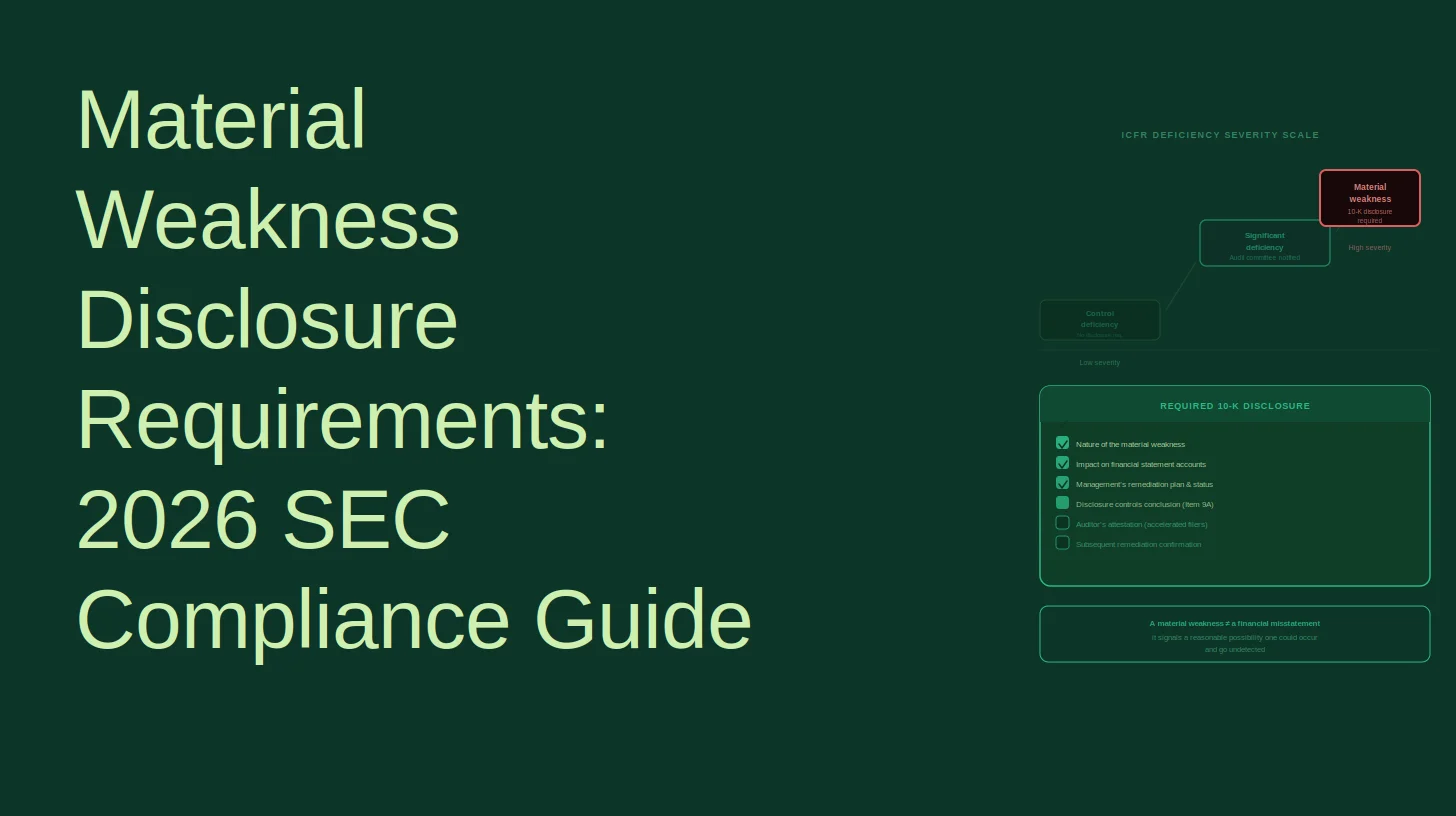
A MW requires management to conclude that ICFR is not effective and to disclose this in Item 9A of the annual report on Form 10-K. The disclosure must describe the nature of the MW, its effect on financial reporting, and management's remediation plan. For accelerated filers subject to SOX 404(b), the external auditor issues an adverse opinion on ICFR.
One point that consistently confuses investors and even some practitioners: an adverse ICFR opinion under 404(b) is not the same as an adverse opinion on the financial statements. A company can receive an adverse ICFR opinion alongside an unqualified (clean) opinion on its financial statements if the MW did not result in an actual material misstatement. The two opinions are separate. For the full disclosure mechanics, see Material Weakness Disclosure Requirements: 2026 SEC Compliance Guide.
Non-Accelerated Filers: A Different Risk Profile
The Dodd-Frank Act permanently exempted non-accelerated filers from the SOX 404(b) auditor attestation requirement in 2010. Non-accelerated filers still must complete the SOX 404(a) management assessment and disclose any MWs in their annual report. But without independent auditor attestation, the classification of a deficiency as an SD rather than a MW rests entirely on management's judgment, with no external check. That changes the risk profile: the SEC's Division of Corporation Finance may still challenge the classification through comment letters.
Real-World Consequences: The Data Behind the Classification Decision
The MW vs. SD classification is not an academic exercise. The market and regulatory consequences are well-documented.
- Stock price: Research by Doyle, Ge, and McVay (2007) in the Journal of Accounting and Economics found that firms disclosing MWs have significantly lower accruals quality and that MW disclosures are associated with negative abnormal stock returns at announcement. The market treats MW disclosures as a signal of broader governance concerns.
- Audit fees: Audit Analytics data consistently documents audit fee premiums of 20-50% for companies disclosing MWs compared to comparable companies without them. The premium reflects additional substantive testing required when ICFR is deemed unreliable.
- SEC comment letters: The SEC's Division of Corporation Finance actively reviews 10-K filings and issues comment letters questioning whether deficiencies were correctly classified. Under-classifying a MW as an SD is a specific enforcement risk. These comment letters are publicly available on EDGAR.
- PCAOB inspection scrutiny: The PCAOB's 2023 inspection reports (released in 2024) continued to flag auditors for failures to properly evaluate the severity of identified control deficiencies and for failures to aggregate deficiencies correctly. Auditors facing this scrutiny have an incentive to be conservative in classification, which means companies should expect rigorous pushback on any borderline SD conclusion.
For the SEC enforcement dimension specifically, see Material Weakness Disclosure and SEC Enforcement in 2026: What CFOs Must Know.
Remediation: Timeline Reality for MWs vs. SDs
The remediation timeline expectation differs significantly between the two classifications, and the practical constraints are more severe than most practitioners realize.
For a significant deficiency, remediation should be addressed promptly but does not carry the same urgency as a MW. The SD must be communicated to the audit committee and tracked, but there is no public clock running.
For a material weakness, the remediation timeline has a hard constraint: a MW identified late in the fiscal year almost certainly cannot be remediated before year-end. Simply implementing a new control is insufficient. The remediated control must have operated for a sufficient period for management and the auditor to conclude it is operating effectively. In practice, this means a MW identified in Q3 or Q4 will typically result in a second consecutive year of adverse ICFR opinions, even if the new control is in place by December 31.
The planning implication is clear: identify and address control gaps early in the fiscal year. A gap surfaced in Q1 can potentially be remediated and tested before year-end. The same gap surfaced in Q4 almost certainly cannot. For a quarter-by-quarter disclosure and remediation roadmap, see Material Weakness Remediation: Quarter-by-Quarter Disclosure Guide.
COSO Framework: How Component-Level Deficiencies Escalate
The COSO 2013 Internal Control Integrated Framework organizes ICFR around five components (Control Environment, Risk Assessment, Control Activities, Information and Communication, Monitoring) and 17 principles. A deficiency in any component or principle must be evaluated for severity under the SD/MW framework.
The practical escalation risk: a deficiency in a higher-level component, particularly the Control Environment, is more likely to be classified as a MW because it affects multiple downstream controls. A tone-at-the-top failure or an inadequate risk assessment process is pervasive by nature. A deficiency in a single Control Activity, by contrast, is more likely to be isolated and classifiable as an SD if the magnitude is limited.
Deloitte's DART guidance notes that a material weakness or significant deficiency exists when a component and one or more relevant principles are not present and functioning, or when components do not operate together in an integrated manner. This means a company cannot treat COSO component failures as automatically below MW level.
FAQ
Is a material weakness a significant deficiency? No. A material weakness is more severe. Every MW involves a deficiency in ICFR, but not every SD rises to MW level. The distinction is whether there is a "reasonable possibility" of material misstatement, a specific probability standard from FASB ASC 450 that the SD definition does not require.
Does a significant deficiency have to be disclosed publicly? No. An SD requires written communication to management and the audit committee before the auditor's report is issued, per PCAOB AS 1305. It does not appear in the public 10-K. A material weakness does require public disclosure in Item 9A of the 10-K.
Can multiple significant deficiencies add up to a material weakness? Yes. Both the SD and MW definitions cover "a deficiency, or a combination of deficiencies." Auditors must evaluate deficiencies individually and in combination. Multiple SDs that collectively create a reasonable possibility of material misstatement must be classified as a MW.
What is the difference between a design deficiency and an operating deficiency? A design deficiency exists when a necessary control is missing or improperly designed so that, even if it operates as designed, the control objective would not be met. An operating deficiency exists when a properly designed control does not operate as designed, or the person performing it lacks the necessary authority or competence. Both types can be classified as SD or MW depending on severity.
Do non-accelerated filers have the same MW disclosure obligations as accelerated filers? Partially. Non-accelerated filers must complete the SOX 404(a) management assessment and disclose MWs publicly. They are permanently exempt from the SOX 404(b) auditor attestation requirement under Dodd-Frank (2010), so there is no independent auditor ICFR opinion. SDs still require written auditor communication to management and the audit committee in any audit.
What does an adverse ICFR opinion mean for our financial statement opinion? They are separate opinions. An adverse opinion on ICFR under SOX 404(b) can coexist with an unqualified (clean) opinion on the financial statements if the MW did not result in an actual material misstatement in the current period. Investors and boards frequently conflate the two, but the auditing standards treat them as distinct conclusions.