
Material Weakness in ICFR: Definition, Examples, and the 2026 Regulatory Update
If your team is staring at a control deficiency and trying to decide whether it must be publicly disclosed, this is the article for you. It covers the precise regulatory definition, the five root-cause categories that drive the vast majority of material weaknesses in practice, the indicators that automatically signal one exists, and a regulatory development effective December 15, 2026 that almost no published guidance has addressed.
Key takeaway: A material weakness in ICFR is not just a bad audit finding. It is a mandatory public disclosure that triggers an adverse management assessment, an adverse auditor opinion (for accelerated filers), and real consequences for your cost of capital and SEC comment letter risk.
What Is a Material Weakness in ICFR?
A material weakness is a deficiency, or a combination of deficiencies, in internal control over financial reporting (ICFR) such that there is a reasonable possibility that a material misstatement of the company's annual or interim financial statements will not be prevented or detected on a timely basis. That definition comes directly from PCAOB AS 2201, Appendix A, paragraph A7, and it is the operative standard for every SEC-registered public company subject to SOX 404.
Two words in that definition carry most of the weight:
- Reasonable possibility does not mean probable. Under the PCAOB standard, it maps to the FASB ASC 450 (formerly FAS 5) threshold: an event is reasonably possible when it is more than remote. That is a deliberately low bar.
- On a timely basis means the control environment must catch misstatements before they reach investors, not just eventually.
The consequence is equally clear: "If one or more material weaknesses exist, the company's internal control over financial reporting cannot be considered effective," per AS 2201 paragraph .02. Management must issue an adverse ICFR assessment under Item 308 of Regulation S-K, and for accelerated filers, the external auditor must issue an adverse opinion on ICFR.
The Three-Tier Severity Hierarchy
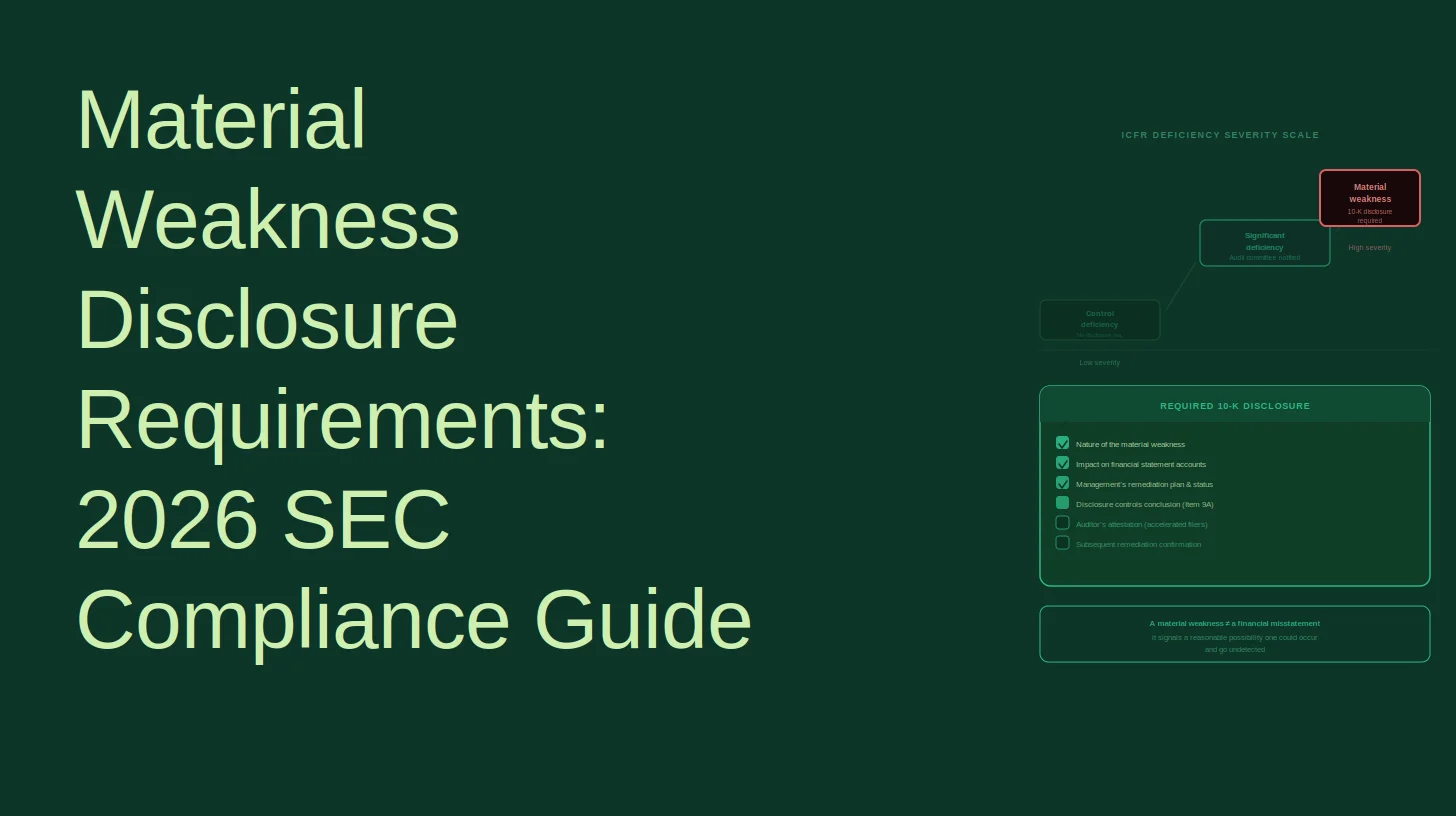
Not every control gap is a material weakness. PCAOB AS 2201 and AS 1305 define three tiers:
| Severity | Definition | Disclosure Required? |
|---|---|---|
| Control deficiency | Design or operation does not allow prevention or detection of misstatements on a timely basis | No public disclosure; internal communication |
| Significant deficiency | Less severe than a material weakness, yet important enough to merit attention by those responsible for oversight | Written communication to audit committee; no public disclosure |
| Material weakness | Reasonable possibility that a material misstatement will not be prevented or detected on a timely basis | Mandatory public disclosure in 10-K (Item 308); adverse ICFR opinion for accelerated filers |
The gap between a significant deficiency and a material weakness is not just semantic. It determines whether your company's ICFR is publicly labeled ineffective.
Design Deficiencies vs. Operating Effectiveness Deficiencies
This distinction matters because the remediation path differs completely.
- A design deficiency exists when a control necessary to meet the control objective is missing, or when an existing control is not properly designed so that even if it operates as designed, the objective would not be met.
- An operating effectiveness deficiency exists when a properly designed control does not operate as designed, or when the person performing the control lacks the necessary authority or competence.
A company that has a well-documented revenue recognition control but whose staff routinely skips the review step has an operating effectiveness problem, not a design problem. Remediating it by rewriting the policy manual without fixing the staffing or supervision issue will not work, and that is precisely why Deloitte's ICFR guidance stresses that root-cause analysis must explain why the control performer did not act appropriately, not just what they failed to do.
The Critical Nuance: A Material Weakness Can Exist Without a Misstatement
This is the most commonly misunderstood aspect of ICFR evaluation, and getting it wrong is expensive.
PCAOB AS 2201, paragraph .03 states explicitly: "A material weakness in internal control over financial reporting may exist even when financial statements are not materially misstated."
The test is about the capability of the control environment to prevent or detect a misstatement, not whether one has actually occurred. A CFO who tells the audit committee "our financials are clean, so we don't have a material weakness" is applying the wrong standard. If the control that should have caught a misstatement was absent or broken, the weakness exists regardless of the outcome in any given period.
This also means that when auditors identify a misstatement that the company's own controls did not catch, that is an automatic indicator of a material weakness, even if the misstatement itself is corrected before the financial statements are issued.
The Five Root-Cause Categories: Where Material Weaknesses Actually Come From
KPMG's 2024 five-year study of 3,502 annual reports found that 279 companies (approximately 8%) disclosed at least one material weakness in the 2023/2024 reporting year. Across the full 2020-2024 period, five root-cause categories account for the overwhelming majority of disclosures, and they have been remarkably stable year over year.
1. Lack of Documentation, Policies, and Procedures
The single most common root cause. In practice, this looks like:
- Revenue recognition policies that exist in email threads but not in a formal, version-controlled document
- Month-end close checklists that are not consistently followed or evidenced
- Acquisition accounting procedures that were never written down because the deal was done under time pressure
- Control matrices that describe controls as they were designed three years ago, not as they currently operate
The SEC comment letter risk here is acute. PwC's August 2026 analysis of SEC comment letter trends documents that SEC staff routinely ask companies to "clarify and disclose the nature of any material weakness, its impact on your financial reporting and ICFR, and management's current plans for remediation." A disclosure that says only "we lacked sufficient documentation" without specifying which processes, which accounts, and what the remediation timeline is will draw a comment letter.
2. Lack of Accounting Resources or Expertise
This category has been one of the two fastest-growing root causes from 2021 to 2024, per the KPMG study. It typically surfaces in three scenarios:
- A company that grew rapidly through acquisitions and did not scale its technical accounting function proportionally
- A newly public company that relied on external advisors pre-IPO but did not hire sufficient in-house expertise post-listing
- A company that lost key personnel during a restructuring and did not replace the institutional knowledge
The weakness here is often a design deficiency: the control exists on paper ("CFO reviews complex accounting judgments") but the CFO does not have the technical depth to execute it effectively for, say, variable interest entity consolidation or ASC 842 lease modifications. The control is not operating as designed because the person performing it lacks the necessary competence, which PCAOB AS 2201 Appendix A identifies as a deficiency in operation.
3. IT, Software, Security, and Access Issues
Also among the fastest-growing categories from 2021 to 2024. This covers a wide range of failures:
- Excessive or inappropriate user access rights in the ERP system (a segregation of duties failure at the system level)
- Absence of change management controls for financial reporting systems, meaning unauthorized or untested changes can reach production
- Inadequate IT general controls (ITGCs) over the systems that produce financial data, undermining the reliability of automated controls that depend on them
- Cybersecurity access control failures that create a pathway for unauthorized modification of financial records
The practical danger with IT-related material weaknesses is that they are often pervasive. A broken ITGC over a core ERP system can invalidate the operating effectiveness of dozens of automated controls that rely on that system's data integrity. Deloitte's ICFR guidance distinguishes between general IT controls that directly address risks of material misstatement (treated as direct controls) and those that support the broader control environment (indirect controls), and notes that indirect control deficiencies require qualitative assessment of pervasiveness and susceptibility to fraud.
For companies undergoing ERP migrations or digital transformation, this category deserves disproportionate attention during the ICFR assessment.
4. Lack of Segregation of Duties and Design Controls
The classic example: a single individual who can both initiate and approve a transaction, or who has both custody of assets and recording responsibility. In smaller or rapidly growing companies, this often reflects a resource constraint rather than deliberate design failure.
Real filing language from this category tends to look like:
- "The Company identified that certain individuals had the ability to both prepare and post journal entries without independent review"
- "The Company's accounts payable process did not include adequate separation between invoice approval and payment authorization"
- "The Company lacked sufficient controls over manual journal entries, including review by personnel independent of the preparer"
The aggregation concept is important here. A single instance of a junior staff member having excess system access may be a control deficiency. But if that access deficiency combines with an absence of compensating detective controls (such as a monthly journal entry review), the combination can aggregate to a material weakness even though neither element alone would cross the threshold. PCAOB AS 2201 explicitly contemplates this: the definition covers "a combination of deficiencies."
5. Inadequate Disclosure Controls
This category covers failures in the process by which financial and non-financial information is gathered, reviewed, and disclosed in SEC filings. Examples include:
- Segment reporting processes that do not capture the right data from business units on a timely basis
- Non-GAAP reconciliation processes that lack formal review and approval
- Related-party transaction identification processes that miss transactions because the disclosure questionnaire process is inadequate
- ESG or climate-related disclosure processes that are not subject to the same rigor as financial statement controls
Note that disclosure controls and procedures (DCP) are distinct from ICFR, though they overlap. A failure in DCP that affects financial statement disclosures can also constitute an ICFR deficiency. For a detailed treatment of how these interact, see SOX 302 vs 404 Certification: The Complete Comparison Guide.
Automatic Indicators of a Material Weakness
PCAOB AS 2201 identifies four circumstances that are themselves indicators that a material weakness exists. When any of these occur, the presumption of a material weakness is strong:
- Identification of fraud by senior management -- even if the amount is not material, fraud by senior management indicates a control environment failure that is pervasive by nature.
- Restatement of previously issued financial statements to reflect correction of a material misstatement.
- Identification by the auditor of a material misstatement in the current period that was not initially identified by the company's own controls.
- Ineffective oversight by the audit committee of the company's external financial reporting and ICFR.
That fourth indicator deserves attention. AS 1305, paragraph .05 states: "If oversight of the company's external financial reporting and internal control over financial reporting by the company's audit committee is ineffective, that circumstance should be regarded as an indicator that a material weakness in internal control over financial reporting exists." If the auditor concludes audit committee oversight is ineffective, the written communication goes not just to the audit committee but to the full board of directors.
The PCAOB AS 2201 Amendment: What Changes on December 15, 2026
This is the regulatory development that almost no published guidance has addressed, and it is live now.
PCAOB Release No. 2024-005, approved by the SEC as SEC Release No. 34-100968 (File No. PCAOB-2025-01, dated August 28, 2025), amends AS 2201 with an effective date of December 15, 2026. That means the amended standard applies to integrated audits of fiscal years ending on or after December 15, 2026.
Companies and their auditors need to be reviewing the amended standard now, before year-end close planning begins, to understand what the changes require in terms of audit procedures, documentation, and the assessment of ICFR effectiveness. Waiting until the fiscal year is underway is too late to adjust control design.
For companies with December 31, 2026 fiscal year-ends, the amended AS 2201 will govern the integrated audit that produces the ICFR opinion filed with the 2026 10-K. That filing is typically due in late February or early March 2027 for large accelerated filers. The planning window is now.
For a broader look at the PCAOB standards package taking effect December 15, 2026, including QC 1000 and AS 1215, see QC 1000 Goes Live: Audit Committee Readiness Checklist for CFOs.
Why 31% of Companies Disclose Material Weaknesses in Multiple Years
Of 757 companies that disclosed a material weakness between 2020 and 2024, 236 (31%) disclosed in multiple years, per KPMG's five-year study. That is not a rounding error. It reflects a systematic failure in how remediation is approached.
The core problem, as Deloitte's ICFR guidance identifies, is that remediation efforts frequently address the symptom (what the control performer did not do) rather than the root cause (why they did not do it). A company that responds to a documentation deficiency by creating new policy templates, without addressing the underlying resource constraints or accountability structures that caused the documentation to lapse, will find the same deficiency recurring at the next assessment.
Durable remediation requires:
- Root-cause analysis that goes one level deeper -- not "the reconciliation was not performed" but "the reconciliation was not performed because the analyst responsible had three other month-end deliverables due simultaneously and no escalation path existed."
- Evidence that the remediated control has operated effectively for a sufficient period -- auditors will not accept a control that was implemented in November as evidence of year-round operating effectiveness.
- Monitoring controls that would catch a recurrence -- the remediated control needs a detective overlay so that if it fails again, the failure is caught before it reaches the auditor.
The AS 6115 Option: Signaling Remediation Before Year-End
Companies that remediate a material weakness mid-year face a communication problem: the market knows about the weakness from the prior 10-K, but there is no mechanism to signal remediation until the next annual assessment. PCAOB AS 6115 fills that gap.
AS 6115 provides a voluntary engagement framework under which an auditor can be engaged to report on whether a previously reported material weakness continues to exist as of a date specified by management, as long as that date is after the most recent annual ICFR assessment. The engagement is not required by any standard -- management must request it, accept responsibility for ICFR effectiveness, evaluate the specific controls using the same COSO framework used in the annual assessment, assert those controls are effective, and support the assertion with sufficient documented evidence.
For companies where the material weakness disclosure has visibly affected the stock price or borrowing costs, an AS 6115 attestation can be a meaningful market signal. It is underused precisely because most practitioners are not aware it exists.
What Must Be Disclosed in the 10-K
Item 308 of Regulation S-K requires management to state whether ICFR is effective. If one or more material weaknesses exist, management must identify each one and describe its nature. The SEC staff's expectations, documented in PwC's August 2026 comment letter trend analysis, are specific:
- The nature of the weakness (which process, which control, which assertion)
- Its impact on financial reporting and ICFR
- Management's remediation plans and timeline
- Whether remediation has been completed
Generic language -- "we identified a material weakness related to our financial close process" -- will draw a comment letter. The SEC staff wants to understand what specifically failed, why, and what has been or will be done about it.
Quarterly reports (10-Q) carry a separate but related obligation: disclosure of any change in ICFR that has materially affected, or is reasonably likely to materially affect, ICFR. If a material weakness is identified during a quarter, or if a significant remediation step is taken, that change should be disclosed in the relevant 10-Q, not held until the annual report.
For a full walkthrough of how material weakness disclosure flows into SOX 302 and 404 certifications, see SOX 302 vs 404 Certification: The Complete Comparison Guide and SOX Section 404 Compliance: 2026 Updates, Key Differences, and Best Practices.
FAQ
Can a company have a material weakness even if its financial statements are not misstated? Yes. PCAOB AS 2201, paragraph .03 states this explicitly. The test is whether the control environment has a reasonable possibility of failing to prevent or detect a misstatement, not whether one has actually occurred. A control that was absent all year but happened not to be needed is still a material weakness.
What is the difference between a significant deficiency and a material weakness? Both are deficiencies in ICFR, but a significant deficiency does not meet the "reasonable possibility of material misstatement" threshold. Significant deficiencies must be communicated in writing to the audit committee but are not publicly disclosed. Material weaknesses must be disclosed in the 10-K and trigger an adverse ICFR assessment.
What are the four automatic indicators of a material weakness? Under AS 2201: (1) fraud by senior management, (2) restatement of previously issued financial statements for a material misstatement, (3) a material misstatement identified by the auditor that the company's own controls did not catch, and (4) ineffective audit committee oversight of financial reporting and ICFR.
Can compensating controls prevent a deficiency from becoming a material weakness? Yes, but only if the compensating control is effective and operates at a level of precision sufficient to prevent or detect a material misstatement. A high-level management review that is not designed precisely enough to catch the specific error the deficient control would have missed does not qualify as an effective compensating control.
What is AS 6115 and when should a company use it? PCAOB AS 6115 is a voluntary engagement under which an auditor attests whether a previously reported material weakness continues to exist as of a management-specified date. Companies use it to signal mid-year remediation to the market with auditor attestation, without waiting for the next annual 10-K assessment.
What does the PCAOB AS 2201 amendment effective December 15, 2026 change? The amended standard (PCAOB Release No. 2024-005, SEC-approved August 28, 2025) governs integrated audits of fiscal years ending on or after December 15, 2026. Companies with December 31, 2026 year-ends should be reviewing the amended requirements now, as they will apply to the ICFR opinion filed with the 2026 10-K.