
IFRS S2 Disclosure Requirements Checklist: 2026 Practitioner Walkthrough
If your team is preparing IFRS S2 climate disclosures and needs a single, structured checklist to work through without downloading a gated PDF, this is it. What follows maps every required disclosure element under IFRS S2 Climate-related Disclosures and the IFRS S1 requirements that must accompany it, flags the transition reliefs still available in 2026 reporting cycles, and calls out the mistakes that trip up first and second-year preparers.
For the full pillar-by-pillar explanation of what each requirement means in practice, see the companion article: IFRS S2 Disclosure Checklist: 2026 Practitioner Walkthrough. This article focuses on the sequencing, the pitfalls, and the items that generic checklists consistently miss.
Key takeaway: You cannot apply IFRS S2 without simultaneously applying IFRS S1. As EY's ISSB checklist states: "IFRS S1 and IFRS S2 must always be applied together." Every item below reflects that joint obligation.
Why IFRS S2 Requires an IFRS S1 Checklist Too
IFRS S2 specifies what to disclose about climate; IFRS S1 governs how to disclose it. IFRS S1 sets the materiality threshold, the qualitative characteristics of useful information, the connectivity requirement linking sustainability disclosures to financial statements, and the timing and location rules. An IFRS S2 checklist that ignores S1 is incomplete by design.
Both standards were issued in June 2023 and are effective for annual reporting periods beginning on or after 1 January 2024. Entities applying the standards under a local endorsement mechanism must check their jurisdiction's specific effective date (see the jurisdiction table below).
The materiality standard under IFRS S1 is single (financial) materiality: information is material if omitting, misstating, or obscuring it could reasonably be expected to influence decisions of primary users of general purpose financial reports. This is a reasonable investor standard, not the double materiality standard used by CSRD/ESRS, which also requires impact materiality. That distinction matters if your entity is subject to both regimes.
Step 1: Confirm Scope and Jurisdiction Before Opening the Checklist
Before working through any checklist item, confirm two things: whether IFRS S2 applies to your entity, and under what local timeline.
| Jurisdiction | Mandatory From | Notes |
|---|---|---|
| Australia (ASRS 2) | FY beginning 1 Jan 2025 (Group 1) | Substantially aligned with IFRS S2 |
| Japan (FSA) | FY beginning 1 Apr 2025 | Prime market listed companies |
| Singapore (SGX) | FY2025 (large-cap); FY2026 (mid-cap); FY2027 (all) | SGX RegCo mandate |
| Hong Kong (HKEX) | FY beginning 1 Jan 2025 | All listed issuers; phase-in for Scope 3 and scenario analysis for smaller issuers |
| UK (UK SRS) | TBC; finalisation expected 2026 | Large listed companies; FRC/FCA consultation ongoing |
| EU (CSRD/ESRS) | Interoperable, not identical | ESRS E1 largely satisfies IFRS S2; some IFRS S2-specific items require additional disclosure |
| Canada | Consultation stage | CSA consultation underway as of 2026 |
If you are subject to CSRD/ESRS E1, the ISSB and EFRAG have published interoperability guidance confirming a building-block approach: ESRS E1 disclosures largely satisfy IFRS S2, but certain IFRS S2-specific items (GHG Protocol methodology, specific cross-industry metrics) require additional disclosure. You cannot assume one report satisfies both without a gap check.
Step 2: Apply the IFRS S1 Cross-Cutting Requirements
These items apply to your climate disclosures under IFRS S2 by virtue of IFRS S1. Work through them before drafting any pillar-specific content.
Materiality assessment
- Identify all climate-related risks and opportunities that could reasonably be expected to affect cash flows, access to finance, or cost of capital over the short, medium, or long term (paragraphs 17-19 of IFRS S1)
- Document the materiality judgements and the process used to make them
- Define your entity's short, medium, and long-term time horizons and disclose those definitions
Location and timing
- Confirm that all required disclosures are included within the general purpose financial report (management commentary, integrated report, or equivalent); cross-referencing to external documents is not permitted
- Confirm that sustainability disclosures are published at the same time as the related financial statements (paragraph 69 of IFRS S1)
- Relief available (first year only): Entities may publish sustainability disclosures after the financial statements in the first year of application, provided they are published within the same reporting period
Connected information
- Link climate-related disclosures to specific line items in the financial statements where climate risks affect asset carrying amounts, provisions, impairment, or useful life assumptions (paragraph 21 of IFRS S1)
- Disclose the significant assumptions, judgements, and estimates used in preparing climate disclosures, analogous to IAS 1 accounting policy and estimation uncertainty disclosures
Watch-out: Connected information is consistently the hardest requirement for first-time preparers and the most commonly incomplete. If your climate narrative says physical risks are material but your financial statements carry no related provisions or impairment, expect questions from auditors and investors.
Comparative information
- Relief available (first year only): Entities are not required to provide comparative prior-period information in the first annual reporting period of application (Appendix C, IFRS S2). Entities with a 1 January 2024 start date did not need to restate 2023 figures in their 2024 disclosures. This relief does not extend to the second year.
Step 3: Work Through the Four Pillars
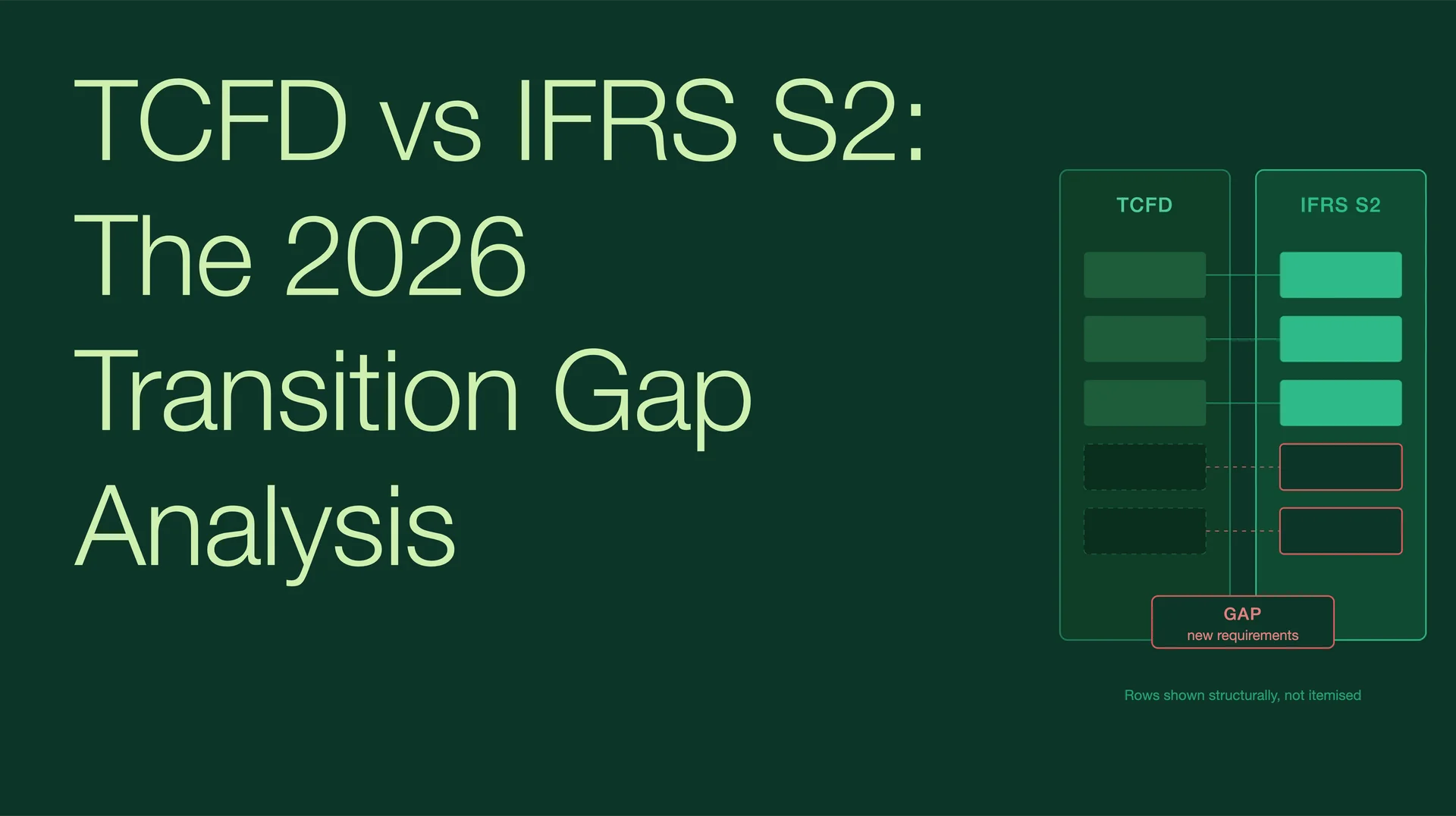
IFRS S2 is structured around the same four content areas as the TCFD framework. For a detailed comparison of IFRS S2 and TCFD requirements, see TCFD vs IFRS S2: The 2026 Transition Gap Analysis.
Pillar 1: Governance (Paragraphs 6-9 of IFRS S2)
- Identify the governance body or individual with oversight responsibility for climate-related risks and opportunities
- Disclose how that responsibility is reflected in terms of reference, board mandates, or equivalent policies
- Disclose how the governance body ensures appropriate climate-related skills and competencies are available, whether directly or through access to external expertise
- Disclose how and how often the governance body is informed about climate-related risks and opportunities
- Disclose how the governance body considers climate-related risks and opportunities when overseeing strategy, major transactions, and risk management
- Disclose management's role in the governance process: who assesses and manages climate risks day-to-day, and through what controls and procedures
- Disclose how climate-related considerations are factored into executive remuneration (this is an IFRS S2-specific requirement with no direct S1 equivalent)
Pillar 2: Strategy (Paragraphs 10-24 of IFRS S2)
Risks and opportunities
- Identify and describe each material climate-related physical risk (acute and chronic) and transition risk (policy, legal, technology, market, reputational)
- Identify and describe each material climate-related opportunity
- For each, specify the time horizon (short, medium, long term) using your entity's defined horizons
Business model and financial effects
- Disclose current and anticipated effects on the business model and value chain
- Disclose current and anticipated effects on strategy and decision-making, including transition plans
- Disclose current and anticipated financial effects on financial position, financial performance, and cash flows, with quantitative information where reasonably estimable and qualitative where not practicable (paragraph 16 of IFRS S2)
Transition plan
- If the entity has a climate transition plan, disclose the current and anticipated effects on the business model and strategy, including key assumptions and dependencies
- Note: The ISSB's Transition Plan Disclosures project is developing additional guidance on this requirement as of 2026. Current disclosures are highly variable in quality; err toward specificity on milestones and assumptions rather than high-level narrative.
Climate resilience and scenario analysis
- Disclose the entity's assessment of climate resilience using scenario analysis (paragraph 22 of IFRS S2)
- Disclose the scenarios used, including at least one scenario consistent with limiting warming to 1.5°C or 2°C where transition risk is material
- Disclose the time horizons used, the key assumptions, and the conclusions drawn
- Reference publicly available scenarios where used (the ISSB's 2024 educational materials cite IEA, NGFS, and IPCC scenarios as examples)
- Relief available (first year only): Qualitative scenario analysis is permitted in the first reporting period. Quantitative capability must be built for subsequent periods.
Pillar 3: Risk Management (Paragraphs 25-27 of IFRS S2)
- Disclose the processes used to identify, assess, prioritise, and monitor climate-related risks
- Disclose the processes used to identify, assess, prioritise, and monitor climate-related opportunities
- Disclose whether and how these processes are integrated into the entity's overall risk management process
- Specify how the entity determines whether a climate risk is significant, including the parameters and thresholds used
Pillar 4: Metrics and Targets (Paragraphs 28-37 of IFRS S2)
This pillar has three distinct components. Missing any one of them is a common first-year gap.
Component A: Cross-industry climate metrics
IFRS S2 paragraph 29 requires seven categories of cross-industry metrics:
| Metric Category | What to Disclose |
|---|---|
| GHG emissions | Scope 1, 2 (location-based and market-based), 3 (all 15 categories); intensity per unit of revenue and per unit of physical output |
| Transition risks | Amount and percentage of assets or business activities vulnerable to transition risks |
| Physical risks | Amount and percentage of assets or business activities vulnerable to physical risks |
| Climate-related opportunities | Amount and percentage of assets or business activities aligned with opportunities |
| Capital deployment | CapEx, financing, or investment deployed toward climate-related risks and opportunities |
| Internal carbon prices | Price per metric tonne of CO2e used internally, if applicable |
| Remuneration | Percentage of executive remuneration linked to climate-related considerations |
Component B: GHG emissions detail
- Scope 1: absolute emissions, disaggregated by constituent greenhouse gas (all 7 Kyoto Protocol gases: CO2, CH4, N2O, HFCs, PFCs, SF6, NF3) and by consolidation approach (equity share or operational control)
- Scope 2: location-based and market-based
- Scope 3: absolute emissions disaggregated by each of the 15 GHG Protocol categories
- GHG intensity: Scopes 1+2+3 combined, per unit of revenue and per unit of physical output
- Disclose the methodology used (GHG Protocol Corporate Standard is the default; jurisdiction-approved alternatives are permitted)
- Scope 3 relief (first year only): Entities are not required to disclose Scope 3 in the first annual reporting period of application (Appendix C, IFRS S2). For entities with a 1 January 2024 effective date, Scope 3 was first required for the year ending 31 December 2025. This relief has now expired for most early adopters.
- Financial institutions: Scope 3 Category 15 (financed emissions) is particularly data-intensive. The PCAF (Partnership for Carbon Accounting Financials) standard is widely used as a methodology consistent with IFRS S2 requirements.
Component C: Industry-based metrics
- Identify the industry or industries in which your entity operates using the SICS (Sustainable Industry Classification System)
- Apply the relevant industry-based disclosure topics from IFRS S2 Appendix B, which references 68 industry-specific disclosure topics drawn from SASB standards
- If your entity operates across multiple industries, apply the metrics for each relevant industry
- Disclose any additional entity-specific metrics used internally to measure and manage climate-related risks and opportunities
Watch-out: Industry-based metrics are the most commonly omitted section in first-year IFRS S2 disclosures. Generic checklists gloss over Appendix B entirely. If you operate in financial services, energy, real estate, or any sector with material physical or transition exposure, the SASB-based industry metrics are not optional.
Targets
- For each climate-related target: disclose the metric used, the objective, the part of the entity to which it applies, the period, the base period, milestones or interim targets, and performance against the target
- If a GHG emissions target is set: disclose whether it is absolute or intensity-based, the scopes covered, whether it relies on carbon offsets, and the third-party verification status
- Disclose whether any target was set by or is aligned with a third-party framework (e.g. Science Based Targets initiative) and identify that framework
Step 4: Check the Transition Relief Timeline
The table below maps the key reliefs to specific reporting years. Many preparers are unclear on which reliefs have already expired.
| Relief | Available In | Expired After |
|---|---|---|
| No comparative prior-period information required | First reporting period only | Year 1 |
| Scope 3 GHG emissions not required | First reporting period only | Year 1 |
| Qualitative (not quantitative) scenario analysis permitted | First reporting period only | Year 1 |
| Sustainability disclosures may be published after financial statements (same period) | First reporting period only | Year 1 |
For entities with a 1 January 2024 effective date, all four reliefs expired after the 2024 reporting year. Full requirements, including Scope 3 and quantitative scenario analysis, applied from the year ending 31 December 2025.
Step 5: Common Mistakes to Fix Before Filing
These are the gaps that appear most frequently in first and second-year IFRS S2 disclosures.
-
Omitting IFRS S1 cross-cutting requirements. Treating IFRS S2 as a standalone standard and missing the materiality documentation, connectivity requirement, and timing rules from IFRS S1.
-
Incomplete Scope 3 disaggregation. Disclosing a single Scope 3 total rather than breaking it down by all 15 GHG Protocol categories. The standard requires category-level disclosure.
-
Not disclosing the GHG methodology. Failing to state which methodology was used (GHG Protocol or an approved alternative) and the consolidation approach for Scope 1.
-
Skipping industry-based metrics entirely. Appendix B applies to almost every entity. Identify your SICS classification and apply the relevant SASB-based metrics.
-
Disconnected financial effects. Describing material climate risks in the narrative but not linking them to specific financial statement line items. Auditors and sophisticated investors will check for consistency.
-
Vague transition plan disclosure. Paragraph 14(b) of IFRS S2 requires disclosure of current and anticipated effects on the business model and strategy. A high-level commitment to net zero without milestones, assumptions, and dependencies does not satisfy the requirement.
-
No remuneration linkage disclosure. The requirement to disclose what percentage of executive remuneration is linked to climate-related considerations is frequently omitted, particularly where the link is indirect or partial.
-
Assuming CSRD/ESRS E1 satisfies IFRS S2 in full. It largely does, but not completely. Run the interoperability gap check before relying on a single report for both regimes.
-
Using the Scope 3 first-year relief in year two. The relief was a one-year deferral, not an ongoing exemption. Entities that omitted Scope 3 in their first report must include it in full in the second.
-
Missing the assurance requirement in your jurisdiction. IFRS S2 itself does not mandate third-party assurance, but Australia and Singapore have introduced local assurance requirements alongside their ISSB-aligned mandates. Check your jurisdiction's rules before finalising the report.
FAQ
Is IFRS S2 mandatory, and when does it apply to us? IFRS S2 is effective for annual reporting periods beginning on or after 1 January 2024 at the international level. Whether it applies to your entity depends on your jurisdiction's endorsement decision. Australia, Japan, Singapore, and Hong Kong have all mandated ISSB-aligned disclosures on phased timelines starting in 2025. Check the jurisdiction table above for your specific effective date.
Do we have to disclose Scope 3 emissions under IFRS S2? Yes, Scope 3 is mandatory under IFRS S2, disaggregated by all 15 GHG Protocol categories. A one-year phase-in relief allowed entities to omit Scope 3 in their first reporting period. For most entities with a 1 January 2024 effective date, that relief expired after the 2024 reporting year, meaning Scope 3 was first required for the year ending 31 December 2025.
What scenario analysis does IFRS S2 actually require? Entities must use climate scenario analysis to assess the resilience of their strategy and business model, using at least two scenarios including one consistent with limiting warming to 1.5°C or 2°C where transition risk is material. The ISSB does not mandate specific scenarios; IEA, NGFS, and IPCC scenarios are commonly used. Qualitative analysis was permitted in the first reporting period only.
How do we identify which SASB industry metrics apply to us? Use the SICS (Sustainable Industry Classification System) to identify your industry classification, then refer to IFRS S2 Appendix B. The Appendix references 68 industry-specific disclosure topics. If your entity spans multiple industries, apply the metrics for each. The IFRS Foundation's standards navigator provides access to the industry-based requirements.
Can our CSRD/ESRS E1 disclosure satisfy IFRS S2? Largely, but not completely. The ISSB and EFRAG have confirmed interoperability through a building-block approach. ESRS E1 disclosures cover most IFRS S2 requirements, but certain IFRS S2-specific items, including GHG Protocol methodology disclosure and specific cross-industry metrics, require additional disclosure. Run a gap check against the ISSB-EFRAG interoperability guidance before relying on a single report.
Where in the annual report should IFRS S2 disclosures appear? IFRS S2 does not prescribe a specific location within the general purpose financial report. Entities may place disclosures in the management commentary, an integrated report, or a standalone sustainability report that forms part of the annual report. Cross-referencing to information elsewhere in the same report is permitted; cross-referencing to external documents is not. All required information must be accessible within the same report.
The ISSB's Transition Plan Disclosures project will add further specificity to how transition plans should be disclosed under paragraph 14(b). Watch for finalised guidance as that project progresses through 2026.