Material Weakness Disclosure Requirements: 2026 SEC Compliance Guide
If your company has identified a deficiency in internal control over financial reporting (ICFR), the disclosure obligation is more layered than most compliance teams realise. This guide maps every requirement: what management must say publicly, what the auditor must say publicly, what the auditor must communicate privately to the audit committee, which filer categories trigger which obligations, and the live PCAOB amendment that takes effect December 15, 2026.
Key takeaway: A material weakness triggers three distinct disclosure obligations simultaneously. Most articles explain one. This guide explains all three and how they interact.
What Is a Material Weakness in ICFR?
A material weakness is a deficiency, or combination of deficiencies, in ICFR such that there is a reasonable possibility that a material misstatement of annual or interim financial statements will not be prevented or detected on a timely basis. That definition appears identically in PCAOB AS 2201 Appendix A, AS 1305, and SEC Exchange Act Rules 13a-15 and 15d-15.
The phrase "reasonable possibility" carries a precise legal meaning. Per PCAOB AS 2201 Appendix A, it means the likelihood of the event is either "reasonably possible" or "probable" as those terms are used in FASB ASC 450 (formerly FAS 5, paragraph 3). This is a lower bar than "probable" alone.
Two points practitioners routinely miss:
- A material weakness can exist even when the financial statements are not materially misstated. AS 2201 §.03 is explicit on this. The risk of misstatement, not an actual misstatement, is the trigger.
- A combination of individually non-material deficiencies can aggregate into a material weakness. Evaluating aggregation risk, especially across IT general controls and process-level controls, is one of the most common points of failure in severity assessments.
The Severity Hierarchy
The three levels run from least to most severe:
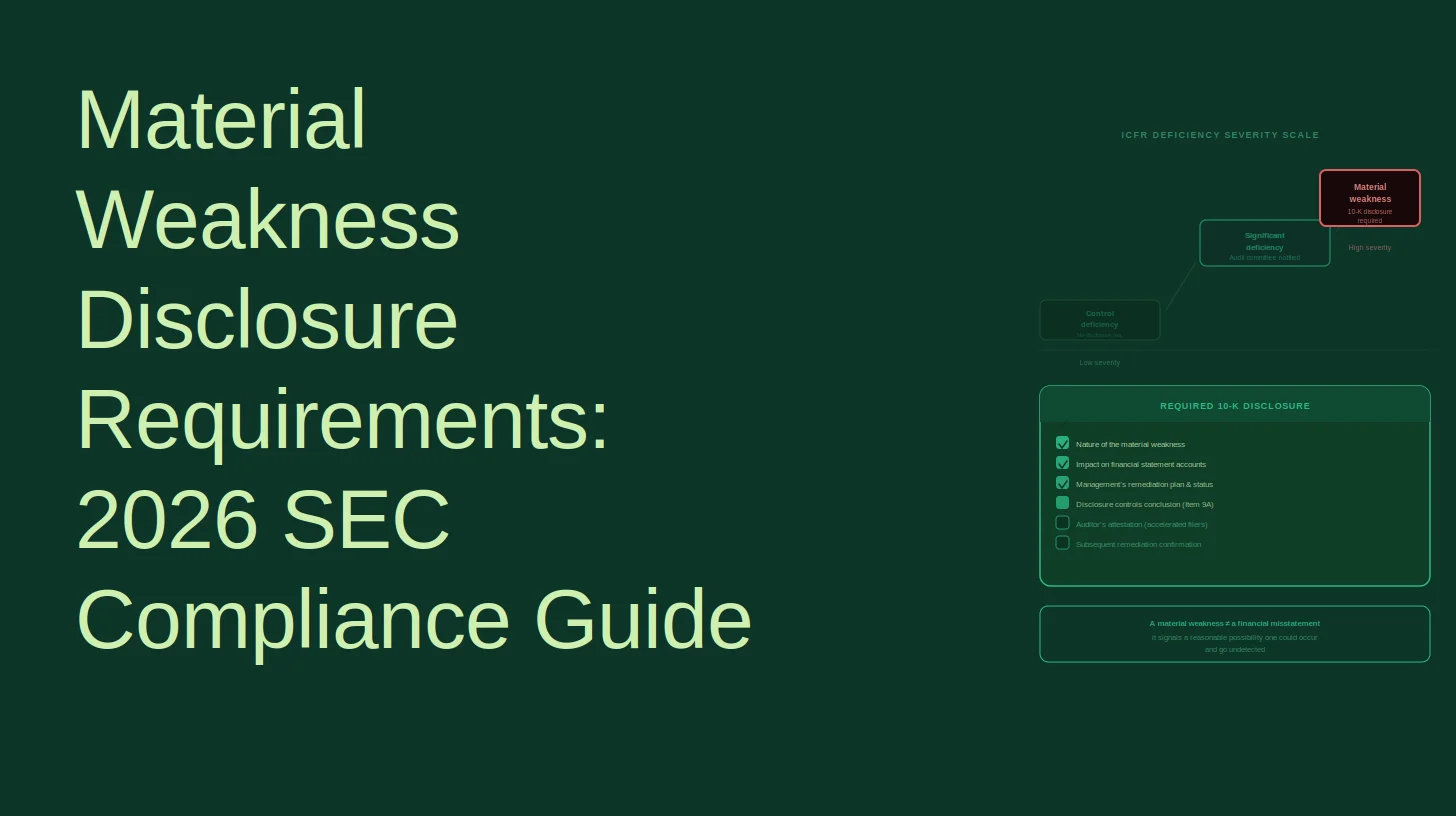
LevelDefinitionPublic Disclosure Required?Control deficiencyDesign or operation of a control does not allow timely prevention or detection of misstatementsNoSignificant deficiencyLess severe than a material weakness, yet important enough to merit attention by those responsible for financial reporting oversightNo (private communication only)Material weaknessReasonable possibility that a material misstatement will not be prevented or detected on a timely basisYes
A significant deficiency does not require public disclosure in SEC filings. It does require the auditor's private written communication to management and the audit committee, which is covered below.
Deficiency in Design vs. Deficiency in Operation
The type of deficiency matters for severity evaluation. Per PCAOB AS 1305 §.01:
- A design deficiency exists when a necessary control is missing, or an existing control is not properly designed so that the control objective would not be met even if the control operates as designed.
- An operation deficiency exists when a properly designed control does not operate as designed, or when the person performing the control lacks the necessary authority or competence.
A missing detective control where no preventive control exists is more likely to constitute a material weakness than a deficiency in a single detective control where a strong preventive control remains intact. Compensating controls that operate effectively can prevent a design deficiency from rising to a material weakness, but they must actually be working, not just documented.
Which Companies Have ICFR Disclosure Obligations?
Not all filers carry the same obligations. SOX Section 404 splits into two parts with different scope rules.
Filer Category404(a) Management Assessment (Item 308 of Reg S-K)404(b) Auditor Attestation (PCAOB AS 2201)Large accelerated filer (public float ≥ $700M)RequiredRequiredAccelerated filer (public float $75M to $699M)RequiredRequiredNon-accelerated filerRequired (since 2010)Not requiredSmaller reporting company (SRC)RequiredNot requiredEmerging growth company (EGC)RequiredExempt under JOBS Act
The practical implication: a non-accelerated filer or SRC must still include management's ICFR assessment in its 10-K and disclose any material weakness, but its auditor will not issue a separate opinion on ICFR. The auditor's obligations shift to the private written communication regime under AS 1305 rather than the integrated audit under AS 2201.
For companies approaching or crossing filer thresholds, this matrix is one of the most common sources of confusion. A company that crosses from non-accelerated to accelerated filer status picks up the 404(b) auditor attestation requirement, which typically requires 12 to 18 months of preparation. See Finrep's guide to filer category definitions and pre-IPO obligations for the full threshold rules.
The Three Disclosure Layers: How They Interact
This is the section most existing guidance skips. A material weakness triggers three distinct obligations that operate in parallel.
Layer 1: Management's Annual Report on ICFR (10-K, Item 308)
Management must include an assessment of ICFR effectiveness in every annual report, and if a material weakness exists as of year-end, management cannot conclude that ICFR is effective. This is the public-facing disclosure in the 10-K.
Under Item 308(a) of Regulation S-K, management's report must:
- State management's responsibility for establishing and maintaining adequate ICFR.
- Identify the control framework used (typically COSO 2013).
- Include management's assessment of ICFR effectiveness as of year-end.
- If a material weakness exists, identify it. The SEC's position, confirmed in its staff FAQ, is that a registrant is obligated to identify and publicly disclose all material weaknesses. Management cannot conclude ICFR is effective if even one material weakness exists.
The SEC expects specificity, not boilerplate. Comment letter patterns show the staff pushing back on vague descriptions like "a material weakness related to financial close processes." The disclosure should describe the nature of the weakness, the root cause, the financial statement areas affected, and the remediation plan with expected timeline.
Layer 2: The Auditor's Public Opinion on ICFR (Integrated Audit, 404(b) Filers Only)
For accelerated and large accelerated filers, the external auditor must issue a separate opinion on ICFR as part of the integrated audit under PCAOB AS 2201. If one or more material weaknesses exist, the auditor must issue an adverse opinion on ICFR. Per AS 2201 §.02: "If one or more material weaknesses exist, the company's internal control over financial reporting cannot be considered effective."
This adverse opinion is separate from the opinion on the financial statements. A company can receive an adverse ICFR opinion and an unqualified opinion on its financial statements in the same audit report, because the material weakness may not have resulted in an actual misstatement.
Layer 3: The Auditor's Private Written Communication to the Audit Committee
This layer applies to all audits, including financial-statement-only audits of non-accelerated filers. Per PCAOB AS 2201 §.78: "The auditor must communicate, in writing, to management and the audit committee all material weaknesses identified during the audit. The written communication should be made prior to the issuance of the auditor's report on the financial statements."
For non-accelerated filers subject to a financial-statement-only audit, AS 1305 §.04 requires the auditor to communicate in writing all significant deficiencies and material weaknesses, clearly distinguishing between the two categories. The communication must also:
- Include the definitions of significant deficiency and material weakness.
- State that the audit objective was to report on financial statements, not to provide assurance on ICFR.
- Note that the communication is intended solely for internal use (board, audit committee, management), with a carve-out for governmental requirements.
There is one additional trigger that practitioners often overlook. Per AS 1305 §.05: "If oversight of the company's external financial reporting and internal control over financial reporting by the company's audit committee is ineffective, that circumstance should be regarded as an indicator that a material weakness in internal control over financial reporting exists." When that indicator is present, the auditor must communicate the material weakness in writing to the full board of directors, not just the audit committee.
What Goes in the 10-K vs. the 10-Q?
The 10-K is where the annual ICFR assessment lives, but the 10-Q carries its own disclosure obligation that is consistently underestimated.
Under Exchange Act Rule 13a-15, management must evaluate any change in ICFR that occurred during the most recent fiscal quarter that has materially affected, or is reasonably likely to materially affect, ICFR. This evaluation is disclosed in Item 4 (Controls and Procedures) of each 10-Q.
The practical consequence:
- If a material weakness is identified after the fiscal year-end but before the annual report is filed, it must be evaluated and disclosed. The weakness did not exist as of the period-end date, so it does not change management's year-end ICFR conclusion, but it must be disclosed as a subsequent event in the controls section.
- If a material weakness persists into interim periods after the 10-K is filed, it must continue to be disclosed in each 10-Q under Item 4 until remediation is complete and management can conclude the weakness no longer exists.
- If a material weakness is identified for the first time during an interim period, it must be disclosed in the 10-Q for that quarter.
A separate but related conclusion is required for disclosure controls and procedures (DC&P) under Item 307 of Regulation S-K and Rule 13a-15(e). DC&P is broader than ICFR: it covers controls over all information required to be disclosed in SEC filings, not just financial statements. A company can have effective ICFR but ineffective DC&P, or vice versa. The two conclusions are made separately, and conflating them is a common error.
ICFR vs. Disclosure Controls and Procedures: A Distinction That Matters
ICFR and DC&P are separate frameworks with separate effectiveness conclusions in every annual and quarterly filing. ICFR, as defined in PCAOB AS 2201 Appendix A, covers the process for providing reasonable assurance regarding reliability of financial reporting and preparation of financial statements in accordance with GAAP. The auditor's own procedures are explicitly not part of ICFR.
DC&P, defined under Rule 13a-15(e), covers controls and procedures designed to ensure that information required to be disclosed in Exchange Act reports is recorded, processed, summarised, and reported within required time periods. A weakness in the process for gathering non-financial data for MD&A, for example, could impair DC&P without affecting ICFR. Both conclusions are signed by the CEO and CFO under SOX Section 302 certifications in every 10-K and 10-Q.
What Causes Material Weaknesses? The 2024 Data
KPMG's 2024 five-year study covering 2020 through 2024 provides the most current empirical picture available. Of 3,502 annual reports filed in the 2023/2024 reporting year, 279 companies (8%) disclosed a material weakness, and that percentage increased slightly compared to the prior year.
The top five root causes, consistent across all five years:
- Lack of documentation, policies, and procedures
- Lack of accounting resources or expertise
- IT, software, security, and access issues
- Lack of segregation of duties or design controls
- Inadequate disclosure controls
Two of these, lack of accounting expertise and IT/software/security/access issues, have steadily increased from 2021 to 2024. This is not a random fluctuation. ERP migrations, cloud transitions, and the growing complexity of cybersecurity controls are structural drivers. A company that replaces its ERP mid-year without adequately testing the migration controls is a textbook candidate for an IT-related material weakness.
Process areas with the highest concentration of material weaknesses: financial close and reporting, control environment, systems, nonroutine and complex transactions, and revenue.
The persistence data is the finding that deserves the most attention. Of the 757 companies that disclosed a material weakness between 2020 and 2024, 236 companies (31%) disclosed material weaknesses in multiple years. A material weakness is not a one-time disclosure event for nearly a third of companies that experience one. Remediation plans that look complete on paper frequently fail in execution, and new weaknesses emerge as the underlying control environment remains fragile.
On a more positive note, material weaknesses related to restatements declined 7% in FY2024, suggesting that companies are increasingly identifying and disclosing weaknesses before they result in restated financials.
Consequences of a Material Weakness Disclosure
The costs extend well beyond the filing itself.
- SEC comment letters. The staff routinely issues comments on the adequacy of material weakness descriptions and remediation disclosures. If a previously unidentified material weakness is discovered after filing, the SEC may question whether it was present in prior periods and should have been reported earlier.
- Restatement risk. While restatement-linked material weaknesses declined in FY2024, the link between persistent material weaknesses and eventual restatements remains real. A weakness in revenue recognition controls or complex transaction accounting carries higher restatement exposure than a segregation-of-duties gap in a low-risk process.
- Securities litigation. Material weakness disclosures are a frequent predicate for securities class action complaints, particularly where the weakness is disclosed alongside a restatement or earnings revision. Plaintiffs allege that prior certifications under SOX Section 302 were false.
- Financing costs. Lenders and credit rating agencies treat material weakness disclosures as a governance signal. Companies with unresolved material weaknesses often face higher borrowing costs or covenant restrictions.
- Audit fees. External auditors perform incremental procedures in response to identified material weaknesses, and those procedures are billed. The fee impact can be material for smaller accelerated filers.
For companies managing SEC comment letter risk more broadly, Finrep's guide on avoiding repeat SEC comments covers the root-cause and process disciplines that reduce re-comment rates.
The PCAOB AS 2201 Amendment: What Changes in December 2026
This is the regulatory development that virtually no existing coverage addresses, and it affects every accelerated filer's integrated audit starting with fiscal years ending on or after December 15, 2026.
The PCAOB amended AS 2201 in 2024 (PCAOB Release No. 2024-005). The SEC approved the amendment on August 28, 2025 (SEC Release No. 34-100968, File No. PCAOB-2025-01). The amended standard is effective December 15, 2026.
The amendments affect paragraph .09 and add new paragraph .99 to AS 2201. Compliance teams and audit committees at accelerated and large accelerated filers should be coordinating with their external auditors now to understand how the amended standard will affect the scope and documentation of the integrated audit for fiscal years ending on or after that date. Companies with December 31, 2026 fiscal year-ends will be the first cohort subject to the amended standard.
The prior version of the integrated audit standard, AU Section 325, was superseded as of December 31, 2016 and should not be referenced in current practice materials.
Remediation: What the SEC Expects You to Say
Once a material weakness is disclosed, the disclosure obligation does not end. The SEC expects companies to provide substantive remediation updates in subsequent filings, not boilerplate statements that "management is taking steps to remediate."
Best practice remediation disclosures include:
- A description of the specific remediation steps taken or planned.
- The expected timeline for completing remediation.
- Whether any remediation steps have been completed as of the filing date.
- A clear statement of whether the material weakness has been fully remediated (and if so, how management tested the effectiveness of the new or enhanced controls).
- If remediation is not complete, a statement that the material weakness continues to exist.
If a company believes a material weakness has been remediated between the fiscal year-end and the filing date, it can disclose the remediation in the 10-K, but it cannot change the year-end ICFR conclusion. The conclusion is fixed as of the period-end date. Remediation after year-end is disclosed as a subsequent development.
For companies that want a formal auditor opinion confirming a previously reported material weakness no longer exists, PCAOB AS 6115 provides a voluntary engagement framework. The PCAOB's standards do not require such an engagement, but some companies pursue it to signal to investors that remediation is complete.
Material Weakness Disclosure Compliance Checklist
Use this as a filing-cycle reference. It is not a substitute for legal or audit advice.
ObligationApplicable ToTimingStandard/RuleManagement's ICFR assessment in 10-KAll SEC filersAnnual (year-end)Item 308(a) of Reg S-KDisclose all material weaknesses in 10-KAll SEC filersAnnual (year-end)Item 308(a) of Reg S-KAuditor's adverse ICFR opinionAccelerated and large accelerated filers onlyPrior to 10-K issuancePCAOB AS 2201Auditor's written communication to audit committee (material weaknesses)All auditsPrior to auditor's reportAS 2201 §.78 / AS 1305 §.04Auditor's written communication (significant deficiencies)All auditsPrior to auditor's reportAS 1305 §.04Quarterly ICFR change evaluation in 10-Q (Item 4)All SEC filersEach quarterExchange Act Rule 13a-15Disclose material weakness identified in interim periodAll SEC filers10-Q for the relevant quarterExchange Act Rule 13a-15CEO/CFO SOX 302 certifications on ICFR and DC&PAll SEC filersEach 10-K and 10-QSOX Section 302Remediation progress updateAll SEC filers with open material weaknessEach subsequent filingSEC comment letter practiceAmended AS 2201 integrated audit requirementsAccelerated and large accelerated filersFiscal years ending on or after December 15, 2026PCAOB Release No. 2024-005
FAQ
Does a material weakness mean the financial statements are wrong?No. PCAOB AS 2201 §.03 is explicit: a material weakness can exist even when the financial statements are not materially misstated. The standard requires the auditor to assess whether a reasonable possibility of misstatement exists, not whether a misstatement actually occurred.
Do significant deficiencies have to be disclosed in SEC filings?No. Significant deficiencies require the auditor's private written communication to management and the audit committee under AS 1305 §.04, but they do not require public disclosure in the 10-K or 10-Q. Only material weaknesses must be publicly disclosed.
Can two small deficiencies combine into a material weakness?Yes. The definition in AS 2201 Appendix A covers "a deficiency, or a combination of deficiencies." Aggregation analysis under AS 2201 §§.62-.70 is required. A cluster of IT general control deficiencies affecting multiple financial reporting processes is a common aggregation scenario.
What happens if a material weakness is found after year-end but before the 10-K is filed?The year-end ICFR conclusion does not change, because the weakness did not exist as of the period-end assessment date. However, the weakness must be disclosed as a subsequent development in the controls section of the 10-K, and it will need to be disclosed in the first 10-Q filed after the 10-K.
Is note disclosure required for material potential losses related to a material weakness?A material weakness in ICFR does not by itself require a contingent liability note under ASC 450. However, if the material weakness has resulted in, or is reasonably likely to result in, a material misstatement that gives rise to a loss contingency (for example, a regulatory fine or securities litigation exposure), ASC 450 disclosure obligations apply independently. The two analyses run in parallel.
When does the PCAOB AS 2201 amendment take effect?The amended standard, approved by the SEC on August 28, 2025, is effective for fiscal years ending on or after December 15, 2026. Companies with December 31, 2026 fiscal year-ends will be the first cohort subject to the amended requirements under PCAOB Release No. 2024-005.
How long do material weaknesses typically persist?Longer than most companies expect. KPMG's 2024 five-year study found that 31% of the 757 companies disclosing a material weakness between 2020 and 2024 disclosed one in multiple years. Remediation plans that look complete on paper frequently fail in execution, and the SEC will scrutinise whether a company's subsequent filings reflect genuine progress.