Short-Swing Profit Rule Calculation: A Practitioner's Step-by-Step Guide
If you're staring at a set of insider transactions and trying to figure out whether Section 16(b) creates disgorgement liability, this guide is for you. The definition and overview of the short-swing profit rule is covered elsewhere. What this article does is walk you through the actual arithmetic, including the scenarios that trip up even experienced compliance officers: multi-lot trades, sale-before-purchase sequences, loss-generating trades that still produce liability, and derivative securities.
Key takeaway: Section 16(b) disgorgement is calculated using the "lowest-in, highest-out" method, not actual economic gain. The result can exceed what the insider actually made, and can be triggered even when the insider lost money overall.
How the Lowest-In, Highest-Out Method Works
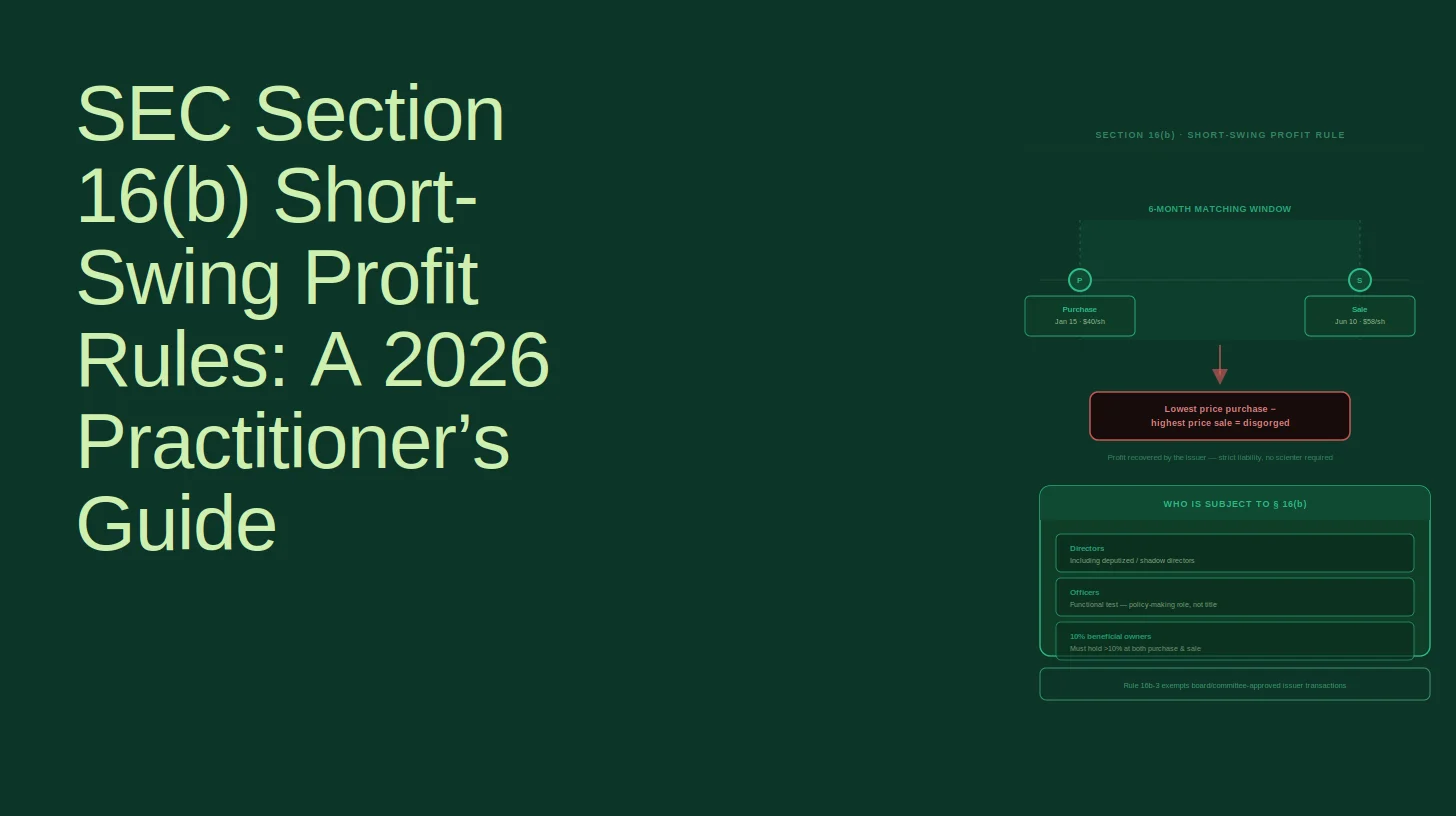
The lowest-in, highest-out method matches the lowest purchase price against the highest sale price within any six-month window, regardless of the actual order of trades. This was established in Smolowe v. Delendo Corp., 136 F.2d 231 (2d Cir. 1943), which held that the calculation must be done "in such a way as to maximize the recovery." That precedent has never been overturned.
The iterative process works like this:
- Identify all purchases and sales by the insider within any rolling six-month window.
- Find the highest-priced sale and the lowest-priced purchase in that window.
- Match them for the number of shares equal to the smaller of the two lots.
- Compute: (sale price minus purchase price) multiplied by shares matched.
- Remove the matched shares from both transactions.
- Repeat with the next highest sale and next lowest purchase.
- Stop when no profitable match remains. Unprofitable pairs are ignored entirely.
Two rules that do not bend: losses from unmatched transactions are never netted against gains from matched ones, and the chronological order of trades is irrelevant to the matching.
Worked Example 1: The Basic Multi-Lot Calculation
This is the NASPP's canonical example, and it illustrates how partial-lot matching works.
Scenario: A CFO buys 200 shares at $100 on January 1, buys another 200 shares at $120 on March 1, then sells 250 shares at $150 on June 15. All transactions fall within a six-month window.
| Transaction | Date | Shares | Price | Aggregate |
|---|---|---|---|---|
| Purchase A | Jan 1 | 200 | $100 | $20,000 |
| Purchase B | Mar 1 | 200 | $120 | $24,000 |
| Sale C | Jun 15 | 250 | $150 | $37,500 |
Step 1: Highest sale is $150 (250 shares). Lowest purchase is $100 (200 shares). Match 200 shares (the smaller lot). Disgorgement: 200 x ($150 - $100) = $10,000.
Step 2: 50 shares of the June 15 sale remain unmatched. Next lowest purchase is $120 (200 shares). Match 50 shares. Disgorgement: 50 x ($150 - $120) = $1,500.
Step 3: No remaining sales to match. Stop.
Total Section 16(b) disgorgement: $11,500.
The CFO's actual gain was $37,500 minus $44,000 in purchases allocated to the 250 shares sold, which is a loss on those specific shares. The disgorgement is $11,500 regardless.
Worked Example 2: Disgorgement Exceeds Actual Gain
This is where the rule's bite becomes clear. The following example is drawn from Finrep's practitioner guide.
| Transaction | Date | Shares | Price | Aggregate |
|---|---|---|---|---|
| Purchase A | Jan 10 | 1,000 | $40 | $40,000 |
| Purchase B | Mar 5 | 1,000 | $55 | $55,000 |
| Sale C | Jun 20 | 1,000 | $50 | $50,000 |
| Sale D | Jun 25 | 1,000 | $60 | $60,000 |
Actual economic gain: $110,000 in proceeds minus $95,000 in cost = $15,000.
Section 16(b) calculation:
- Step 1: Highest sale is $60 (Sale D, 1,000 shares). Lowest purchase is $40 (Purchase A, 1,000 shares). Match 1,000 shares. Disgorgement: 1,000 x ($60 - $40) = $20,000.
- Step 2: Remaining unmatched: Purchase B at $55 (1,000 shares) and Sale C at $50 (1,000 shares). Sale price ($50) is lower than purchase price ($55), so no profitable match. Stop.
Total Section 16(b) disgorgement: $20,000, $5,000 more than actual gain.
The insider owes $5,000 more than they actually made. This is not a bug; it is the design.
Worked Example 3: Losing Money Overall, Still Owing Disgorgement
This is the scenario that surprises insiders most. The H2O Open Casebook states it plainly: "This rule is not designed to be fair. It is designed to discourage insiders from buying and selling within a six-month window. If they do, they face potential disgorgement even if they traded at a loss."
| Transaction | Date | Shares | Price |
|---|---|---|---|
| Purchase A | Jan 1 | 100 | $50 |
| Sale B | Feb 1 | 100 | $40 |
| Purchase C | Mar 1 | 100 | $30 |
| Sale D | Apr 1 | 100 | $20 |
Actual result: Two losing trades. Total loss = $2,000.
Section 16(b) calculation:
- Highest sale: $40 (Sale B, 100 shares). Lowest purchase: $30 (Purchase C, 100 shares). Match 100 shares. Disgorgement: 100 x ($40 - $30) = $1,000.
- Remaining: Purchase A at $50 and Sale D at $20. Sale price below purchase price. No match. Stop.
Total disgorgement: $1,000, despite a $2,000 actual loss.
The insider lost money on every trade and still owes $1,000 to the company.
Worked Example 4: Partial-Lot Matching with Multiple Transactions
This is the most complex scenario in the H2O casebook and the one most compliance officers get wrong.
| Transaction | Date | Shares | Price |
|---|---|---|---|
| Purchase A | Jan 1 | 100 | $50 |
| Purchase B | Feb 1 | 100 | $40 |
| Sale C | Mar 1 | 100 | $30 |
| Purchase D | Apr 1 | 50 | $20 |
| Purchase E | May 1 | 25 | $10 |
| Sale F | Jun 1 | 175 | $5 |
Every single trade is unprofitable in isolation. Total actual loss is substantial. Here is the Section 16(b) calculation:
- Step 1: Highest sale is $30 (Sale C, 100 shares). Lowest purchase is $10 (Purchase E, 25 shares). Match 25 shares. Disgorgement: 25 x ($30 - $10) = $500.
- Step 2: 75 shares of Sale C remain. Next lowest purchase is $20 (Purchase D, 50 shares). Match 50 shares. Disgorgement: 50 x ($30 - $20) = $500.
- Step 3: 25 shares of Sale C remain. Next lowest purchase is $40 (Purchase B). Sale price ($30) is below purchase price ($40). No profitable match. Stop.
- Step 4: Highest remaining sale is $5 (Sale F, 175 shares). Lowest remaining purchase is $40 (Purchase B). Sale price below purchase price. No match. Stop.
Total disgorgement: $1,000, on a set of trades that were all losers.
The key mechanic: once a purchase lot is partially matched, the remaining shares stay available for the next iteration. Shares from Sale F are not matched against purchases at $40 or $50 because $5 is below both prices.
The Sale-Before-Purchase Direction: The Most Commonly Missed Scenario
The six-month window runs in both directions. A sale followed by a purchase within six months is matchable just as a purchase followed by a sale. Most pre-clearance programs catch buy-then-sell sequences. Far fewer catch sell-then-buy.
The Comm Bancorp case is a clean real-world illustration. Director Joseph P. Moore Jr. sold 2,000 shares at $37.25 on June 23, 2009, then purchased 2,000 shares at $26.00 on December 16, 2009. That is a sale-before-purchase sequence completed within six months.
Disgorgement calculation:
- Highest sale: $37.25 (2,000 shares). Lowest purchase: $26.00 (2,000 shares).
- Match 2,000 shares: 2,000 x ($37.25 - $26.00) = $22,500.
- Plus 6% simple interest: $129.45.
- Total: $22,629.45.
Moore executed a formal Short-Swing Profit Disgorgement Agreement. The company received the full amount.
For compliance officers: your pre-clearance system must flag proposed purchases by insiders who have sold shares in the prior six months, not just proposed sales by insiders who have bought.
The 10% Beneficial Owner Threshold: A Critical Asymmetry
The Foremost-McKesson, Inc. v. Provident Securities Co., 423 U.S. 232 (1976) Supreme Court case established a rule that catches activist investors and large institutional holders off guard.
The rule: A 10% beneficial owner is subject to Section 16(b) only if they were already above 10% before the transaction in question. The purchase that takes a holder over 10% does not itself count as a covered purchase for matching purposes.
Practical implications:
- An investor who crosses 10% on a purchase and then sells within six months: the crossing purchase is not matchable, but subsequent purchases after the threshold was crossed are.
- A 10% holder who falls below 10% before a subsequent purchase: that later purchase may not be covered, per SEC Release No. 33-8600.
- Officers and directors do not get this asymmetry. They are covered for all transactions while they hold the title, regardless of ownership percentage.
This distinction matters most for activist investors accumulating positions near the 10% line. The purchase that crosses the threshold is a free pass; everything after it is not.
Derivative Securities: How Rule 16b-6 Changes the Calculation
Options, warrants, and convertible securities add a layer of complexity that most articles skip entirely. Rule 16b-6 governs how derivative securities interact with Section 16(b) matching.
The core rule under Rule 16b-6(a): Establishing or increasing a call equivalent position (buying a call option) is deemed a purchase of the underlying security. Establishing or increasing a put equivalent position (buying a put) is deemed a sale.
The exercise exemption under Rule 16b-6(b): The closing of a derivative position through exercise or conversion is exempt from Section 16(b). However, the shares acquired upon exercise of a call option are not exempt. They can be matched against sales of the underlying stock within six months of the exercise date.
The most common trap: An insider exercises stock options in March and sells the acquired shares in May. The option grant itself may be exempt under Rule 16b-3 (if properly approved). The exercise is exempt under Rule 16b-6(b). But the shares acquired at exercise are live for matching. If the insider also sold shares in January (two months before the exercise), that January sale is within six months of the March exercise and is matchable against the exercise price.
Calculation for mixed derivative and underlying transactions (Rule 16b-6(c)): For transactions involving both derivative and underlying securities, disgorgement cannot exceed the difference in price of the underlying security on the date of purchase and the date of sale. The profit is measured as if the transactions involved only the derivative security, valued at the time of the matching transaction, for the lesser of the number of underlying securities actually purchased or sold.
Rule 16b-3 Exemptions: What Qualifies and What Does Not
Rule 16b-3 exempts certain transactions between the issuer and its officers and directors (not 10% holders) from Section 16(b). The exemption is not automatic. It requires specific approval mechanics.
| Transaction Type | Exemption Condition | Common Mistake |
|---|---|---|
| Equity grants and awards (RSUs, options) | Board, non-employee director committee, or shareholder approval | Approval obtained after grant, not before |
| Dispositions to issuer (tax withholding at RSU vesting) | Board, non-employee director committee, or shareholder approval | Assuming it is automatically exempt without formal approval |
| Tax-conditioned plan transactions (ESPP under IRC Section 423) | Plan must meet IRC Section 423 requirements | ESPP acquisition exempt; shares acquired are not |
| 10b5-1 plan transactions | No automatic exemption under Rule 16b-3 | Assuming a valid 10b5-1 plan creates a Section 16(b) defense |
The non-employee director committee requirement under Rule 16a-1(h) is strict: the director must not currently be an officer or employee of the issuer, must not receive compensation from the issuer other than as a director, and must not have a relationship requiring disclosure under Item 404(a) of Regulation S-K.
RSU vesting: The vesting event itself is generally a covered acquisition unless exempt under Rule 16b-3. The tax-withholding share surrender at vesting (net settlement) is a disposition to the issuer and is exempt under Rule 16b-3(e) if the board or a qualifying committee approved it. But if the RSU grant was not properly approved, the vesting acquisition can be matched against a sale within six months.
ESPP: The purchase under a Section 423 plan may be exempt. The shares acquired are not. An insider who buys shares through an ESPP in February and sells open-market shares in July is within a six-month window and the ESPP purchase is matchable against the July sale.
Does a 10b5-1 Plan Protect Against Section 16(b)?
No. This is one of the most persistent misconceptions in insider trading compliance.
A Rule 10b5-1 trading plan provides an affirmative defense against Rule 10b-5 insider trading claims. It does not touch Section 16(b), which is strict liability and recognizes no intent-based defense. Transactions executed under a 10b5-1 plan are still matchable against other purchases or sales within six months unless they independently qualify for a Rule 16b-3 or other exemption.
The SEC's December 2022 amendments to Rule 10b5-1 (effective February 2023) tightened the affirmative defense conditions: officers and directors now face a 120-day cooling-off period after plan adoption before the first trade, a single-trade plan limit per 12 months, and a good-faith certification requirement. These changes increased compliance burden but did not alter Section 16(b) mechanics at all.
The practical implication: a compliance officer who clears a 10b5-1 plan transaction for Rule 10b-5 purposes still needs to run the Section 16(b) matching analysis separately. The two analyses are independent.
Warning: An insider who adopts a 10b5-1 plan and sells shares under it in April, then separately purchases shares in the open market in June, has a sale-before-purchase sequence that is fully matchable under Section 16(b), regardless of the plan.
How Plaintiff Law Firms Find Section 16(b) Violations
Under Section 16(a), insiders must file Form 4 within two business days of each transaction. Every Form 4 is publicly available on EDGAR and machine-readable.
Plaintiff law firms, sometimes called Section 16 bounty hunters, have automated this process. Their systems ingest Form 4 filings as they are published, identify purchase-sale pairs within six-month windows, apply the lowest-in, highest-out calculation, and flag any pair that produces a positive disgorgement figure. The process is largely automated and runs continuously.
The typical sequence:
- Insider files Form 4 for a sale.
- Plaintiff firm's system flags it against prior purchases in the trailing six months.
- If a match exists, the firm sends a demand letter to the company within weeks.
- The company has 60 days from written demand to bring suit before the shareholder can sue directly, per 15 U.S.C. Section 78p(b).
- Attorney's fees in successful suits are awarded from the recovery, which makes even modest violations worth pursuing.
Late or inaccurate Form 4 filings make this worse in two ways: they attract SEC enforcement attention independently, and they give plaintiff firms a longer window to identify violations before the two-year statute of limitations runs.
The statute of limitations runs two years from the date the profit was realized, which courts interpret as the date of the later of the matched purchase and sale, not the date of discovery. A violation from a June purchase and November sale has a statute of limitations running until November two years later.
A Compliance Decision Framework for Section 16(b)
Before any insider transaction, work through this sequence:
Step 1: Is the insider covered?
- Director or officer (as defined under Rule 16a-1(f), including policy-making VPs)? Covered.
- Beneficial owner of more than 10% of a registered equity class? Covered, with the Foremost-McKesson asymmetry for the crossing purchase.
- Neither? Section 16(b) does not apply.
Step 2: Is the company subject to Section 16?
- Does the company have a class of equity registered under Section 12 of the Exchange Act (listed on a national exchange, or more than $10 million in assets with 2,000 or more record holders)? If yes, proceed. If no, Section 16 does not apply.
Step 3: Is the proposed transaction exempt?
- Is it a grant or award from the issuer approved by the board, a qualifying non-employee director committee, or shareholders? Exempt under Rule 16b-3(d).
- Is it a disposition to the issuer (e.g., tax withholding at RSU vesting) with proper approval? Exempt under Rule 16b-3(e).
- Is it an ESPP purchase under a Section 423 plan? The acquisition may be exempt; the shares acquired are not.
- Is it a bona fide gift with genuine donative intent? Generally not a purchase or sale for Section 16(b) purposes per SEC C&DI guidance.
- Is it an "unorthodox transaction" (merger, tender offer, involuntary transaction) where there is no possibility of speculative abuse? May be exempt under the doctrine from Kern County Land Co. v. Occidental Petroleum Corp., 411 U.S. 582 (1973), though this is narrow and fact-specific.
Step 4: Run the matching analysis.
- Pull all purchases and sales by this insider in the trailing six months from Form 4 filings.
- Add the proposed transaction.
- Apply the lowest-in, highest-out method iteratively.
- If any profitable match exists, quantify the disgorgement before the transaction occurs.
Step 5: Document everything.
- Board or committee approval minutes for Rule 16b-3 exemptions.
- Pre-clearance records showing the matching analysis was run.
- Form 4 filed within two business days of the transaction.
Pre-Clearance Program: What It Must Cover
A pre-clearance program that only reviews proposed transactions in isolation is not adequate. It must:
- Maintain a rolling six-month transaction log for each covered insider, updated in real time from Form 4 filings and internal records.
- Flag both directions. Proposed purchases must be tested against sales in the prior six months. Proposed sales must be tested against purchases in the prior six months.
- Include equity compensation events. RSU vesting dates, option exercise windows, and ESPP purchase dates must be loaded into the matching analysis, not treated as automatically exempt.
- Separate the 10b5-1 analysis from the Section 16(b) analysis. Clearing a transaction for Rule 10b-5 purposes does not clear it for Section 16(b) purposes.
- Set a response protocol for demand letters. When a plaintiff firm's demand letter arrives, the 60-day clock starts immediately. The company needs a pre-established process for legal review, disgorgement calculation verification, and decision on whether to settle or litigate.
- Monitor Form 4 filing deadlines. Late filings are both an independent SEC enforcement risk and a signal to plaintiff firms that compliance controls are weak.
For a deeper look at blackout period design and the Exhibit 19 filing requirement, see Finrep's insider trading blackout period policy guide.
FAQ
Can Section 16(b) disgorgement exceed my actual profit? Yes. The lowest-in, highest-out method is designed to maximize disgorgement, not to mirror actual economic gain. In the worked example above, an insider with a $15,000 actual gain owed $20,000 in disgorgement.
Does the six-month window run from purchase to sale only, or also from sale to purchase? Both directions. A sale followed by a purchase within six months is matchable. This is the most commonly missed scenario in practice.
Does a 10b5-1 plan protect against Section 16(b) liability? No. A 10b5-1 plan provides a Rule 10b-5 affirmative defense only. Section 16(b) is strict liability and does not recognize a 10b5-1 defense. The two analyses must be run independently.
What is the statute of limitations for a Section 16(b) claim? Two years from the date the profit was realized, which courts interpret as the date of the later of the matched purchase and sale. It does not run from the date of discovery.
Are RSU vesting events covered transactions? Generally yes, unless exempt under Rule 16b-3. The vesting is an acquisition. The tax-withholding share surrender at vesting is a disposition to the issuer and is exempt if properly approved by the board or a qualifying non-employee director committee.
Who receives the disgorged amount? The issuer, not the SEC or shareholders directly. If the company fails to pursue recovery within 60 days of a shareholder's written demand, the shareholder may bring a derivative suit on the company's behalf. Attorney's fees are typically awarded from the recovery, which is why plaintiff firms pursue even modest violations.