Imagine you're the CFO of a public company. You've just left a small-group meeting with institutional investors where the questions were sharp and you gave plenty of context. Then it hits you: did you just tell them something the market doesn't know?
The paradox: Regulation FD makes you disclose material information to everyone at once, but whether something is "material" often only becomes clear after you've said it to a few people. It's like being told not to cross a line you can't see until you're past it.
This guide covers what Reg FD requires, where the materiality and timing traps sit, what two decades of enforcement show, and how to build a program that holds up when a slip happens.
What Regulation FD Requires
Regulation Fair Disclosure took effect on October 23, 2000, and sits at 17 CFR Part 243. The full adopting release remains the best guide to how the SEC reads it. Rule 100(a) says that when an issuer, or anyone acting on its behalf, discloses material nonpublic information (MNPI) to certain outsiders, the issuer must make that information public: simultaneously if the disclosure was intentional, promptly if it wasn't.
A violation needs three elements, with no exclusion available:
- The speaker is the issuer or a person acting on its behalf.
- The information is both material and nonpublic.
- The recipient is one of the outsiders Rule 100(b)(1) lists.
Reg FD covers issuers with a class of securities registered under Section 12 or reporting under Section 15(d), including closed-end funds. Under Rule 101(b), it doesn't apply to other investment companies, foreign governments or foreign private issuers.
Who Counts as Speaking for the Company
A "person acting on behalf of an issuer" is any senior official, plus any other officer, employee or agent who regularly communicates with market professionals or security holders (Rule 101(c)). Senior officials are directors, executive officers, investor relations or public relations officers, and anyone with similar functions (Rule 101(f)).
Agents matter more than most policies admit. In the SEC's 2024 DraftKings case, the posts that broke the rule were published by the company's outside PR firm.
There's one carve-out. Someone who discloses MNPI in breach of a duty of trust or confidence to the issuer isn't acting on its behalf, and the SEC staff applies that to senior officials who speak even though company policy doesn't authorize them to (C&DI 101.10). Insider trading law still reaches them.
Who Counts as a Covered Recipient
Rule 100(b)(1) lists four groups:
- Broker-dealers and their associated persons, which covers sell-side analysts.
- Investment advisers, institutional investment managers that filed a Form 13F for the latest quarter, and their associated persons.
- Investment companies, private funds that would be investment companies but for Section 3(c)(1) or 3(c)(7), and their affiliated persons.
- Any holder of the issuer's securities, when it's reasonably foreseeable the holder will trade on the information.
Employees, customers, suppliers, strategic partners and the press aren't on the list, unless they also hold your stock and are likely to trade on what you tell them. The SEC narrowed the rule to these enumerated persons so that ordinary business communications and disclosures to the media would fall outside it. Its staff also confirms that sharing confidential information with employees doesn't trigger Reg FD (C&DI 101.09).
What Reg FD Doesn't Do
Reg FD is a disclosure rule, not an antifraud rule. Rule 102 says a failure to make a disclosure required solely by Reg FD isn't a Rule 10b-5 violation, and the adopting release makes clear that private plaintiffs can't build a 10b-5 claim on it. Rule 103 adds that a Reg FD failure doesn't cost the issuer Form S-3 or S-8 eligibility or affect current public information under Rule 144(c).
Enforcement comes from the SEC alone, through cease-and-desist orders, injunctions and civil penalties.
The Catch-22 Unfolds
Reg FD borrows the existing materiality test rather than creating its own. Information is material if there's a substantial likelihood a reasonable investor would consider it important in making an investment decision, the standard from TSC Industries v. Northway (1976) and Basic v. Levinson (1988). The test is objective, and it gets applied with hindsight.
The adopting release lists events that deserve a careful look: earnings information; mergers, acquisitions, tender offers, joint ventures or changes in assets; new products, discoveries, or customer and supplier developments; changes in control or management; auditor changes; events affecting the issuer's securities, such as defaults, buybacks, splits or dividend changes; and bankruptcies or receiverships. The SEC was explicit that none of these is material per se.
Here's the part most catch-22 discussions leave out. The SEC wrote that issuers "will not be second-guessed on close materiality judgments" and that it won't bring Reg FD cases "for mistaken materiality determinations that were not reckless." It added that a call that might be reckless in a prepared statement isn't necessarily reckless in an impromptu answer to an unexpected question.
That relief has limits. The same release warns that a pattern of "mistaken" materiality calls makes it harder to claim any one disclosure wasn't intentional. And an unplanned disclosure still counts as intentional if the speaker knew it was material and nonpublic when she said it (C&DI 102.04).
Real-world scenario: the earnings preview dilemma. A tech company's IR director takes calls from three analysts on the same day about an upcoming product launch. She sticks to what she believes is public, then adds some "harmless" color about customer enthusiasm. Two days later one analyst upgrades the stock, citing customer reception, and the shares jump 8%.
The question: Was the color material? If it was, the company owed the market a prompt public disclosure, and the clock started when a senior official learned what was said.
The Timeline Trap
Reg FD runs on its own clock, and it's much faster than Form 8-K's.
- Intentional disclosure: public disclosure must be simultaneous. "Intentional" means the speaker knew, or was reckless in not knowing, that the information was both material and nonpublic (Rule 101(a)).
- Non-intentional disclosure: public disclosure must be prompt. Rule 101(d) defines that as soon as reasonably practicable, and no later than the later of 24 hours or the start of the next day's trading on the New York Stock Exchange, measured from when a senior official learns of the disclosure and knows (or is reckless in not knowing) it was material and nonpublic.
The clock starts when a senior official learns, not when the slip happens. Say a product manager tells an analyst something material at 3 p.m. on a Friday and the IR director hears about it at 9 a.m. Monday. The 24 hours run to 9 a.m. Tuesday, the NYSE opens at 9:30 a.m. Tuesday, and the later of the two, 9:30 a.m. Tuesday, is the outer limit.
Weekends get the same treatment. The adopting release says that if a senior official learns of the slip after Friday's close, the outer limit is the NYSE open on Monday.
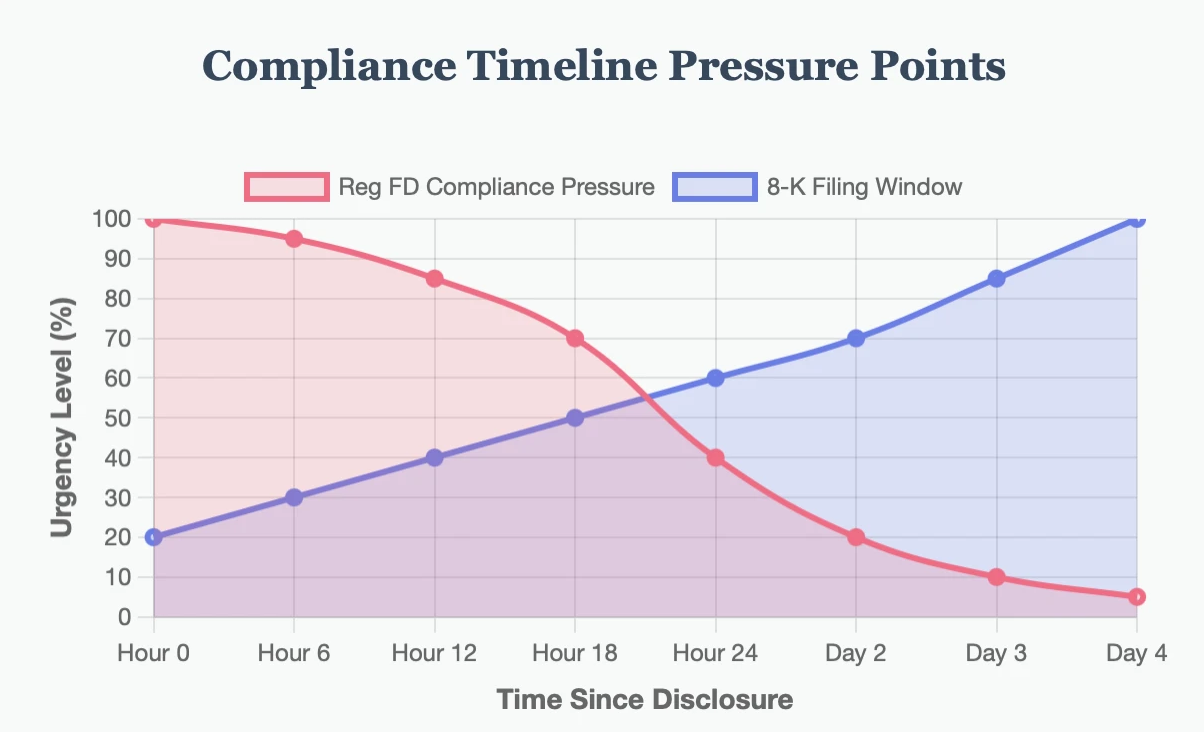
Form 8-K normally allows four business days. But General Instruction B.1 says an 8-K furnished under Item 7.01, or filed under Item 8.01 solely to satisfy Reg FD, must meet Reg FD's deadline instead. So a slip can force an event into public view before its own 8-K item would have required any report at all.
Two features of Form 8-K soften the trap:
- Furnished, not filed. Item 7.01 information isn't "filed" for Section 18 purposes unless the company says so or incorporates it by reference (General Instruction B.2). Item 8.01 disclosure is filed.
- No admission of materiality. A report under Item 7.01 or 8.01 isn't an admission that information required solely by Reg FD is material (General Instruction B.6). You can cure without conceding the point.
What Counts as Public Disclosure
Rule 101(e) gives two routes: furnish or file a Form 8-K, or use another method "reasonably designed to provide broad, non-exclusionary distribution of the information to the public." In practice that means:
- A Form 8-K under Item 7.01 or 8.01.
- A press release through a widely circulated news or wire service.
- A conference call or webcast the public can join, announced in advance. The notice must give the date, time, subject matter and call-in information, and several days' notice is reasonable for a regular earnings call (C&DI 102.01).
- Another EDGAR filing, such as a 10-Q, as long as the information isn't buried or scattered through it (C&DI 102.02).
- The company website or a social media channel, but only if investors have been told that's where the company puts material news.
Some methods don't work. A shareholder meeting that's open to the public but not webcast or broadcast isn't public disclosure (C&DI 102.05), and a reporter's presence doesn't make a private meeting public (C&DI 102.06). Deleting the statement isn't a cure either: DraftKings had its posts down within half an hour and still settled, because no public disclosure followed until its earnings release.
Common Pitfalls and How They Happen
The guidance confirmation trap. Telling one analyst you're "still comfortable" with guidance is a confirmation, and the SEC staff treats "not changed" and "still comfortable" exactly that way (C&DI 101.01). Whether a confirmation is material depends on how much time has passed and what's happened since. Late in a quarter, it can tell an analyst how the quarter actually went.
If you don't want to confirm, say "no comment," or make clear the prior estimate speaks as of its date and isn't being updated. Flowserve was the SEC's first case over a private reaffirmation: its CEO reaffirmed annual earnings guidance to analysts 42 days before fiscal year-end, and the company paid $350,000 in 2005.
The incremental information problem. No single piece of information seems material, but together they paint a revealing picture. One executive says Q3 sales started "strong," another that a key customer is "very satisfied," a third that manufacturing efficiency has "improved." The adopting release is blunt: an issuer "cannot render material information immaterial simply by breaking it into ostensibly non-material pieces."
The mosaic doctrine is the flip side. An issuer may share seemingly inconsequential data that a skilled analyst pieces together with public information, and it may review an analyst's model to correct historical facts already on the record (C&DI 101.03). What it can't do is use a model review to pass along MNPI "either expressly or in code."
The selective silence issue. Sometimes what you don't say is as telling as what you do. If you've historically answered a question and suddenly won't, a sharp investor may read the silence as the answer. Schering-Plough paid $1 million in 2003, and its former CEO $50,000, after the SEC found he conveyed negative earnings news to institutional investors "through a combination of spoken language, tone, emphasis, and demeanor."
The social media minefield. The SEC's 2013 Netflix report confirmed that social media can be a disclosure channel, but only if investors have been told in advance which channels the company will use. Reed Hastings had announced a streaming milestone on his personal Facebook page, and Netflix stock rose from $70.45 at the time of the post to $81.72 at the next day's close.
DraftKings shows the risk is current. On July 27, 2023, its PR firm posted on the CEO's personal X and LinkedIn accounts that the company was "still seeing really strong growth in existing states." Company staff had approved the content, the posts broke DraftKings' own social media and Reg FD policies, and the first public disclosure came with second-quarter results on August 3.
The company paid $200,000 and agreed to train everyone with corporate communications duties within 30 days. Every PR firm, IR agency and social media manager that speaks for you is a person acting on your behalf, so their contracts should bind them to your policy and your pre-approval rules.
Exclusions and Their Limits
Rule 100(b)(2) now has three exclusions, and each is narrower than it looks.
| Exclusion | What it covers | The limit |
|---|---|---|
| Duty of trust or confidence | Attorneys, investment bankers, accountants and others who owe the issuer that duty | The duty has to exist; a friendly analyst doesn't owe one |
| Express confidentiality agreement | Anyone who expressly agrees to keep the information confidential | A promise not to violate securities laws isn't enough (C&DI 101.06); a separate no-trading promise isn't required (C&DI 101.05) |
| Registered offerings | Disclosure in a registration statement or prospectus, a free writing prospectus, a Rule 134 or 135 notice, or oral communications after filing | Resale, plan, exercise, conversion, pledge and ADR registrations under Rule 415(a)(1)(i)-(vi) don't qualify, unless a resale is paired with a primary capital-raising offering. Road shows for unregistered deals stay covered (C&DI 101.07) |
There's no longer a credit rating agency exclusion. Dodd-Frank Section 939B removed it for disclosures made on or after October 4, 2010. Sharing MNPI with a rating agency now needs an express confidentiality agreement unless the agency simply isn't an enumerated recipient.
ESG data raises the same question, and the answer turns on who the rater is. MSCI's 2021 Form 10-K, for example, describes its ESG ratings subsidiary as an SEC-registered investment adviser, which puts that kind of firm on Rule 100(b)(1)'s list. Unpublished emissions figures, supply chain audit findings or transition targets shared with an ESG rater or a sustainability-focused fund deserve the same materiality test as financial data.
Directors can talk to shareholders. The staff's view is that Reg FD doesn't bar private director-shareholder conversations, but authorized directors should pre-clear topics or bring counsel, and a shareholder's express confidentiality agreement takes the conversation outside the rule (C&DI 101.11).
What Two Decades of Enforcement Show
The cases cluster around a few behaviors: private calls, private meetings, guidance signals and channels investors weren't told about.
| Case | Year | Outcome | What happened |
|---|---|---|---|
| Siebel Systems | 2002 | $250,000 penalty | Material comments at a technology conference the public couldn't access; among the SEC's first Reg FD actions |
| Schering-Plough | 2003 | $1 million; former CEO paid $50,000 | CEO signaled weaker earnings in private meetings with institutional investors |
| Flowserve | 2005 | $350,000; CEO paid $50,000 | CEO privately reaffirmed annual guidance to analysts |
| Netflix | 2013 | Report of investigation, no enforcement action | CEO's personal Facebook post; SEC issued social media guidance |
| AT&T | 2022 | $6.25 million; three IR executives paid $25,000 each | IR executives privately called analysts at about 20 firms to walk revenue estimates down |
| DraftKings | 2024 | $200,000 | PR firm posted growth commentary on the CEO's personal accounts |
When AT&T settled in December 2022, the SEC called the penalty the largest ever in a Reg FD case. The facts were stark: internal documents told IR staff that smartphone sales and revenue were material, and the one-on-one calls happened anyway.
Reg FD and Rule 10b5-1 Plans
Both depend on the same input: an accurate view of what's material and nonpublic today. Since February 27, 2023, directors and officers must certify in each new 10b5-1 plan that they aren't aware of MNPI on the adoption date. An insider who heard the information behind a selective disclosure can't honestly make that certification until the information is public.
Keep one MNPI log that serves both the disclosure committee and plan pre-clearance. For plan mechanics, see Rule 10b5-1 Trading Plan Requirements: 2026 Compliance Guide.
Building a Reg FD Program That Holds Up
DraftKings had a written Reg FD policy and a social media policy, and the SEC charged it anyway. "When in doubt, disclose" isn't a program either: rushed disclosure can be wrong, and anything filed under Item 8.01 carries Section 18 exposure. What works is a set of controls fast enough to make the call well under pressure.
- Map every channel. Earnings calls, one-on-ones, non-deal roadshows, conferences, investor days, corporate and executive social accounts, PR and IR agencies, podcasts and media, and AI tools that draft or schedule content. For each, record who controls it and who can speak or post.
- Name covered persons and spokespersons. Directors, executive officers, IR and PR staff, anyone who regularly talks to analysts or holders, and every outside agent. Keep a short list of authorized spokespersons.
- Pre-clear external communications. Anything touching results, guidance, KPIs, M&A or other potentially material topics gets approved first, including CEO posts drafted by an agency or an AI tool. Log the approval and the materiality reasoning.
- Set a quiet period. It's company policy, not a Reg FD requirement. In the weeks before earnings, spokespeople stop one-on-ones and don't confirm or update guidance.
- Script the high-risk events. Earnings Q&A, investor days and conference sessions get talking points and an off-limits list. Webcast them and post slides when they start.
- Write down the remediation clock. Anyone who thinks they slipped calls the general counsel or chief compliance officer at once. Counsel and the CFO assess and document materiality, the disclosure committee picks the method, and a pre-drafted Item 7.01 8-K or wire release goes out inside the Rule 101(d) deadline. A post-incident review then asks why pre-clearance failed.
- Train everyone, including vendors. Directors, officers, IR and PR staff and outside agencies, at onboarding and at least annually.
Investor Conference Checklist
- Confirm the session is webcast live and publicly accessible, or keep the content to public information.
- Post slides on the IR site when the session starts.
- Review every slide for information that isn't yet public.
- Prepare Q&A talking points and an off-limits list.
- Have IR or legal monitor the Q&A in real time.
- If something material slipped, start the escalation protocol before leaving the venue.