IFRS S2 Disclosure Requirements and Examples: 2026 Practitioner Walkthrough
This guide is for CFOs, ESG controllers, and sustainability reporting leads who already know IFRS S2 has four pillars. The harder question is: what does a compliant disclosure actually look like on the page, and how do you build one without missing the requirements that trip up early adopters?
IFRS S2 Climate-related Disclosures was issued by the ISSB in June 2023 and is effective for annual reporting periods beginning on or after 1 January 2024. As of mid-2026, over 30 jurisdictions have made adoption decisions. If you are in scope, the clock is running.
For a full disclosure checklist mapped to every paragraph, see our IFRS S2 Disclosure Checklist: 2026 Practitioner Walkthrough. This article goes one level deeper: concrete examples, the hard parts explained, and the gaps that EY's 2024 implementation tracker found in early adopter filings.
Key takeaway: The three most common disclosure gaps in early IFRS S2 filings are failure to link climate risks to specific financial statement line items, insufficient scenario analysis assumptions, and incomplete Scope 3 category coverage. All three are avoidable with the right preparation sequence.
Does IFRS S2 Apply to Your Organisation?
IFRS S2 applies wherever a jurisdiction has mandated or permitted its use, and the adoption map is expanding fast. The standard itself does not define a size threshold; that is left to each jurisdiction's implementing regulation. Here is the current picture:
| Jurisdiction | Status | Effective Date | Notes |
|---|---|---|---|
| Australia (AASB S2) | Mandatory | Group 1: FY beginning 1 Jan 2025; Group 2: 1 Jul 2026; Group 3: 1 Jul 2027 | Group 1 = assets >AUD 5bn or revenue >AUD 500m |
| Singapore (SGX) | Mandatory | Large-cap: FY2025; All others: FY2026 | SGX-listed issuers |
| Japan (FSA) | Mandatory | FY2023 (filed 2024) | Prime market listed companies |
| Brazil (CVM) | Mandatory | Large listed: 2024; Smaller listed: 2026 | CVM Resolution 193/2023 |
| UK (UK SDS) | Legislating | Expected from 2026 reporting periods for largest entities | Consultation ongoing |
| Canada (CSDS 2) | Consulting | Proposed 2025-2026 depending on size | CSSB finalised standard in 2024 |
| Global (voluntary) | Permitted | Immediately, with IFRS S1 applied concurrently | IOSCO endorsed July 2023 |
Sources: AASB, SGX RegCo, IFRS Foundation adoption tracker, CVM
One practical note for multinationals: IFRS S2 uses financial materiality only, meaning information is material if omitting or misstating it could reasonably influence decisions of investors, lenders, and creditors. CSRD uses double materiality, which also captures the company's impact on the environment. If you report under both, you run two separate materiality assessments. The ISSB and EFRAG published joint interoperability guidance in May 2024 to reduce duplication, but the materiality lenses remain distinct.
What IFRS S2 Actually Requires: The Four Pillars with Annotated Examples
IFRS S2 is structured around four disclosure pillars derived from the TCFD framework: Governance, Strategy, Risk Management, and Metrics and Targets. Each pillar has specific line-item requirements. Here is what each one demands in practice, with examples drawn from the IFRS S2 Illustrative Guidance (Part B) and PwC's model disclosures.
Pillar 1: Governance
The governance disclosure answers one question for investors: who is responsible, and how does climate actually reach the board?
Required disclosures include:
- The identity of the governance body or individual responsible for oversight of climate-related risks and opportunities
- How that body is informed about climate risks (briefing frequency, information sources)
- How the body oversees targets and progress against them
- Whether and how climate-related considerations are factored into executive remuneration
The remuneration link is the disclosure most companies have not previously made explicit. It requires coordination between the sustainability team and the remuneration committee, and it is politically sensitive. A compliant example from PwC's model disclosure looks like this:
"The Board Risk Committee receives quarterly climate risk briefings from the Chief Sustainability Officer. Climate-related targets, including a 30% reduction in Scope 1 and 2 emissions by 2030, are incorporated into the long-term incentive plan for the CEO and CFO, representing 15% of the total LTI weighting."
That level of specificity is what IFRS S2 expects. A generic statement that "the board considers climate risk" does not meet the standard.
Pillar 2: Strategy
The strategy pillar is the most demanding. It requires disclosure of:
- Climate-related risks and opportunities over short, medium, and long time horizons (entity-defined, but the definitions must be disclosed)
- Current and anticipated effects on the business model and value chain
- Effects on financial position, financial performance, and cash flows in the current period and anticipated in future periods
- Climate resilience of the strategy, assessed using scenario analysis
- Planned or executed responses, including transition plans
The financial effects requirement is where most early adopters fall short. EY's 2024 implementation tracker found that the most common gap was failure to disclose the financial effects of climate risks on specific financial statement line items. Saying "rising carbon prices could increase operating costs" is not enough. The disclosure needs to identify the affected line item (cost of goods sold, property, plant and equipment impairment, insurance expense) and, where practicable, quantify the effect.
Deloitte's IAS Plus analysis highlights a specific quantitative requirement that many companies have not previously disclosed: the amount of capital expenditure, financing, or investment deployed toward climate-related risks and opportunities in the current period, and the anticipated amounts in future periods.
Transition plan disclosures are a distinct sub-requirement within Strategy. EY notes that a transition plan under IFRS S2 is not the same as a net-zero commitment. It requires specificity about:
- Milestones and interim targets
- Capital allocation decisions tied to the transition
- Accountability mechanisms (who owns delivery)
- Any targets required by law or regulation in the entity's operating jurisdictions
Pillar 3: Risk Management
Risk management disclosures explain the processes the entity uses to identify, assess, prioritise, and monitor climate-related risks, and how those processes are integrated into the entity's overall risk management framework.
A compliant disclosure names the specific risk management process (e.g., the enterprise risk management framework, the annual risk register review), the criteria used to assess severity, and how climate risk is escalated. It also distinguishes between physical risks (acute events like floods, chronic changes like sea-level rise) and transition risks (policy, technology, market, reputational).
Pillar 4: Metrics and Targets
Metrics and Targets is the most technically complex pillar. It has three layers:
- Cross-industry metric categories (required for all entities)
- Industry-based metrics derived from SASB Standards (required where relevant)
- Entity-specific metrics used internally to manage climate risks
Cross-industry metrics include:
- GHG emissions: Scope 1, Scope 2, and Scope 3 (measured using the GHG Protocol Corporate Standard as the default)
- Percentage of assets or business activities vulnerable to transition risks and to physical risks
- Capital deployed toward climate-related risks and opportunities
- Internal carbon price (if used in capital allocation or investment decisions)
- Climate-related targets and progress against them
The internal carbon price requirement catches many companies off guard. If your organisation uses a shadow carbon price in investment appraisals, IFRS S2 requires you to disclose it, including the price per tonne and how it is applied.
Industry-Specific Metrics: How the SASB Layer Works in Practice
IFRS S2 covers 68 industry classifications across 11 sectors, using SASB-derived metrics as non-mandatory guidance. The SASB metrics are guidance, not hard requirements, but companies must disclose industry-specific metrics that are relevant to their circumstances. In practice, the SASB classification is the starting point.
The IFRS Foundation's Knowledge Hub provides sector-specific worked examples. Here is how the metrics differ across four sectors:
| Sector | Key IFRS S2 Industry-Specific Metrics (examples) |
|---|---|
| Commercial Banks | Volume of real estate collaterals highly exposed to transition risk; concentration of credit exposure to carbon-related assets; number and value of mortgage loans in 100-year flood zones |
| Oil and Gas (Upstream) | Percentage of revenue from coal mining (if applicable); GHG emissions intensity per unit of production; methane emissions |
| Real Estate | Proportion of property in areas subject to flooding, heat stress, or water stress; proportion of homes delivered certified to a green-building standard |
| Food and Beverage | Percentage of investment in climate adaptation measures (e.g., soil health, irrigation); revenue associated with water withdrawn in high water-stress regions |
Source: IFRS S2 Illustrative Guidance (Part B)
What if your company spans multiple industries? The ISSB's FAQ confirms: apply all relevant SASB classifications. A diversified financial group that operates commercial banking and insurance arms needs to identify and apply the metrics for both. What if no SASB standard exists for your industry? The standard's proportionality principle applies: use reasonable and supportable information available without undue cost or effort, and disclose the basis for your approach.
The Five Hardest IFRS S2 Requirements (and How to Handle Them)
KPMG's IFRS S2 implementation guide identifies five areas where companies consistently underestimate the challenge. Here is the practitioner's take on each.
1. Scope 3 GHG Emissions
Scope 3 is required from year two onward. The one-year transition relief means entities need not disclose Scope 3 in the first annual reporting period they apply IFRS S2. Use that year to build the data infrastructure, not to delay the work.
Scope 3 covers 15 categories under the GHG Protocol, from purchased goods and services (Category 1) to use of sold products (Category 11) and investments (Category 15). The standard does not require all 15 categories if they are not material. But you need to assess materiality across all 15 before you can exclude any. KPMG's 2024 readiness survey found fewer than 25% of large companies had quantified the financial effects of climate risks on their balance sheet, and Scope 3 data gaps are a primary reason.
Practical steps for year one:
- Map your value chain and identify the top five Scope 3 categories by likely materiality
- Engage your top 20 suppliers on primary data collection
- Use spend-based or activity-based estimates for remaining categories, with clear methodology disclosure
- Document the GHG Protocol methodology applied and any deviations
2. Scenario Analysis
IFRS S2 requires scenario analysis to assess climate resilience, including at least one scenario consistent with limiting global warming to 1.5°C. The standard does not prescribe specific scenarios (IEA NZE, NGFS, RCP 1.9 are all used in practice), but the assumptions and methodology must be disclosed.
KPMG's 2024 survey found fewer than 40% of large companies had completed a formal scenario analysis exercise. The phrase "reasonable and supportable" in the standard is not a licence to be vague. A compliant scenario analysis disclosure names the scenarios used, the time horizons, the key assumptions (carbon price trajectory, policy assumptions, physical hazard projections), and the implications for the entity's strategy and financial position.
EY recommends a "dry run" disclosure before the mandatory deadline: draft the scenario analysis section internally, stress-test the assumptions with your risk team, and identify where the data gaps are before auditors or regulators ask.
3. Financial Effects Connectivity
This is the requirement that most clearly distinguishes IFRS S2 from its TCFD predecessor. The standard requires disclosure of the location of climate-related risks and opportunities in the financial statements, and the amounts and line items affected.
In practice, this means your sustainability team and your financial reporting team need to work from the same risk register. A physical risk (say, a manufacturing facility in a flood-prone region) should trace to a specific asset on the balance sheet, a potential impairment charge, and an insurance cost line in the P&L. The IFRS Foundation comparison of IFRS S2 and TCFD confirms this connectivity requirement goes explicitly further than TCFD.
4. Transition Plan Disclosure
IFRS S2 requires disclosure of the entity's current and anticipated changes to its business model and strategy to address climate-related risks and opportunities. This is not a net-zero pledge. A compliant transition plan disclosure includes:
- Specific interim milestones (e.g., 50% renewable electricity by 2027)
- Capital expenditure committed or planned for decarbonisation
- Named accountability (which executive or committee owns delivery)
- Any targets required by law or regulation in operating jurisdictions
A disclosure that says "we are committed to net zero by 2050" without milestones, capital allocation, or accountability does not meet the standard.
5. Selecting the Right Industry Classification
The SASB industry classification system is not self-evident. A company that manufactures food products and operates its own retail stores may fall under both the Processed Foods and Food Retailers and Distributors classifications. The ISSB's FAQ confirms both apply. Start by reviewing the IFRS S2 Industry-based Guidance document and mapping each business segment to the closest SASB classification. Document your rationale, because auditors will ask.
What the Transition Reliefs Actually Cover (Year 1 vs. Year 2+)
The IFRS S2 transition reliefs are specific and time-limited. Here is exactly what is and is not required:
| Requirement | Year 1 | Year 2+ |
|---|---|---|
| Comparative information | Not required | Required |
| Scope 3 GHG emissions | Not required | Required |
| Quantitative financial effects (if not practicable) | Can omit with explanation | Required where practicable |
| GHG Protocol methodology | Alternative method permitted if previously used (disclose method) | GHG Protocol is default |
| Scenario analysis (quantitative financial effects) | Can omit quantitative detail | Expected |
The proportionality principle runs through all of these. The ISSB designed IFRS S2 to be applied using "reasonable and supportable information available without undue cost or effort" in several places, which matters for mid-sized companies and first-time reporters. But proportionality is not a blanket exemption: the qualitative disclosures under all four pillars are required from day one.
Where to Publish IFRS S2 Disclosures
IFRS S2 disclosures must be published as part of the general purpose financial report, at the same time as the financial statements. They do not need to be in a separate sustainability report. Companies have flexibility in exactly where within the annual report they appear, provided the disclosures are clearly identified and cross-referenced to the financial statements.
The IFRS Foundation's FAQ confirms a standalone sustainability report is not required. Many companies are embedding IFRS S2 disclosures in the management commentary or a dedicated climate note within the annual report, cross-referenced to the relevant financial statement line items.
Building Assurance-Ready Disclosures
IFRS S2 disclosures are designed to be assurable. That means the data infrastructure behind them needs to meet the same standard as financial data: documented sources, clear methodology, version control, and an audit trail.
The three areas where assurance readiness is weakest in early filings, based on EY's tracker, are:
- Scope 3 data: supplier data is often unverified and inconsistently collected
- Scenario analysis assumptions: undocumented or changed between periods without explanation
- Financial effects: no clear linkage between the climate risk register and the financial statement close process
If your mandatory deadline is within 18 months, run a dry-run disclosure now. Draft every section, identify the data gaps, and build the controls before the auditors arrive.
For the IFRS S1 general requirements that underpin all of this, see our IFRS S1 Disclosure Requirements: 2026 Practitioner Walkthrough. For the full paragraph-by-paragraph checklist, the IFRS S2 Disclosure Checklist maps every requirement to its transition relief status and jurisdiction.
FAQ
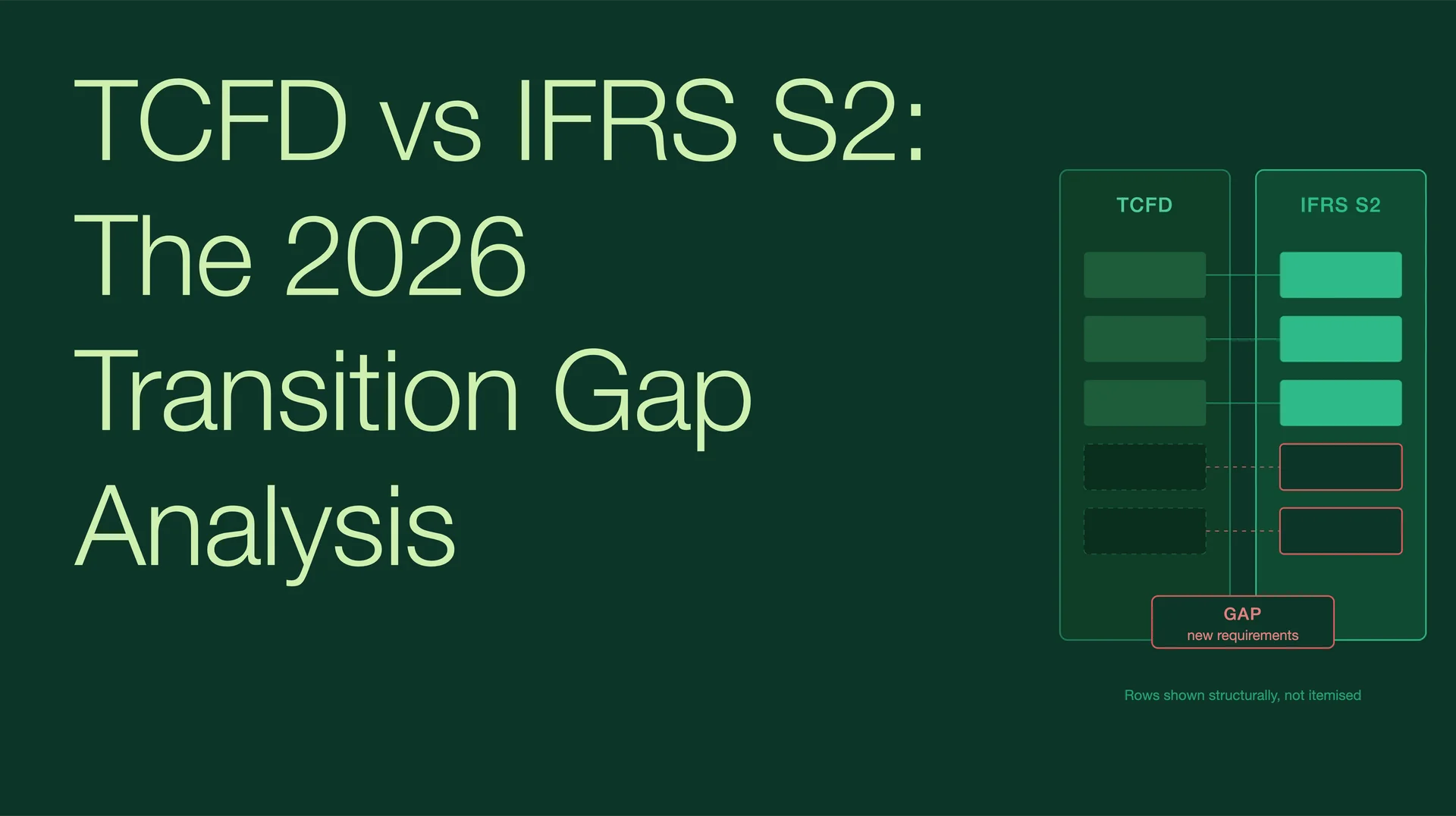
Can we use our existing TCFD report to satisfy IFRS S2? Partially. IFRS S2 fully incorporates all TCFD recommendations, but goes further in three areas: Scope 3 disclosure is mandatory (TCFD encouraged but did not require it), industry-specific SASB metrics are required, and explicit connectivity to financial statement line items is specified. A TCFD report is a good starting point, but it will have gaps. See our TCFD vs IFRS S2 gap analysis for the full comparison.
Do we need to report under both IFRS S2 and CSRD if we operate in the EU? Yes, if you meet both scope tests. But the ISSB and EFRAG published joint interoperability guidance in May 2024 to reduce duplication. The key difference is materiality: IFRS S2 uses financial materiality only; CSRD requires double materiality. You will need two separate materiality assessments, but much of the underlying data collection overlaps.
What happens if we cannot quantify the financial effects of climate risks in year one? The transition relief permits omission of quantitative financial effects in year one if it is not practicable to provide them, provided you explain why. This is not a permanent exemption. From year two, quantitative disclosure is expected where practicable, and the bar for "not practicable" rises as data infrastructure matures.
How do we define short, medium, and long term under IFRS S2? The standard does not prescribe specific time periods. The ISSB FAQ confirms these are entity-specific, but the definitions must be disclosed. In practice, many companies align with their strategic planning horizon (e.g., short = 0-3 years, medium = 3-10 years, long = 10+ years), but the choice must reflect the nature of the entity's climate risks.
Does IFRS S2 require a standalone sustainability report? No. Disclosures can be included in the annual report, management commentary, or another component of the general purpose financial report, provided they are clearly identified and cross-referenced. The IFRS Foundation's FAQ confirms this explicitly.
What assurance level does IFRS S2 require? IFRS S2 does not mandate a specific assurance level. Jurisdictions are implementing their own assurance requirements: Australia's regime, for example, phases in limited assurance for Group 1 entities. Companies should check their jurisdiction's specific requirements and build data infrastructure capable of supporting at least limited assurance from the first mandatory filing.