An M&A transaction is not over when the deal closes. For SEC reporting teams, the work that attracts the most regulatory scrutiny begins the moment the definitive agreement is signed and does not end until the post-close integration disclosures in the first two or three 10-Ks after closing are reviewed and approved by the SEC.
The SEC's Division of Corporation Finance reviews M&A-related filings closely and consistently. Form S-4 registration statements, merger proxy statements (DEFM14A and PREM14A), tender offer filings (SC-TO), and the periodic reports that follow a completed acquisition all generate comment letter activity at rates significantly above the base rate for routine 10-K and 10-Q reviews.
Research published in the Review of Accounting Studies found that Form S-4 filings receiving SEC comment letters are less likely to result in post-merger restatements or goodwill impairments, which confirms that SEC review of M&A disclosures has a measurable impact on accounting quality. The SEC knows this. It is why M&A-related filings receive the level of scrutiny they do.
This post maps the specific comment letter patterns that hit acquirers most consistently, organised by the stage of the transaction at which they occur, from announcement through post-close integration. For each pattern, you will find the disclosure requirement driving the comment, what the SEC typically asks, and what resolution looks like. At the end, you will see how Finrep's Comment Letters Explorer filters specifically for M&A comment patterns to accelerate your pre-filing research and how the M&A disclosure workflow in Finrep supports your team through each stage.
Why M&A Filings Attract Disproportionate SEC Scrutiny
M&A-related filings are reviewed more intensively than routine periodic reports for three reasons that are structural to the transaction process.
First, M&A filings are Securities Act registration statements or proxy solicitation materials, not just Exchange Act periodic reports. They trigger investor protection obligations that go beyond ordinary course disclosure requirements. Shareholders of both the acquirer and the target must be given enough information to make an informed decision about the transaction. The SEC's responsibility to protect those shareholders is the foundation of every comment it issues.
Second, the financial information in M&A filings is inherently forward-looking and uncertain. Pro forma combined financial statements are projections based on assumptions about purchase price allocation, fair value estimates, financing structure, and synergy realisation. Every one of those assumptions is a potential comment trigger because every one of them requires management judgment that investors cannot independently verify.
Third, the timeline pressure inherent in M&A transactions creates disclosure quality risk. Deal teams are working under intense pressure to get filings out, shareholder votes scheduled, and closings executed. SEC reporting teams are frequently brought in later than they should be. Disclosures prepared under time pressure by teams simultaneously managing integration planning and board reporting are exactly the disclosures that receive the most comments.
According to the SEC's Division of Corporation Finance overview, staff review all transactional filings with the same objective as periodic report reviews: to ensure investors receive accurate, complete, and non-misleading information. In M&A contexts, the volume and complexity of the judgments embedded in the disclosures make that objective harder to meet and the review correspondingly more intensive.
Stage 1: Pre-Announcement and Announcement Filings
What Is the 8-K Obligation at Deal Announcement and Where Does It Get Complicated?
When a definitive merger agreement is executed, an 8-K is required under Item 1.01 (entry into a material definitive agreement) within four business days. The 8-K must describe the material terms of the agreement and typically includes the agreement itself as an exhibit.
The comment patterns at this stage are less frequent but meaningful when they occur. SEC staff review the 8-K for adequacy of deal term description, accuracy of any financial metrics disclosed, and consistency between what the 8-K says and what the subsequently filed proxy or S-4 says. Inconsistency between the announcement 8-K and the proxy disclosure of deal terms is a comment trigger that creates avoidable drafting pressure later.
The more consequential obligation at announcement is the Regulation FD consideration. If management discusses the transaction in detail on an earnings call or in analyst meetings, those disclosures must be consistent with the subsequently filed proxy or S-4. SEC staff read earnings call transcripts and compare them to proxy disclosures. Narrative inconsistencies between what management said in the Q&A and what the proxy says about synergies, rationale, or risk are a known comment source.
What Are the Most Common SEC Comment Triggers in Merger Proxy Statements?
The merger proxy statement, filed as PREM14A (preliminary) and DEFM14A (definitive), is the document that generates the most M&A comment letter activity at the announcement stage. The SEC reviews preliminary proxies before they can be sent to shareholders, and comment letters on proxies must be resolved before the definitive proxy can be filed and the shareholder vote scheduled.
The delay risk here is material. Every week of comment letter back-and-forth on a proxy statement is a week added to the time between announcement and close. For transactions with regulatory closing conditions, this delay compounds. For transactions with market price or financing conditions, it creates additional risk. Getting the proxy disclosure right the first time is not just a quality objective; it is a transaction execution objective.
The comment patterns most consistently triggered in merger proxy statements are the following.
Background of the merger narrative. The SEC requires that the proxy provide a complete and accurate account of the process by which the board arrived at the decision to approve the transaction. Comment letters frequently ask acquirers to expand the background section to describe earlier contacts with the target, to explain why alternative acquirers or structures were not pursued, and to be more specific about the timeline and content of board deliberations. A background section that reads like a summary rather than a narrative will generate a comment requesting more substance.
Fairness opinion disclosure. The financial advisor's fairness opinion must be described in the proxy with sufficient detail for shareholders to understand the analysis performed and the conclusions reached. SEC staff consistently comment on proxy statements where the description of the fairness opinion methodology is too general, where the specific financial analyses performed (discounted cash flow, comparable company, precedent transaction) are not adequately described, or where the assumptions underlying those analyses are not disclosed. If the fairness opinion was updated or if multiple opinions were obtained, that history must be disclosed.
Reasons for the merger and board recommendation. The proxy must explain why the board believes the transaction is in the best interests of shareholders. Comment letters frequently ask acquirers to distinguish between the generic factors listed (strategic rationale, synergies, premium paid) and the specific analyses or information that actually drove the board's conclusion. A list of factors without explanation of how each was weighted is a standard comment trigger.
Related party disclosures. Any financial interest that directors, officers, or significant shareholders have in the transaction must be disclosed fully. Incomplete related party disclosure in merger proxies is one of the fastest ways to generate a comment requiring an amendment. The SEC's review of executive compensation arrangements that are accelerated, modified, or triggered by the transaction is particularly thorough.
Stage 2: The Form S-4 Registration Statement
What Is a Form S-4 and Why Does It Generate More Comments Than Almost Any Other Filing?
When the consideration in a merger includes acquirer stock, the acquirer must register that stock under the Securities Act using a Form S-4 registration statement. The S-4 is a combined document that includes both the Securities Act registration statement disclosures and the proxy statement disclosures required for the shareholder vote. It is reviewed by the SEC before it becomes effective, which means the transaction cannot close until the SEC has completed its review and declared the S-4 effective.
The S-4 generates more comment letter activity than almost any other SEC filing type for two reasons. First, the SEC's review is mandatory and takes place before the filing becomes effective, unlike annual report reviews which occur after the filing is already public. Second, the S-4 contains the most complex financial information of any SEC filing: historical financial statements of both companies, pro forma combined financial statements, and forward-looking information about synergies and integration costs.
Research examining S-4 filings across a large sample of M&A transactions found that the most common comment-driven revisions involve pro forma financial statements, total purchase price disclosure, and goodwill allocation. These three areas are where the majority of substantive S-4 comment activity concentrates.
Pro Forma Financial Statements: The Highest-Volume Comment Category
Pro forma financial statements in Form S-4 are prepared under Article 11 of Regulation S-X and are the single highest-volume comment category in M&A-related filings. The purpose of pro forma statements is to give investors a picture of what the combined entity's financial results would have looked like had the transaction occurred at the beginning of the prior fiscal year (for income statement purposes) or as of the most recent balance sheet date (for balance sheet purposes).
The SEC's comment patterns on pro forma statements fall into four recurring categories.
Completeness of purchase price allocation adjustments. The most common S-4 comment is a request to expand the pro forma adjustments to reflect the full purchase price allocation, including fair value adjustments to all identifiable assets and liabilities. In a notable example from the Kraft-Heinz S-4, the SEC asked the company to revise its pro forma presentation to include adjustments necessary to allocate the estimated purchase price to all net assets acquired in compliance with Article 11 of Regulation S-X. Any S-4 where the pro forma balance sheet does not include adjustments for all significant identified intangible assets, deferred revenue haircuts, inventory step-ups, and property, plant and equipment fair value adjustments should expect this comment.
Footnote disclosure of pro forma adjustments. The SEC consistently asks acquirers to expand their footnote disclosures to clearly identify the specific components of each pro forma adjustment, including the underlying transaction documents or appraisal reports supporting the amounts. A pro forma adjustment labelled "fair value adjustment to intangible assets" without a breakdown by asset category, valuation methodology, and useful life assumption is a standard comment trigger.
Non-recurring transaction costs in pro forma adjustments. Article 11 of Regulation S-X requires that non-recurring transaction costs (investment banking fees, legal fees, accounting fees, financing costs) be excluded from the pro forma income statement to present a cleaner picture of ongoing combined operations. The SEC frequently comments when transaction costs are not properly identified and excluded, or when adjustments labelled as non-recurring include items that will recur in the combined business.
Synergy adjustments. The SEC prohibits the inclusion of speculative synergy adjustments in Article 11 pro forma statements. Only adjustments that are directly attributable to the transaction and factually supportable are permitted. If synergies are discussed anywhere in the S-4, the SEC may ask why those synergies are not reflected in the pro forma or ask an acquirer to remove synergy adjustments that were included without adequate factual support.
Purchase Price Allocation and Goodwill
The total purchase price and its allocation to the fair values of assets acquired and liabilities assumed is a primary comment focus because it directly determines the goodwill recognised and the amortisation charges affecting future earnings. SEC staff review purchase price allocation disclosures for three specific issues.
Identification of all significant intangible assets. Under ASC 805 (Business Combinations), all identifiable intangible assets must be recognised separately from goodwill at acquisition date fair value. The SEC consistently comments on S-4s where the preliminary purchase price allocation assigns most of the purchase consideration to goodwill without adequately explaining whether all significant intangible assets have been identified and valued. Customer relationships, developed technology, trade names, in-process research and development, and non-compete agreements are the categories most commonly subject to comment when absent from or inadequately disclosed in the preliminary allocation.
Basis for goodwill recognised. When goodwill is a significant portion of total purchase consideration, the SEC asks acquirers to explain what the goodwill represents. A disclosure that says goodwill reflects the assembled workforce and synergies without further specificity will generate a comment asking for a more substantive explanation of the strategic rationale and expected benefits driving the goodwill amount.
Contingent consideration and earn-out arrangements. If the purchase price includes contingent consideration, the fair value of that consideration at acquisition date must be disclosed and the assumptions driving that fair value must be explained. Earn-out disclosures that describe the arrangement without explaining the fair value methodology or the range of possible outcomes are a consistent comment trigger.
According to the FASB Accounting Standards Codification (free access; license agreement required on first visit), ASC 805 requires disclosure of the amounts recognised for each major class of asset acquired and liability assumed, the amount of goodwill and a description of the factors making up the goodwill recognised, and for contingent consideration, the range of outcomes and the reasons why the range cannot be estimated.
Stage 3: Post-Close Integration Disclosures
What SEC Comment Patterns Emerge in the First Annual Report After an Acquisition?
The first 10-K filed after a significant acquisition closes is one of the most comment-intensive annual filings a company can make. The SEC reviews post-close annual reports with specific attention to whether the accounting for the transaction is complete, whether the disclosures about the combined business are adequate, and whether the MD&A provides sufficient analysis of how the acquisition is affecting results.
Purchase price allocation completion. The acquisition date purchase price allocation must be finalised within 12 months of the acquisition date under ASC 805. In the first annual report, the SEC reviews whether the allocation has been finalised or whether the measurement period is still open, whether any measurement period adjustments were made and why, and whether all significant intangible assets have been identified and are being amortised over their useful lives. Acquirers that leave significant amounts in preliminary goodwill without completing the allocation within the measurement period should expect a comment asking for the status and timeline of completion.
Segment reporting changes under ASC 280. Acquisitions frequently change how the chief operating decision maker (CODM) views and manages the business, which can change the company's reportable segments. The SEC reviews the first post-close annual report to assess whether the segment structure disclosed reflects the actual way the combined business is managed. If the CODM began receiving integrated performance reports that combine the acquired business with an existing segment shortly after closing, but the company is still reporting the pre-acquisition segment structure, a comment asking about the ASC 280 analysis should be expected.
MD&A quantification of acquisition impact. The SEC consistently asks acquirers to provide more specific quantification of the acquisition's impact on revenue, gross margin, and operating income in the MD&A. Statements like "revenue increased primarily due to the acquisition of [target]" without quantifying the acquired revenue contribution are a standard comment trigger. The SEC expects acquirers to separately quantify organic growth and acquired growth when the acquisition is material.
Goodwill impairment testing. Following a significant acquisition, goodwill impairment is a heightened scrutiny area. If the acquired business is underperforming relative to the expectations embedded in the purchase price, the SEC will ask about the reporting unit structure, the timing and results of impairment testing, and the assumptions underlying the fair value assessment. Any acquirer whose stock price has declined materially since closing, whose acquired business is missing revenue or EBITDA targets, or who has made significant integration-related workforce reductions should proactively strengthen their goodwill impairment testing disclosures.
Integration costs and restructuring charges. Post-close integration costs, restructuring charges, and workforce reduction costs are a consistent comment area. The SEC reviews whether these costs are properly classified under ASC 420 (Exit or Disposal Cost Obligations) or ASC 712, whether the disclosure of total expected integration costs and costs incurred to date is complete, and whether integration costs are being appropriately distinguished from ongoing operational costs in the MD&A.
Stage 4: 2026 Regulatory Context for M&A Disclosures
What Has Changed in SEC M&A Guidance in Early 2026?
In early 2026, the SEC released new and updated Compliance and Disclosure Interpretations (C&DIs) specifically addressing business combinations, tender offers, and shareholder solicitations. The new C&DIs address the conditions under which shares offered in business combinations and third-party exchange offers can be registered on Form S-4, including situations involving lock-up agreements. The SEC has provided additional flexibility in how these arrangements are structured while maintaining disclosure obligations. Acquirers preparing S-4 filings in 2026 should confirm that their transaction counsel has reviewed these updated C&DIs before the S-4 is filed.
The Harvard Law School Forum on Corporate Governance January 2026 analysis of SEC comment trends notes that while overall comment letter volume declined in the 12-month period ended June 2025, M&A-related filings continue to receive intensive review. The report specifically identifies MD&A disclosure quality and pro forma financial statement adequacy as areas where SEC staff focus is expected to continue or increase in 2026.
The Acquirer and Target Disclosure Checklist
M&A disclosure responsibilities are not symmetrical. The acquirer carries significantly more of the disclosure burden in most transaction structures, but the target's historical financial statements and cooperation in due diligence directly affect the acquirer's ability to prepare complete and accurate S-4 disclosures.
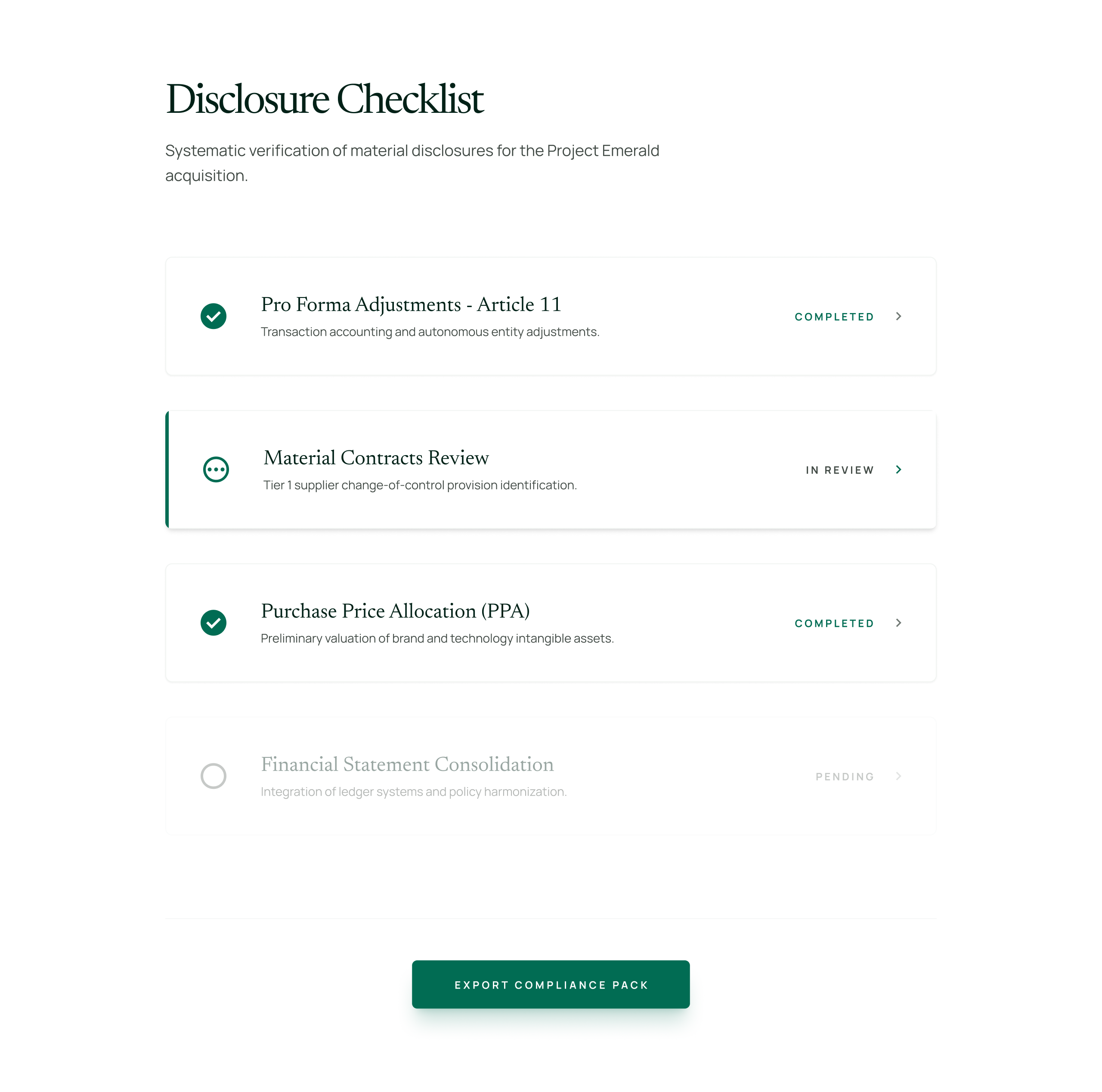
Before the S-4 or merger proxy is filed, the acquirer's SEC reporting team should confirm all of the following are complete and reviewed.
Transaction documents and financial analysis
- Definitive agreement reviewed for material terms requiring disclosure
- Fairness opinion received and all underlying analyses documented
- Board deliberation minutes reviewed for completeness and consistency with proxy background narrative
- Management projections used in fairness opinion process identified and disclosure approach determined
Pro forma financial statements
- Preliminary purchase price allocation prepared with all identifiable intangibles assessed
- Article 11 Regulation S-X pro forma adjustments documented with source references
- Non-recurring transaction costs identified and excluded from pro forma income statement
- Contingent consideration fair value methodology documented
- Pro forma adjustments reviewed by external auditors
Disclosure completeness
- All related party interests in the transaction identified and disclosure drafted
- Executive compensation arrangements triggered by the transaction fully disclosed (golden parachute table prepared)
- Material contracts requiring disclosure identified and listed as exhibits
- Risk factors updated to reflect transaction-specific risks (integration risk, regulatory closing risk, financing risk, customer concentration)
Historical target financial statements
- Audited financial statements of the target obtained for required periods under Rule 3-05 of Regulation S-X
- For significant acquisitions, target financial statements reviewed for required audit quality
- Any significant accounting policy differences between acquirer and target identified and disclosure approach determined
Post-Close Disclosure Checklist
In the first annual report after a significant acquisition closes, the following items require specific attention beyond the standard 10-K preparation process.
- Purchase price allocation status disclosed with timeline for finalisation if measurement period is still open
- All measurement period adjustments since the acquisition date identified and explained
- Segment reporting structure assessed against ASC 280 criteria for the combined business
- MD&A separately quantifies organic and acquired contributions to revenue, gross margin, and operating income changes
- Goodwill impairment testing disclosure updated to reflect post-close reporting unit structure
- Integration cost tracking disclosure includes total expected costs, costs incurred to date, and timing of remaining costs
- Pro forma revenue and earnings disclosure for the comparative period provided for significant acquisitions under ASC 805
How Finrep's Comment Letters Explorer Accelerates M&A Disclosure Research
The comment letter patterns described in this post are drawn from the SEC's published EDGAR correspondence archive. Every comment the SEC has sent to an acquirer about their S-4 pro forma adjustments, every proxy comment about fairness opinion disclosure adequacy, every post-close comment about purchase price allocation completion, is publicly available in EDGAR and searchable.
The challenge is research efficiency. Finding the relevant comments across dozens of comparable M&A transactions requires navigating individual EDGAR filing pages, identifying correspondence filings, reading through letters to extract M&A-specific comments, and building a pattern library across the peer set. For a transaction with a filing deadline measured in weeks, that research takes time your team does not have.
Finrep's Comment Letters Explorer compresses this research. Your team enters the M&A comment pattern to research: pro forma purchase price allocation, fairness opinion adequacy, segment reporting post-close, earn-out fair value. Finrep queries the EDGAR comment letter archive and returns a structured view of relevant exchanges organised by comment type, transaction size, industry, and resolution outcome.
The M&A-specific filter in Comment Letters Explorer narrows results to transactional filings: Form S-4, PREM14A, DEFM14A, SC-TO, and the post-close 10-K and 10-Q filings of acquiring companies. This gives your team a research set directly relevant to your transaction stage rather than a broad cross-section of comment letter activity across all filing types.
For each comment pattern, Comment Letters Explorer shows what the SEC asked, how comparable acquirers responded, and what disclosure change ultimately resolved the comment. This is the research that tells you not just what question you might receive, but what answer the SEC will accept.
For teams managing the full M&A disclosure workflow, Finrep's M&A disclosure workflow connects comment letter research to the specific disclosure tasks at each transaction stage, from S-4 preparation through post-close integration disclosures.
According to Finrep client data, 2025, teams using Finrep's disclosure intelligence tools reduce their SEC reporting preparation time from 10 days to 3 to 4 days, with 60 to 70% fewer review loops with auditors. In M&A contexts, where the filing deadline is fixed by the transaction timeline, this time saving directly reduces transaction execution risk.
Frequently Asked Questions
What types of SEC comment letters are most common in M&A transactions?
The most common SEC comment letters in M&A transactions focus on four areas. First, pro forma financial statement completeness under Article 11 of Regulation S-X, specifically purchase price allocation adjustments, non-recurring transaction cost exclusions, and footnote disclosure of adjustment components. Second, merger proxy disclosure adequacy, covering the background of the merger narrative, fairness opinion methodology description, and related party interests. Third, post-close disclosures in the acquirer's first annual report, including purchase price allocation completion status, segment reporting changes under ASC 280, and MD&A quantification of acquired versus organic growth. Fourth, goodwill and intangible asset recognition under ASC 805, particularly identification of all significant identifiable intangibles and the basis for goodwill recognised.
How long does SEC review of a Form S-4 typically take?
The SEC has 30 days to complete its initial review of a Form S-4 from the date of filing. In practice, most S-4 filings receive a comment letter within 25 to 30 days of filing. After the acquirer files a response, the SEC has 10 business days to complete its review. Transactions with complex pro forma financial statements or significant goodwill allocations can experience review processes spanning two to three months, which directly delays the transaction closing timeline. This is the primary reason pre-filing preparation to anticipate and address likely comment areas is so operationally valuable in M&A contexts.
What is Article 11 of Regulation S-X and why does it matter for M&A filings?
Article 11 of Regulation S-X governs the preparation of pro forma financial information in SEC filings including Form S-4. It specifies what adjustments are permitted and required in pro forma income statements and balance sheets, including the requirement to reflect all acquisition-date fair value adjustments, exclude non-recurring transaction costs from the pro forma income statement, and limit pro forma adjustments to items that are directly attributable to the transaction and factually supportable. Non-compliance requires significant S-4 amendments that delay closing.
What financial statements of the target are required in a Form S-4?
Under Rule 3-05 of Regulation S-X, acquisitions exceeding 40% significance require three years of audited target financial statements in the S-4. Acquisitions between 20% and 40% significance require two years. Below 20% significance, no separate target financial statements are required. The significance calculation uses the investment, asset, and income tests applied against the acquirer's most recent annual financial statements and must be completed early in transaction planning.
How does Finrep's Comment Letters Explorer help with M&A disclosure preparation?
Finrep's Comment Letters Explorer filters the EDGAR comment letter archive specifically for M&A-related comment patterns, covering Form S-4, merger proxy, tender offer, and post-close periodic report correspondence. Your team searches by comment category and receives a structured view of what the SEC asked, how comparable acquirers responded, and what disclosure resolved the comment. This replaces two to three days of manual EDGAR research with a structured, citable output applicable directly to your current filing draft.
What is the single most important thing acquirers can do to reduce M&A comment letter risk?
Begin the SEC reporting team's involvement in the transaction at the term sheet stage, not after the definitive agreement is signed. The disclosure judgments that attract the most comment activity, fairness opinion process documentation, purchase price allocation methodology, pro forma adjustment completeness, and related party disclosure, require input from the SEC reporting function during deal structuring. Teams that engage their SEC reporting advisors early consistently produce first-round S-4 filings with fewer comments and shorter review cycles.
Key Takeaways
- M&A-related filings attract disproportionate SEC comment letter activity because they contain the most complex financial judgments of any SEC filing type and because the review has direct consequences for transaction timing and completion.
- The four highest-volume comment areas in M&A filings are pro forma financial statement completeness under Article 11, merger proxy disclosure quality (background narrative, fairness opinion description, related party interests), post-close purchase price allocation completion, and ASC 805 intangible asset identification.
- The SEC's 2026 C&DI updates on business combinations and tender offers provide new flexibility on registration statement structures for share-for-share transactions. Acquirers filing S-4s in 2026 should confirm their transaction counsel has reviewed these updates before filing.
- Research covering large samples of Form S-4 filings confirms that S-4s receiving SEC comment letters result in improved accounting quality post-merger, specifically fewer restatements and goodwill impairments. This is the empirical case for treating comment letter anticipation as a priority, not a compliance exercise.
- Finrep's Comment Letters Explorer with M&A filter compresses the research required to anticipate these patterns from days to hours, with a structured, citable output your team can apply directly to the S-4 or proxy draft before filing.
Request access to Finrep's Comment Letters Explorer with M&A-specific comment pattern filters.
Finrep is an AI-powered financial disclosure intelligence platform for the Office of the CFO. 40 purpose-built AI agents for SEC reporting, technical accounting, investor relations, legal counsel, and disclosure committee functions. SOC2 Type II and ISO 27001 certified. Zero data residency. Backed by Accel. Trusted by CFO teams at FOX, Roku, HP, RingCentral, Wells Fargo, and Infosys.
For further reading on comment letter research methodology and pre-filing pressure-testing, see How to Use SEC Comment Letters to Audit Your Own Filings.