
AI Prohibited Uses in SOX ICFR Controls: What Regulators Signaled in 2026
No single rule lists forbidden AI uses in SOX ICFR. But 2026 has brought the clearest regulatory signals yet, and finance teams that are still treating AI governance as a future problem are already behind.
This article is for CFOs, controllers, and internal audit leaders at public companies who need to know what has changed at the PCAOB, SEC, and COSO in the past 12 months, and what those changes mean for AI tools already running inside their financial close, journal entry, and estimation processes. For the foundational taxonomy of prohibited versus restricted versus permitted AI uses, see our AI-ICFR governance map. For the FEI framework that maps those categories to COSO components, see our AI-ICFR Framework guide for CFOs. This piece focuses on what is new and what you need to do now.
Key takeaway: The PCAOB's open rulemaking on technology in the audit, the SEC's active comment letter campaign on AI disclosure, and COSO's April 2026 GenAI guidance have collectively moved AI governance from advisory best practice to a de facto compliance requirement. The gap between what companies are doing with AI in finance and what their ICFR documentation reflects is the central enforcement risk of 2026.
What Changed in 2026 for AI in SOX ICFR
Three regulatory developments in the past year have materially raised the stakes for ungoverned AI in ICFR-relevant processes.
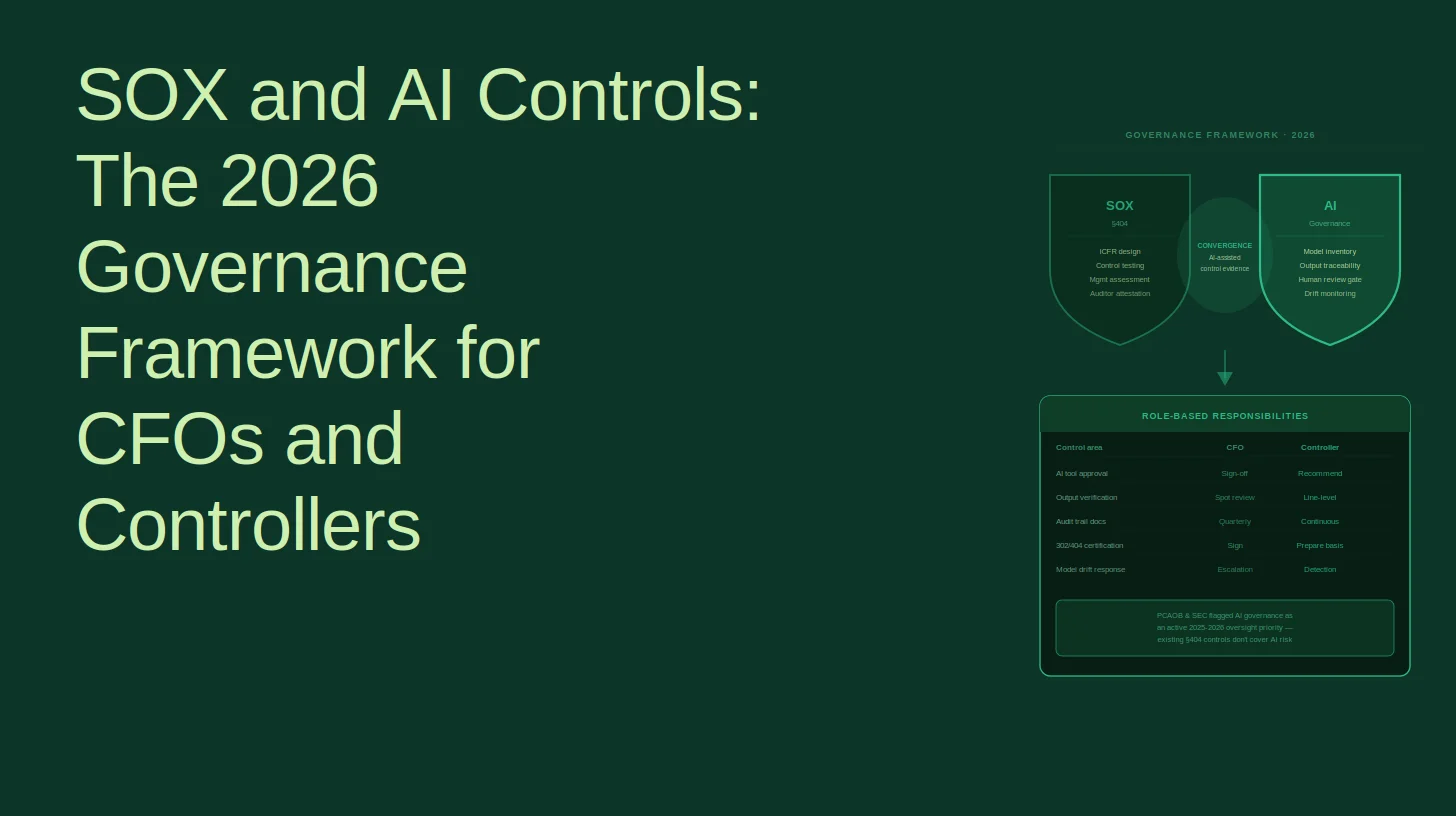
First, the PCAOB's rulemaking project on "Technology and the Evolving Audit" moved from concept release to active proposal stage. The project, listed on the PCAOB's rulemaking agenda, is expected to create explicit standards for how auditors must evaluate AI systems used by their clients in financial reporting processes. When those standards land, they will define by implication what management must document and control. Companies that have not already built AI governance into their ICFR programs will face a compressed remediation window.
Second, the SEC's Division of Corporation Finance has been issuing comment letters to registrants asking specifically about AI's role in financial reporting and whether that role is adequately disclosed. These letters are not a formal rule, but they establish de facto disclosure expectations. Companies using AI in material processes such as revenue recognition, impairment testing, or reserve estimation that do not address this in their filings risk being asked to amend. The SEC's broader regulatory philosophy, stated explicitly in its 2024 Staff Bulletin on AI in investment advice, is unambiguous: "The use of AI tools does not relieve a firm or its associated persons of their obligations under the federal securities laws."
Third, COSO published its GenAI roadmap in April 2026, translating the 2013 Internal Control Integrated Framework into GenAI-specific controls. The guidance explicitly addresses AI's probabilistic outputs and requires that they be managed under the same five COSO components as any other control. For SOX filers, this is significant: COSO's 2023 emerging technology guidance had already stated that when an automated control replaces a manual one, the IT general controls over that system become critical. The April 2026 GenAI roadmap makes that principle concrete for large language models and generative AI tools. See our COSO GenAI guidance walkthrough for the full breakdown.
The Five AI Uses Regulators and Big-4 Firms Now Treat as Prohibited or Pre-Approval Required
No regulator has published a list of banned AI uses in ICFR. The prohibition framework is being built from the bottom up, and as of mid-2026, five categories have reached near-consensus across PCAOB inspection findings, SEC comment letters, and Big-4 advisory guidance.
Grant Thornton's 2025 advisory identifies these five categories explicitly:
-
Autonomous journal entry posting above materiality thresholds without human approval. An AI system that posts adjusting entries without a qualified human sign-off eliminates the management review control that SOX Section 404 is designed to protect. KPMG's 2025 AI governance guidance treats this as a hard prohibition.
-
AI-generated management estimates without documented human review of model assumptions. FASB's existing standards on management estimates, including ASC 250, ASC 820, and ASC 326, require that estimates be based on reasonable and supportable assumptions. If an AI model cannot explain its assumptions in auditable terms, using it for impairment testing, reserve estimation, or fair value measurement may be non-compliant with the underlying accounting standard, not just with ICFR governance requirements.
-
AI that modifies its own access permissions or control parameters. This is the AI equivalent of a user granting themselves elevated access, a classic segregation-of-duties violation. Traditional user access review processes do not catch it because they focus on human accounts. BDO's 2025 report flags AI service accounts with broad system access as a logical access control gap that ITGC frameworks must explicitly address.
-
AI trained on data that has not passed completeness and accuracy testing. KPMG identifies this as a prohibited use because the control is only as reliable as its inputs. An AI model trained on incomplete or inaccurate historical data will produce systematically biased outputs, and those outputs may not trigger any obvious alert before they affect the financial statements.
-
AI-generated financial disclosures without human editorial review and sign-off. The SOX Section 302 certification requires the CEO and CFO to certify that disclosure controls and procedures are effective. If AI is drafting material disclosures and no qualified human is reviewing the substance, not just the formatting, that certification may be deficient. This is a direct legal risk.
The Human-in-the-Loop Standard: Where Regulators Are Landing
The practical dividing line between permissible and prohibited AI in ICFR is whether a qualified human reviews and approves the AI's output before it affects the financial statements.
Deloitte's 2024 internal audit report draws the distinction clearly: "AI-automated controls, where AI makes the decision autonomously, eliminate the human judgment element that management review controls are designed to provide. These require compensating controls: independent validation of AI outputs on a sample basis."
The AICPA's practice guide on AI in accounting reinforces this from the management review control side: "If management review controls are designed only to review AI outputs without understanding the AI's methodology, those controls may be ineffective. Management review controls over AI must include periodic validation of the AI model itself, not just its outputs."
This human-in-the-loop (HITL) requirement is not yet codified in SOX or PCAOB standards. But it is the consensus position of Big-4 advisory practice as of 2025-2026, and the PCAOB's 2024 inspection priorities document signals that inspectors are already assessing whether firms have adequate quality control over AI-assisted procedures, "including whether the firm understands the tool's logic and has tested its reliability."
The distinction between AI-assisted and AI-automated matters for ICFR design:
| Control Type | Human Role | ICFR Risk Level | Compensating Control Required |
|---|---|---|---|
| AI-assisted | Human decides; AI provides input | Lower | Document human review and basis for approval |
| AI-automated (detective) | Human reviews exception reports | Medium | Validate AI logic; test exception thresholds |
| AI-automated (preventive) | Human reviews after the fact | High | Independent output validation; HITL redesign |
| AI-automated (no review) | None | Prohibited / material weakness risk | Redesign required |
What the PCAOB's 2024 Inspection Findings Mean for Your ICFR Program
PCAOB inspectors flagged AI-generated work product as an area of heightened scrutiny in their 2024 inspection priorities, and the implications run directly to management's ICFR documentation obligations.
PCAOB AS 1105 requires that audit evidence be sufficient and appropriate. When AI generates financial data or analysis that forms the basis of financial statements, auditors must evaluate whether that AI-generated evidence meets this standard. If the AI's logic is a black box, the evidence may not be "appropriate," meaning auditors may need alternative procedures or require management to provide additional documentation of the AI's processing.
The 2023 PCAOB Staff Spotlight on technology-based audit procedures went further, identifying a specific prohibited practice: using AI output as audit evidence without independent validation of the tool. Firms that treated AI output as self-evidencing, without testing the tool's logic, received inspection findings.
For management, the implication is direct. PCAOB AS 2201 requires auditors to evaluate the design and operating effectiveness of controls over all processes that could materially affect financial reporting. When AI performs or influences those processes, the AI system's controls, covering inputs, processing logic, outputs, access, and change management, must be testable. If they are not, the auditor cannot form an opinion on ICFR effectiveness.
The ITGC Scoping Problem That Is Catching Companies Off Guard
The most common ICFR deficiency related to AI in 2025 was not a control failure. It was a documentation failure.
EY's 2025 Technology Risk in ICFR publication found that over 60% of companies using AI in finance had not updated their risk and control matrix to reflect AI's role. External auditors are increasingly flagging this gap. The failure to update ICFR documentation when AI tools are introduced into financial processes is now the most commonly cited AI-related deficiency in EY's advisory practice.
Three ITGC domains are most affected, per BDO's 2025 report:
-
Change management. AI models that retrain continuously or are updated by vendors without formal change tickets create change management control gaps. A traditional change management control requires a ticket, approval, and testing before a system change goes live. A model that updates its own weights on new data has no equivalent process. Companies need a defined revalidation trigger, whether that is a scheduled cadence, a performance threshold breach, or a vendor-initiated update.
-
Logical access. AI service accounts often carry broad system permissions that are not subject to the same quarterly access review processes as human user accounts. If the AI system can read and write to the general ledger, that access needs to be in scope for access review.
-
Computer operations. AI inference runs may not be logged in the same way as traditional batch processes, creating gaps in operations monitoring. If an AI model produces an output that affects a financial statement balance and there is no log of that run, the auditor has no evidence trail.
A specific and underappreciated version of this problem involves third-party AI tools embedded in ERP platforms. SAP's AI features, Oracle Fusion AI, Microsoft Copilot for Finance, and Workday AI are often treated as vendor-managed and excluded from ITGC scope. But if the AI feature performs a key control function, such as automated three-way match or AI-driven reconciliation, it must be in scope. The vendor's SOC 1 report may not cover the AI-specific controls, creating a gap that neither the company nor its auditor has addressed. For a full walkthrough of ITGC scoping in technology-heavy environments, see our ITGC scoping guide for SaaS environments.
Model Drift: The Control Deficiency Nobody Has a Framework For Yet
Model drift, the gradual degradation of an AI model's accuracy as real-world data patterns diverge from training data, is a specific ICFR risk with no analog in traditional control frameworks.
If an AI model used in revenue recognition or reserve estimation drifts and begins producing systematically biased outputs, that drift could constitute a control deficiency. If the bias is material, it could constitute a material weakness. No current PCAOB or SEC rule explicitly addresses model drift monitoring as an ICFR requirement, but Big-4 guidance is uniform: periodic model revalidation is a necessary compensating control for any AI system performing a key control function.
The practical question for audit committees is: what is the revalidation trigger? Best practice as of 2026 includes:
- A defined performance monitoring metric with a threshold that triggers revalidation (for example, output accuracy falling below a specified tolerance)
- A scheduled periodic revalidation cadence independent of performance monitoring (for example, quarterly for high-risk models)
- A mandatory revalidation whenever the underlying business process or data distribution changes materially (for example, a new product line, a change in customer mix, or a new accounting standard)
For a deeper look at how model drift and AI hallucination interact with financial reporting risk, see our AI hallucination in financial reporting walkthrough.
The EU AI Act Overlap: A Convergence Opportunity for Multinational SOX Filers
For companies subject to both SOX and the EU AI Act, the governance requirements are converging in ways that create an efficiency opportunity.
The EU AI Act, effective August 2024 with phased compliance running through 2026, classifies AI systems used in critical infrastructure and processes affecting individuals' rights as high-risk. High-risk AI systems require conformity assessments, human oversight mechanisms, and accuracy documentation. These requirements are substantively similar to what good ICFR governance requires for AI in financially material processes.
Multinational SOX filers that are building EU AI Act compliance programs should map those programs directly to their ICFR AI governance work. The documentation requirements overlap significantly: both frameworks require evidence of training data validation, human oversight design, accuracy monitoring, and change management. Building one integrated governance program is more efficient than running two parallel workstreams.
2026 Action Checklist for CFOs and Audit Committees
Use this checklist to assess your current AI exposure in ICFR before your next external audit or SEC comment letter:
- Inventory AI tools in financially material processes. List every AI system, including ERP-embedded features, that touches journal entries, reconciliations, revenue recognition, estimates, or financial disclosures.
- Classify each as AI-assisted or AI-automated. Automated uses require compensating controls or redesign.
- Update your risk and control matrix. Add AI systems as in-scope automated controls with documented inputs, processing logic, outputs, and human review steps.
- Scope AI systems into ITGC. Confirm change management, logical access, and operations controls exist for each in-scope AI system, including vendor-managed tools.
- Assess SOC 1 coverage for third-party AI tools. If the vendor's SOC 1 does not cover the AI feature, document the gap and implement a complementary user entity control.
- Design a model drift monitoring program. Define revalidation triggers and cadence for each AI model performing a key control function.
- Review Section 302 certification exposure. Confirm that CEO and CFO certifications are supportable given current AI use in financial reporting processes.
- Assess disclosure obligations. Determine whether AI use in material financial reporting processes requires disclosure under SEC comment letter expectations or the cybersecurity disclosure rules (SEC Rule 33-11216).
- Brief the audit committee. Ensure the audit committee has received a specific briefing on AI-related ICFR risks, not just AI's efficiency benefits.
- Monitor PCAOB rulemaking. Track the "Technology and the Evolving Audit" project for final standards that will define management documentation obligations.
The regulatory direction is clear even if the final rules are not yet written. Companies that build AI governance into their ICFR programs now will be positioned to respond to auditor inquiries and SEC comment letters from a position of strength rather than remediation.