13F Filing Deadlines 2026: Every Date, Rule, and Trap Institutional Managers Must Know
If you manage $100 million or more in Section 13(f) securities, your 13F filing deadline 2026 calendar has four hard dates. Miss one, and you are not just late on a form, you are potentially in the crosshairs of an SEC exam that specifically flagged 13F compliance as a priority this year.
Here is the complete picture: exact dates, the arithmetic behind them, the Form SHO complication that almost no deadline article mentions, and the EDGAR mechanics that catch filers off guard at 5:31 p.m.
The Four Form 13F Filing Deadlines for 2026
The statutory rule is 45 calendar days after each calendar quarter-end. When that 45th day falls on a weekend or federal holiday, the deadline rolls forward to the next business day. Two of the four 2026 dates trigger that roll-forward.
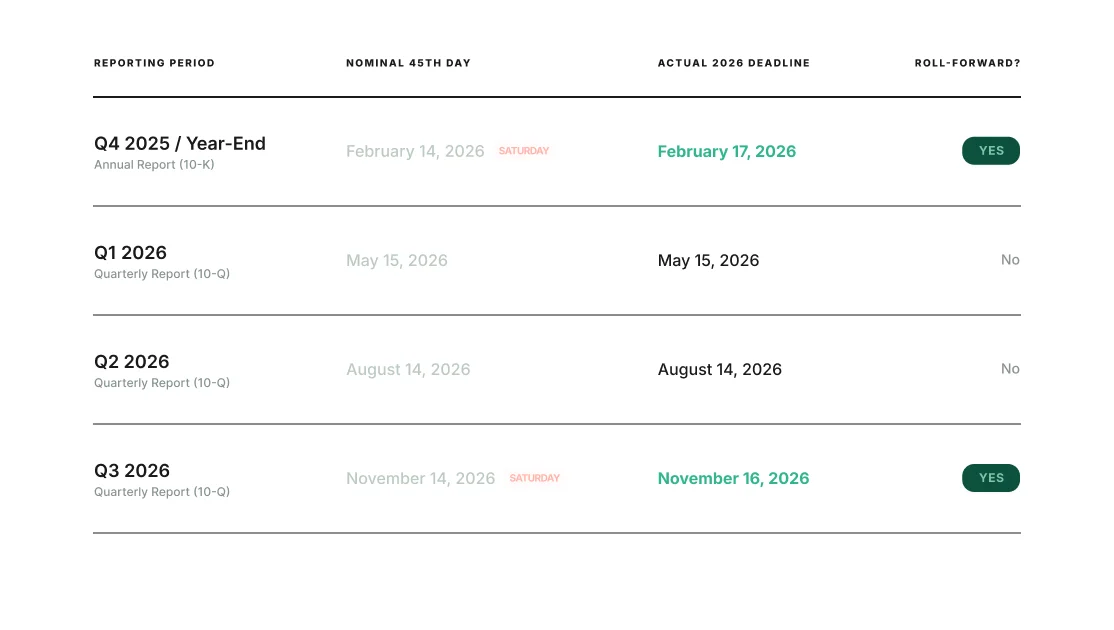
The SEC's own FAQ makes the February date explicit: "the deadline for the December 31, 2025 Form 13F report will be no later than February 14, 2026, a Saturday", which means the actual filing deadline is Monday, February 17. That nuance trips up more filers than you might expect.
Key takeaway: February 17 and November 16 are the two adjusted dates for 2026. If your compliance calendar still shows February 14 or November 14, fix it now.
Who Is Required to File Form 13F?
Any institutional investment manager exercising investment discretion over $100 million or more in Section 13(f) securities must file under Section 13(f) of the Securities Exchange Act of 1934. Three details matter here.
The $100 million threshold is not total AUM. It applies specifically to Section 13(f) securities, exchange-traded equities, certain equity options and warrants, shares of closed-end investment companies, and certain convertible debt securities. A manager with $300 million in AUM but only $90 million in Section 13(f) securities does not file. The threshold is measured by aggregate fair market value on the last trading day of any month of any calendar year; crossing it in a single month triggers the filing obligation for the subsequent calendar year.
Foreign managers are not exempt. If a non-U.S. asset manager uses any means or instrumentality of U.S. interstate commerce and exercises investment discretion over $100 million or more in Section 13(f) securities, it must file. This catches many non-U.S. managers with U.S. equity exposure who assume the obligation does not apply to them.
Governmental entities file too. Municipal pension funds, sovereign wealth funds, and other government-related entities are institutional investment managers for 13F purposes. The SEC's FAQ is explicit: "person" includes "a natural person, company, government, or political subdivision, agency, or instrumentality of a government."
For a deeper look at the threshold mechanics and what counts as investment discretion, see Finrep's SEC Form 13F Reporting Requirements: 2026 Compliance Guide.
Why Is February 17, 2026 a Dual Deadline for Form 13F and Form SHO?
February 17 carries more weight than most filers realize. It is not just the Form 13F Q4 2025 deadline. It is also the first-ever filing deadline for Form SHO under Rule 13f-2, a separate short-sale transparency obligation that runs alongside Form 13F.
Here is the background. Rule 13f-2 was originally set to take effect January 2, 2025, with initial Form SHO filings due February 14, 2025. In February 2025, the SEC granted a temporary exemption because the technical standards for compliance were only released on December 16, 2024, immediately before the holidays, leaving insufficient time for implementation. The exemption was not a repeal. As SEC Acting Chairman Mark Uyeda stated at the time:
"This exemption gives filers more time to implement the technical updates required for compliance according to standards that were released only on Dec. 16, 2024, immediately prior to the holidays. Regardless of this exemption, abusive naked short selling as part of a manipulative scheme remains unlawful.", SEC Press Release, February 7, 2025
The first Form SHO deadline was pushed to February 17, 2026, covering the January 2026 reporting period. Form SHO must be filed within 14 calendar days after the end of each calendar month under Rule 13f-2.
Form SHO is distinct from Form 13F. It applies to institutional investment managers that meet or exceed certain short-position thresholds, not all 13F filers will also be Form SHO filers. But if you are a large manager with significant short positions, February 17, 2026 meant two separate EDGAR submissions on the same day.
Key takeaway: Skadden has noted that "industry participants have highlighted certain ambiguities and compliance questions regarding the scope of Rule 13f-2." If you have short positions that might trigger Form SHO, get legal counsel on whether you are in scope, the rule is live and the exemption period is over.
What Time Does EDGAR Stop Accepting Form 13F Filings on the Deadline?
EDGAR accepts filings from 6 a.m. to 10 p.m. ET on weekdays (excluding federal holidays). But there is a critical distinction buried in the rules: filings submitted after 5:30 p.m. ET receive the next business day's filing date.
This means a 13F submitted at 6:00 p.m. on August 14 is technically filed on August 17, and is late.
The exceptions to this rule are Schedules 13D and 13G, Section 16 filings, and Rule 462(b) registration statements, which receive the actual filing date regardless of time. Form 13F is not one of those exceptions.
Build your internal deadline around 5:00 p.m. ET, not 10:00 p.m. That buffer absorbs last-minute EDGAR system issues, reviewer sign-offs, and the kind of submission errors that only appear when you are rushing.
One additional note for filers watching the August 14 deadline: the SEC announced on June 1, 2026 that the June 2026 EDGAR release was cancelled. Monitor the EDGAR submissions page for any system notices ahead of the August deadline.
What Other SEC Filings Are Due on the Same Date as Form 13F?
Form 13F does not exist in isolation. Compliance teams managing institutional portfolios face multiple overlapping obligations on the same four dates.
DeadlineForm 13FSchedule 13GForm 13H (Annual)February 17, 2026Q4 2025 / Year-EndQuarter-end assessmentAnnual update (calendar year 2025)May 15, 2026Q1 2026Quarter-end assessmentN/AAugust 14, 2026Q2 2026Quarter-end assessmentN/ANovember 16, 2026Q3 2026Quarter-end assessmentN/A
Sources: Day Pitney 2026 Compliance Calendar; Skadden 2026 Filing Deadlines.
Schedule 13G quarterly assessments align exactly with the 13F dates following amendments effective September 30, 2024. Large traders filing Form 13H face their annual update on February 17 as well. If your team manages all three obligations, February 17 is the most demanding day on your compliance calendar.
One more wrinkle for Schedule 13G filers: the SEC withdrew its prior guidance in early 2025 (CDI 103.11 and 103.12) that engagement on ESG or governance topics unrelated to control would typically not affect 13G eligibility. Under the current guidance, shareholder engagement that "exerts pressure on management to implement specific measures or changes to a policy may be influencing control over the issuer" and could require a switch to Schedule 13D. Activist-adjacent managers who file both 13F and 13G should review their engagement practices against this updated standard.
Form 13F Amendments Still in Effect: Are You Using the Right Form?
The June 2022 amendments to Form 13F (SEC Release No. 34-95148) took effect January 3, 2023. If your EDGAR workflow predates that update, you may be filing an outdated form. The four substantive changes that remain in force are:
- CT checkbox on the Summary Page, a checkbox indicating when confidential treatment is being requested.
- Additional manager identifiers, CRD number and SEC file number must be reported if applicable.
- FIGI identifiers, managers may now report a Financial Instrument Global Identifier alongside (not instead of) the CUSIP number.
- Dollar rounding simplified, values must be rounded to the nearest dollar, not the nearest $1,000.
Confidential treatment requests must also be filed electronically on EDGAR as of February 28, 2023. Paper CT requests are no longer accepted. If your workflow still routes CT requests through paper, that is a compliance failure waiting to happen.
The current OMB approval for Form 13F (OMB Number 3235-0006) expires January 31, 2029, which signals no near-term structural overhaul of the form is coming. What you see now is what you will be filing through at least 2028.
The Quarterly 13F List: Check It Before You File
Section 13(f) securities are defined by reference to the SEC's official quarterly list. The Q1 2026 list was published March 31, 2026. Filers may rely on the current list when determining which holdings to report for a given quarter.
This matters in practice. Securities are added and removed from the list quarterly. A holding that was reportable in Q4 2025 may not appear on the Q1 2026 list, and vice versa. Filing without checking the current list risks both omissions and over-reporting.
Shared Investment Discretion: The Sub-Adviser Trap
Where two or more managers each required to file Form 13F exercise investment discretion over the same securities, only one manager must include those securities in its report. The other manager must identify the reporting manager in its own filing. This anti-duplication rule is set out in Special Instructions 5 and 7 of the Form 13F General Instructions.
Sub-advisers and wrap-fee program sponsors frequently get this wrong. If you share discretion with another manager, confirm in writing which entity is the reporting manager before each filing deadline.
SEC Exam Priority: 13F Is Not Just a Calendar Exercise in 2026
The SEC's Division of Exams released its FY 2026 Examination Priorities in November 2025. Form 13F compliance, alongside Form N-PX, is specifically flagged for investment advisers with activist strategies. Examiners are looking at whether activist managers' holdings disclosures are accurate, complete, and consistent with their fiduciary obligations.
The 2026 priorities also flag increased scrutiny of advisers managing both private funds and registered investment companies with similar strategies. If your 13F holdings overlap with a registered fund's portfolio, expect examiners to test consistency.
This is not a theoretical risk. It means your 13F compliance program needs to be exam-ready, not just deadline-ready.
FAQ
What is the Form 13F deadline for Q4 2025?February 17, 2026. The nominal 45-day deadline falls on February 14, which is a Saturday, so it rolls forward to Monday, February 17.
How delayed are 13F filings relative to the quarter they cover?Up to 45 calendar days. A Q2 2026 filing (covering April through June 30) is not due until August 14, 2026, meaning the market sees holdings data that is nearly six weeks old by the time it is public.
Does the $100 million threshold apply to total AUM or only Section 13(f) securities?Only Section 13(f) securities. Total AUM is irrelevant. The threshold is measured by aggregate fair market value of qualifying securities on the last trading day of any month of any calendar year.
Do foreign institutional investment managers have to file Form 13F?Yes, if they use any means or instrumentality of U.S. interstate commerce and exercise investment discretion over $100 million or more in Section 13(f) securities.
What is the EDGAR cut-off time for Form 13F on a deadline day?5:30 p.m. ET. A filing submitted after that time receives the next business day's date and is technically late. EDGAR accepts submissions until 10 p.m. ET, but the 5:30 p.m. cut-off is what determines the filing date for 13F purposes.
Is Form SHO the same as Form 13F?No. Form SHO is a separate monthly filing under Rule 13f-2 for managers that meet certain short-position thresholds. The first Form SHO deadline was February 17, 2026. It runs on a 14-day monthly cycle, not the 45-day quarterly cycle of Form 13F.
Can I still submit a paper confidential treatment request with my 13F?No. All CT requests must be filed electronically on EDGAR. Paper requests have not been accepted since February 28, 2023.