IFRS S1 Disclosure Requirements: 2026 Practitioner Walkthrough
IFRS S1 disclosure requirements tell you what to report. This article tells you how to actually do it. If your team is building or auditing a sustainability reporting process under the ISSB framework, this walkthrough covers the sequencing, the common pitfalls, and the decisions you need to make before your first filing.
IFRS S1 General Requirements for Disclosure of Sustainability-related Financial Information was issued by the ISSB in June 2023 and is effective for annual reporting periods beginning on or after 1 January 2024. Over 30 jurisdictions are in various stages of adoption as of mid-2026, according to the IFRS Foundation's adoption tracker. If you are also navigating IFRS S2's climate-specific layer, the Climate Scenario Analysis Under IFRS S2 walkthrough covers that in detail.
Key takeaway: IFRS S1 is the umbrella standard. It sets the general requirements that apply to every sustainability topic. IFRS S2 then adds climate-specific requirements on top. You cannot apply IFRS S2 without also applying IFRS S1.
Step 1: Confirm Whether IFRS S1 Applies to You
IFRS S1 applies to any entity that prepares general purpose financial reports and is required or chooses to apply IFRS Sustainability Disclosure Standards. It is not limited to IFRS Accounting Standards preparers.
Mandatory application depends on your jurisdiction. Australia mandated IFRS S1-aligned disclosures (AASB S1) for large entities from 1 January 2025, making it one of the first jurisdictions to do so. The UK is adopting IFRS S1 and S2 as UK Sustainability Reporting Standards (UK SRS), with mandatory application for large listed companies expected following the 2025-2026 consultation process. Japan, Singapore, Brazil, Nigeria, and Canada are at various stages of adoption.
Early application is permitted from 1 January 2024, but only if you also apply IFRS S2 at the same time. You cannot cherry-pick.
Practical check:
- Has your jurisdiction mandated IFRS S1-aligned reporting? Check the IFRS Foundation jurisdiction tracker.
- Are you a large listed entity in Australia, Japan, or Singapore? Mandatory timelines are already live or imminent.
- Are investors or lenders requesting ISSB-aligned disclosures voluntarily? That is increasingly common regardless of jurisdiction.
Step 2: Run Your Materiality Assessment
IFRS S1 uses financial materiality, not double materiality. Information is material if omitting, misstating, or obscuring it could reasonably be expected to influence decisions that primary users (investors, lenders, creditors) make on the basis of your general purpose financial reports. This is the same materiality definition used in IFRS Accounting Standards.
This is the most common point of confusion for teams also subject to CSRD. The EU's ESRS framework requires double materiality: you assess both financial materiality (how sustainability risks affect the company) and impact materiality (how the company affects people and the environment). Under IFRS S1, impact materiality is not required. A topic that causes significant harm to communities but has no reasonably expected effect on your cash flows, access to finance, or cost of capital is not material under IFRS S1. The IFRS Foundation's interoperability guidance published in May 2024 confirms that entities reporting under CSRD will largely satisfy IFRS S1 requirements, but the reverse is not true.
How to run the materiality assessment in practice:
- Identify the universe of sustainability topics. Start with the SASB Materiality Map for your industry, the IFRS S2 requirements for climate, and any sector-specific regulatory guidance. Cast wide at this stage.
- Assess financial effect over short, medium, and long term. For each topic, ask: could this reasonably affect our cash flows, access to finance, or cost of capital? IFRS S1 requires you to define what short, medium, and long term mean for your entity, and those definitions must be consistent with your financial statements and strategic planning horizon.
- Apply the proportionality principle. IFRS S1 requires you to use "reasonable and supportable information that is available at the reporting date without undue cost or effort." This is not a licence to omit hard-to-collect data indefinitely, but it does mean you are not required to build a data collection programme that is disproportionate to the materiality of the topic.
- Document the judgements. IFRS S1 requires disclosure of significant judgements made in the materiality assessment, mirroring the IAS 1 requirement for significant accounting judgements. If you concluded that biodiversity risk is not material, document why, with reference to your value chain exposure and financial effect analysis.
- Assign ownership. The materiality assessment sits at the intersection of finance and sustainability. In practice, the CFO and Chief Sustainability Officer need to co-own it, with input from the risk function and sign-off from the audit committee.
Pitfall: Many teams run a stakeholder engagement process to identify material topics and then treat the output as their IFRS S1 materiality assessment. Stakeholder importance is not the same as financial materiality. The two processes need to be clearly separated in your documentation.
Step 3: Structure Disclosures Around the Four Pillars
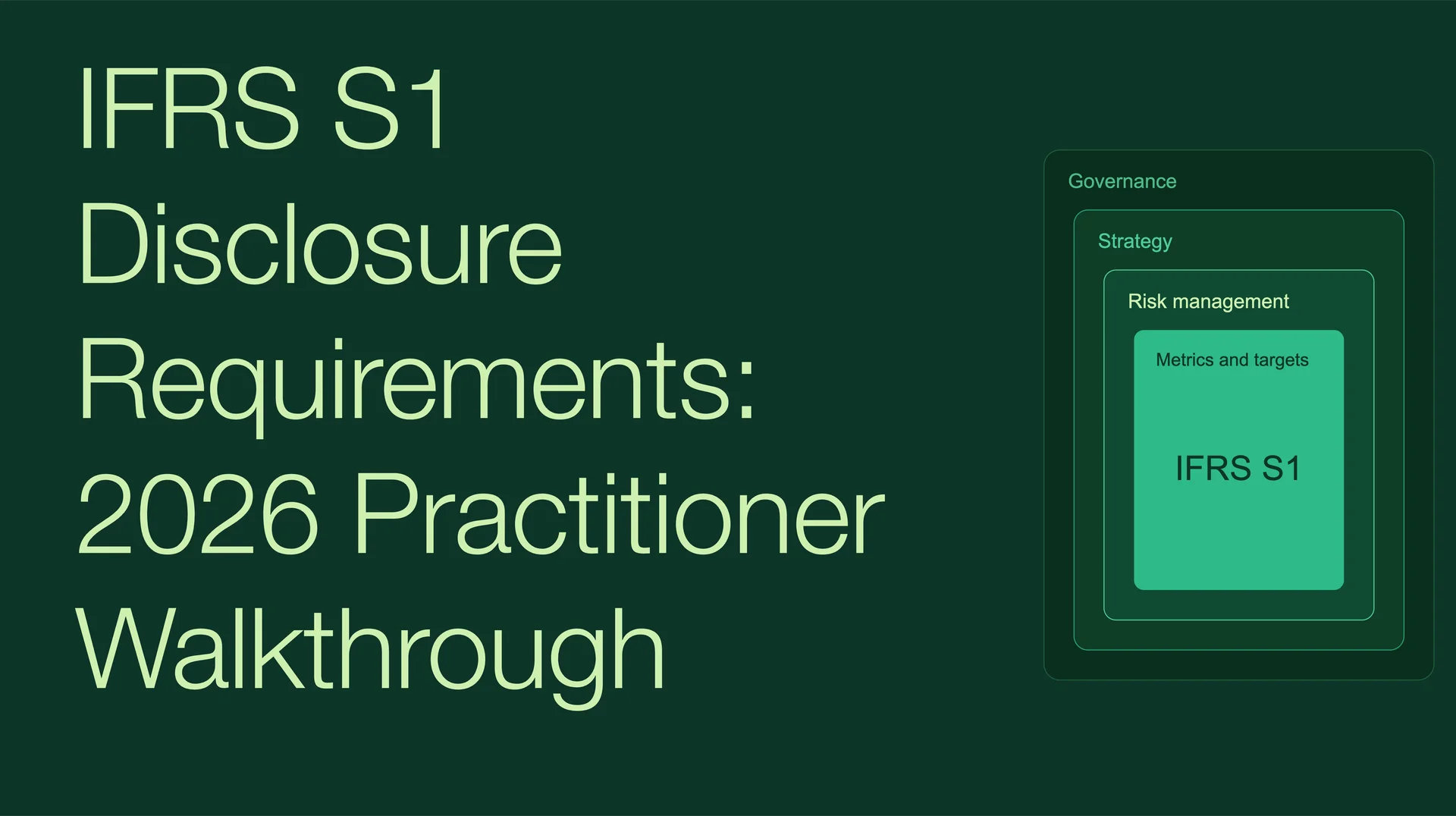
IFRS S1 organises all sustainability disclosures around four content pillars drawn from the TCFD recommendations. These apply to every sustainability topic that clears your materiality threshold, not just climate.
| Pillar | What IFRS S1 Requires in Practice |
|---|---|
| Governance | Identity of the body or individual responsible for oversight; how they exercise oversight; management's role; how the board is informed about sustainability risks and opportunities |
| Strategy | Risks and opportunities identified over short, medium, and long term; effects on business model and value chain; effects on strategy and decision-making; current and anticipated financial effects; resilience assessment |
| Risk Management | Processes to identify, assess, prioritise, and monitor sustainability risks and opportunities; whether and how these are integrated into overall enterprise risk management |
| Metrics and Targets | Metrics used to measure and monitor risks and opportunities (cross-industry, industry-based, and entity-specific); targets set; performance against targets |
Governance pillar: what auditors actually look for
The governance disclosure is not a board biography. IFRS S1 requires you to explain how the board exercises oversight, not just who is responsible. That means describing the frequency of board-level sustainability reporting, how sustainability performance is linked to executive remuneration, and what information the board receives and when. If your board receives a quarterly sustainability dashboard, say so and describe its contents.
Strategy pillar: the financial effects requirement
This is where most first-time preparers underdeliver. IFRS S1 requires disclosure of the effects of sustainability risks and opportunities on your financial position, financial performance, and cash flows, both in the current period and anticipated over the short, medium, and long term. A qualitative statement that "climate change may affect our operations" does not satisfy this requirement. You need to connect the risk to a financial line item or range.
Metrics and targets: using the guidance hierarchy
When IFRS S1 does not specify metrics for your industry, you must work through a defined hierarchy of sources:
- IFRS S2 requirements and guidance (for climate topics)
- SASB Standards for your industry classification
- CDSB Framework application guidance
- The most recent TCFD recommendations
- Industry or regulatory requirements in your jurisdiction
- Other sustainability reporting standards (e.g., GRI), if consistent with IFRS S1
For a financial services firm assessing biodiversity risk, for example, there is currently no ISSB topic-specific standard. You would go to the SASB Standards for Commercial Banks or Asset Management, then to the TNFD recommendations as the most relevant available guidance, and document your rationale. The ISSB's 2024-2026 work plan includes projects on biodiversity, human capital, and human rights, all of which will sit under the IFRS S1 umbrella when finalised.
Step 4: Operationalise the Connectivity Requirement
Connectivity is IFRS S1's most distinctive and most underimplemented requirement. The standard requires sustainability disclosures to be presented in a way that enables users to understand the connections between different sustainability topics, and between sustainability disclosures and the financial statements.
In practice, this means tracing a sustainability risk to a specific financial statement line item. Here is a worked example:
- A manufacturer identifies physical climate risk (flooding at a key production site) as material under IFRS S1.
- The strategy disclosure quantifies the anticipated financial effect: a 15% probability of a production disruption that would reduce revenue by approximately $40 million in a severe scenario.
- The connectivity requirement means this disclosure must be explicitly linked to the property, plant and equipment note in the financial statements (where the site's carrying value appears), the IAS 37 provisions note (if a provision has been recognised for remediation costs), and the going concern assessment if the disruption is severe enough to be relevant.
This is analogous to the IAS 1 paragraph 125 requirement to disclose sources of estimation uncertainty in the financial statements. IFRS S1 extends that logic to sustainability: if a sustainability metric involves significant estimation, disclose the nature of the uncertainty and the range of reasonably possible outcomes.
Where to present the disclosures: IFRS S1 requires sustainability disclosures to be part of the entity's general purpose financial reports, published alongside the financial statements. It does not prescribe a specific location. In practice, most preparers are using a dedicated sustainability section within the annual report or integrated report, with cross-references to the relevant notes in the financial statements. A standalone voluntary sustainability report published separately from the annual report does not satisfy the requirement.
Step 5: Elect Your Transition Reliefs
IFRS S1 includes several practical reliefs for first-time adopters. These are time-limited and require an explicit election.
| Relief | What It Allows | Duration |
|---|---|---|
| Comparative information | Omit comparative sustainability data in the first annual reporting period | First year only |
| Timing of publication | Publish sustainability disclosures after the financial statements in the first year (no later than the next quarterly or half-year interim report, or within nine months of year-end if no interim report is required) | First year only |
| Scope 3 emissions (under IFRS S2) | Omit Scope 3 GHG emissions disclosure in the first annual reporting period | First year only |
For a company with a 31 December 2025 year-end applying IFRS S1 for the first time, the timing relief means sustainability disclosures could be published alongside the half-year interim report (typically August 2026) rather than with the annual report in early 2026. This addresses the practical reality that sustainability data takes longer to compile than financial data.
Document each relief election explicitly in your disclosures. Investors and auditors will expect to see which reliefs you have taken and why.
Pitfall: The transition reliefs expire after the first reporting period. If you rely on them in year one, your year-two disclosures must include full comparatives, Scope 3 data, and simultaneous publication. Build the data infrastructure now, not after year one.
Step 6: Address the Value Chain Scope
IFRS S1 requires you to consider your entire value chain, including upstream and downstream activities, when identifying and disclosing sustainability risks and opportunities. This is one of the most significant practical challenges for preparers.
"Undue cost or effort" is the proportionality threshold. In practice, this means:
- For Tier 1 suppliers with significant spend concentration, direct data collection is generally expected.
- For diffuse supply chains with thousands of small suppliers, industry averages or proxy data with appropriate disclosure of estimation uncertainty is acceptable in early adoption periods.
- Downstream value chain data (product use-phase emissions, end-of-life impacts) is typically the hardest to collect. Document your methodology and its limitations.
The Scope 3 Emissions Disclosure Methodology guide covers the calculation approaches and materiality screening for the emissions dimension of this challenge.
Step 7: Prepare for Assurance
IFRS S1 does not mandate external assurance. But the standard is explicitly designed so that disclosures can be assured, and the trajectory is clear: the IAASB finalised ISSA 5000 in late 2024 as the international standard for sustainability assurance, and several jurisdictions mandating IFRS S1-aligned disclosures are requiring assurance alongside them.
For CFOs and audit committees, the practical implication is that internal controls over sustainability reporting (ICSR) need to be built now, not when assurance becomes mandatory. The same control design principles that apply to financial reporting (completeness, accuracy, cut-off, existence) apply to sustainability metrics. If your Scope 1 emissions figure cannot be traced from the source meter reading through to the disclosure, a limited assurance engagement will find that gap.
The ICFR and Climate Disclosure Audit walkthrough covers the control design questions in detail.
IFRS S1 vs. CSRD: What Overlaps and What Doesn't
For multi-jurisdiction preparers, the key question is whether CSRD compliance gives you IFRS S1 compliance for free. The short answer: mostly yes, but not entirely.
| Dimension | IFRS S1 | CSRD / ESRS |
|---|---|---|
| Materiality | Financial materiality only | Double materiality (financial + impact) |
| Scope | All sustainability topics affecting financial prospects | All sustainability topics (broader) |
| Value chain | Required | Required |
| Connectivity to financials | Explicit requirement | Required under ESRS |
| Assurance | Not mandated by standard | Limited assurance mandated (reasonable assurance phased in) |
| Presentation | Within general purpose financial reports | Management report |
The IFRS Foundation's May 2024 interoperability guidance maps the two frameworks in detail. The practical implication: if you are preparing CSRD-compliant disclosures, you are producing more than IFRS S1 requires (because of double materiality and impact disclosures). You can present the IFRS S1-required subset alongside the broader CSRD disclosures, provided the required information is not obscured by the additional content.
IFRS S1 explicitly permits this: entities can present additional information to meet other requirements alongside the IFRS S1-required disclosures.
FAQ
Do we need both IFRS S1 and IFRS S2? Yes, if climate is a material topic for your entity. IFRS S1 is the general requirements layer; IFRS S2 adds climate-specific requirements. You cannot apply IFRS S2 without IFRS S1. If climate is not material after your assessment, you still apply IFRS S1 for any other material sustainability topics.
What if no ISSB standard covers our industry's key sustainability topics? Work through the guidance hierarchy: SASB Standards for your sector, then CDSB Framework guidance, then TCFD recommendations, then industry or regulatory requirements, then GRI if consistent with IFRS S1. Document your rationale for the sources you selected.
Can we publish our sustainability disclosures in a separate sustainability report? No. IFRS S1 requires sustainability disclosures to be part of the general purpose financial reports, published alongside the financial statements. A standalone voluntary report does not satisfy the standard. Most preparers use a dedicated section within the annual or integrated report with cross-references to the financial statement notes.
Is IFRS S1 mandatory globally? Not yet. The standard is available for immediate application globally, but mandatory application depends on jurisdictional adoption. Australia mandated IFRS S1-aligned disclosures from 1 January 2025. The UK, Singapore, Japan, Brazil, and others are in various stages of adoption. IOSCO's July 2023 endorsement called on its 130 member securities regulators to incorporate the standards into their frameworks.
What assurance is required under IFRS S1? IFRS S1 itself does not mandate assurance. However, ISSA 5000 (finalised late 2024) provides the international standard for sustainability assurance engagements, and several jurisdictions are requiring assurance alongside mandatory IFRS S1-aligned disclosures. Build assurance-ready controls now rather than retrofitting them.
How do we define short, medium, and long term? IFRS S1 does not prescribe definitions. You define them, but they must be consistent with the time horizons used in your financial statements and strategic planning. Disclose the definitions you use. A common approach: short term aligns with the financial statement going concern period (typically 12 months), medium term with the strategic plan horizon (3-5 years), and long term with the entity's asset life or sector-relevant planning horizon.