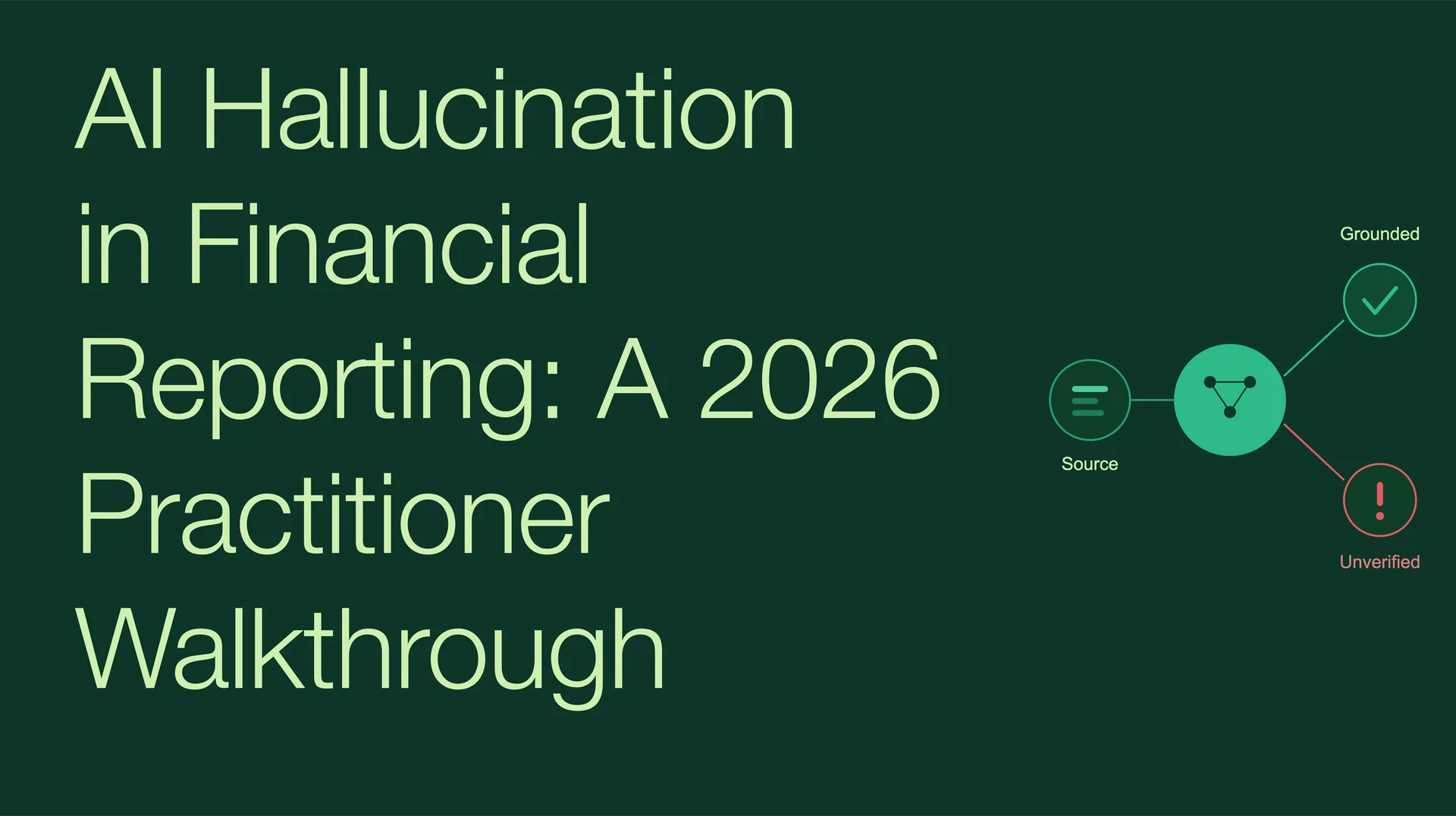
AI Hallucination in Financial Reporting: A 2026 Practitioner Walkthrough
AI hallucination in financial reporting is no longer a theoretical edge case. It is a named examination focus in FINRA's 2026 Annual Regulatory Oversight Report, a reason a Big Four firm refunded a government client in October 2025, and the failure mode that wiped roughly £100 billion off Google's market value in a single afternoon in February 2023. Finance teams deploying AI across the close and reporting cycle need a task-by-task risk map, a clear picture of what regulators actually require, and controls that hold up under auditor scrutiny, not just vendor demos.
This walkthrough covers exactly that. If you want the broader picture of how AI is reshaping reporting workflows, start with how AI is transforming financial reporting workflows today. This article goes deeper on the specific hallucination risk embedded in each reporting task and the controls that address it.
Key takeaway: The question is not whether your AI will hallucinate. According to Aveni, AI hallucinations occur in up to 41% of finance-related queries. The question is whether your controls will catch one before it reaches a filed disclosure.
Where AI Hallucination Risk Actually Lives in the Reporting Cycle
Not all financial reporting tasks carry equal hallucination exposure. The risk concentrates in tasks where the model has the most latitude to generate free text and where reviewers are most likely to anchor on the AI draft without independent scrutiny. Here is the task-by-task breakdown.
| Reporting Task | Hallucination Risk Level | Primary Failure Mode |
|---|---|---|
| XBRL/iXBRL tagging | Low-to-medium | Wrong taxonomy element mapped to a line item; silent misrepresentation in machine-readable filing |
| Covenant calculations | High consequence | Small numerical error crosses a disclosure threshold; 0.5% deviation can equal millions of dollars per Deloitte |
| MD&A drafting | Highest | Model invents trend explanations unsupported by the underlying data; reviewers anchor on fluent prose |
| Footnote disclosures | High | Fabricated citations to standards (e.g., "IFRS 99") or incorrect cross-references to other notes |
| Earnings release language | High, market-sensitive | Plausible but wrong figures or forward-looking statements reach the market before correction |
| CSRD/ESRS narrative sections | High and growing | Free-text, judgment-intensive, subject only to limited assurance, prepared under extreme time pressure |
| Audit sampling and variance commentary | Medium-high | AI-generated explanations for variances that do not reflect the actual underlying cause |
The pattern is consistent: narrative-heavy, free-text sections carry the most risk. Baltic Assist's analysis puts it plainly: the more latitude the model has to generate text, the higher the chance it drifts from the underlying numbers.
XBRL tagging deserves a specific note. AI tools are increasingly used to map financial statement line items to taxonomy elements, and an incorrect tag can cause material misrepresentation in machine-readable filings consumed directly by regulators and investors. For a detailed evaluation of AI accuracy in XBRL workflows, see AI XBRL tagging accuracy for SEC filers.
Why RAG Systems Are Not the Safety Net You Think They Are
Retrieval-augmented generation (RAG) reduces hallucination risk but does not eliminate it, and the retrieval layer itself is typically the weak link. A top LLM paired with perfect retrieval scores approximately 89% accuracy on financial questions under benchmark conditions. The same model, running against a realistic enterprise setup with live ledger data, fails on the majority of queries, according to 2026 benchmarks cited by Baltic Assist.
The failure modes in enterprise RAG deployments are specific:
- Retrieval failure: the system pulls the wrong document version, an outdated policy, or an incomplete context chunk, and the model generates a confident answer based on bad inputs.
- Context window truncation: long financial documents get compressed; the model loses critical details and fills gaps with statistically probable text.
- Stale training data: the base model's knowledge cutoff means it may confidently apply superseded accounting guidance, a particular risk for standards under active amendment.
- Overconfidence signalling: the model presents a hallucinated output with identical tone and formatting to a correct one, making it indistinguishable to a non-expert reviewer.
For comparison: GPT-4 hallucinated 28.6% of citations when generating references for systematic reviews in a 2024 medical study cited by Deloitte. Stanford researchers found general-purpose chatbots hallucinated on 58-88% of legal questions in 2024. Financial reporting shares the citation-heavy, precision-critical characteristics of both domains.
Domain-specific AI trained on financial services data and regulatory vocabulary produces fewer hallucinations than general-purpose LLMs on financial tasks, because it has fewer knowledge gaps to fill with statistically probable but wrong text. Even so, domain-specific models require the same validation controls.
The Agentic AI Escalation: Why Single-Query Governance Is Not Enough
Agentic AI, where autonomous agents act on each other's outputs across a multi-step workflow, creates a qualitatively different hallucination risk. A single-query LLM produces one output a human can review. A multi-agent financial close workflow compounds errors at every step before any human sees the result.
Consider a realistic agentic close sequence:
- Agent A pulls the trial balance and generates a variance summary.
- Agent B drafts MD&A commentary based on Agent A's summary.
- Agent C populates the disclosure template using Agent B's draft.
- Agent D flags the output as ready for disclosure committee review.
If Agent A hallucinates a variance explanation, that error propagates through Agents B, C, and D, arriving at the disclosure committee as a polished, internally consistent narrative with no visible seam. Deloitte's analysis describes this as hallucinations creating "a chain of compounded errors in which small inaccuracies at each step accumulate into large-scale distortion of business processes."
The governance gap is real: according to the RiskConnect 2025 New Generation of Risk Report, 60% of companies are considering adopting agentic AI but over half have yet to undertake any form of risk assessment.
For agentic workflows, the control framework must operate at each agent handoff, not just at the final output.
What Regulators Actually Require in 2026
The regulatory picture is fragmented across five frameworks, all of which are simultaneously relevant to a large enterprise finance team. No single source maps them together. Here is the consolidated view.
| Regulator / Framework | Specific Obligation | Effective / Active |
|---|---|---|
| SEC (Regulation S-K, Item 303) | MD&A disclosures must be accurate; AI use in preparing disclosures does not transfer liability to the vendor | Ongoing; staff guidance active |
| PCAOB AS 2301 | Auditors must assess risk of material misstatement from AI-assisted procedures; documentation requirements apply | Ongoing; flagged as 2026 focus area |
| FINRA 2026 Oversight Report | Hallucinations and bias named as testable governance risks; firms must demonstrate testing and oversight | December 2025 publication; 2026 examinations |
| EU AI Act, Article 14 | Human oversight, transparency, traceability, and event logging required for high-risk AI systems affecting EU persons; penalties reach tens of millions of euros or a percentage of global turnover | Core obligations enforceable from 2 August 2026 |
| CSRD / ESRS | Sustainability reporting subject to limited assurance; narrative ESRS sections carry high hallucination exposure with no current AI-specific carve-out | FY2024 first reporters; expanding scope |
The EU AI Act's Article 14 human oversight requirement applies to any organisation whose AI outputs affect people in the EU, regardless of server location. The regulation does not prohibit AI in financial reporting. It requires a qualified human to remain accountable for what the AI produces.
For the SEC's specific guidance on AI use in disclosures and what comment letters are actually flagging, see SEC AI financial reporting guidance 2026. For the disclosure question specifically, including whether AI use in MD&A preparation requires disclosure as a material risk factor, see AI disclosure in your Form 10-Q.
The Liability Question: "The AI Made a Mistake" Is Not a Defence
When an AI-generated hallucination reaches a filed disclosure, the enterprise, not the AI vendor, bears legal responsibility. The Air Canada precedent established this clearly: a Canadian tribunal ruled in 2024 that Air Canada was responsible for what its chatbot said, even though the chatbot invented a refund policy that did not exist. "The algorithm made a mistake" was not a viable defence.
The same logic applies directly to financial reporting. Under the UK FCA's Consumer Duty, firms own the outcomes of AI-generated outputs. Under SEC rules, the signatory on a filing is responsible for its accuracy. Lawyers who submitted court briefs citing entirely fabricated ChatGPT-generated case citations in 2023 faced sanctions, establishing professional liability for AI hallucination in high-stakes document production.
The October 2025 Big Four incident, where a firm acknowledged using generative AI to produce a government report containing fabricated citations and refunded part of the fee, is the highest-profile professional-services hallucination case to date. For a detailed breakdown of that case and its implications for audit and advisory contexts, see the Deloitte AI hallucination case analysis.
The liability allocation between AI vendors and enterprise users is not ambiguous in practice: the enterprise user who deploys the tool and signs the filing owns the error.
A Concrete Control Framework for the Financial Reporting Cycle
"Human-in-the-loop" is necessary but not sufficient as a control description. What it means in practice, mapped to the reporting cycle, is the following.
Pre-Generation Controls
- Data source validation before any AI query. Confirm the retrieval layer is pulling from the correct, current version of the trial balance, prior-period disclosures, and applicable standards. Document the data sources used for each AI-assisted task.
- Prompt governance. Standardise prompts for recurring tasks (MD&A variance commentary, footnote drafting). Unstructured prompts increase hallucination risk by giving the model more latitude to fill gaps.
- Model selection by task. Use domain-specific financial AI for citation-heavy tasks (footnote cross-references, covenant calculations). Reserve general-purpose LLMs for lower-risk drafting assistance where a human will substantially rewrite the output.
Output Reconciliation Controls
- Numerical outputs reconciled to source ledger. Every AI-generated figure must be traced to the source system before it enters a draft disclosure. This is not optional for any output that will appear in a filed document.
- Citation verification. Every standard, regulation, or case cited by the AI must be independently verified against the primary source. AI systems fabricating regulatory references, such as citing "FCA Guidance Note 99" that does not exist, is a documented failure mode.
- Variance explanation review. AI-generated commentary explaining variances must be reviewed by the person who owns the underlying account, not just a general reviewer who may not know the actual cause.
Disclosure Committee Protocols
- AI provenance flagging. Any section of a disclosure that was AI-drafted or AI-assisted must be flagged as such in the disclosure committee package. Reviewers should know what they are reviewing, not anchor on AI prose as if it were human-drafted.
- Independent verification requirement for material disclosures. For any disclosure that is quantitatively or qualitatively material, require a reviewer who did not interact with the AI tool to independently verify the key assertions.
- Sign-off documentation. The disclosure committee sign-off should record which sections were AI-assisted, what validation steps were taken, and who performed them. This is the audit trail regulators and external auditors will ask for.
Agentic Workflow-Specific Controls
- Human checkpoint at each agent handoff. In multi-agent workflows, insert a human review gate at each step where one agent's output becomes another agent's input. Do not allow hallucinations to compound through the pipeline undetected.
- Output comparison against prior period. Automated comparison of AI-generated disclosures against the prior period equivalent flags anomalies that may indicate hallucination rather than genuine change.
Audit Trail Requirements
- Explainability as a non-negotiable. Every AI output used in a financial disclosure must be traceable to the specific source data that informed it. If the output cannot be traced, it cannot be verified; if it cannot be verified, it should not appear in a filed document. This is also the EU AI Act's Article 14 traceability requirement in practical terms.
- Logging for external auditor review. Maintain logs of AI queries, retrieved context, and outputs for each AI-assisted reporting task. External auditors will ask for these under PCAOB AS 2301 risk assessment procedures.
For the SOX 404 control implications of AI-assisted journal entries and close procedures specifically, see AI journal entry testing and SOX 404 controls.
CSRD and ESRS: The Hallucination Risk Surface Nobody Is Talking About
Sustainability reporting under CSRD and ESRS is the fastest-growing hallucination risk surface in financial reporting, and it is almost entirely absent from current guidance. ESRS narrative sections are free-text, judgment-intensive, subject only to limited assurance, and being prepared under extreme time pressure by teams that are simultaneously learning the standards. These are exactly the conditions that maximise hallucination risk.
Specific ESRS hallucination exposures include:
- ESRS E1 (Climate): AI-generated Scope 3 emissions narratives citing methodologies or conversion factors that do not match the underlying calculation.
- ESRS S1 (Own Workforce): AI-drafted workforce disclosures that misstate headcount, turnover rates, or collective bargaining coverage.
- ESRS G1 (Business Conduct): AI-generated anti-corruption disclosures citing internal policies that have been superseded or that do not exist in the form described.
The limited assurance standard applied to CSRD disclosures does not provide the same detection coverage as reasonable assurance. An AI-hallucinated ESRS narrative that is internally consistent and plausible may pass limited assurance procedures without the underlying fabrication being detected.
For the current CSRD scope and threshold rules for US companies, see CSRD reporting requirements for US companies 2026.
Audit Committee Governance Questions for 2026
Audit committees that have not yet asked management these questions should do so before the next filing cycle.
- Which sections of our financial statements and MD&A were AI-assisted in preparation? What is the complete inventory of AI tools used in the reporting process?
- What validation steps were taken for each AI-assisted section, and who performed them? Is there documentation?
- Has our external auditor been informed of AI use in the preparation of financial statement sections? What additional procedures did they perform as a result?
- Does our AI tooling produce an audit trail that traces every output to its source data? Has that trail been tested?
- For agentic AI workflows: where are the human review checkpoints, and have they been tested under realistic conditions, not just vendor demos?
- What is our process for discovering and correcting an AI hallucination that has already been filed? Who owns that process?
- Have we assessed our AI tools against the EU AI Act Article 14 requirements if we have EU operations or report to EU persons?
- Is AI use in our financial reporting preparation disclosed as a risk factor or in our MD&A? Have we assessed whether it should be?
For vendor-level due diligence on AI tools used in the reporting process, the ISO 42001 financial reporting vendor due diligence walkthrough provides a concrete checklist.
FAQ
What is an AI hallucination in financial reporting? An AI hallucination is an output from a large language model that is factually incorrect, fabricated, or unsupported by the underlying data, presented with the same confidence as an accurate result. In financial reporting, this includes invented standard citations, incorrect figures, and trend explanations unsupported by the actual data.
Which financial reporting tasks carry the highest AI hallucination risk? MD&A drafting, footnote disclosures, and CSRD/ESRS narrative sections carry the highest risk because they give the model the most latitude to generate free text. Covenant calculations carry the highest consequence risk because a small numerical error can cross a material disclosure threshold.
Does using a RAG system eliminate AI hallucination risk in financial reporting? No. Benchmark data shows that even a top LLM with perfect retrieval achieves only approximately 89% accuracy on financial questions under ideal conditions. In real enterprise deployments, the retrieval layer itself is typically the weak link, pulling wrong document versions or incomplete context.
What do regulators require for AI use in financial disclosures? FINRA's 2026 Oversight Report names hallucinations as a testable governance risk. The EU AI Act's Article 14 requires human oversight, traceability, and event logging for high-risk AI systems, enforceable from 2 August 2026. SEC rules hold the filing signatory responsible for disclosure accuracy regardless of whether AI was used in preparation.
Is "the AI made a mistake" a viable defence for a hallucinated financial disclosure? No. The Air Canada tribunal ruling (2024) established that organisations are responsible for what their AI systems produce. Under SEC rules, the signatory owns the accuracy of the filing. Under the UK FCA's Consumer Duty, firms own the outcomes of AI-generated outputs.
How should an audit committee document AI use in financial reporting? The disclosure committee package should flag which sections were AI-assisted, record what validation steps were taken and by whom, and retain logs of AI queries and outputs. External auditors will request this documentation under PCAOB AS 2301 risk assessment procedures.