
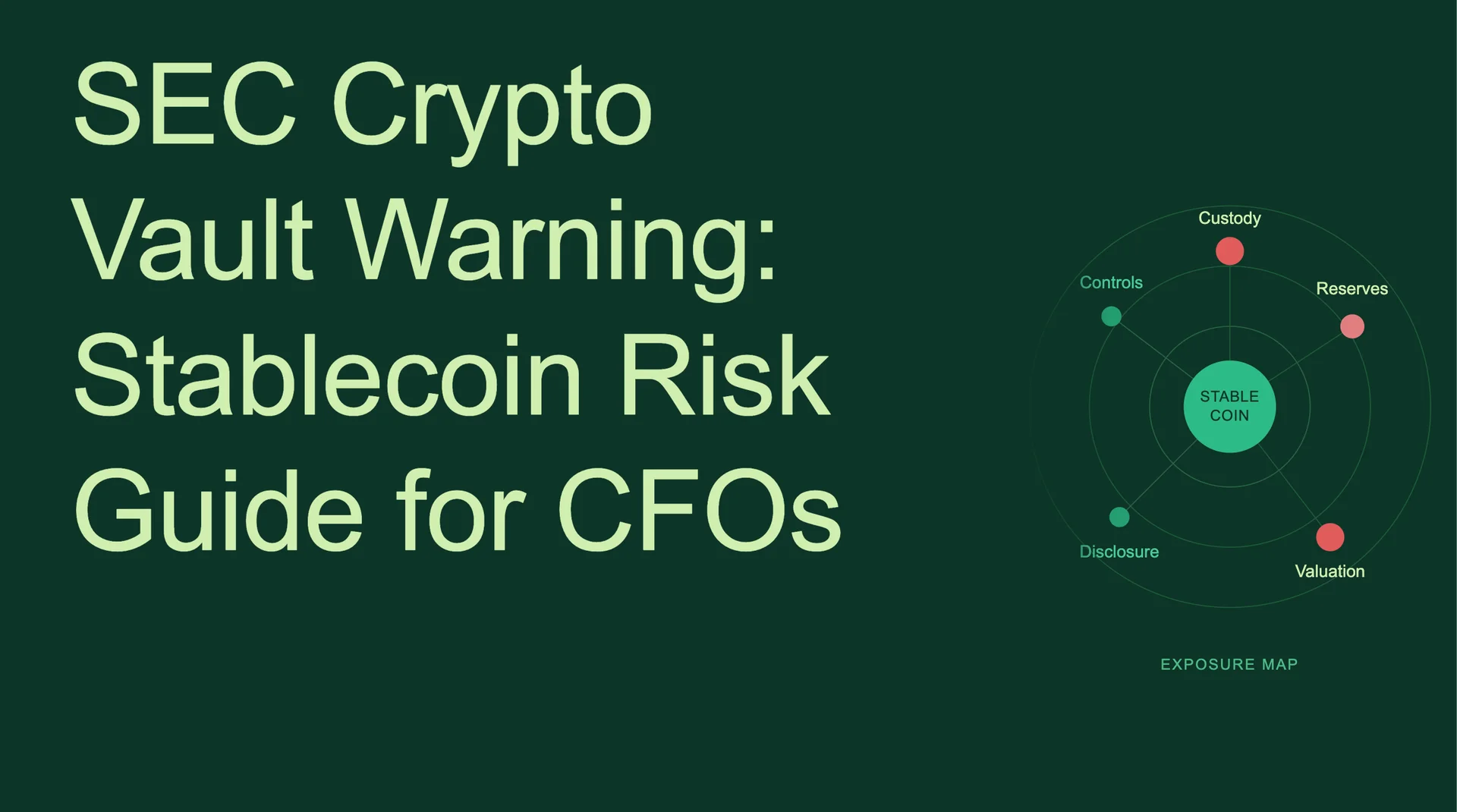
On July 22, 2026, SEC Commissioner Hester Peirce published a statement titled "Headstands and Summervaults: A Statement on Crypto Vaults and Lending Strategies." The statement is available on sec.gov and is confirmed from multiple independent legal analyses published in the five days since.
Two important preliminary facts before the analysis.
First, this is an individual commissioner statement, not a Commission rule, not a regulation, and not the official position of the SEC as an institution. Commissioner Peirce speaks for herself. The McGuireWoods analysis published July 24, the most comprehensive legal piece on the statement, is explicit on this point: the statement is only one commissioner's view, not a new rule or the Commission's official position.
Second, Commissioner Peirce is the SEC's most crypto-friendly commissioner, having been nicknamed "Crypto Mom" by the crypto industry for her consistent advocacy for clearer, less restrictive crypto regulation. Her warning that some crypto vault structures and onchain lending strategies may fall within securities laws is therefore not an adversarial regulatory threat. It is a friendly warning from the most sympathetic voice on the Commission, framed explicitly as an invitation to work with the SEC rather than as a precursor to enforcement.
With that context established: the substance of her warning is real, applies to a specific and growing category of product, and has implications for corporate treasury teams that are not being addressed in any current coverage of the statement.
Every analysis of the Peirce statement published to date is written for the crypto industry, specifically for vault operators, DeFi protocol designers, and lending platform builders. None addresses the corporate treasury CFO angle: if your company holds its operating cash or short-term liquidity in a yield-bearing stablecoin vault through a platform like Coinbase's treasury services, does Peirce's statement create a securities compliance question for your treasury program?
This post covers that specific question.
What Did SEC Commissioner Peirce Say on July 22, 2026 and What Is a Crypto Vault?
A crypto vault is a smart-contract system that accepts user deposits of crypto assets and routes those assets to yield-generating activities such as staking, lending, or liquidity provision. The vault holds the deposited assets and returns yield to depositors, typically in the same asset they deposited plus additional yield tokens or interest payments.
Vaults range significantly in their management structure. At one end of the spectrum are fully automated vaults: the smart contract executes predetermined allocation rules without any human discretion. At the other end are actively curated vaults: a manager or curator exercises ongoing discretion about which protocols to allocate assets to, what leverage to use, how to respond to market conditions, and when to rotate between strategies.
Peirce's statement, confirmed directly from sec.gov, opens with the Commission's track record over the past 18 months of clarifying which crypto assets and activities are not within the securities laws. She then states the limiting principle: that the securities laws do not apply to all crypto assets and activities does not mean that the securities laws do not apply to any crypto assets or activities.
The specific quote that has been widely cited: "If you do headstands, backflips, and other gymnastics to read the law so that it does not apply to crypto assets and activities that are well within the scope of the federal securities laws, you will have a painful fall."
Peirce described the spectrum of vault structures and identified where the securities law question arises: when a vault relies on a manager's or curator's active discretion to generate returns for depositors. That discretion is the key fact. A vault could become an investment contract when depositors expect profits mainly from a curator's efforts, consistent with the SEC v. Howey Co. test for investment contracts. Per the McGuireWoods analysis, the statement's animating principle is discretion: when a person or group exercises discretion over how investors generate returns from crypto assets deployed onchain, securities laws may attach.
Peirce gave the same framework for onchain lending: decisions about interest rates, which assets to accept, loan-to-value limits, and liquidation thresholds could implicate securities laws. Onchain loans can carry the hallmarks of notes that are securities, she said, depending on the parties' motivations and how the loans are distributed.
Why Coinbase and Robinhood Integrating Vault Products Makes This a Corporate Treasury Issue
The Peirce statement addresses vault operators and DeFi protocol designers. Its corporate treasury implication flows from a market development that has occurred over the past 12 to 18 months: major regulated financial platforms have integrated vault-like products into their institutional treasury services.
Coinbase Prime, Coinbase's institutional product, offers yield-bearing stablecoin programmes to corporate treasury clients. Robinhood has integrated stablecoin yield products through its platform. Both products allow corporate treasury teams to hold a portion of their cash in USDC or other stablecoins and earn yield, rather than leaving cash in traditional money market funds or bank deposits earning the prevailing short-term rate.
The vaults referenced in the brief hold over $8 billion in assets. That figure reflects the scale of yield-bearing stablecoin products deployed across institutional and corporate participants. The corporate treasury segment of that total has grown materially as more public companies have adopted stablecoin treasury management as a cash management alternative.
The question the Peirce statement creates for corporate treasury CFOs is not whether holding USDC itself creates a securities issue. Stablecoins as such are not securities under the current regulatory framework and the GENIUS Act, which establishes a regulatory framework for payment stablecoins. The question is whether the yield-generating mechanism through which the stablecoin is held creates a securities compliance question.
A corporate treasury team that holds $50 million of USDC in a yield-bearing vault product offered through Coinbase Prime, where a manager or curator is exercising discretion about how to deploy those assets to generate yield, may have a different regulatory profile than a treasury team that holds $50 million in a money market fund or a bank deposit. The Peirce statement is the first formal SEC communication to flag that distinction explicitly.
The Three Legal Theories That Could Apply: Investment Contract, Investment Company, or Securities Note
The McGuireWoods analysis published July 24 is the most rigorous legal treatment of the Peirce statement and identifies three separate securities law frameworks that could apply to crypto vault products, each with different consequences.
The first theory is the investment contract test under SEC v. Howey Co., 328 U.S. 293 (1946). An investment contract exists when there is: an investment of money, in a common enterprise, with an expectation of profits, derived primarily from the efforts of others. The Peirce statement specifically cited Howey and the "expectation of profits from others' efforts" element as the trigger for vault analysis. An actively curated vault where the depositor expects yield generated through the curator's ongoing management decisions has the structure of an investment contract. A fully automated vault where the yield is generated by deterministic smart contract execution, with no human discretion involved, presents a weaker Howey case.
The second theory is the Investment Company Act of 1940. An investment company is generally defined as an issuer that is primarily engaged in the business of investing, reinvesting, or trading in securities. If a vault product issues shares or interests to depositors and invests the pooled assets in securities (including lending arrangements that are themselves securities), the vault operator may be an unregistered investment company. The ICA requires registration and imposes significant regulatory obligations on registered investment companies.
The third theory is the "note" analysis under Reves v. Ernst & Young, 494 U.S. 56 (1990). The Supreme Court in Reves established that a promissory note is presumed to be a security unless it falls within a specific exception. Peirce's statement noted that onchain loans can carry the hallmarks of notes that are securities, depending on the parties' motivations and how the loans are distributed. If a corporate treasury team is participating in an onchain lending protocol where its stablecoin is being lent to borrowers, the lending arrangement may itself be a securities transaction.
The McGuireWoods analysis confirms the important practical limitation: none of these theories creates automatic securities registration requirements for all vault products. The analysis is facts-and-circumstances specific to each vault structure. Peirce's statement did not announce enforcement action and does not constitute a Commission position. What it did was flag that the discretion question is the operative analysis and that vault operators and participants should assess their specific structure against each of these frameworks.
What Is the "Active Management" Trigger That Determines Whether Securities Laws Apply?
The key analytical distinction Peirce's statement draws is between passive and active vault structures. This distinction is the operative test for whether securities law analysis is required.
A passive vault structure is one where the allocation of deposited assets to yield-generating activities is entirely determined by predetermined, fixed smart contract logic. No human makes discretionary decisions about where to deploy the assets, what protocols to use, how much to allocate to each strategy, or when to rebalance. The yield is a deterministic output of the smart contract's fixed rules applied to market conditions. The Defiant analysis of the Peirce statement describes this as the purely programmatic end of the vault spectrum.
An active or curated vault structure is one where a manager or curator makes ongoing discretionary decisions about the vault's strategy. The curator might decide to increase allocation to a lending protocol when yields are attractive, reduce exposure to a specific protocol due to security concerns, adjust leverage based on market conditions, or rotate between staking opportunities. The depositor's yield depends on the quality of the curator's decisions. The Yahoo Finance analysis confirmed Peirce's framing: a vault could become an investment contract when depositors expect profits mainly from a curator's efforts.
For corporate treasury CFOs, the active management question has a specific application: what does the yield-bearing stablecoin product your treasury team is using actually do with the deposited assets? Does a Coinbase Prime treasury service or similar product involve a human portfolio manager making discretionary allocation decisions on behalf of depositors? Or is the yield generated through a fixed, automated mechanism (such as USDC earning interest through a Circle-managed reserve of US Treasury securities)?
The answer is likely different for different products. A yield-bearing stablecoin that earns interest through the issuer's investment of backing reserves (the Circle USDC model) is structurally different from a DeFi vault that deploys USDC to onchain lending protocols at a curator's discretion. The former is unlikely to raise the Howey concerns Peirce flagged. The latter may.
The specific question your treasury team and general counsel need to answer: is the yield mechanism in the product your company uses driven by human discretionary management of deposited assets, or by a fixed, automated mechanism? The answer determines whether further securities law analysis is required.
What Does This Mean for Your Corporate Treasury Team's Stablecoin Holdings Right Now?
The Peirce statement does not require immediate action for most corporate treasury teams. It does require a specific compliance assessment before the next board treasury policy review or the next Q2 10-Q SEC filing.
The assessment has three steps.
Step 1: identify every yield-bearing stablecoin product in the treasury portfolio. Pull the current list of cash management positions that involve stablecoins or crypto assets earning yield. Include any Coinbase Prime yield products, any DeFi protocol positions, any onchain lending arrangements, and any vault products accessed through treasury management platforms.
Step 2: for each product, determine the yield mechanism. Is the yield generated by the stablecoin issuer's investment of reserves in traditional financial instruments (US Treasuries, bank deposits)? Or is the yield generated by deploying the stablecoin into onchain protocols (lending, liquidity provision, staking) through a manager's or protocol's discretionary allocation decisions? Products in the first category are unlikely to raise the Peirce statement's active management concern. Products in the second category require legal analysis.
Step 3: for products in the second category, engage securities counsel. The facts-and-circumstances analysis required to apply the Howey test, the ICA definition, or the Reves note framework to a specific vault product is a legal question that general counsel or outside securities counsel must perform. The Peirce statement is a warning, not a legal conclusion. Counsel must evaluate the specific product structure.
The McGuireWoods analysis of the Peirce statement is the recommended starting point for that legal engagement: it maps the enforcement record for vault-like products, notes that the Commission has dismissed several crypto lending cases without adjudicating the securities law question, and provides the analytical framework counsel will use in the assessment.
Does Peirce's Statement Require a Form 8-K Material Event Disclosure?
No. The Peirce statement is an individual commissioner's view, not a new rule, regulation, or official Commission position. It does not create a new legal obligation and therefore does not constitute a material event requiring disclosure under Form 8-K or Item 303 of Regulation S-K.
Form 8-K disclosure is required for specified triggering events (material definitive agreements, financial condition changes, regulatory actions against the company, and similar events enumerated in Form 8-K's items). A commissioner's individual statement on an area of law does not trigger any of those items for companies that hold stablecoin positions in their treasury.
However, the Q2 2026 10-Q risk factor and MD&A review should consider whether the Peirce statement, in conjunction with the broader regulatory uncertainty around yield-bearing stablecoins, represents a material risk that should be disclosed or updated. If the company holds a material amount of assets in yield-bearing stablecoin products and the regulatory status of those products is uncertain, the risk factor section may warrant an update or addition describing the regulatory uncertainty and its potential effect on the company's treasury program.
The specific risk factor language that may be appropriate: a disclosure that the regulatory framework for yield-bearing stablecoin products is evolving, that individual SEC commissioner statements have flagged potential application of securities laws to actively managed vault products, and that the company's treasury team and counsel are assessing whether specific products in the portfolio are within the securities perimeter. That disclosure is both accurate and proportionate to the current state of the regulatory analysis.
What Is the Investment Company Act Risk, Could Your Treasury Program Require Registration?
This is the question with the highest potential consequence and the most remote probability for most corporate treasury programs.
The Investment Company Act risk would arise if a court or the Commission concluded that a company's participation in a vault product made the company itself an issuer of investment company interests, or alternatively that the vault operator is an unregistered investment company whose interests are securities that the company is holding without proper disclosure.
For a corporate treasury team that is a passive depositor in a vault product, the ICA analysis focuses on the vault operator, not on the depositor. The question is whether the vault operator has issued interests that are investment company interests, not whether the corporate treasury team is itself an investment company.
However, there is a separate ICA risk for companies that hold large amounts of financial instruments (including yield-bearing stablecoin vault interests) relative to their operating assets: the inadvertent investment company problem. Section 3(a)(1)(C) of the ICA defines an investment company to include any issuer that is engaged primarily in the business of investing in securities and that owns investment securities with a value exceeding 40 percent of the company's total assets. If a company's stablecoin vault holdings, combined with other investment securities, approach or exceed that 40 percent threshold, the company may need to evaluate whether it risks inadvertent investment company classification.
For most operating companies, the stablecoin treasury position is a small fraction of total assets and the 40 percent threshold is not remotely at risk. For companies with very large treasury programs relative to their operating asset base (common in cash-rich technology companies), the threshold deserves monitoring.
How Does This Interact With the GENIUS Act Stablecoin Reporting Framework?
The GENIUS Act (the Guiding and Establishing National Innovation for US Stablecoins Act) establishes a federal regulatory framework for payment stablecoins. Its passage in 2026 created OCC oversight for nationally chartered stablecoin issuers and established reserve and transparency requirements for stablecoin issuers.
The GENIUS Act covers payment stablecoins specifically: stablecoins issued for payment purposes with value pegged to a fiat currency, backed by high-quality liquid reserves. Its regulatory framework applies to the issuer of the stablecoin, not to the holder or to products that use stablecoins as an input.
The Peirce statement addresses a different layer: the products that deploy stablecoins to generate yield. A payment stablecoin governed by the GENIUS Act framework is the input asset. The vault that takes that stablecoin and deploys it to onchain lending or staking protocols is the structure that Peirce's analysis applies to.
These two frameworks are complementary, not overlapping, in their scope. The GENIUS Act does not resolve the question of whether a vault that actively manages stablecoin assets is an investment contract or requires securities registration. The Peirce statement addresses that complementary question.
For corporate treasury teams, the practical implication is that GENIUS Act compliance by a stablecoin issuer (USDC's compliance with OCC requirements, for example) does not immunise the yield-bearing vault product that uses that stablecoin from the separate securities law analysis Peirce describes. Both questions must be assessed independently.
What Should Your CFO, General Counsel, and Treasury Team Do This Week?
Four specific actions this week, before the Q2 10-Q is finalised.
First, pull the complete list of yield-bearing stablecoin positions in the treasury portfolio and identify the yield mechanism for each. This is a treasury operations task that does not require legal expertise. The goal is to distinguish products where yield comes from the stablecoin issuer's reserve management versus products where yield comes from onchain deployment of stablecoin assets by a manager or automated protocol.
Second, brief general counsel on the Peirce statement and the McGuireWoods analysis. Forward both documents. Request a preliminary assessment of whether any products in the treasury portfolio are in the category of actively managed vault structures that Peirce's analysis applies to. This preliminary assessment can typically be completed in two to three days for counsel familiar with crypto securities law.
Third, assess whether the treasury risk factor in the Q2 10-Q should be updated to reflect the regulatory uncertainty around yield-bearing stablecoin products. If the company holds a material amount in products of uncertain regulatory status, a risk factor update is appropriate. The risk factor should be company-specific, quantified (the amount held and its percentage of treasury assets), and forward-looking about the regulatory trajectory.
Fourth, if general counsel's preliminary assessment identifies any product as potentially within the securities perimeter under Peirce's analysis, engage outside securities counsel for a more thorough analysis before the Q2 10-Q is filed. The McGuireWoods analysis, the Howey framework, and the ICA inadvertent investment company analysis each require specialised knowledge that general corporate counsel may not have at the depth required.
Commissioner Peirce has invited vault operators and participants to work with the SEC rather than proceed on the assumption that securities laws do not apply. For corporate treasury teams with meaningful yield-bearing stablecoin positions, engaging securities counsel now, before a potential enforcement inquiry, is the appropriate response to that invitation.
Frequently Asked Questions
What did SEC Commissioner Peirce say about crypto vaults on July 22?
Commissioner Peirce published a statement titled "Headstands and Summervaults: A Statement on Crypto Vaults and Lending Strategies" on July 22, 2026, warning that crypto vault products and onchain lending strategies may fall within federal securities laws depending on their structure. She said moving activities onchain does not automatically remove them from the SEC's jurisdiction. The key factor is active management: when a curator or manager exercises ongoing discretion over how deposited assets generate yield, the vault may constitute an investment contract under the Howey test, may trigger Investment Company Act analysis, or may involve lending arrangements that are securities notes under Reves.
Is this a formal SEC rule or just one commissioner's opinion?
It is an individual commissioner statement, confirmed from sec.gov. It is not a Commission rule, regulation, or official SEC position. The statement reflects Commissioner Peirce's view and is framed as guidance and an invitation to work with the SEC, not as an enforcement threat. However, the legal frameworks Peirce described (Howey, ICA, Reves) are established law that the full Commission has authority to enforce.
Does holding USDC in a corporate treasury account create securities law risk?
Holding USDC as a stablecoin in a bank account or custodial account does not raise the concerns Peirce identified. The securities law question arises when USDC is deployed into a yield-generating vault product where a manager or protocol exercises discretion over how the assets generate returns. The yield mechanism, not the stablecoin itself, is the relevant fact.
Does the GENIUS Act resolve this regulatory question?
No. The GENIUS Act establishes a regulatory framework for payment stablecoin issuers. It addresses the issuer's reserve requirements and OCC oversight. It does not address the securities law status of vault products that deploy stablecoins to generate yield. The Peirce statement and the GENIUS Act address different layers of the stablecoin ecosystem.
What is the most immediate action a CFO should take?
Identify every yield-bearing stablecoin product in the treasury portfolio and determine whether the yield comes from the stablecoin issuer's reserve management or from the active deployment of stablecoin assets by a human manager or protocol. Products in the second category require securities law analysis by qualified counsel before the company can conclude they are outside the securities perimeter.
Key Takeaways
- On July 22, 2026, SEC Commissioner Hester Peirce published "Headstands and Summervaults: A Statement on Crypto Vaults and Lending Strategies," warning that actively managed crypto vaults and onchain lending strategies may fall within federal securities laws. The statement is available on sec.gov.
- The statement is an individual commissioner's view, not a Commission rule or official SEC position. It is framed as an invitation to work with the SEC, not as an enforcement announcement.
- The key trigger for securities law analysis is active management: when a curator or manager exercises ongoing discretion over how deposited stablecoin assets generate yield for depositors, the vault may be an investment contract under Howey, may require ICA registration, or may involve lending arrangements that are Reves notes.
- A fully automated vault with no human discretion is at the passive end of the spectrum and presents weaker Howey concerns. An actively curated vault where a manager selects strategies, adjusts allocations, and optimises yield is at the active end and requires securities law analysis.
- For corporate treasury teams, the immediate action is to identify yield-bearing stablecoin products in the portfolio and determine the yield mechanism for each. Products where yield comes from the stablecoin issuer's own reserve management are different from products where yield is generated by deploying stablecoin into onchain protocols through a manager's discretion.
- The GENIUS Act's regulatory framework for payment stablecoin issuers does not resolve the securities law question about vault products that deploy those stablecoins to generate yield. Both questions must be assessed independently.
- The Q2 2026 10-Q risk factor section should be assessed for whether a risk factor update is needed to reflect regulatory uncertainty around yield-bearing stablecoin products, if the company holds a material amount in products of uncertain securities law status.
- The McGuireWoods analysis published July 24, 2026, is the most comprehensive legal treatment of the Peirce statement and is the recommended starting point for any securities counsel engagement on this question.