
AI Continuous Monitoring for Financial Controls: The 2026 Implementation Guide
If your board has asked whether your controls are "continuous and AI-ready," this guide is for you. It is written for CFOs, controllers, internal audit directors, and ESG reporting leads who need to implement AI-powered continuous control monitoring (CCM) in 2026 without creating new audit or regulatory risk.
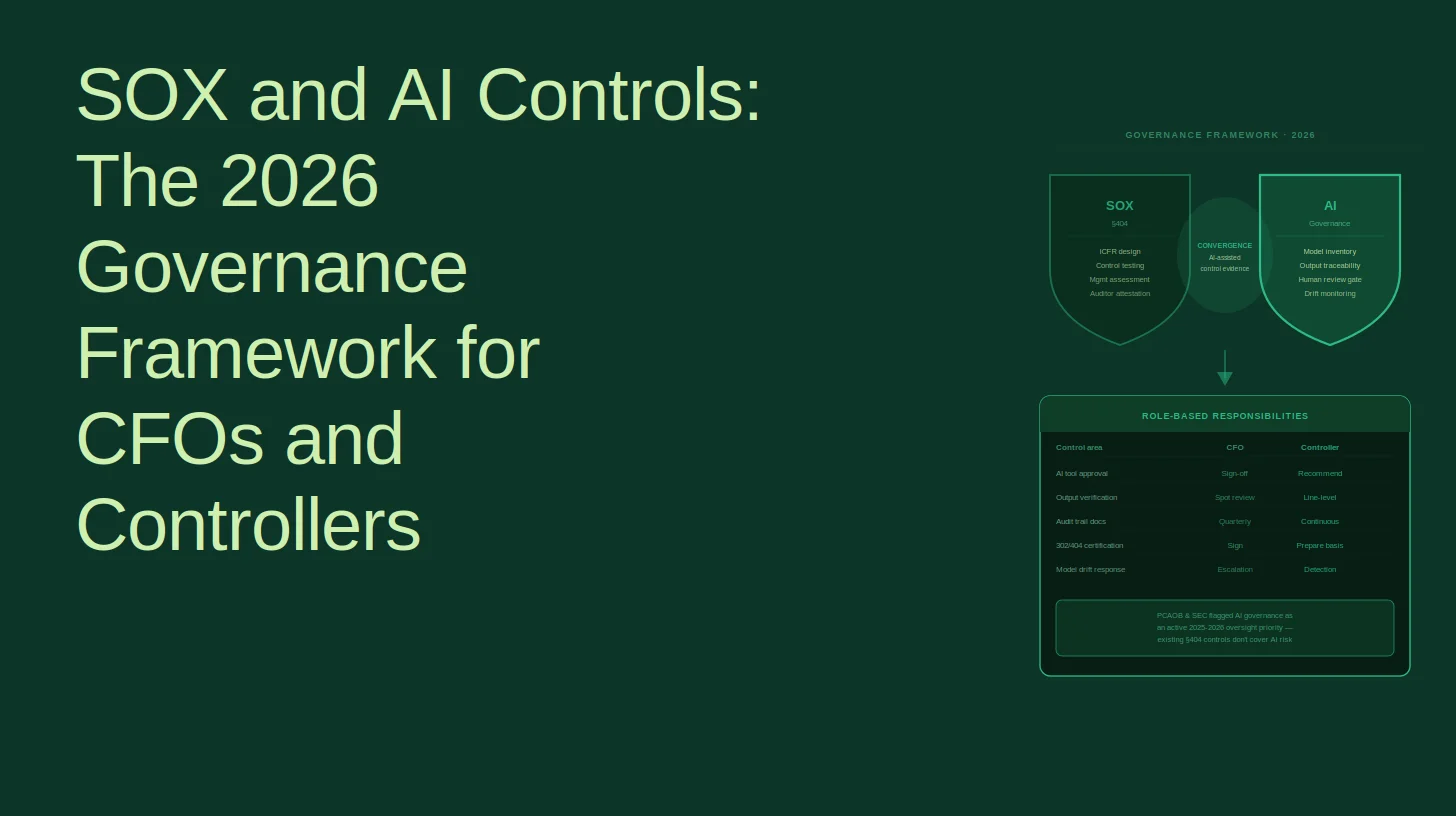
The short answer: AI continuous monitoring of financial controls is no longer a future-state aspiration. It is an operational imperative, driven by three converging forces: SOX/ICFR obligations that now demand real-time evidence, ESG assurance requirements landing on the same finance teams, and the February 2026 U.S. Treasury Financial Services AI Risk Management Framework (FS AI RMF), which introduces 230 mapped control objectives covering governance, data, model development, validation, monitoring, third-party risk, and consumer protection.
Key takeaway: Periodic, sample-based ICFR testing is structurally insufficient for 2026. AI CCM replaces it with full-population, continuous analysis -- but automation is not assurance. The governance layer above the AI tools is where most implementations fail.
Why Sample-Based ICFR Testing Is No Longer Enough
The core problem with legacy ICFR is timing. Control gaps are typically discovered weeks or months after they occur, during quarterly close or annual audit. Sample-based testing, by design, leaves large portions of the transaction population unreviewed. Manual testing introduces error, consumes high-value resources, and produces evidence that is stale the moment the audit window closes.
The scale of the problem is significant. According to Gartner data cited by MindBridge, nearly 59% of controllership professionals report multiple financial reporting errors per month, and one-third report errors on a weekly basis. (Note: these figures are cited in 2026 vendor content; verify against the original Gartner source before using in board materials.)
Modern ERP environments have grown more fragmented and hybridized, while regulatory scrutiny has intensified across ESG, cyber controls, and real-time reporting. The complexity exceeds what legacy control systems were built to manage.
The structural shift is from point-in-time, sample-based ICFR to continuous, AI-augmented control monitoring -- sometimes called AiCFR or Continuous Control Monitoring (CCM). AI enables testing across 100% of transactions in the general ledger and subledgers, with anomaly detection that adapts to new patterns rather than relying on pre-defined rules.
How AI CCM Maps to Each COSO Component
The COSO Internal Control-Integrated Framework remains the structural backbone for ICFR. Its five components were designed for periodic, manual testing. AI operationalizes each one continuously.
| COSO Component | Legacy Approach | AI CCM Approach |
|---|---|---|
| Control Environment | Annual policy attestations, manual tone-at-the-top reviews | Continuous policy compliance monitoring, automated exception flagging |
| Risk Assessment | Periodic risk workshops, static risk registers | Dynamic, full-population risk scoring across accounts and entities in real time |
| Control Activities | Sample-based transaction testing, manual reconciliations | 100% transaction population testing, automated reconciliation with anomaly detection |
| Information and Communication | Quarterly reporting packages, siloed ERP data | API-integrated dashboards, real-time alerts across ERP and GRC platforms |
| Monitoring Activities | Annual ICFR testing cycles, quarterly sub-certifications | Continuous evaluation of control performance with documented review evidence |
The gap between control design and actual control effectiveness is widest in the Monitoring component. Control owners frequently cannot explain why certain anomalies were or were not flagged -- a disconnect that creates material deficiency risk under PCAOB AS 2201.
For a deeper look at how AI intersects with prohibited uses in SOX ICFR controls, see AI Prohibited Uses in SOX ICFR Controls: The 2026 Governance Map.
What the Treasury FS AI RMF Requires for Monitoring Controls
Released on February 19, 2026, the U.S. Treasury Financial Services AI Risk Management Framework is not a compliance checklist. As Lowenstein Sandler's Amy Mushahwar and Chloe Rippe put it: "The Financial Services AI Risk Management Framework (FS AI RMF) is not another governance checklist. It is a remediation blueprint, designed for a highly regulated sector, subject to the process of examination."
Developed with more than 100 financial institutions, the Financial Services Sector Coordinating Council (FSSCC), and the Cyber Risk Institute (CRI), the framework includes four components:
- AI Adoption Stage Questionnaire -- a maturity-based self-assessment that calibrates control expectations to your institution's actual AI deployment level.
- Risk and Control Matrix (RCM) -- the core engine with 230 mapped control objectives translating NIST AI RMF principles into operational controls.
- Guidebook -- implementation guidance on how controls should be operationalized.
- Control Objective Reference Guide -- a 400+ page document of evidence examples designed to withstand audit and supervisory review.
All materials are hosted by the Cyber Risk Institute.
What the FS AI RMF Requires Specifically for Monitoring
The framework's model lifecycle layer is where financial control monitoring teams will feel the most pressure. It requires:
- Documented development and validation independence -- the team validating the AI model cannot be the team that built it.
- Bias testing -- models must be tested for systematic errors before deployment.
- Drift detection -- ongoing monitoring of model performance against a baseline, with automated alerts when the model degrades.
- Explainability thresholds -- the model must be able to explain why a transaction was flagged, to a standard that satisfies an examiner.
- Automated re-identification regression testing -- before deployment, models must be tested to confirm sensitive client data has not been memorized.
These controls must be embedded in MLOps pipelines, not retrofitted after deployment. The Lowenstein alert is direct on this point: "Operationalization must occur across four infrastructure layers, and it must occur upstream, embedding controls directly into CI/CD and MLOps processes rather than retrofitting them after deployment."
The FS AI RMF is designed to integrate with existing governance programs including the NIST Cybersecurity Framework, enterprise risk management, and SOC 2 -- rather than fragment them. This is a deliberate design choice to address overlapping frameworks that dilute accountability and obscure control ownership.
Does it apply to you? The framework is advisory at the federal level, but state regulators are expected to look to it as a benchmark for emerging best practices. Boards, risk committees, CISOs, chief data officers, and legal teams responsible for examination readiness should treat it as effectively binding.
Extending AI CCM to ESG and Non-Financial Controls
This is the gap no top-ranking article addresses: finance teams in 2026 are being asked to build continuous monitoring for both financial and non-financial controls simultaneously, often with the same infrastructure and no additional headcount.
CSRD's European Sustainability Reporting Standards (ESRS) and ISSB's IFRS S1/S2 both demand evidence-based, auditable sustainability disclosures. The assurance standard for ESG data is converging with the assurance standard for financial data -- limited assurance today, reasonable assurance as the frameworks mature.
The practical implication: the same AI CCM infrastructure that monitors journal entries and reconciliations can, with appropriate data feeds, monitor ESG data controls -- emissions factors, supply chain data quality, scope 3 boundary consistency. The control design principles are identical: define the control, identify the data source, set anomaly thresholds, document exceptions, and produce audit-ready evidence.
For the intersection of ICFR and climate disclosure controls, see ICFR and Climate Disclosure Audit: A 2026 Practitioner Walkthrough.
The sequencing question is: build the financial CCM infrastructure first, validate it with external auditors, then extend the data model to ESG controls. Attempting both simultaneously without a validated financial CCM foundation is the most common implementation mistake.
The Implementation Roadmap: Six Steps
Here is the sequencing that works. Skip steps and you will either fail the audit or fail the board presentation.
Step 1: Data Readiness Assessment (Weeks 1-6)
AI CCM is only as good as the data it consumes. Before selecting a platform, map your data landscape:
- Which ERP systems (SAP, Oracle, Workday) hold the transaction data, and can they expose it via API?
- Is your chart of accounts consistent across entities, or do you have a mapping problem?
- What is the latency of your ERP data -- real-time, daily batch, or weekly?
- Do you have structured iXBRL/XBRL data from EDGAR submissions that can serve as an additional data layer? (AI monitoring increasingly operates on structured financial data, and the quality of that structured data directly affects monitoring accuracy.)
The FS AI RMF's data layer controls are explicit on this: lineage tracking, feature store governance, training data documentation, de-identification, and cross-border data flows all require automated lineage logging and dataset version control. Data sensitivity tagging must occur at intake.
Step 2: Control Prioritization (Weeks 4-8)
Do not try to automate every control at once. Prioritize by:
- Material controls -- those that, if they failed, could produce a material misstatement under SOX Section 404.
- High-volume, repetitive controls -- journal entry approvals, three-way match, intercompany reconciliations. These are where AI adds the most value fastest.
- Controls with documented deficiencies -- if a control has had a prior-year finding, automate it first.
- ESG data controls -- scope these separately and sequence them after financial controls are validated.
Apply risk-based assessment frequencies: high-impact systems and controls processing sensitive data warrant more frequent validation than lower-risk components. This is the same principle embedded in NIST SP 800-53 Rev. 5 and directly applicable to financial control prioritization.
Step 3: Platform Selection and ERP Integration (Weeks 6-16)
The platform decision is a governance decision, not just a technology decision. Key criteria:
- Can it ingest data from your specific ERP stack via API without requiring a full data warehouse build?
- Does it produce audit-ready evidence artifacts -- timestamped, immutable logs of every anomaly flag, review action, and disposition?
- Does the vendor provide audit rights, documentation exchange, and incident triggers as required by the FS AI RMF's third-party and API layer?
- Can you validate the model's outputs independently, or is the detection logic a black box?
Vendors using foundation models must be treated as third-party AI systems under the FS AI RMF. Vendor artifacts are machine-readable compliance inputs, not static documents. Build contractual audit rights into the procurement process.
For a structured vendor evaluation framework, see AI Model Risk Management in Finance: The 2026 Practitioner's Framework.
Step 4: Model Governance Layer (Parallel to Steps 2-3)
This is where most implementations fail. The AI model doing the monitoring is itself a risk. You must govern it.
The governance layer requires:
- Model owner -- a named individual (typically the controller or CAO) who is accountable for model performance and signs off on the model validation report.
- Independent validation -- the internal audit team or an external party validates the model before go-live and on a defined cadence thereafter.
- Drift detection protocol -- define the baseline performance metrics (false positive rate, false negative rate, coverage rate), set alert thresholds, and document the remediation process when the model degrades.
- Explainability standard -- define what level of explanation is required for each anomaly flag. An examiner or external auditor must be able to understand why a transaction was flagged without accessing the model's internal weights.
- Human escalation path -- every AI-generated flag must have a documented human review and disposition. The model does not close exceptions; a human does.
As Telos puts it: "Tools can collect data, but governance determines whether the organization understands what the data means."
For the AI hallucination risk specific to financial reporting, see AI Hallucination in Financial Reporting: A 2026 Practitioner Walkthrough.
Step 5: Evidence Documentation for SOX 404 and PCAOB AS 2201 (Ongoing)
This is the open regulatory question practitioners are struggling with most. The SEC has not issued staff guidance on how AI-generated ICFR evidence satisfies SOX 404 requirements. PCAOB has not issued specific standards for AI-assisted audit procedures under AS 2201. The Center for Audit Quality hosted a webinar on this topic in March 2026, but definitive guidance remains pending.
In the absence of specific guidance, the defensible approach is:
- Treat AI-generated monitoring evidence as a control activity, not as a substitute for the control itself. The control is the business process; the AI monitors whether the control is operating effectively.
- Document the AI model's configuration, validation status, and drift metrics as part of the control documentation package.
- Retain timestamped, immutable logs of every anomaly flag, human review, and disposition decision. These are the audit artifacts.
- Discuss the evidence format with your external auditors before year-end, not during fieldwork. PCAOB-registered firms are developing their own positions on AI-generated evidence, and alignment early avoids surprises.
- Do not present AI CCM as eliminating the need for substantive testing. It changes the nature and scope of testing; it does not eliminate the auditor's independent obligation.
Step 6: Audit Committee Reporting (Quarterly)
Audit committees are asking for "AI readiness" attestations that finance teams often cannot yet provide. Structure your quarterly reporting around four questions:
- Which controls are now monitored continuously, and what percentage of the relevant transaction population do they cover?
- What is the current false positive and false negative rate of the AI monitoring models, and how does it compare to the baseline?
- Have any models experienced drift, and if so, what remediation was taken?
- What open exceptions remain from AI-generated flags, and what is the remediation timeline?
This framing gives the audit committee a governance view, not a technology update. It also creates the board-level documentation trail that regulators will look for.
The Three Pitfalls That Derail AI CCM Programs
Pitfall 1: Confusing automation with assurance. AI CCM automates the detection of anomalies. It does not provide assurance. Assurance requires human judgment, documented evidence, and accountability. The regulatory expectation under both SOX and the Treasury FS AI RMF is that humans remain accountable for control effectiveness, even when AI does the monitoring.
Pitfall 2: Deploying AI CCM without governing the AI model. The model doing the monitoring is itself a risk. If the model drifts and starts missing control failures -- or generates so many false positives that reviewers stop investigating -- the control environment has degraded without anyone noticing. Model governance is not optional.
Pitfall 3: Confusing financial control CCM with cybersecurity continuous monitoring. The Telos and NIST SP 800-53 frameworks address cybersecurity controls (CMMC, FISMA, CDM). Financial control CCM addresses ICFR under COSO and SOX. These are different frameworks with different evidence requirements. A cybersecurity continuous monitoring program does not satisfy SOX 404 obligations, and vice versa.
What "Continuous" Actually Means for Regulators
Practitioners often ask: does "continuous" mean real-time, daily, or something else? The answer is risk-based.
- High-risk, high-volume controls (journal entry approvals, revenue recognition triggers, intercompany eliminations): real-time or intraday monitoring is the standard.
- Moderate-risk controls (account reconciliations, subledger-to-ledger tie-outs): daily monitoring is defensible.
- Lower-risk controls (policy attestations, access reviews): weekly or monthly monitoring may be appropriate, with documented rationale.
The key regulatory expectation is not a specific frequency but a specific outcome: control deficiencies must be identified and remediated before they become material, not discovered at audit time. The evidence must be current, not assembled retrospectively.
FAQ
Does AI continuous monitoring satisfy SOX Section 302 and 404 requirements? AI CCM can satisfy the monitoring component of ICFR under COSO, but it does not replace the full SOX 404 assessment. Management's assessment under SOX Section 404 still requires a documented evaluation of control design and operating effectiveness. AI CCM provides the operating effectiveness evidence continuously rather than periodically. External auditors must still independently assess ICFR under PCAOB AS 2201, and no SEC or PCAOB guidance has yet confirmed that AI-generated evidence alone satisfies the auditor's independent testing obligation.
Is the Treasury FS AI RMF legally binding? The FS AI RMF is advisory at the federal level. However, state regulators are expected to reference it as a benchmark for emerging best practices, and it is designed to withstand supervisory examination. Treat it as effectively binding for examination readiness purposes.
Can the same AI CCM infrastructure cover both financial and ESG controls? Yes, with appropriate data feeds and control design. The monitoring logic is the same; the data sources differ. Build and validate the financial CCM layer first, then extend to ESG data controls under CSRD/ISSB. Attempting both simultaneously without a validated financial foundation is the most common implementation error.
What happens when the AI model misses a material control failure? This is a model governance question, not just a technology question. The named model owner is accountable. The remediation process must be documented, the model must be retrained or reconfigured, and the missed failure must be assessed for materiality under SOX. This is why independent model validation and drift detection are non-negotiable governance requirements.
How do we handle third-party AI monitoring vendors under the FS AI RMF? The FS AI RMF's third-party and API layer requires vendor transparency, documentation exchange, audit rights, and incident triggers. Institutions using foundation models must treat vendor artifacts as machine-readable compliance inputs. Build contractual audit rights and incident notification obligations into vendor agreements before deployment.
What is the audit committee's primary oversight responsibility for AI CCM? The audit committee's role is to ensure that management has a governance layer above the AI tools, not just the tools themselves. That means asking about model validation status, drift metrics, false negative rates, and the human escalation process -- not just whether the platform is deployed.