
Management Review Controls SOX Documentation: A Practitioner Walkthrough
If your external auditor keeps asking for more documentation on your management review controls, you are not alone. PCAOB inspection findings have consistently flagged MRC documentation as one of the most common audit failures, and the pressure flows directly to SOX compliance teams. This guide tells you exactly what to document, how to structure it, and where companies go wrong.
Key takeaway: A signature on a reconciliation is no longer evidence of a control. Auditors need to reconstruct your reviewer's logic from the paper trail alone. If they cannot, the control fails.
What Counts as a Management Review Control Under SOX?
A management review control (MRC) is any control in which a manager compares recorded financial information against an expectation and investigates significant differences. Unlike transactional controls that test individual entries against a rule, MRCs involve judgment over aggregated or complex data.
Common examples under SOX Sections 302 and 404:
- Review of account reconciliations
- Review of journal entries
- Budget-to-actual variance analysis
- Review of work supporting an accounting estimate (allowance for credit losses, goodwill impairment, tax provision)
- Business performance reviews comparing metrics such as gross margin or expenses as a percentage of sales
MRCs sit in the judgmental, higher-risk areas of the financial statements. That is precisely why PCAOB AS 2201 requires auditors to evaluate both their design and operating effectiveness, and why PCAOB inspectors scrutinise them so closely.
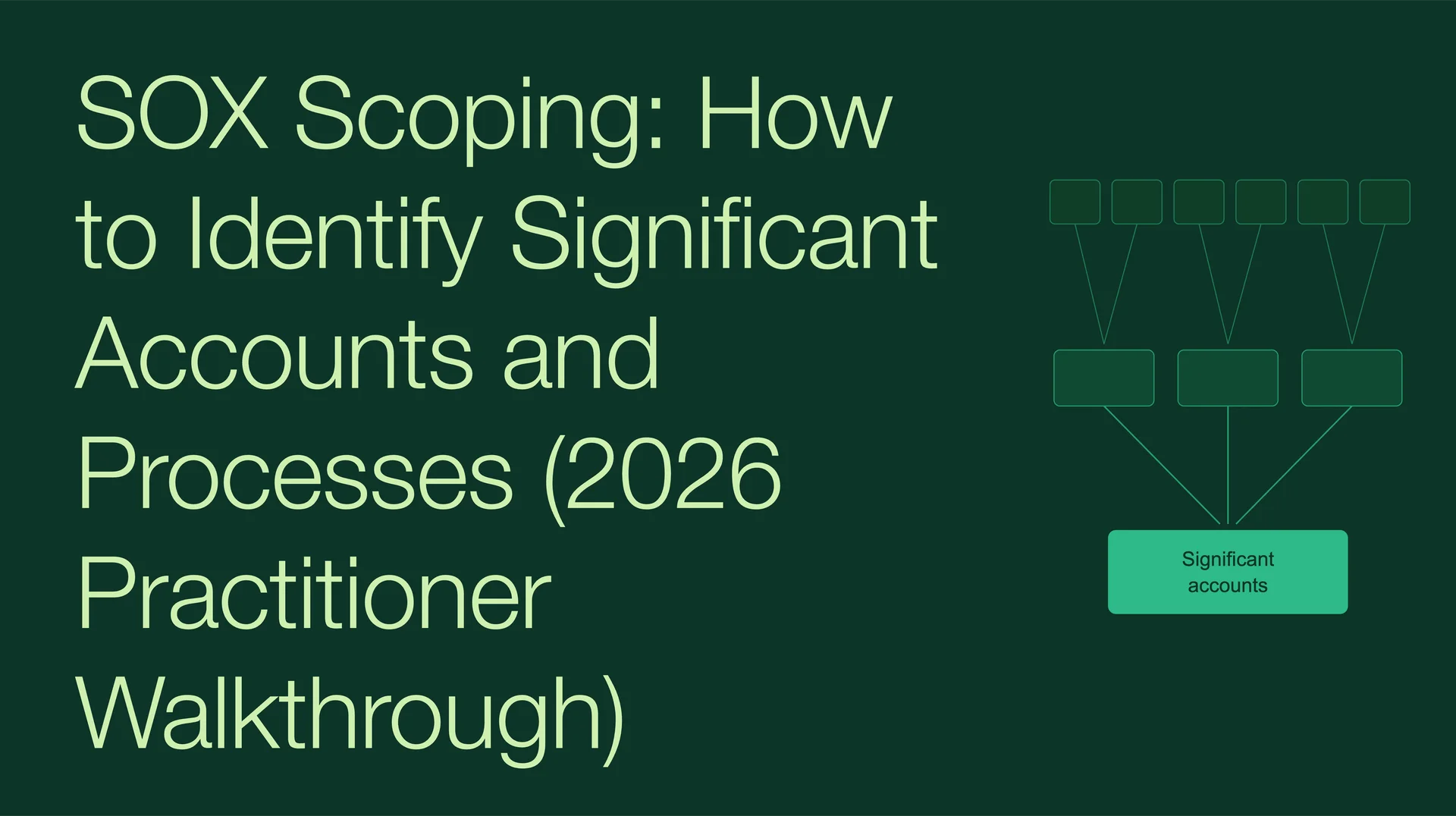
For a broader map of how MRCs fit into your overall ICFR scoping, see SOX Scoping: Significant Accounts and Processes Walkthrough.
MRC vs. Transactional Control: The Key Difference
| Feature | Management Review Control | Transactional Control |
|---|---|---|
| What is reviewed | Aggregated financial data | Individual transactions |
| Basis for conclusion | Judgment, expectation, experience | Rule-based matching |
| Evidence of performance | Meeting notes, documented inquiry, exception log | System log, approval workflow |
| PCAOB precision concern | High | Lower |
| Common deficiency | Insufficient documentation of the review process | Missing segregation of duties |
The subjectivity of MRCs is what makes them hard. As Grant Thornton's Snapshot 2025-11 puts it: "MRCs can be challenging because they often involve significant judgment by the control owner and are identified as controls over more judgmental or complex financial statement areas, which typically have a higher risk of material misstatement."
The Five Required Design Elements
Before you can document an MRC's operating effectiveness, the control must be well designed. Grant Thornton's Snapshot 2025-11 identifies five elements that every MRC design must specify:
- Who performs the review, name the role, not just the department. The reviewer must be competent and independent of the person who prepared the item.
- What information is reviewed, the specific report, reconciliation, or data set. If it is system-generated, note the system and report name.
- The expectation or criteria, what the reviewer compares the data against (prior period, budget, operational metrics, known business drivers). This must be built from outside the number being reviewed.
- The frequency, monthly, quarterly, or at each close. The review must occur in time to correct the books before reporting.
- What happens when exceptions are identified, the investigation and resolution process, including who is consulted, what support is obtained, and how the conclusion is reached.
A control description that says only "Controller reviews the AR reconciliation monthly" fails on elements 3, 4, and 5. That is a design deficiency, and it requires redesign before you can even test operating effectiveness.
For the distinction between design and operating effectiveness deficiencies, see Design vs Operating Effectiveness Testing Under SOX: 2026 Practitioner Walkthrough.
What 'Precision' Actually Means for MRCs
Precision is the most important technical concept in MRC design, and it is the one the top-ranking articles on this topic almost never explain. An MRC that operates at too high a level of aggregation will not be considered effective even if it is perfectly documented.
PCAOB AS 2305 addresses precision directly: the control must be capable of detecting a material misstatement at the relevant level of aggregation.
Two practical tests:
- Level of aggregation: A budget-to-actual review at the consolidated revenue level will not catch a material misstatement in a single product line if that line is small relative to the total. Review at the business unit or account level is more precise.
- Investigation threshold: The threshold for what triggers an inquiry must be set below materiality. A threshold set at or above materiality means a material misstatement could pass through the review without investigation.
Worked example: Assume your quantitative materiality is $5 million. A budget-to-actual review that only flags variances above $6 million is not a control over material misstatement. Set the threshold at, say, $1.5 to $2 million, document that threshold in the control description, and require a documented explanation for every item above it.
PCAOB Staff Audit Practice Alert No. 11 states directly that verifying a sign-off provides little or no evidence of a control's effectiveness. The precision of the review, not the seniority of the reviewer, is what determines whether the control works.
What Documentation Must the Control Owner Retain?
"A simple signoff by management after a review is no longer sufficient documentation to satisfy an internal audit or one performed by an external auditor," according to ZenGRC's SOX MRC guidance. "Due to the risk involved, the PCAOB requires detailed documentation of each MRC."
For each MRC performance, the control owner should retain a file that a knowledgeable third party can follow from start to finish. The file must show:
- The report or data reviewed, with the date it was pulled and the period it covers.
- The reviewer's expectation, stated before the review (not reconstructed after). For a budget-to-actual review, this means the budget or forecast and the business rationale for any known variances.
- The items that exceeded the investigation threshold, listed explicitly.
- The inquiry made for each exception, who was asked, what was asked, and when.
- The support obtained, the invoice, contract, or other corroborating evidence. An explanation from the person who owns the number is a hypothesis; the control ends when that explanation is supported by evidence.
- The final conclusion, approval or rejection, with the reviewer's sign-off and date, before the close deadline.
- Any correcting entries posted as a result of the review.
For a complex MRC such as a tax provision review, documentation now typically requires meeting minutes that include: topics discussed, any conflicts or disagreements and how they were resolved, and how the approval conclusion was reached. A journal entry with a VP's signature is no longer sufficient.
Practical Documentation Template
Here is a minimum-viable structure for an MRC evidence file:
| Field | What to Record |
|---|---|
| Control ID | Reference to your control matrix |
| Review period | Month/quarter end date |
| Reviewer name and title | Specific individual, not just "management" |
| Report reviewed | Name, system source, pull date |
| Expectation | Budget, prior period, or operational metric used |
| Investigation threshold | Dollar or percentage amount, documented in advance |
| Exceptions identified | List each item above threshold |
| Inquiry and support | Who was asked, response received, evidence reviewed |
| Conclusion | Approved / requires adjustment |
| Correcting entries | Journal entry reference, if applicable |
| Sign-off date | Must precede the filing or close deadline |
The IPE Problem: When Your Review Relies on a System Report
This is the gap most compliance teams miss. When an MRC relies on a system-generated report or a spreadsheet, the reliability of that underlying data must itself be tested. PCAOB AS 2301 is explicit: if the control uses information produced by the entity (IPE), the auditor must obtain evidence about the completeness and accuracy of that information.
A precise review of an incomplete or inaccurate report is not a control.
What this means in practice:
- If your budget-to-actual review uses a report extracted from your ERP, that report must be tested for completeness and accuracy, typically through IT general controls (ITGCs) or a one-time reconciliation to the source ledger.
- If your reconciliation review uses a spreadsheet, the spreadsheet's formulas and source data must be validated.
- The IPE testing does not need to happen at every review period, but it must be documented and linked to the MRC evidence file.
For ITGC scoping in technology-heavy environments, see ITGC Scoping for SOX in SaaS Environments: 2026 Practitioner Walkthrough.
Design Deficiency vs. Operating Effectiveness Deficiency
These are two different problems and they require different fixes.
Design deficiency: The control, even if performed perfectly as described, could not prevent or detect a material misstatement. Examples: the investigation threshold is above materiality; the reviewer is not independent of the preparer; the control description does not specify what triggers an inquiry. Fix: redesign the control before the next test period.
Operating effectiveness deficiency: The control is well designed but was not performed as described in a given period. Examples: the review happened after the filing date; exceptions were identified but not investigated; the evidence file is missing. Fix: retrain the control owner, implement a workflow tool to enforce the process, and retest.
The distinction matters for your response to an auditor's finding. A design deficiency that has been in place for multiple periods, covering a significant account, is more likely to rise to a material weakness than a one-period operating failure with a clear root cause and prompt remediation.
For the full deficiency classification framework, see Material Weakness in ICFR: Definition, Examples, and the 2026 Regulatory Update.
The Deliberative Process Tension: How Much Is Too Much?
This is the real balancing act. As ZenGRC notes: "Financial accountants don't particularly like auditors reviewing the details of their thought processes around something like a tax provision because there is judgment involved. It's the disclosure of their entire thought process and how they arrived at the acceptable tax numbers."
Some external auditors push to sit in on MRC meetings to witness the process directly, because meeting minutes may not capture every nuance. When auditors are present, management's openness in the meeting is often reduced.
The practical answer is to document the process, not the deliberation. You do not need to record every option considered or every internal disagreement. You do need to show:
- What information was reviewed
- What questions were raised
- What evidence resolved those questions
- What conclusion was reached and why
The goal, as ZenGRC describes it, is to "guide a third party, an auditor, through the same process as the controller to reach the same conclusion." That is a process record, not a transcript of management's internal debate.
How Technology Is Changing MRC Evidence Capture
GRC platforms and workflow automation tools are increasingly the practical answer to the MRC documentation problem. A checklist or workflow tool that captures the review steps in real time, with timestamps and user authentication, produces audit-ready evidence without requiring the reviewer to write a narrative after the fact.
What to look for in a workflow tool for MRC documentation:
- Enforces the review sequence (expectation set before data reviewed, exceptions logged before sign-off)
- Captures the reviewer's identity and the timestamp of each step
- Attaches supporting documents directly to the exception log
- Produces a read-only audit trail that cannot be altered after sign-off
- Integrates with or exports to your GRC system for control testing
For a broader evaluation of AI and automation tools in the SOX context, see AI Tools for SOX Compliance and Internal Audit: 2026 Evaluation Framework.
MRC Considerations for Smaller Reporting Companies and EGCs
Smaller reporting companies (SRCs) and emerging growth companies (EGCs) are not subject to SOX 404(b) auditor attestation, which means no external auditor is required to opine on ICFR effectiveness. But management's 404(a) assessment still applies, and the CEO and CFO still certify ICFR under Section 302 every quarter.
The practical implication: MRC documentation standards for SRCs and EGCs are set by management's own assessment framework, not by PCAOB inspection pressure on the external auditor. That gives more flexibility on format, but it does not eliminate the need for substantive evidence. If a material weakness is later identified, the adequacy of management's documentation will be scrutinised in any SEC review or restatement process.
For the full timeline of SOX obligations by filer type, see SOX Compliance Timeline After an IPO: By Filer Type (2026).
Common PCAOB Inspection Deficiencies for MRCs
PCAOB Annual Inspection Reports have repeatedly flagged MRC-related failures as among the most common audit deficiencies. The recurring themes:
- Auditors failing to evaluate whether the precision of an MRC is sufficient to detect a material misstatement
- Auditors accepting sign-off as evidence of performance without testing the substance of the review
- Auditors not testing the completeness and accuracy of IPE used in the review
- MRCs over estimates (allowance for credit losses, goodwill impairment, revenue recognition) where the review is the primary detective control and documentation is thin
These inspection findings create a direct cascade: PCAOB cites the audit firm, the audit firm increases documentation demands on clients, and compliance teams face higher bars with each audit cycle.
FAQ
What is the difference between an MRC and a transactional control? A transactional control tests individual entries against a rule, typically automated. An MRC involves a manager's judgment-based review of aggregated financial data, such as a reconciliation or variance analysis. MRCs are harder to document because the conclusion depends on experience and context, not a binary pass/fail.
What does 'precision' mean for a management review control? Precision means the control is designed to detect a material misstatement at the relevant level of aggregation. Under PCAOB AS 2305, a review that operates at too high a level (e.g., consolidated totals when the risk is at the product-line level) or with a threshold above materiality is not considered precise enough to be an effective control.
What evidence must a control owner retain after performing an MRC? At minimum: the report reviewed, the stated expectation, a list of exceptions above the threshold, documentation of each inquiry and the supporting evidence obtained, the final conclusion, and a dated sign-off before the close deadline. For complex reviews like a tax provision, meeting minutes are now standard.
What is IPE and why does it matter for MRCs? IPE stands for information produced by the entity. When an MRC relies on a system-generated report or spreadsheet, the completeness and accuracy of that data must be separately tested under PCAOB AS 2301. A precise review of flawed data is not an effective control.
What is the difference between a design deficiency and an operating effectiveness deficiency for an MRC? A design deficiency means the control, even if performed perfectly, cannot catch a material misstatement. An operating effectiveness deficiency means the control is well designed but was not performed correctly in a given period. The remediation path is different: redesign vs. retraining and process enforcement.
Do MRC documentation standards differ for 302 quarterly certifications vs. 404 annual assessments? The substantive standard is the same, but the audit intensity differs. The 404 annual assessment involves full design and operating effectiveness testing by both management and (for 404(b) filers) the external auditor. Quarterly 302 certifications require management to evaluate whether any changes have materially affected ICFR, but do not require a full re-test. MRC evidence files should be maintained at the same standard throughout the year, since any quarter's evidence may be sampled in the annual audit.