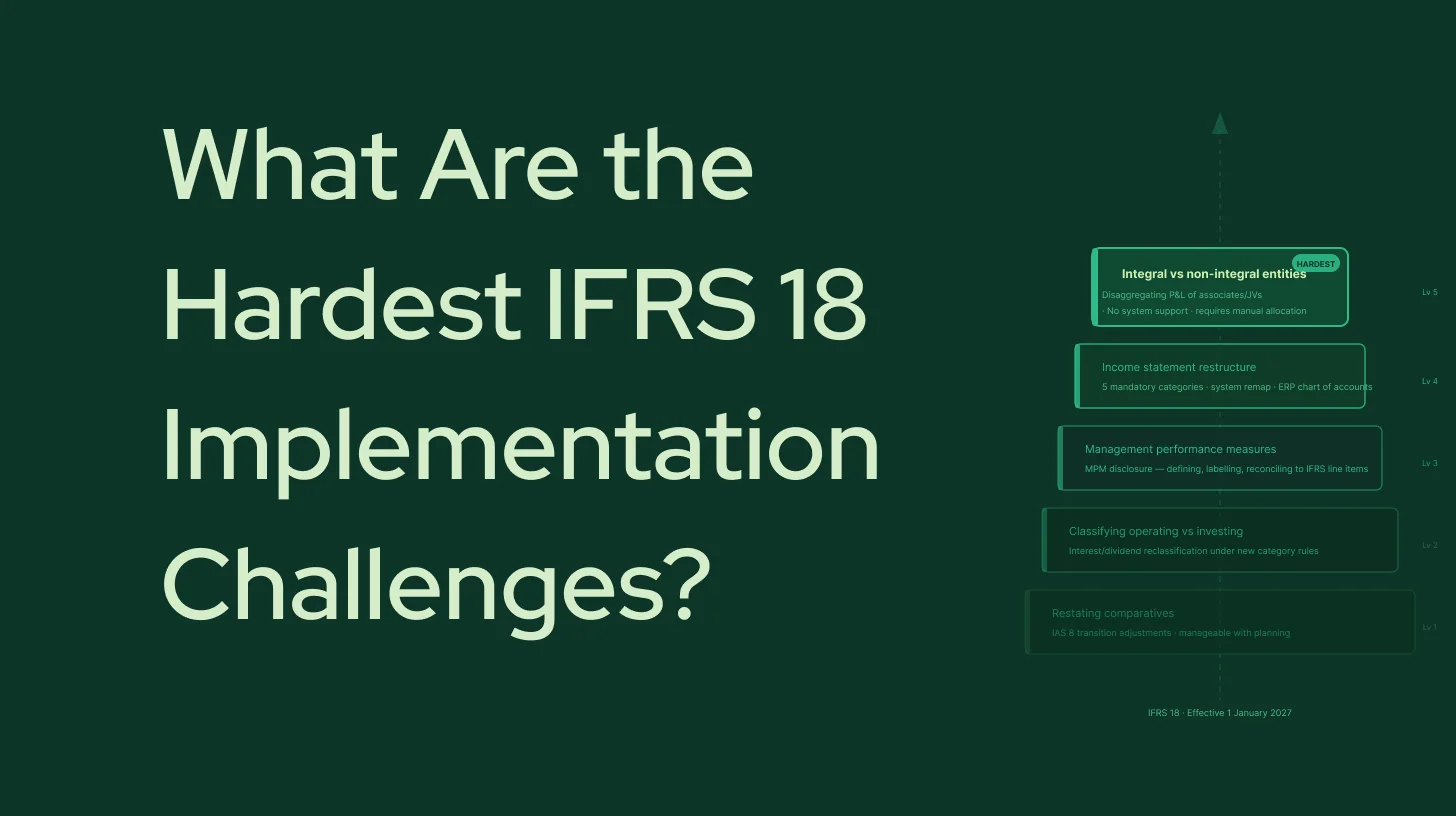
What Are the Hardest IFRS 18 Implementation Challenges?
IFRS 18 is mandatory from 1 January 2027. The retrospective restatement requirement means your 2026 data must already be captured under the new rules. Yet as of Q1 2025, approximately 80% of IFRS preparers surveyed had not started an implementation project, a striking gap given how little runway remains.
This guide is for finance directors, group controllers, CFOs, and external reporting managers who need to understand exactly what IFRS 18 will break in their current processes, how much time it will take to fix, and what to do before the window closes.
Key takeaway: IFRS 18 is not a disclosure update. It is a transformation of the income statement, your KPI framework, your IT architecture, and your stakeholder communications, all at once.
What Does IFRS 18 Change and What Does It Leave Unchanged?
IFRS 18 does not change recognition or measurement. No assets or liabilities move. What changes is how you present and disclose performance, and the downstream effects of that change are far larger than most teams have priced in.
Issued by the IASB on 9 April 2024, IFRS 18 replaces IAS 1 and introduces:
- Three defined income/expense categories on the face of the income statement: operating, investing, and financing.
- Two new required subtotals: operating profit, and profit before financing and income taxes.
- Management-defined Performance Measure (MPM) disclosures: any non-GAAP subtotal used in public communications must be disclosed in the notes with a reconciliation to the nearest IFRS-defined subtotal.
- Enhanced aggregation and disaggregation requirements, including mandatory disclosure of five natural expense categories (depreciation, amortisation, employee benefits, impairment losses, and inventory write-downs) when expenses are presented by function.
The standard applies across more than 140 jurisdictions. EFRAG has preliminarily endorsed it as conducive to the European public good, and EU adoption is on track.
Why Does the IFRS 18 Retrospective Restatement Requirement Make 2026 the Real Deadline?
The single most underestimated IFRS 18 implementation challenge is the retrospective restatement requirement. Companies presenting 2027 financials must show restated 2026 comparatives under IFRS 18 rules. That means IFRS 18-compliant data must be captured throughout 2026, a year before the standard is technically mandatory.
Panelists at a December 2025 KPMG preparer forum noted that companies wanting clean comparatives needed IFRS 18-compliant figures by end of 2025. For companies that missed that window, the 2026 parallel run is not optional, it is the last chance to avoid a retroactive restatement scramble.
For December year-end companies, the practical implication is stark: system changes, chart-of-accounts redesign, and subsidiary data alignment must all be operational by 1 January 2026 to capture a full year of compliant data.
Key takeaway: If your IT and chart-of-accounts changes are not live by 1 January 2026, you will be restating 2026 data manually under time pressure in early 2027. That is not a viable path for any organisation with quarterly or semi-annual reporting.
What Is the IFRS 18 Implementation Timeline for a December Year-End Company?
Here is the backwards-engineered timeline every finance team needs:
MilestoneDeadlineComplete impact assessment and scopingQ2 2026 (if not done)Finalise chart-of-accounts redesign and category mappingQ3 2026IT system changes live and tested1 January 2026 (ideally) / Q3 2026 (latest)Subsidiary data alignment and consolidation mapping completeQ3 2026MPM scoping finalised and reconciliation templates draftedQ3 2026Parallel run of legacy and IFRS 18 systemsFull year 2026Auditor pre-engagement on judgment areasQ2 2026Covenant and remuneration review completeQ3 2026Investor and analyst communication plan readyQ4 2026First IFRS 18 financial statements (with 2026 comparatives)2027 annual report
One panelist at the December 2025 forum noted that competing projects and shifting priorities made additional lead time essential, and that lessons from other recent standard implementations helped build realistic timelines and anticipate bottlenecks. IFRS 18 is more complex than a typical disclosure update.
What Are the Hardest IFRS 18 Implementation Challenges Finance Teams Are Encountering?
1. How Are FX Gains, Fair Value, and Interest on Provisions Classified Under IFRS 18?
The three-category framework sounds clean in theory. In practice, several common income and expense items sit awkwardly across category boundaries.
The IASB's March 2025 academic workshop confirms that the investing category covers income and expenses from assets that generate a return individually and largely independently of other resources. That definition creates genuine judgment for companies with mixed-use assets or integrated business models.
Items flagged as classification flashpoints at the September 2025 IASB World Standard Setters Conference include:
- Foreign currency gains and losses on external loans, leases, and intercompany loans
- Fair value gains and losses allocation across categories
- Insurance service costs
- Interest expense on pension liabilities and provisions
The IASB does provide relief from some classification requirements where they would result in undue cost or effort, and accounting policy choices exist for specific income and expense types. Document every judgment call with a clear rationale, auditors will scrutinise these.
2. How Do Diverse Groups and Banks Determine Main Business Activity Under IFRS 18?
The classification of income and expenses into operating, investing, or financing depends fundamentally on what your main business activities are. For a single-product manufacturer, this is straightforward. For a conglomerate or a bank, it is not.
The September 2025 IASB panel explicitly flagged "possible challenges in determining main business activities for groups with diverse operations and activities" and the impact of changes to those activities on comparatives over time.
For banks and financial institutions, the live questions include:
- Are lending activities and investments in assets effectively operating or investing?
- How much evidence is required to demonstrate an activity qualifies as investing?
- Do regulatory assets form part of the main business activity?
For diverse conglomerates, the challenge is that different business units may have genuinely different main business activities. The same income line can be operating in one division and investing in another. There is no single right answer, but there must be a documented, defensible one.
3. What Happens When a Subsidiary and Parent Have Different IFRS 18 Category Classifications?
This is the challenge that almost no published guidance addresses with the specificity it deserves.
If a parent and its subsidiary have different main business activities, they may classify the same income or expense differently. As KPMG notes: "If a parent and its subsidiary have different main business activities, they may need to classify income and expenses differently, which can affect the consolidation process."
Consider a practical example: a real estate subsidiary classifies rental income as operating (its main business activity). At group level, where the main business activity is manufacturing, that same rental income belongs in the investing category. A consolidation adjustment is required every period. For groups with dozens of subsidiaries across multiple platforms, this is a systemic data and process problem, not a one-time fix.
Companies with numerous consolidated entities, diverse IT systems, or non-standardised charts of accounts face heightened challenges in achieving the data granularity required, particularly for smaller operations not on standardised platforms.
What to do: Map every material subsidiary's main business activity now. Identify where group-level reclassifications will be required, and build those adjustments into your consolidation system, not a spreadsheet.
4. When Does an Internal KPI Become a Management-Defined Performance Measure Under IFRS 18?
MPMs are subtotals of income and expenses that are not specified by IFRS Accounting Standards, are included in public communications outside the financial statements, and communicate management's view of financial performance. Common examples include adjusted operating profit, adjusted EBITDA, and free cash flow.
The boundary between a reportable MPM and an internal KPI is genuinely unclear in practice. Two specific scoping questions are unresolved:
The regulatory disclosure question. The September 2025 IASB panel flagged whether disclosures required by local regulators constitute MPMs under IFRS 18, even if management does not use them internally. This is a live, unresolved interpretive question with significant compliance implications for financial institutions and regulated industries. Engage your auditor on this before scoping is finalised.
The income tax effect calculation. For each MPM, IFRS 18 requires disclosure of the income tax effect on each reconciling item. This is technically complex. The IASB's Effects Analysis acknowledges this is a significant cost driver and provides options for simplified approaches to calculating the income tax effect on reconciling items. Use them, but document why the simplified approach is appropriate for each item.
5. What Do IFRS 18's Aggregation and Disaggregation Requirements Mean in Practice?
IFRS 18's aggregation and disaggregation framework is principle-based. A single dissimilar characteristic can be sufficient to require disaggregation if the resulting information is material. That means the right level of disaggregation today may not be right in two years if your business model changes.
Raymond Chamboko of PAFA, speaking at the September 2025 IASB World Standard Setters Conference, flagged "concern that there may be a need for regular change and impact on comparatives as business responds to dynamic world and changes in circumstances or their composition."
The IASB panel also noted the challenge of "marrying narrative provided by management with the extent of aggregation/disaggregation" and "considering the fine line between necessary disclosure and obscuring the message contained in the financial statements."
For companies that currently present expenses by function, IFRS 18 requires disclosure in the notes of five specific natural expense amounts: depreciation, amortisation, employee benefits, impairment losses, and inventory write-downs. The IASB limited the mandatory disclosure to these five items as a cost mitigation measure from the original exposure draft, but mapping these amounts from a function-based system still requires chart-of-accounts work.
The materiality trap. KPMG's preparer panel explicitly cautioned against letting materiality drive decisions early in the project. Assess the full scope first; apply materiality at the end. Early materiality calls create expensive rework and risk under-reporting in smaller entities.
6. What IT System and Chart-of-Accounts Changes Does IFRS 18 Require?
This is the implementation challenge that separates companies that will transition smoothly from those that will be in crisis in early 2027.
KPMG's preparer panel was unambiguous: "Panelists cautioned against planning for manual IFRS 18 workarounds, particularly for companies that already rely heavily on automated reporting systems. For organizations with semiannual or quarterly reporting, manual adjustments would be difficult to sustain."
The core system requirements are:
- Chart-of-accounts redesign to tag every income and expense line to the correct IFRS 18 category at source.
- Consolidation system updates to handle subsidiary-level reclassifications at group level.
- MPM reconciliation automation to produce the required note disclosures without manual intervention each period.
- Parallel-run capability to run legacy and IFRS 18 reporting simultaneously throughout 2026.
Budget cycles are slow. If IT investment has not been approved, it needs to be escalated now. KPMG recommends incorporating IFRS 18 into any ongoing transformation projects to benefit from established processes and existing momentum.
7. How Does IFRS 18's New Operating Profit Definition Affect Debt Covenants and Remuneration Schemes?
This is the most underappreciated board-level risk in IFRS 18, and it is almost entirely absent from existing implementation guidance.
KPMG is direct about it: "Operating profit as defined under IFRS 18 may be different from operating profit as calculated today. This change may affect KPI targets, debt covenants, remuneration agreements and budgeting/performance reporting, if they reference operating profit."
KPMG Switzerland adds that companies already presenting an operating profit subtotal may still need to adjust their calculations to meet IFRS 18's new definition. The delta can be material for some business models.
The September 2025 IASB panel flagged the impact on calculation of ratios and debt covenants as an emerging theme across jurisdictions.
What this means in practice:
- Review every debt covenant that references operating profit, EBIT, or EBITDA. Quantify the delta between the current definition and IFRS 18's definition.
- Review executive remuneration schemes that use operating profit as a performance metric.
- Engage legal and treasury now, before the 2027 filing, to renegotiate definitions or add savings clauses where necessary.
- Brief the board and audit committee on the potential covenant impact before it appears in the 2027 financials.
Which Functions Need to Be Involved in an IFRS 18 Implementation and Why?
As EY's IFRS 18 roadmap states: "The shift to implementation of IFRS 18 requires integrated, cross functional change. Entities must define a clear vision for adoption and assign responsibilities."
The controllership team cannot do this alone. KPMG identifies that the core implementation team must be supplemented by:
FunctionIFRS 18 InvolvementIT / SystemsChart-of-accounts redesign, system upgrades, parallel runTreasuryCovenant review, financing category classificationHR / RemunerationBonus scheme KPI review and renegotiationInvestor RelationsAnalyst communication on new operating profit definitionInternal AuditControls over classification judgments and MPM scopingLegalCovenant renegotiation, regulatory MPM questionBusiness OperationsMain business activity determination at subsidiary level
Failure to involve these stakeholders early is a common mistake that leads to downstream rework, and in the case of covenants and remuneration, potential legal and governance exposure.
When Should Finance Teams Engage the External Auditor on IFRS 18 and on What Topics?
The IASB's Effects Analysis acknowledges that auditors face new audit risks around classification judgments, MPM scoping, and income tax effect calculations. Preparers should expect heightened scrutiny in all three areas.
For a deeper look at the specific audit risks IFRS 18 creates, see Finrep's analysis of audit risks and implementation hurdles in IFRS 18.
The practical implication for finance teams: engage your auditor in Q2 2026 at the latest, before classification decisions are locked. Have documented, defensible rationales for:
- Main business activity determinations at group and subsidiary level
- Classification of all material judgment items (FX, fair value, interest on provisions)
- MPM scoping decisions, including the regulatory disclosure question
- The income tax effect approach chosen for each MPM reconciling item
Auditors are engaging earlier and more intensively than many preparers anticipated. Arriving at the audit with undocumented judgment calls is not an option.
How Should Companies Communicate the IFRS 18 Operating Profit Change to Investors and Analysts?
When your 2027 annual report lands, equity analysts and debt investors will see an operating profit line that is not directly comparable to the one they have been modelling for years. Some will notice. Many will not, until they do, at which point the questions will come.
A proactive IR communication plan should:
- Quantify the delta between your current operating profit definition and IFRS 18's definition, and disclose it early.
- Explain which items moved categories and why.
- Provide a bridge table in the 2027 report reconciling the old and new definitions.
- Brief sell-side analysts and key buy-side investors before the first IFRS 18 filing, not after.
The aggregation/disaggregation decisions also affect the narrative. The IASB panel noted the challenge of "marrying narrative provided by management with the extent of aggregation/disaggregation" and the risk of "obscuring the message contained in the financial statements." More disclosure is not always better disclosure.
FAQ
Do we need to restate 2026 comparatives, and what does that mean for our timeline?Yes. IFRS 18 requires retrospective application. Your 2027 financial statements must include restated 2026 comparatives. That means IFRS 18-compliant data must be captured throughout 2026. System and process changes need to be operational by 1 January 2026 to avoid a manual restatement exercise.
How do we determine which non-GAAP measures qualify as MPMs?An MPM is any subtotal of income and expenses that is not specified by IFRS Accounting Standards, is included in public communications outside the financial statements, and communicates management's view of financial performance. The boundary with internal KPIs is a judgment call. The unresolved question for regulated industries is whether regulatory disclosures required by local regulators constitute MPMs even if management does not use them internally. Engage your auditor on scoping before finalising.
Will IFRS 18's new operating profit definition affect our debt covenants?Possibly, and materially for some business models. IFRS 18's operating profit definition is not a codification of existing practice. Quantify the delta between your current definition and the IFRS 18 definition, then review every covenant and remuneration scheme that references operating profit. Renegotiate definitions proactively rather than discovering a breach in 2027.
What is the income tax effect calculation on MPM reconciling items?For each MPM, IFRS 18 requires disclosure of the income tax effect on each reconciling item between the MPM and the nearest IFRS subtotal. This is technically complex. The IASB provides simplified approaches to calculating this effect. Use the simplified options where available, but document your rationale for each item.
Should we early-adopt in 2026?Early adoption is permitted and disclosed in the notes. For companies already running a 2026 parallel run, early adoption removes the need to maintain two sets of books simultaneously. The decision depends on system readiness, stakeholder communication timing, and whether your auditors are prepared. It is worth modelling both paths.
Is IFRS 18 a one-time implementation or an ongoing obligation?Both. The initial implementation is a project with a deadline. But the aggregation/disaggregation framework requires ongoing reassessment as your business evolves. A single dissimilar characteristic can trigger a disaggregation requirement if the information is material. Build a recurring review process into your reporting calendar, not just a project plan.
The 2026 parallel-run window is open. Every month without a live implementation project is a month of comparative data that will need to be reconstructed under pressure. As KPMG puts it: "To ensure a successful transition, preparers need to start early, involve key stakeholders, and develop a detailed implementation roadmap considering all potential effects on systems, processes, people and financial communication." That advice is not a platitude. It is the minimum viable plan.