ASC 350-20 Goodwill Impairment Testing and Disclosure Requirements: 2026 Practitioner Guide
Goodwill impairment testing under ASC 350-20 is one of the most judgment-intensive areas of U.S. GAAP, and the SEC staff knows it. If your balance sheet carries significant goodwill, here is exactly what your auditors will scrutinize, what the SEC staff will ask about, and what you must disclose, whether or not you recognize a loss.
Key takeaway: The two-step goodwill impairment test is gone for public companies. ASU 2017-04 replaced it with a one-step model effective for calendar-year public companies starting in 2020. If your team still references "Step 2" or "implied fair value of goodwill," that subparagraph was superseded.
What the ASC 350-20 Goodwill Impairment Test Actually Requires
Under ASC 350-20-35-28, goodwill must be tested for impairment at least annually, at the same date each year, and more frequently whenever a triggering event occurs. The annual test date can be any date during the fiscal year. Different reporting units can be tested on different dates. The test does not have to fall at fiscal year-end.
The current model has two entry points:
- Qualitative assessment ("Step 0") introduced by ASU 2011-08: assess whether it is more likely than not (likelihood greater than 50%) that the fair value of a reporting unit is less than its carrying amount. If not, stop. No quantitative test required.
- Quantitative one-step test: compare the reporting unit's fair value to its carrying amount. If carrying amount exceeds fair value, recognize an impairment loss equal to that excess, capped at the total goodwill allocated to that reporting unit.
The cap matters in practice. If a reporting unit carries $200 million of goodwill and its carrying amount exceeds fair value by $300 million, the impairment charge is limited to $200 million. The excess cannot create a negative goodwill balance.
The qualitative assessment is optional for every reporting unit in every period. An entity can bypass it and go straight to the quantitative test, then resume qualitative screening in a later year. It is not an all-or-nothing election across the entity.
The Qualitative Assessment: What Your Workpapers Must Show
Passing the qualitative screen without performing a quantitative test requires documented analysis of specific factors, not a general conclusion that business is fine. The FASB's codification lists the categories that must be considered:
- Macroeconomic conditions: deterioration in general economic conditions, limitations on accessing capital, foreign exchange movements, equity and credit market developments
- Industry and market factors: competitive environment deterioration, decline in market multiples (in absolute terms and relative to peers), regulatory or political developments
- Cost factors: increases in raw materials, labor, or other costs negatively affecting earnings and cash flows
- Overall financial performance: negative or declining cash flows, decline in actual or planned revenue or earnings versus prior periods
- Entity-specific events: changes in management, key personnel, strategy, or customers; contemplation of bankruptcy; litigation
- Reporting unit events: change in composition or carrying amount of net assets, more-likely-than-not expectation of disposing of all or part of a reporting unit, recognition of a goodwill impairment loss in a subsidiary
- For public companies: a sustained decrease in share price, considered in both absolute terms and relative to peers
The workpaper must address each relevant category and reach a conclusion on the totality of evidence. A boilerplate memo that lists the factors without applying them to the specific reporting unit is not sufficient documentation, and auditors applying PCAOB AS 2502 will push back on it.
| Documentation element | Qualitative "pass" | Quantitative test |
|---|---|---|
| Factor-by-factor analysis | Required | Required as context |
| Fair value estimate | Not required | Required (ASC 820) |
| WACC / discount rate | Not required | Required and disclosed |
| Valuation methodology | Not required | Required in disclosures |
| Third-party specialist | Optional | Often engaged |
| Level 3 unobservable input detail | Not required | Exception applies (see below) |
When a Triggering Event Forces an Interim Test
Interim goodwill impairment testing is required when events or changes in circumstances indicate it is more likely than not that a reporting unit's fair value has fallen below its carrying amount. For public companies, the analysis must be performed when the triggering event occurs, without the use of hindsight. You cannot wait until quarter-end and then look back.
The FASB's codification identifies specific interim triggers:
- Cash or operating losses at the reporting unit
- Consecutive operating results significantly below analyst or internal forecasts
- Significant revisions to internal or external forecasts
- A new restructuring plan
- Market capitalization below book value
- A negative long-term outlook for the industry
- An increase in deferred tax valuation allowances at the reporting unit
- A sustained decrease in share price
The 2025-2026 macro environment has materially elevated triggering event risk. Elevated risk-free rates and credit spreads have pushed weighted-average costs of capital (WACCs) higher across most sectors, compressing the headroom between reporting unit fair values and carrying amounts. Tariff-driven revenue forecast revisions, particularly in technology hardware, consumer goods, and industrials, are forcing significant downward adjustments to projected cash flows in DCF models. A reporting unit that passed its annual test in late 2024 with comfortable headroom may face a genuine triggering event question at any interim period in 2025 or 2026 if forecasts have been revised downward and the discount rate has risen.
For practical guidance on mapping current macro conditions to the specific ASC 350-20 triggering event factors, see our Q2 2026 goodwill impairment triggering events analysis.
Fair Value Measurement: The ASC 820 Interface
When a quantitative test is required, the reporting unit's fair value must be determined in accordance with ASC 820. In practice, this almost always involves a combination of the income approach (discounted cash flow) and the market approach (guideline public company multiples or guideline transaction multiples).
The income approach requires significant judgment about:
- Projected cash flows and terminal growth rates
- The discount rate (WACC), which incorporates the risk-free rate, equity risk premium, company-specific risk premium, and capital structure
- The weighting between approaches
In the current environment, the income approach is particularly sensitive. A 50-basis-point increase in WACC can reduce a reporting unit's DCF value by 10-15% depending on the cash flow profile, turning a comfortable cushion into a potential impairment.
One relief provision that preparers frequently miss: ASC 350-20-50-3 provides a significant fair value disclosure exception. The quantitative disclosures about significant unobservable inputs used in Level 3 fair value measurements required by ASC 820-10-50-2(bbb) are not required for fair value measurements related to goodwill impairment testing after initial recognition in a business combination. This is an explicit carve-out from the standard ASC 820 Level 3 disclosure framework. Many preparers either over-disclose (providing unnecessary Level 3 input tables) or confuse this exception with the general ASC 820 hierarchy disclosures. The exception is real and should be applied.
ASC 350-20-50 Disclosure Requirements: The Complete Map
Disclosure obligations differ depending on whether impairment is recognized.
Disclosures Required in Every Period (ASC 350-20-50-1)
The goodwill rollforward is required for each period for which a balance sheet is presented, meaning all comparative periods, not just the current year. It must be disaggregated by reportable segment when the entity has multiple reportable segments. The required line items are:
- Gross amount and accumulated impairment losses at the beginning of the period
- Additional goodwill recognized during the period (excluding goodwill in a disposal group meeting held-for-sale criteria at acquisition)
- Adjustments from subsequent recognition of deferred tax assets (ASC 805-740-25-2 through 25-4 and 805-740-45-2)
- Goodwill included in a disposal group classified as held for sale, and goodwill derecognized without prior held-for-sale classification
- Impairment losses recognized during the period
- Net exchange differences (ASC 830)
- Any other changes in carrying amounts
- Gross amount and accumulated impairment losses at the end of the period
Under ASC 350-20-45-1, goodwill must appear as a separate line item on the balance sheet, net of accumulated impairment losses. It cannot be combined with other intangible assets.
Additional Disclosures When Impairment Is Recognized (ASC 350-20-50-2)
When a goodwill impairment loss is recognized, two additional disclosures are required:
- A description of the facts and circumstances leading to the impairment
- The amount of the impairment loss and the method of determining the fair value of the associated reporting unit, whether based on quoted market prices, prices of comparable businesses, a present value or other valuation technique, or a combination
Note that the prior requirement to disclose the implied fair value of goodwill was superseded by ASU 2017-04. That line item no longer exists.
What the SEC Staff Actually Asks About: 2026 Comment Letter Patterns
Goodwill and other intangibles remain an active SEC staff comment area as of early 2026. PwC's March 2026 SEC comment letter tracker identifies five recurring themes:
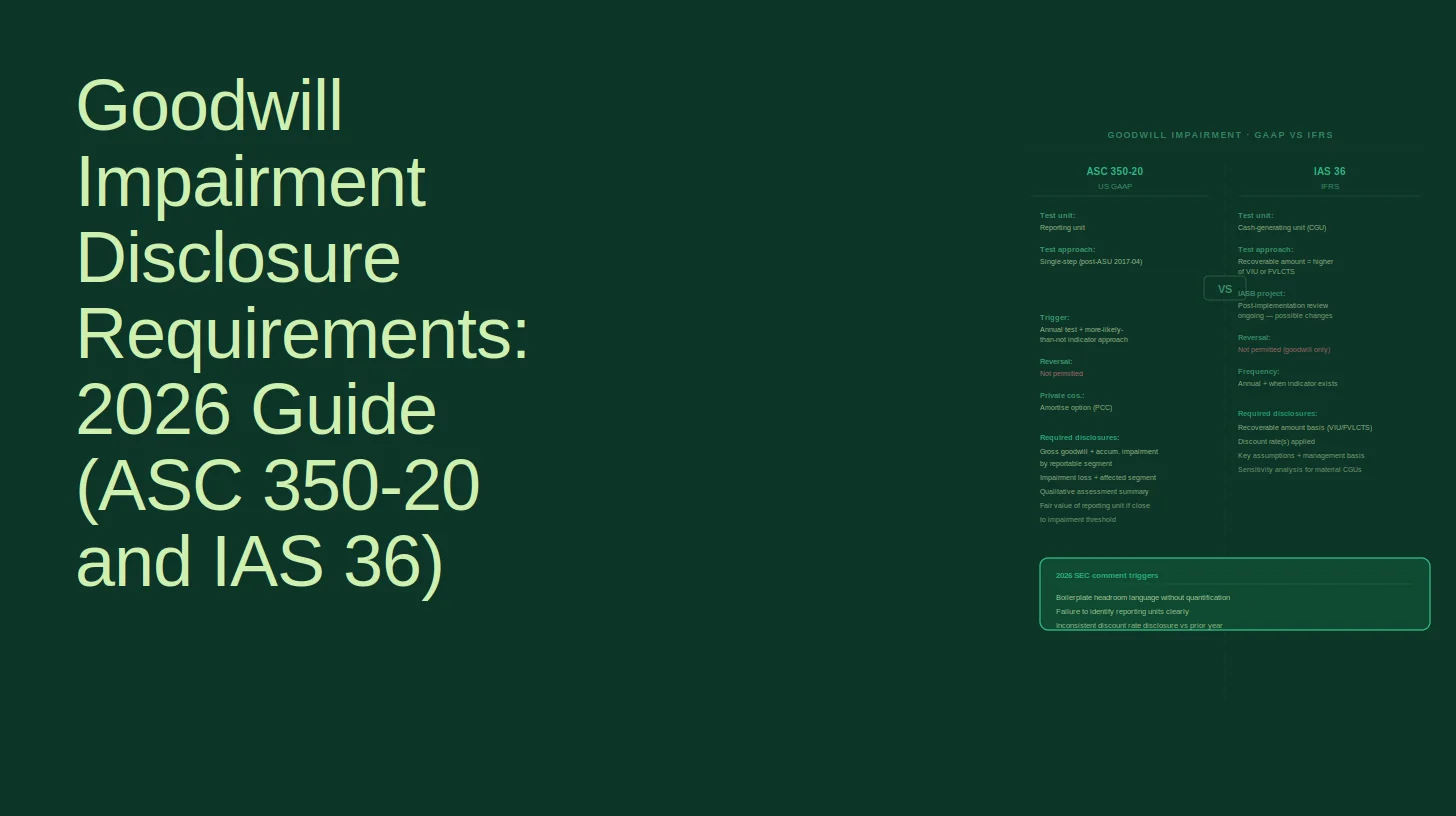
- Segment-level goodwill allocation: The SEC staff has cited ASC 350-20-35-45 directly, requiring entities to "revise your financial statements in future filings to disclose the amount of goodwill allocated to each reportable segment." Presenting goodwill only at the consolidated level, without segment disaggregation, draws this comment. This is the most common deficiency.
- Basis for qualitative assessments: When indicators of potential impairment exist, the staff asks for the specific factors considered and why the entity concluded a quantitative test was unnecessary.
- "At-risk" reporting unit disclosures: The SEC staff expects entities to disclose when a reporting unit's fair value is not substantially in excess of its carrying amount, even if no impairment is recognized. The standard itself does not use the phrase "at risk," but the SEC's expectation is well-established through comment letters. Boilerplate language that all reporting units passed with substantial headroom, when one unit is close to the line, will draw a comment.
- Annual testing date changes: The staff asks about the rationale for any change in testing date and whether the change was justified as preferable.
- Triggering event analysis documentation: The staff asks whether management monitored for triggering events during the period and what the analysis showed.
The segment-level allocation comment is a live enforcement priority. If your rollforward presents goodwill as a single consolidated number and you have multiple reportable segments, revise before your next filing.
For a detailed checklist of all ASC 350-20-50 disclosure elements mapped to codification paragraphs, see our goodwill impairment disclosure requirements checklist.
Goodwill Reallocation When Reporting Units Change
Segment reorganizations create a disclosure and testing obligation that most preparers underestimate. When an entity restructures its reporting units, ASC 350-20 requires goodwill to be reallocated using a relative fair value approach, analogous to the method used when a portion of a reporting unit is disposed of. The reallocation must be reflected in the goodwill rollforward disclosure and may itself constitute a triggering event requiring an interim impairment test before the reorganization is complete.
The practical implication: if your company restructures segments mid-year, do not wait until the annual test date. Assess whether the reorganization is a triggering event, perform the reallocation, and document the relative fair values used. The SEC staff will ask.
Private Company and NFP Alternatives
Private companies and not-for-profit entities have two elections that significantly reduce the cost and complexity of goodwill accounting.
Election 1: Amortization alternative (ASU 2014-02, codified at ASC 350-20-15-4)
Goodwill may be amortized on a straight-line basis over 10 years, or a shorter period if the entity demonstrates that another useful life is more appropriate. Under this alternative:
- Goodwill is tested for impairment only when a triggering event occurs, not annually
- The test is performed at the entity level (not the reporting unit level) unless a specific reporting unit is identified as at risk
- The election is irrevocable once made
- Required disclosures include the amortization method, useful life, and accumulated amortization
Election 2: Triggering event evaluation at period-end (ASU 2021-03)
ASU 2021-03, issued in March 2021, provides private companies and NFPs that have elected the amortization alternative with an additional option: evaluate triggering events as of the end of the reporting period rather than when the triggering event occurs during the period. An entity that elects this alternative is not required to monitor triggering events throughout the period.
The FASB issued this update in direct response to COVID-19-era concerns about the cost and complexity of mid-period triggering event analysis. As the FASB noted in ASU 2021-03: "The Board decided to issue the amendments in this Update in response to stakeholders' concerns about (1) the cost and complexity of performing a goodwill triggering event evaluation during the reporting period, rather than completing the analysis as of the end of the reporting period, and (2) the relevance of the triggering event evaluation with the financial information reported to and used by stakeholders."
The same logic applies directly to the tariff and macro volatility environment of 2025-2026. Private company teams that have not yet evaluated whether to elect ASU 2021-03 should do so now.
| Feature | Public company (no election) | Private company: amortization alternative | Private company: + ASU 2021-03 election |
|---|---|---|---|
| Annual impairment test | Required | Not required | Not required |
| Triggering event monitoring | Continuous (without hindsight) | Continuous | At period-end only |
| Test level | Reporting unit | Entity (or reporting unit if at risk) | Entity (or reporting unit if at risk) |
| Amortization | None | Straight-line, max 10 years | Straight-line, max 10 years |
| Election irrevocable? | N/A | Yes | No (can discontinue) |
The FASB's Open Goodwill Project: What Preparers Must Watch
The FASB's goodwill project remains active as of mid-2026, with no final standard issued. The Board has been deliberating whether to reintroduce amortization of goodwill for public companies, which would be the most significant change to goodwill accounting since SFAS 142 eliminated amortization in 2001. The FASB's project page is the authoritative source for current status.
If the FASB issues a proposed standard, public companies will face SAB 74 disclosure obligations in their SEC filings. SAB 74 requires registrants to disclose the potential effect of an accounting standard that has been issued but not yet adopted. If the proposed standard would materially affect goodwill carrying amounts or income statement presentation, the disclosure obligation is real and the SEC staff will ask about it.
For a detailed guide to SAB 74 disclosure mechanics, see our SAB 74 disclosure requirements guide.
Preparers should also consider whether their current accounting policy disclosures adequately describe the impairment-only model and how a shift to amortization would affect comparability. Updating those disclosures proactively, before a final standard, is a reasonable risk management step.
FAQ
When did the two-step goodwill impairment test go away? ASU 2017-04 eliminated the two-step model for public business entities, effective for annual periods beginning after December 15, 2019 (calendar year 2020 and beyond). The current one-step model compares reporting unit fair value to carrying amount and recognizes impairment equal to the excess, capped at total goodwill. The prior Step 2 calculation of implied fair value of goodwill no longer applies.
Do we have to disclose Level 3 unobservable inputs when we use a DCF to test goodwill? No. ASC 350-20-50-3 explicitly exempts goodwill impairment fair value measurements from the quantitative Level 3 input disclosures required by ASC 820-10-50-2(bbb). You must disclose the valuation methodology used (income approach, market approach, or combination) when impairment is recognized, but the detailed unobservable input tables required for other Level 3 measurements do not apply.
What does "at-risk" reporting unit mean, and must we disclose it? The standard does not use the phrase "at risk," but the SEC staff expects disclosure when a reporting unit's fair value is not substantially in excess of its carrying amount, even if no impairment is recognized. If one of your reporting units passed the annual test with thin headroom, a generic statement that all units passed with substantial cushion will draw a comment letter. Disclose the specific unit, the approximate headroom, and the key assumptions.
Can we change our annual goodwill impairment testing date? Yes, but the change must be applied prospectively and justified as preferable. Relevant factors include external reporting deadlines, seasonality, availability of annual budgets, and whether the goodwill is at significant risk of impairment. A change that moves the test date to avoid recognizing an impairment that would have been identified at the original date is not acceptable.
How does goodwill reallocation work when we reorganize segments? Goodwill must be reallocated to the new reporting units using a relative fair value approach. The reallocation must be reflected in the goodwill rollforward by segment, and the reorganization may itself constitute a triggering event requiring an interim impairment test. Document the relative fair values used in the reallocation and assess whether an interim test is required before completing the reorganization.
What should private companies consider before electing the amortization alternative? The election is irrevocable once made. Before electing, consider whether lenders or investors rely on goodwill carrying amounts, whether the amortization charge would materially affect earnings metrics used in debt covenants or compensation plans, and whether the entity expects to go public in the near term (at which point the alternative would no longer be available). The reduction in annual testing complexity is real, but so is the income statement impact of 10 years of straight-line amortization.