Revenue recognition under ASC 606 is one of the highest-frequency, highest-judgment workflows in the Controller's office. A single multi-element contract can require two to four hours of work to map performance obligations, determine standalone selling prices, allocate transaction price, and construct a recognition schedule before any review. At scale, across a portfolio of complex arrangements, this compounds into a significant portion of the close cycle.
Generative AI can compress the assembly and structuring portion of that work substantially. The judgment stays with the Controller. The five-step analysis, the clause-level citations, the recognition schedule table, and the identification of where judgment is required can all be produced by a well-structured prompt applied to the contract text.
This post maps exactly how that workflow is constructed, why the prompt discipline matters under COSO's February 2026 guidance and PCAOB AS 2301, and what needs to happen before any AI-assisted revenue recognition output enters a financial statement or disclosure.
What Is the ASC 606 Five-Step Model and Where Does AI Fit Into It?
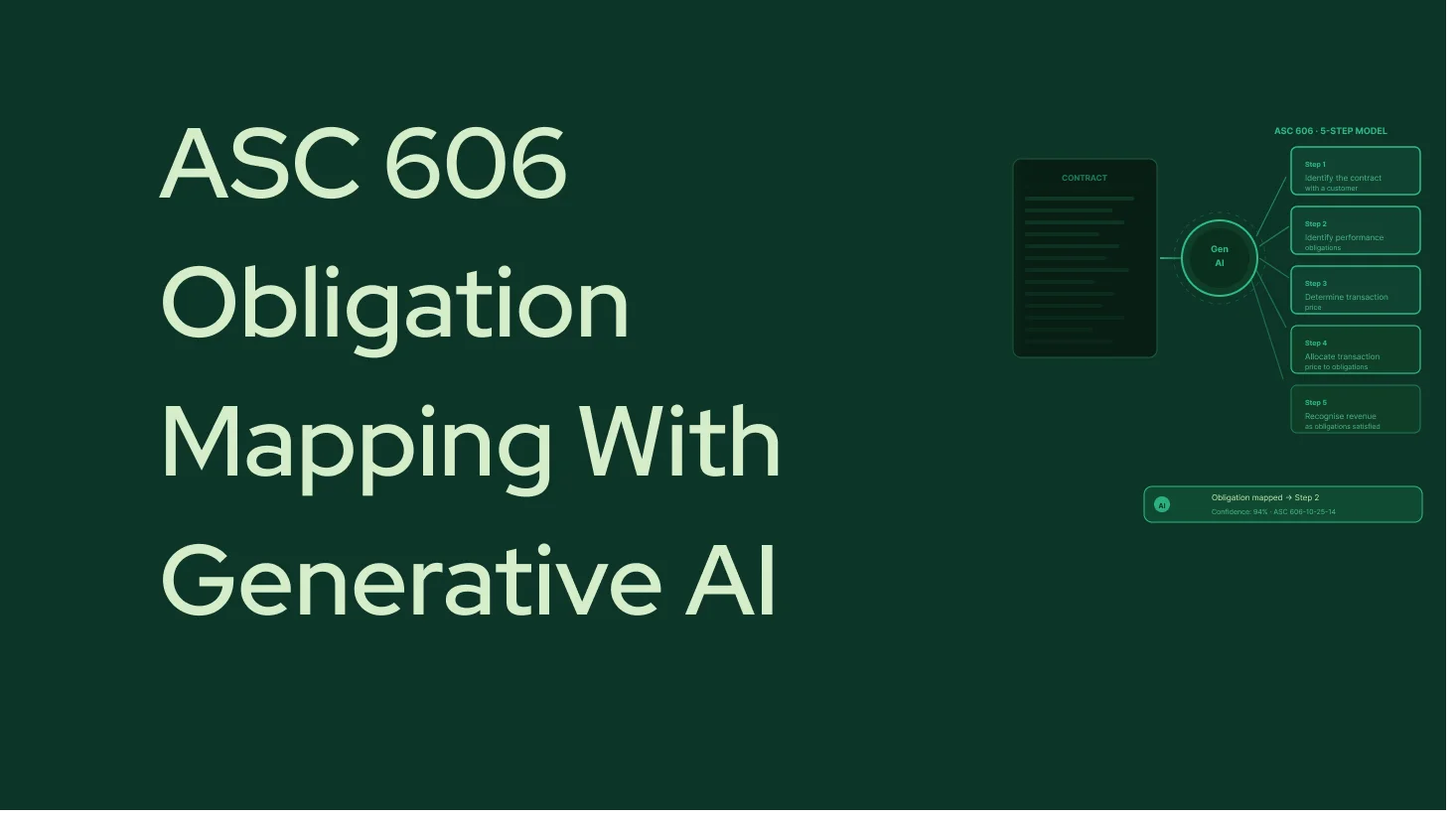
ASC 606, Revenue from Contracts with Customers, governs revenue recognition for most entities under US GAAP. The standard requires a five-step analysis for every customer contract: identify the contract, identify the distinct performance obligations, determine the transaction price, allocate the transaction price to the performance obligations, and recognise revenue when or as each obligation is satisfied.
Each step requires both data extraction and judgment. Data extraction means reading the contract and identifying the relevant terms: the parties, the pricing, the deliverables, the payment schedule, the termination provisions, the variable consideration mechanisms. Judgment means applying ASC 606's criteria to those terms to determine whether obligations are distinct, whether variable consideration should be constrained, and whether revenue is recognised at a point in time or over time.
Generative AI is well-suited to the data extraction portion and to the structured application of the standard's criteria to the extracted terms. It is not a substitute for the judgment calls that ASC 606 explicitly leaves to management, particularly the standalone selling price determination, the variable consideration constraint assessment, and the over-time versus point-in-time classification for complex arrangements.
The correct architecture for AI in this workflow is: the model performs extraction and structures the analysis, surfacing judgment questions explicitly rather than resolving them; the Controller or Revenue Accounting Manager resolves those questions with their own analysis and documents the basis; the AI-generated output becomes a working paper, not the accounting conclusion.
COSO's February 2026 guidance emphasises that generative AI transforms how information is generated, processed, and acted upon, but does not change the fundamental purpose of internal control: to help organisations achieve their objectives reliably. For revenue recognition, this means the control over AI-assisted ASC 606 analysis is management's review and sign-off on the output, not the AI's analysis itself.
What Does the Prompt Need to Contain to Produce a Usable ASC 606 Output?
A prompt that produces an auditable, usable ASC 606 analysis has five required elements. Each addresses a specific failure mode that a poorly structured prompt produces.
Element 1: A defined role and regulatory frame. The prompt should open by assigning the model a specific role — revenue accountant applying ASC 606 and naming the regulatory frame. This constrains the model to the correct analytical domain and prevents it from importing irrelevant accounting frameworks or jurisdiction-specific rules into the analysis.
Element 2: Source material pasted in full with an explicit source-only constraint. The full contract text, including all schedules and amendments, must be pasted into the prompt. The prompt must then instruct the model to use only this source material and to cite the specific contract clause supporting each conclusion it reaches. A prompt that does not include this constraint will produce an analysis that may be factually accurate for a generic contract but not necessarily accurate for this contract.
Element 3: The five-step structure named explicitly in sequence. The prompt should name all five ASC 606 steps in order and ask the model to complete each in sequence. This mirrors the standard and makes the output immediately legible to a reviewer or auditor who already thinks in the five-step frame. An unstructured prompt that asks the model to "analyse this contract under ASC 606" produces an output that is difficult to review systematically.
Element 4: A JUDGMENT REQUIRED instruction for every judgment call. This is the most operationally significant element. Wherever ASC 606 requires a judgment that the contract text alone cannot resolve — standalone selling price is not directly observable, the variable consideration constraint requires a probability assessment, the transfer of control analysis requires assessment of legal title and physical possession — the prompt must instruct the model to write "JUDGMENT REQUIRED" and state exactly what input is needed, rather than fabricating a conclusion.
According to the MIT Project NANDA study of 300 enterprise AI deployments, tightly scoped, domain-specific prompts with explicit output definitions are the category that delivers measurable return. Revenue recognition is precisely the domain where the model's tendency to produce confident-sounding conclusions is most dangerous, because the numbers produced flow directly into the income statement and the revenue footnote.
Element 5: A recognition schedule table as a required output. The prompt should require the model to produce a recognition schedule showing revenue allocated to each performance obligation by period. This converts the analysis from a narrative document into a structured table that can be reviewed against the general ledger and used directly in the footnote drafting process.
How Do You Apply the Five Steps to a Multi-Element Contract Specifically?
A multi-element software contract is the most common ASC 606 complexity the Controller's office encounters. The following maps how an AI-assisted analysis works through each step for a contract containing an implementation fee, an annual software licence, and a support component.
Step 1: Identify the contract. The model identifies the parties, the contract date, the payment terms, and any modification provisions. It cites the relevant contract clauses. For a standard SaaS arrangement, this step is straightforward. The JUDGMENT REQUIRED flag at this step is typically limited to contracts where collectability is in question or where the arrangement includes multiple agreements that may need to be combined under ASC 606-10-25-9.
Step 2: Identify distinct performance obligations. This is the step where AI assistance is most valuable and most risky simultaneously. The model applies ASC 606's two-criteria test: is the good or service capable of being distinct on its own, and is it distinct within the context of the contract? For each proposed obligation, the model cites the contract clause that supports treating it as distinct.
For a typical SaaS contract, the model may correctly identify the implementation fee as a separate obligation if the implementation services are distinct from the licence, or may correctly identify them as a combined single obligation if the customer cannot benefit from the implementation without the licence. The key discipline is that the model must cite the clause that supports its conclusion. If it cannot, it writes JUDGMENT REQUIRED and states what additional analysis is needed — typically, whether the services are capable of being distinct based on customer-specific facts about how the implementation is delivered.
Step 3: Determine the transaction price. The model identifies the total contract consideration, maps any variable elements (performance bonuses, usage-based fees, refund provisions), and applies the ASC 606 variable consideration guidance. This step almost always produces a JUDGMENT REQUIRED flag for variable consideration, because the constraint assessment requires a management probability estimate that the contract text alone cannot provide. The model should state exactly what estimate is needed: the expected value or most likely amount, and the basis for the constraint conclusion.
Step 4: Allocate the transaction price. Allocation requires standalone selling prices (SSPs) for each obligation. If SSPs are observable from standalone sales, the model can cite them from any pricing schedule included in the source material. If SSPs are not directly observable, the model writes JUDGMENT REQUIRED and states that SSP inputs must be supplied by management before allocation can be completed. The model should not fabricate an SSP. This is the most common failure mode in AI-assisted ASC 606 analysis and the most consequential, because the SSP inputs directly determine the revenue recognised in each period.
Step 5: Recognise revenue when or as obligations are satisfied. The model classifies each obligation as recognised at a point in time or over time, citing the ASC 606 criteria that support the classification. For a software licence, the analysis typically turns on whether the licence provides a right to access IP or a right to use IP at a point in time. This classification requires reading the specific licence terms and applying ASC 606-10-25-27 through 25-29. The model cites the clause and, where the contract terms are ambiguous, writes JUDGMENT REQUIRED.
What Does COSO's February 2026 Guidance Require for AI-Assisted Revenue Recognition?
COSO's February 23, 2026 publication, "Achieving Effective Internal Control Over Generative AI," builds on COSO's Internal Control Integrated Framework (2013) by introducing a pragmatic approach to managing the new and evolving risks and internal controls related to generative AI.
For revenue recognition specifically, four requirements from the COSO guidance apply directly.
Requirement 1: AI output must be treated as an assertion requiring validation. The COSO guidance is explicit that AI output is not a reliable fact. A recognition schedule produced by an AI prompt must be reviewed by a named human reviewer before it enters the accounting records or a financial statement footnote. The reviewer must independently confirm the schedule against the contract terms and the entity's SSP data.
Requirement 2: A centralised use-case inventory must document AI touching financial reporting. Any AI workflow that produces output affecting a material revenue line must be documented in the entity's AI use-case inventory. The documentation must include the use case name and owner, what data it touches, what it produces, and whether its output can affect amounts or disclosures in the financial statements. For an ASC 606 obligation mapping workflow, this is a HIGH-tier use case under the COSO tiering methodology: it produces output that directly affects recognised revenue and the revenue footnote.
Requirement 3: A full audit trail must be retained. The COSO GenAI guidance's implementation roadmap consists of six steps: govern, inventory, assess, design, implement, and monitor. The monitoring step requires that every AI-assisted analysis retain a reconstructable record: the final prompt, the model name and version, the contract inputs, the raw AI output, every JUDGMENT REQUIRED resolution with the human reviewer's documented basis, and the date and name of the reviewer. This record is the evidence that management's assessment of disclosure controls and procedures can point to.
Requirement 4: HIGH-tier use cases require human sign-off, output validation, and full logging. The COSO tiering methodology classifies AI use cases as HIGH if the output can affect a material amount or disclosure. An ASC 606 obligation mapping workflow for a material revenue stream is HIGH by definition. The minimum controls for a HIGH-tier use case are: a named human reviewer who independently confirms the output, validation of the output against source data, and logging of the full evidence set described above.
According to Virtas Partners' April 2026 analysis of the COSO GenAI guidance, SEC guidance still requires management to assess ICFR, and registrants must disclose material changes in ICFR in quarterly and annual reports, including changes such as implementation of a new information system if the change materially affected ICFR. A Controller who deploys an AI-assisted ASC 606 workflow without updating the entity's ICFR assessment is exposed on both the disclosure controls and procedures and the ICFR certification.
What Does PCAOB AS 2301 Require When AI Assists Revenue Recognition Analysis?
PCAOB Auditing Standard AS 2301, The Auditor's Responses to the Risks of Material Misstatement, requires auditors to consider how the entity uses technology in its financial reporting processes when designing audit procedures. When an entity uses generative AI to assist ASC 606 obligation mapping, the external auditor must understand and evaluate that process as part of the audit.
The practical implication for the Controller's office is that the AI-assisted workflow must be documentable and explainable. The auditor will ask three questions: what prompt was used, what inputs were provided to the model, and how did management validate the output before it entered the accounting records. If the entity cannot produce complete answers to all three, the auditor's comfort with the revenue recognition process is reduced regardless of whether the numerical outputs are correct.
PCAOB AS 2301 does not prohibit AI assistance in accounting workflows. It requires that the auditor evaluate the reliability of the process. A workflow with a well-documented prompt, complete source inputs, a clear JUDGMENT REQUIRED resolution log, and a named reviewer for every output satisfies the reliability standard. A workflow where the prompt is not retained, the model version is not logged, and the reviewer's basis for JUDGMENT REQUIRED resolutions is not documented does not satisfy it.
The connection between COSO's February 2026 guidance and PCAOB AS 2301 is direct. COSO tells management what the internal control requirements are for AI use cases affecting financial reporting. AS 2301 tells the external auditor to evaluate those controls. A Controller who has implemented the COSO framework for their ASC 606 AI workflow has also, by construction, produced the documentation the external auditor needs to evaluate that workflow.
What Is the Control Wrapper for an ASC 606 AI Workflow?
The control wrapper is the minimum set of controls and documentation that a HIGH-tier AI use case must have before its output enters the accounting records or any financial statement disclosure.
Verify: Every distinct-obligation conclusion must be confirmed against the specific contract clause the model cited. Every JUDGMENT REQUIRED item must be resolved by a named reviewer with a documented basis. The recognition schedule must be reconciled to the contract's payment terms and to the entity's SSP data. No JUDGMENT REQUIRED item may remain unresolved when the output is used.
Retain: The final prompt version used. The model name and version number. The complete contract text submitted as input, including the version date. The raw AI output before any human editing. Every JUDGMENT REQUIRED resolution: the reviewer's name, the date, and the documented basis for the conclusion. The final recognition schedule after reviewer edits. The name of the reviewer who confirmed the final output.
This retention set is what satisfies COSO's monitoring requirement, FINRA's 2026 log retention expectation for AI touching financial reporting, and the auditor's AS 2301 documentation inquiry.
A practical implementation note: the retention set should be stored in the entity's SOX workpaper system or equivalent controlled document management environment, not in the reviewer's personal drive or email. The audit trail must be accessible and reconstructable by anyone with authorisation, not only by the reviewer who ran the analysis.
Frequently Asked Questions
Can generative AI complete an ASC 606 five-step analysis without human review?
No. Under COSO's February 2026 guidance, AI output that can affect a material amount or disclosure must be treated as an assertion requiring validation by a named human reviewer before it enters the accounting records. For ASC 606 obligation mapping, the revenue line is material by definition and the recognition schedule flows directly into the financial statements. Human review and sign-off are not optional. The AI produces the structured analysis; the Controller or Revenue Accounting Manager owns every accounting conclusion.
What is the JUDGMENT REQUIRED instruction and why is it the most important element of the prompt?
The JUDGMENT REQUIRED instruction tells the model to stop and flag a gap rather than fabricate a conclusion when ASC 606 requires a management estimate or judgment that the contract text alone cannot resolve. Standalone selling price determination, variable consideration constraint assessment, and the over-time versus point-in-time classification for ambiguous arrangements all require JUDGMENT REQUIRED flags. Without this instruction, the model produces confident-sounding conclusions for these items that may be factually incorrect. The JUDGMENT REQUIRED flag converts the model from a guesser into an assembler and surfaces every open question to the human reviewer.
What makes an ASC 606 AI workflow a HIGH-tier use case under COSO's February 2026 guidance?
COSO's tiering methodology classifies a use case as HIGH if its output can affect a material amount or disclosure in the financial statements. An ASC 606 obligation mapping workflow produces a recognition schedule that directly determines how revenue is recognised and disclosed in the revenue footnote. It is HIGH by definition. HIGH-tier use cases require human sign-off on the output, validation against source data, and full logging of the prompt, model version, inputs, raw output, reviewer name and date, and all JUDGMENT REQUIRED resolutions.
What does PCAOB AS 2301 require when the entity uses AI for revenue recognition analysis?
PCAOB AS 2301 requires auditors to evaluate the reliability of the entity's technology-assisted processes when those processes affect financial reporting. For an AI-assisted ASC 606 workflow, the auditor will ask what prompt was used, what inputs were provided, and how management validated the output. A workflow with a documented prompt, retained inputs, a JUDGMENT REQUIRED resolution log, and a named reviewer satisfies the auditor's reliability inquiry. A workflow without these elements does not, regardless of whether the numerical outputs happen to be correct.
Does implementing an AI-assisted ASC 606 workflow require updating the entity's ICFR assessment?
Yes, in most cases. If the AI-assisted workflow materially affects how the entity performs revenue recognition analysis, it represents a change in the information systems and processes supporting ICFR. Under SEC reporting requirements, management must disclose material changes in ICFR in its 302 and 906 certifications and in the ICFR section of the annual report. The COSO February 2026 guidance and the Virtas Partners analysis of that guidance both confirm that implementing AI in financial reporting processes creates an ICFR disclosure obligation if the change is material.
Key Takeaways
- Generative AI is well-suited to the extraction and structuring portion of ASC 606 analysis: identifying the contract terms, mapping obligations to contract clauses, building the recognition schedule table, and identifying where judgment is required. It is not a substitute for the management judgments ASC 606 requires, particularly SSP determination and variable consideration constraint assessment.
- The five required elements of a usable ASC 606 prompt are: a defined role and regulatory frame, a source-only constraint with clause-level citation requirements, the five-step structure named in sequence, a JUDGMENT REQUIRED instruction for every judgment call, and a recognition schedule table as required output.
- COSO's February 23, 2026 guidance classifies AI use cases affecting material revenue amounts as HIGH tier, requiring human sign-off, output validation against source data, and full logging of the prompt, model version, inputs, output, and reviewer identity. This is not a new standard; it is COSO's existing five-component framework applied to AI.
- PCAOB AS 2301 requires the external auditor to evaluate the reliability of technology-assisted processes affecting financial reporting. A documented prompt, retained inputs, a JUDGMENT REQUIRED resolution log, and a named reviewer produce the evidence the auditor needs. The absence of any of these elements reduces auditor comfort regardless of whether the numerical outputs are accurate.
- Implementing an AI-assisted ASC 606 workflow is an ICFR change for purposes of the SOX 302 and 906 certifications. The Controller should assess whether the change is material to ICFR and update the entity's disclosure accordingly.
- The retention set for every AI-assisted ASC 606 analysis should be stored in the entity's SOX workpaper system: final prompt, model name and version, contract input version, raw output, all JUDGMENT REQUIRED resolutions with documented basis, final recognition schedule, and reviewer name and date.