AI Footnote Disclosure Drafting for SEC Filings: 2026 Practitioner Walkthrough
If your SEC reporting team is spending two weeks on financial statement footnotes alone, AI drafting tools are worth a serious look. But footnotes are not MD&A. They carry audited numbers, XBRL-tagged figures, and ASC-specific disclosure requirements that make a hallucinated sentence far more dangerous than a vague risk factor. This walkthrough tells you exactly which notes to automate first, where AI breaks down, and what governance you need to stay defensible with the SEC, your auditors, and in litigation.
Key takeaway: AI can produce serviceable first drafts of many financial statement footnotes, but the realistic total cycle-time saving is 15-20%, not the 40-70% vendors advertise. The gap is human review, XBRL consistency checking, and auditor sign-off, none of which compress.
Which Footnote Types Can AI Safely Draft?
Start with the lowest-hallucination notes, not the most time-consuming ones. The instinct is to automate the notes that hurt most, such as the lease table or the segment revenue schedule. That is the right instinct, but only for the right subset. The key variables are: how templated is the content, and how severe is an AI error?
The table below maps common footnote types against hallucination risk and automation suitability.
| Footnote Type | Standard | Hallucination Risk | Automation Suitability |
|---|---|---|---|
| Accounting policy elections | ASC 235 | Low | High, boilerplate with entity-specific inputs |
| Lease liability / ROU asset tables | ASC 842 | Low-Medium | High for table structure; verify every figure |
| Disaggregated revenue tables | ASC 606 | Low-Medium | High for table structure; verify period labels |
| Segment revenue and profit | ASC 280 | Medium | Moderate, prior-period comparatives are a known hallucination hotspot |
| Fair value hierarchy tables (Level 1/2) | ASC 820 | Medium | Moderate, structured inputs reduce risk |
| Share-based compensation tables | ASC 718 | Medium | Moderate, vesting schedules require source verification |
| Tax rate reconciliation narrative | ASC 740 | Medium-High | Low, judgment-intensive; AI defaults to generic language |
| Going concern assessment | ASC 205-40 | High | Do not automate, requires management judgment |
| Contingent liabilities | ASC 450 | High | Do not automate, litigation facts are hallucination-prone |
| Fair value Level 3 narratives | ASC 820 | High | Do not automate, unobservable inputs require preparer judgment |
| Related-party disclosures | ASC 850 | High | Do not automate, facts are entity-specific and legally sensitive |
| Subsequent events | ASC 855 | High | Do not automate, contains the most sensitive pre-release MNPI |
KPMG's 2025 technical guidance identifies five specific hallucination hotspots in AI-drafted 10-K sections: numerical figures cited in narrative, prior-period comparatives, legal proceedings descriptions, forward-looking statements with specific metrics, and segment reporting disclosures. All five appear heavily in financial statement footnotes, which is precisely why footnote automation requires a different risk map than MD&A automation.
For a broader look at hallucination risk across the full 10-K, see AI Hallucination Risk in SEC Filings: A 2026 Practitioner Walkthrough.
The XBRL Consistency Problem Nobody Warns You About
AI-drafted footnote narrative that contradicts the iXBRL-tagged financials is a direct path to an SEC comment letter. This risk is almost entirely absent from vendor marketing materials, and it is the most technically specific danger in footnote automation.
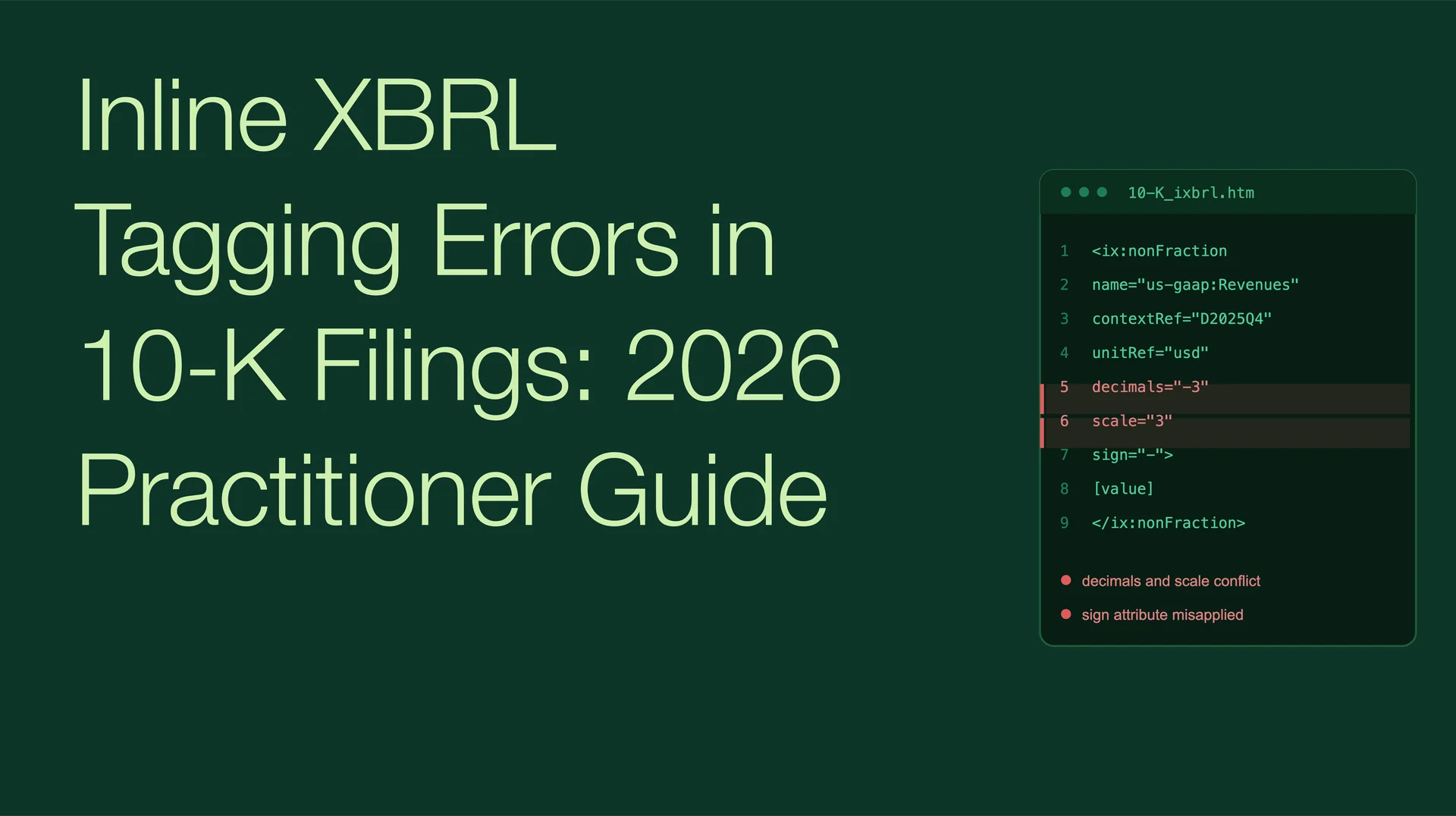
Under SEC Regulation S-T Rule 405, inline XBRL requirements mean the human-readable narrative and the machine-readable tagged data must be consistent. If AI drafts a lease liability note referencing $142.3 million while the iXBRL-tagged balance sheet shows $142.4 million due to a rounding convention difference, the SEC's automated review systems can flag the discrepancy. The same problem arises when AI uses a different period label, such as "fiscal 2025" instead of "the year ended December 31, 2025," that does not match the tagged context.
The practical fix is sequencing:
- Complete XBRL tagging of the primary financial statements before finalising any AI-drafted footnote narrative.
- Run a figure-by-figure cross-check: every number in the AI-drafted note must trace to the tagged value, not the source spreadsheet independently.
- Check period labels and entity identifiers, not just dollar amounts.
- Use platforms that link the narrative editor to the tagging layer (Workiva, IRIS CARBON, and DFIN ActiveDisclosure all offer variants of this architecture).
The SEC's December 2025 FDTA report explicitly connects machine-readable disclosure data to AI-driven investor analysis, noting that structured data reduces LLM error rates on financial tasks. That means your XBRL quality now affects not just filing compliance but how AI tools read and summarise your disclosures to investors.
For a full treatment of the tagging workflow, see AI XBRL Tagging Automation for SEC Filings: 2026 Practitioner Walkthrough.
What the SEC Actually Requires When AI Drafts Your Footnotes
The SEC has not issued a rule specifically governing AI-drafted footnotes, but its position is unambiguous. The SEC's Division of Corporation Finance has stated directly: "The use of AI does not change an issuer's disclosure obligations. Issuers remain responsible for the accuracy and completeness of their filings, regardless of the tools used to prepare them." There is no AI exception to Rule 10b-5 or Regulation S-K.
SEC staff have flagged AI-generated boilerplate as a disclosure quality concern in comment letters. The specific risk for footnotes is that ASC 235 requires disclosures that are necessary for users to understand the financial statements, and generic LLM output frequently fails that standard for judgment-intensive notes. A going concern assessment drafted by AI that reads like every other going concern assessment in the EDGAR database is exactly the kind of language that draws a comment.
Voluntary disclosure of AI use in footnote drafting is currently not required. No SEC rule mandates it. However, if the SEC asks about your disclosure controls and procedures in a comment letter or examination, and AI was used without adequate documentation, the absence of a governance record becomes the problem. The better posture is to document the process, not necessarily to disclose it in the filing.
For the full SEC enforcement picture, see SEC Liability for AI-Generated Financial Disclosures: 2026 Enforcement Reality.
SOX 302 Certification When AI Drafted the Footnotes
This is the question most CFOs are not asking directly enough. Under SOX Section 302, the CEO and CFO must certify that, based on their knowledge, the filing does not contain any untrue statement of material fact or omit a material fact necessary to make the statements not misleading.
"Based on their knowledge" is not a passive standard. Securities practitioners have been consistent: it cannot be satisfied by rubber-stamping an AI-generated draft. The human review step is the legal substance of the certification.
The footnote-specific version of this problem is sharper than the MD&A version. Footnotes carry specific numerical cross-references, prior-period comparatives, and ASC-mandated disclosures. If an AI-drafted ASC 842 note contains a hallucinated lease liability figure and the CFO signs the 302 certification without independently verifying that number against the source data, the certification is potentially false.
The Harvard Law School Forum on Corporate Governance flagged in 2025 that plaintiffs' securities lawyers are already examining whether AI-generated disclosure language contributed to alleged misstatements, and that AI use in drafting could become a factor in 10b-5 scienter arguments, specifically whether management "knew or should have known" of an inaccuracy.
The minimum defensible standard for AI-drafted footnotes, based on current securities counsel guidance:
- Every AI-drafted note reviewed line-by-line by a qualified human reviewer, not a junior staff member doing a formatting pass.
- Every numerical figure in AI-drafted narrative independently verified against source financial data, not just the prior draft.
- Outside counsel review of all AI-drafted disclosure language before filing.
- A documented record of the review process, including who reviewed what and when.
How Auditors Are Treating AI-Drafted Footnotes
The PCAOB is paying attention, and your external auditors are adjusting. In 2025, the PCAOB issued Staff Spotlight guidance on AI in auditing, noting that auditors must understand and evaluate the controls over AI tools used in the financial reporting process, including disclosure drafting. This has direct implications for how auditors approach footnotes drafted with AI assistance.
In practice, this means several things for your audit timeline:
- Auditors are beginning to ask, as part of their risk assessment procedures, whether AI was used in drafting the notes they are opining on.
- If AI was used, auditors may expand their substantive procedures on footnote disclosures, particularly for the high-risk note types in the table above.
- Auditors are requesting documentation of the AI governance process, including which tools were approved, what human review occurred, and how numerical figures were verified.
- Audit committees are being briefed on AI use in the disclosure process as a new risk vector, and Reed Smith recommends that AI governance policy be circulated to the audit committee at the outset of each filing cycle.
The SEC's Office of the Chief Accountant has stated in multiple 2024-2025 speeches that the use of technology tools, including AI, in the financial reporting process does not diminish the responsibility of management or auditors. OCA staff have specifically noted that auditors must evaluate the design and operating effectiveness of controls over AI-assisted disclosure preparation.
Brief your external auditors before the audit begins, not after they find AI-drafted notes in the file. The conversation is easier when you initiate it.
The MNPI Problem: Feeding Footnotes Into a Third-Party LLM
Financial statement footnotes contain some of the most sensitive pre-release data in your filing. Subsequent events, unreported litigation outcomes, going concern assessments, and M&A activity all appear in footnotes before the 10-K is filed. Feeding this content into a third-party LLM API raises Regulation FD and insider trading concerns that are more acute for footnotes than for boilerplate sections.
Reed Smith is explicit on this point, and not hypothetically: "A board member who uploads a draft preliminary proxy statement to a consumer large language model may be transmitting MNPI to a platform that owes no duty of confidentiality to the company. A CFO who pastes deal terms from a draft registration statement into an unsecured tool may be creating a selective disclosure problem under Regulation FD. These are not hypothetical concerns; Reed Smith is seeing them in practice."
Consumer-grade AI tools, meaning free-tier LLMs and browser-based assistants without enterprise agreements, generally reserve the right to use inputs for model training, retain data indefinitely, and share aggregated data with third parties. Those terms are fundamentally incompatible with the confidentiality obligations that attach to draft SEC filings.
The practical rules:
- Use only enterprise-licensed tools with contractual prohibitions on using customer inputs for model training, data-deletion commitments, and SOC 2 Type II certification.
- Anonymize inputs where possible, but treat anonymization as risk reduction, not elimination. Structural details and industry markers can still identify the company.
- For the highest-sensitivity footnotes, such as subsequent events and contingencies, consider keeping AI out of the drafting process entirely and using it only for formatting or cross-reference checking after the substantive content is human-drafted.
For a detailed treatment of the MNPI data-handling problem, see LLM MNPI Data Leakage and Reg FD: A 2026 Compliance Walkthrough.
The Close Process Sequencing Problem
There is a timing trap in AI footnote drafting that vendors never mention. Footnote cross-references, such as "See Note 8" or "as described in Note 4," are often not final until late in the close. Note numbering shifts when notes are added or removed. AI drafted early in the cycle will embed stale cross-references that require a full re-check pass before filing.
The practical sequencing that minimises rework:
- Freeze the note structure (number and order of notes) before running AI drafting on any note that contains cross-references.
- Draft accounting policy notes first (ASC 235 boilerplate, basis of presentation, significant accounting policies). These are the most templated and least dependent on final numbers.
- Draft table-heavy notes second (ASC 842 lease tables, ASC 606 disaggregated revenue, ASC 280 segment tables) once the underlying financial data is final.
- Draft narrative-heavy notes third (ASC 820 fair value hierarchy narratives, ASC 718 share-based compensation discussion) with full human review.
- Keep judgment-intensive notes human-led throughout (ASC 450 contingencies, ASC 205-40 going concern, ASC 850 related parties, ASC 855 subsequent events).
- Run XBRL consistency check after all AI-drafted notes are human-reviewed and before the filing is locked.
This sequencing also reduces the risk that AI-drafted notes contain hallucinated figures from a prior close cycle. LLMs trained on public filings have a tendency to default to plausible-sounding numbers when source data is ambiguous, which is exactly what happens when you feed an early-draft footnote with placeholder figures.
Governance Documentation Checklist for AI Footnote Drafting
If the SEC sends a comment letter asking about your disclosure process, this is what you need to produce. The minimum defensible governance record for AI footnote drafting, based on Reed Smith's six-rule framework and current securities counsel guidance:
Before the filing cycle:
- Written AI use policy identifying approved tools, prohibited inputs, anonymization requirements, and escalation paths.
- Enterprise license agreements reviewed for: prohibition on training-data use, contractual confidentiality, data-deletion commitments, SOC 2 Type II certification, data-residency representations, and audit logging.
- AI impact assessment documenting identified risks (MNPI exposure, privilege waiver) and remediation steps.
- Audit committee briefing on AI use in the disclosure process.
- External auditor notification of AI use in footnote drafting.
During the filing cycle:
- Log of which footnote sections were AI-drafted, which tool was used, and the date.
- Record of human reviewer identity and sign-off date for each AI-drafted section.
- Numerical verification record: for each AI-drafted note, a tie-out confirming every figure was independently verified against source financial data.
- XBRL consistency check record confirming narrative figures match tagged values.
- Outside counsel review sign-off before filing.
After filing:
- Retain the above records as part of your disclosure controls documentation under SOX.
- Update the policy after each cycle based on issues identified.
This documentation also addresses the question of whether AI-drafted footnotes that contain hallucinated figures could constitute a material weakness in internal controls over financial reporting under AS 2201 and SOX 404. The answer depends entirely on whether the controls described above were designed and operating effectively. A documented, functioning human review process is the control. The absence of documentation is the weakness.
For the broader AI governance framework, see AI Model Governance for Financial Reporting: 2026 CFO Playbook.
What Enterprise Tools Are Actually Being Used
The market is splitting into two categories: integrated filing platforms and standalone LLM-native tools. For footnote drafting specifically, integrated platforms have a structural advantage because they connect the narrative editor to the XBRL tagging layer, which is the core of the consistency problem.
- Workiva has integrated AI drafting assistance into its platform, including for financial statement footnotes. Its architecture keeps data within a controlled environment, addressing some (but not all) MNPI concerns. AI outputs still require human review.
- DFIN ActiveDisclosure offers AI-assisted drafting with live Excel data links, so when a source figure changes, the document updates. The XBRL tagging is built into the drafting workflow rather than bolted on at the end.
- IRIS CARBON embeds XBRL tagging into the drafting process and runs automated checks that the human-readable numbers match the tagged values, which directly addresses the consistency risk.
- General-purpose LLMs (GPT-4, Claude, Gemini) can produce footnote first drafts but have no native connection to your XBRL tagging layer, no built-in MNPI controls, and no audit trail. They are the wrong tool for production footnote drafting without significant workflow engineering around them.
As Reed Smith notes: "AI can help management and directors engage more deeply with a document. AI cannot replace judgment or expertise. LLMs can misread defined terms, misapply legal standards, miss context that an experienced reviewer would catch, and fabricate citations to authorities that do not exist."
FAQ
Do we need to disclose in our 10-K that AI was used to draft the footnotes? No SEC rule currently requires this disclosure. Voluntary disclosure is a live governance question with no clear peer consensus as of October 2026. The more pressing obligation is ensuring your disclosure controls and procedures adequately account for AI use, which is a SOX question, not a disclosure question.
Can AI-drafted footnotes create a SOX 404 material weakness? Yes, if the controls over AI drafting are absent or ineffective. A hallucinated figure in a filed footnote that was not caught by human review is evidence of a control failure. The control is the documented human review process, not the AI tool itself.
Which footnote is the highest-risk starting point for AI drafting? Contingent liability disclosures under ASC 450 and related-party disclosures under ASC 850 are the highest-risk. Both require entity-specific facts that AI cannot reliably source, and both are areas where the SEC and plaintiffs' lawyers look closely. Start with accounting policy notes and lease tables instead.
How do auditors treat AI-drafted footnotes differently from human-drafted ones? The PCAOB's 2025 Staff Spotlight guidance requires auditors to evaluate controls over AI tools used in the financial reporting process. In practice, auditors are requesting documentation of the AI governance process and may expand substantive procedures on footnotes where AI was used, particularly for high-risk note types.
Is feeding a draft footnote into a third-party LLM a Regulation FD violation? It can be. Draft footnotes frequently contain material non-public information, including unreported litigation outcomes, subsequent events, and going concern assessments. Uploading this to a platform without adequate confidentiality protections may constitute selective disclosure. Use only enterprise-licensed tools with contractual confidentiality obligations.
What is a realistic time saving from automating footnote drafting? The realistic total cycle-time saving across the full 10-K is 15-20%. For templated footnotes like lease tables and accounting policy notes, the saving on those specific sections may be higher. For judgment-intensive notes, the human review requirement means net savings are minimal. Vendor claims of 40-70% do not survive contact with the actual review workflow.