
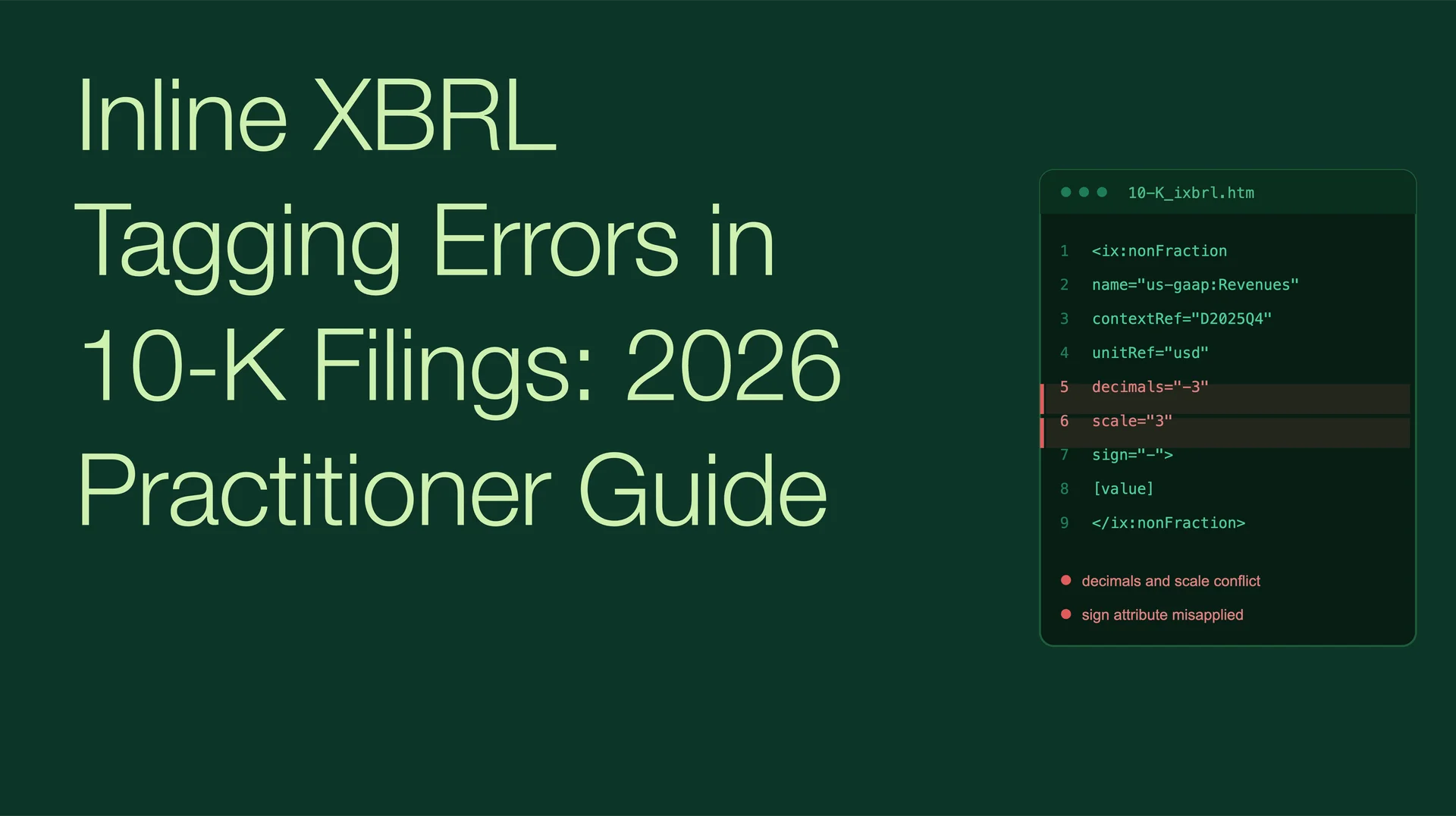
Inline XBRL Tagging Errors in 10-K Filings: 2026 Practitioner Guide
If your 10-K passes EDGAR validation and you assume the XBRL is clean, you are looking at the wrong signal. EDGAR accepts filings with substantive inline XBRL tagging errors every day. The errors that matter most, the ones that draw SEC comment letters, corrupt Bloomberg and Refinitiv data feeds, and sometimes require an amended 10-K/A, are the ones EDGAR's automated checks never catch.
This guide maps the specific error types, explains what EDGAR does and does not catch, covers the new tagging requirements that are tripping up experienced teams right now, and gives you a concrete pre-submission workflow grounded in the EDGAR Filing Manual and SEC staff guidance.
Key takeaway: EDGAR validation errors block your filing. EDGAR warnings let it through. Most of the substantive tagging errors that trigger SEC comment letters are warnings, not errors, and many pass validation entirely.
What EDGAR Validation Actually Catches (and What It Misses)
EDGAR's automated validation, specified in Volume II of the EDGAR Filing Manual, checks a defined set of technical rules. It catches missing required tags, invalid taxonomy references, broken file structure, and certain calculation arithmetic failures. These produce hard errors that block submission.
What it does not catch:
- Wrong element selection. Tagging revenue with a close-but-incorrect standard element passes validation. EDGAR does not know what your income statement line item means, only that you used a valid element.
- Incorrect period context. Tagging total assets (an instant-date balance sheet item) with a duration context passes validation. The data is wrong; EDGAR does not flag it.
- Misleading decimals attributes. Setting
decimals='-3'when you are reporting in millions causes data consumers to read your figures as 1,000x smaller than intended. EDGAR accepts it. - Sign convention errors. Tagging treasury stock or a net loss with the wrong sign passes validation but corrupts downstream data.
- Deprecated element usage. Using a tag from last year's taxonomy that FASB has since deprecated passes EDGAR but produces data that aggregators flag or suppress.
Calculation linkbase inconsistencies produce warnings, not errors. The filing goes through. But those warnings are visible to every data consumer who inspects the filing, and the SEC's Office of Structured Disclosure (OSD) treats them as a quality signal.
For a deeper look at which error categories the Division of Corporation Finance specifically comments on, see Finrep's companion piece on XBRL tagging errors that trigger SEC review.
The Seven Inline XBRL Tagging Errors Most Likely to Surface in Your 10-K
1. Decimals Attribute Errors
The decimals attribute tells data consumers the precision of every tagged numeric value. decimals='-6' means the figure is in millions, rounded to the nearest million. decimals='0' means exact to the dollar. Get this wrong and every downstream model that ingests your XBRL data reads the wrong number.
The most common mistake: reporting in millions but setting decimals='-3' (thousands). Bloomberg, Refinitiv/LSEG, S&P Capital IQ, and FactSet all ingest EDGAR XBRL data directly. A decimals error of this kind causes them to show your revenue or total assets as 1,000x smaller than the actual figure, or to apply a manual override that flags your filing as low quality.
This error passes EDGAR validation every time. The XBRL 2.1 specification defines the attribute, but EDGAR does not validate whether the precision you declare is consistent with how you present figures in the human-readable document.
Fix: Lock the decimals attribute in your tagging template at the start of each filing cycle. Confirm it matches the unit of presentation in the financial statements. Do not let individual taggers set it ad hoc.
2. Period Context Errors
Every tagged value must carry a context that specifies the entity, the reporting period, and any applicable segment or dimension. Balance sheet items require an instant-date context (a single point in time). Income statement and cash flow items require a duration context (a start and end date).
Tagging total assets with a duration context, or tagging net income with the wrong fiscal year start date, produces data that is structurally wrong. EDGAR accepts it. A data consumer building a time-series from your EDGAR data gets garbage.
Period context errors are especially common when a company changes its fiscal year, when a 52/53-week year creates non-standard period end dates, or when prior-period comparative data is tagged with copy-paste contexts from the current period.
Fix: Build a context library at the start of each filing. Define the instant date for each balance sheet period and the start/end dates for each income statement period. Require taggers to select from the library rather than create contexts manually.
3. Sign Convention Errors
The FASB US GAAP taxonomy defines the expected sign (positive or negative) for every element through its balance attribute: debit or credit. Contra-accounts, losses, and cash outflows are the most common error sites.
For example, us-gaap:TreasuryStockValue is defined as a debit balance. It reduces equity, so it is presented as a positive number in the XBRL data even though it appears as a deduction on the face of the balance sheet. Filers who tag it as negative cause data aggregators to double-count the equity reduction.
Similarly, a net loss should be tagged as a positive value under us-gaap:NetIncomeLoss when the taxonomy element is defined to carry negative values as losses. Getting this backwards is one of the most consequential errors in the taxonomy because it flips the sign of the bottom line in every model that consumes the data.
The FASB Taxonomy Viewer documents the balance attribute for every element. Check it before tagging any contra-account, loss, or outflow.
4. Wrong Element Selection and Inconsistent Tagging Across Periods
The 2025 US GAAP taxonomy contains over 18,000 elements. Finding the single most appropriate element for a given line item is genuinely hard, and the consequences of getting it wrong compound over time.
The SEC's Division of Corporation Finance has specifically commented on this pattern: using different XBRL elements to tag the same reported line item from period to period. When a tagging vendor changes, when a new team member takes over, or when no element documentation exists from the prior cycle, the same financial statement line item ends up under a different element in consecutive filings. The machine-readable time-series breaks. Analysts and data aggregators who rely on that series get inconsistent data.
The SEC's comment letter language is direct: if the change in element was not warranted by a change in the nature of the line item, confirm you will maintain consistency going forward.
Fix: Maintain a tagging map, a document that records the element selected for every line item, updated each filing cycle. Review it before making any element change. Where a change is genuinely warranted by an accounting change, document the basis.
5. Calculation Linkbase Inconsistencies
The calculation linkbase defines the mathematical relationships between tagged values: which line items sum to a subtotal, which subtotals roll up to a total. When the arithmetic in the linkbase does not match the face of the financial statements, EDGAR produces a warning.
These warnings are accepted. They are also visible. The SEC's OSD monitors them, and the Division of Corporation Finance has cited calculation linkbase inconsistencies in comment letters. Data aggregators treat them as a quality flag.
The most common cause: a line item is added to or removed from the financial statements mid-cycle without updating the calculation linkbase. The human-readable document is correct; the machine-readable relationships are stale.
Fix: After any change to the face of the financial statements, update the calculation linkbase before submission. Run the EDGAR validation and review every warning, not just the errors.
6. Custom (Extension) Tag Overuse
Custom extension tags are permitted when no standard element in the US GAAP taxonomy adequately describes a concept. They are not permitted as a shortcut when finding the right standard element is difficult.
The SEC's OSD has consistently flagged high rates of custom tag usage as a quality problem. Extension tags are non-comparable across filers. The EDGAR XBRL Viewer and data aggregators treat them as opaque. Academic research published in The Accounting Review found that filers with high custom tag rates have lower data comparability and are more likely to receive XBRL-related comment letters.
The practical problem: when a tagging team cannot find the right standard element quickly, they create an extension. The right standard element often exists but requires familiarity with the taxonomy's labeling conventions, which differ from how line items are described in financial statements.
Fix: Require a documented search of the standard taxonomy before any extension is created. Use the FASB Taxonomy Viewer's search and label functions. Extensions should be the exception, not the default.
7. Deprecated Element Usage
FASB publishes an updated US GAAP taxonomy every year. The 2025 taxonomy (effective for fiscal years ending on or after December 15, 2025) introduced new elements and deprecated old ones. Using a deprecated element does not produce an EDGAR error, but it produces data that aggregators flag as low quality or suppress.
Teams that reuse prior-year tagging templates without checking the FASB taxonomy release notes are systematically exposed to this error. The element that was correct in your 2024 10-K may be deprecated in the 2025 taxonomy.
Fix: At the start of each annual filing cycle, download the FASB taxonomy release notes and check every element in your tagging map against the deprecated element list. The FASB taxonomy page publishes these notes with each release.
New Tagging Requirements That Are Causing Errors Right Now
The three disclosure expansions below added new error vectors that even experienced teams are still working through. Each requires tagging that is structurally different from core financial statement tagging.
| Disclosure | Rule | Effective Date | Tagging Type | Key Error Pattern |
|---|---|---|---|---|
| Pay-versus-performance (PvP) | Item 402(v), Reg S-K | Fiscal years ending on or after Dec 16, 2022 | Structured tabular (ECD taxonomy) | Missing required elements; wrong tabular list structure |
| Clawback policy | Rule 10D-1 | Fiscal years ending on or after Dec 1, 2023 | Structured (ECD taxonomy) | Missing policy existence tag; incorrect recovery amount elements |
| Cybersecurity risk management | Item 106, Reg S-K | Fiscal years ending on or after Dec 15, 2023 | Block-text and detailed narrative (CYD taxonomy) | Omitting required block-text tags; treating narrative as untagged prose |
Pay-Versus-Performance Tagging
The PvP final rule requires specific XBRL elements for compensation actually paid (CAP), total shareholder return (TSR), peer group TSR, net income, and the company-selected measure. These elements live in the SEC's ECD taxonomy, separate from the core US GAAP taxonomy.
The most common errors: failing to tag all required data points in the PvP table, using core financial statement elements instead of ECD taxonomy elements, and errors in the tabular list structure that the SEC requires for the PvP disclosure. The Division of Corporation Finance has issued comment letters on incomplete PvP tagging in every filing cycle since the requirement took effect.
Clawback Policy Tagging
The clawback final rule requires listed companies to tag their clawback policy existence, any triggering events, and recovery amounts in their 10-K. This is a new structured data requirement with specific ECD taxonomy elements. Teams that handled the human-readable clawback disclosure correctly but did not update their XBRL tagging workflow are exposed.
Cybersecurity Narrative Tagging
The cybersecurity disclosure rule requires iXBRL tagging of Item 106 disclosures using the SEC's CYD taxonomy. This is block-text and detailed narrative tagging, not numeric tagging. It is technically the most challenging category because it requires embedding machine-readable tags in qualitative prose, not just wrapping numbers.
Teams accustomed to numeric tagging often treat narrative disclosures as untagged prose. For Item 106, that is a compliance failure.
What Happens When You Have Tagging Errors: The Consequence Spectrum
Not all tagging errors carry the same risk. Here is how consequences actually map:
EDGAR rejection (hard errors) Missing required tags, invalid taxonomy references, broken file structure. The filing does not go through. You know immediately.
SEC comment letter The Division of Corporation Finance or the OSD identifies the error through periodic filing review. You receive a comment letter requiring explanation and remediation. Depending on the severity, you may need to commit to correcting the error in future filings or file an amended 10-K/A. Failure to respond adequately can escalate.
Data aggregator suppression or override Bloomberg, Refinitiv/LSEG, S&P Capital IQ, and FactSet apply their own quality filters to EDGAR XBRL data. When they detect errors, they may suppress the data point, apply a manual override, or flag the filing. This damages your data comparability profile and can affect analyst models, independent of any SEC action. The EDGAR Inline XBRL Viewer makes every tagged value publicly inspectable, so any sophisticated investor can see the underlying metadata.
Form S-3 eligibility risk Under Regulation S-T Rule 405, materially deficient XBRL tagging can constitute a failure to file. A company that fails to meet its filing requirements may lose eligibility to use Form S-3 for short-form registration, which requires timely filing of all required reports. This is a tail risk, but it is a real one for companies that treat XBRL as a secondary concern.
Pre-Submission Validation Workflow: Seven Steps
This is the workflow that catches errors before they become comment letters.
-
Run EDGAR validation and read every warning. Do not treat warnings as acceptable noise. Calculation linkbase inconsistencies, deprecated element warnings, and context errors all appear as warnings. Investigate each one.
-
Open the EDGAR Inline XBRL Viewer. The SEC's built-in viewer is free and available to any filer. Click through every tagged value and confirm the element name, period, decimals, unit, and taxonomy reference match your intent. This is the single most underutilized quality control step.
-
Check the FASB taxonomy release notes. At the start of each annual cycle, compare your tagging map against the deprecated element list in the current FASB taxonomy release. For 2026 filings, confirm you are using the 2025 or 2026 taxonomy (the 2026 taxonomy has been accepted by EDGAR since March 2026; support for the 2024 taxonomy is being retired around mid-2026).
-
Verify the decimals attribute against your presentation. Confirm that every numeric tag carries the correct decimals value for the unit of presentation in the financial statements. Do this as a separate pass, not as part of element selection.
-
Validate PvP, clawback, and cybersecurity tagging separately. These use different taxonomies (ECD, CYD) and different tagging structures. Run a dedicated review for each, checking that all required elements are present and that the tabular or block-text structure matches SEC requirements.
-
Run the XBRL US Data Quality Committee (DQC) rules. The DQC publishes a free set of data quality rules that go beyond EDGAR validation. The SEC's own quality signals draw on these rules. Running them before submission catches errors that EDGAR misses.
-
Compare current-period element selections against the prior-period tagging map. Any element change requires a documented justification. If the change is not warranted by a change in the nature of the line item, revert to the prior-period element.
How to Respond to an SEC Comment Letter on XBRL Errors
If you receive a comment letter from the Division of Corporation Finance or the OSD targeting iXBRL deficiencies, the response process follows the same structure as any other comment letter, with one practical difference: the SEC typically does not require an amended 10-K/A for tagging errors alone unless the error constitutes a failure to include required tagging entirely.
For most tagging quality errors (wrong element, calculation inconsistency, sign error), the standard response is:
- Acknowledge the specific error.
- Explain the root cause (taxonomy misunderstanding, process gap, vendor error).
- Commit to correcting the error in future filings.
- If the error affected data comparability materially, consider whether a voluntary amendment serves investors better than waiting for the next filing cycle.
For missing required tagging (a PvP table with no XBRL tags, a cybersecurity narrative with no block-text tags), the SEC may require an amended filing. Consult with your securities counsel before responding.
The SEC's Office of Structured Disclosure publishes staff observations on common tagging errors. These are the most authoritative and actionable reference documents available, and they are almost entirely absent from the vendor-dominated search results on this topic.
In-House vs. Outsourced iXBRL Tagging: The Decision Framework
Academic research published in The Accounting Review found that XBRL error rates are systematically higher for smaller filers, first-year adopters, and companies using in-house tagging rather than specialist filing agents. The correlation is not about capability; it is about taxonomy familiarity and process maturity.
The decision to handle iXBRL tagging in-house or outsource it should turn on three questions:
- Taxonomy depth: Does your team have the time to track annual FASB taxonomy updates, deprecated elements, and new SEC tagging requirements (PvP, clawback, cybersecurity) as they evolve?
- Process integration: Is your tagging workflow integrated with your financial close, or does it run as a separate, last-minute step? The DataTracks analysis of 10-K filing errors identifies the gap between financial close and SEC reporting as one of the four structural causes of persistent errors.
- Validation tooling: Do you have access to EDGAR Filing Manual-compliant validation tools and DQC rules, or are you relying on EDGAR's own validation as your primary quality gate?
For companies evaluating AI-assisted tagging tools specifically, Finrep's AI XBRL tagging accuracy evaluation guide covers the error modes to watch for and how to assess tool accuracy before committing.
FAQ
Does EDGAR reject a 10-K if the XBRL tagging is wrong? Only for hard errors: missing required tags, invalid taxonomy references, or broken file structure. Most substantive tagging errors, wrong element selection, period context errors, sign errors, decimals mistakes, produce warnings or pass validation entirely. The filing goes through; the errors surface later through SEC comment letters or data aggregator flags.
Do we have to file a 10-K/A to correct XBRL tagging errors? Generally no, unless the error constitutes a failure to include required tagging (for example, a PvP table with no XBRL tags at all). For most quality errors, the SEC expects correction in the next filing cycle and a commitment in the comment letter response. Consult securities counsel for any error the SEC characterizes as a filing deficiency.
How do we know if we used a deprecated XBRL element? Download the FASB taxonomy release notes for the current year from the FASB taxonomy page. The release notes list every deprecated, modified, and new element. Compare against your tagging map. Some validation tools also flag deprecated elements automatically.
Can investors see our XBRL tagging errors? Yes. The EDGAR Inline XBRL Viewer is public. Any investor or analyst can click on a tagged value and see the underlying element name, period, decimals, unit, and taxonomy reference. Data aggregators also publish quality flags on EDGAR filings. Tagging errors are not private.
What is the difference between a block-text tag and a detailed tag in XBRL? A block-text tag wraps an entire section of narrative disclosure (for example, the full cybersecurity risk management discussion) in a single machine-readable tag. A detailed tag wraps individual data points within that section. The SEC's cybersecurity disclosure rules require both types for Item 106. Teams accustomed to numeric tagging often omit block-text tags for narrative sections entirely.
Does poor XBRL tagging affect our ability to use Form S-3? It can. Under Regulation S-T Rule 405, materially deficient XBRL tagging can constitute a failure to file. Form S-3 eligibility requires timely filing of all required reports. A 10-K with materially deficient tagging could, in theory, affect short-form registration eligibility. This is a tail risk but one worth understanding before treating XBRL as a checkbox exercise.