What Is Technical Accounting Benchmarking?
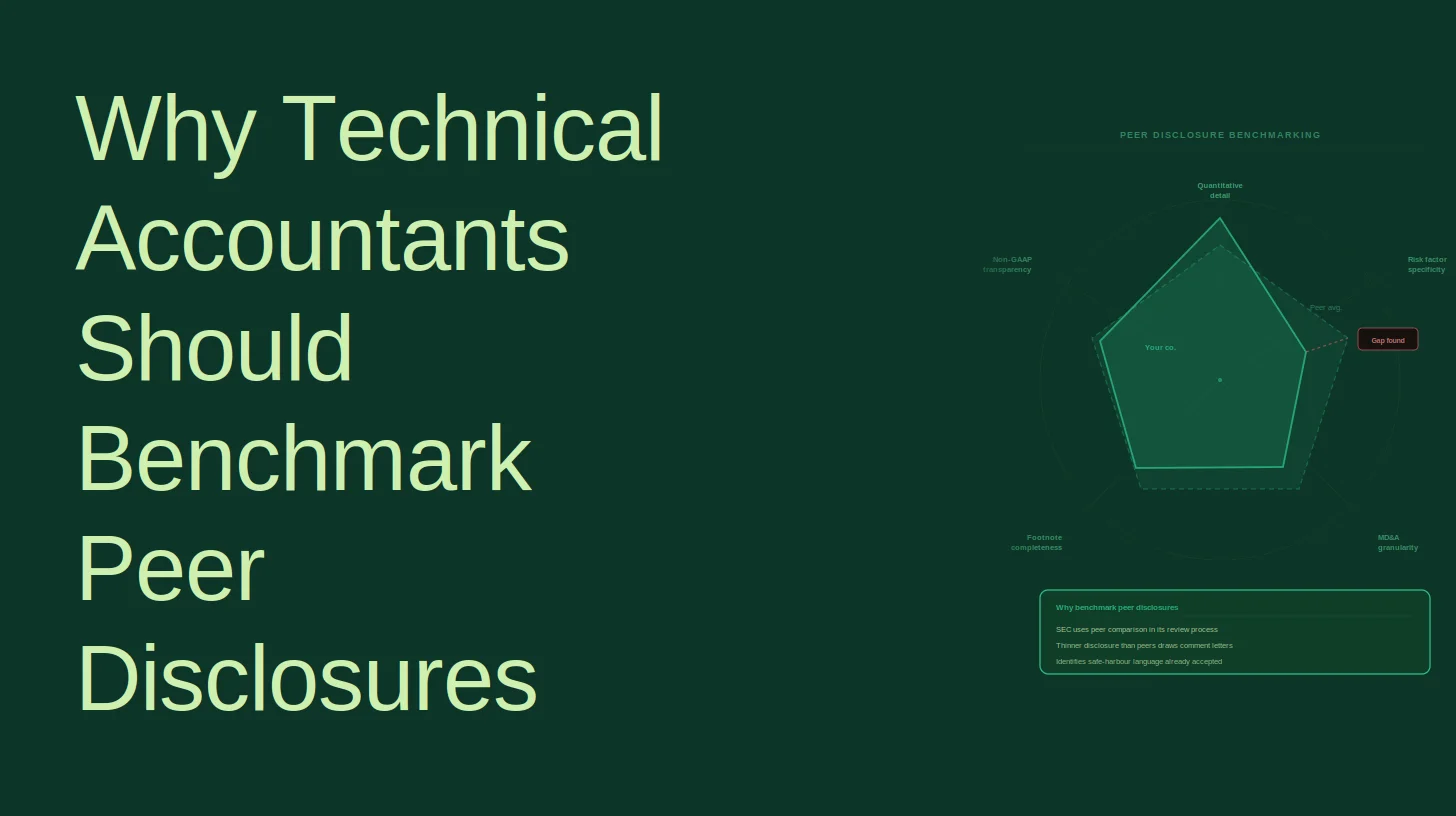
Technical accounting benchmarking is the process of reviewing accounting policies, disclosures, and financial statement presentations used by comparable public companies to understand how they apply accounting standards in practice.
The objective is not to determine accounting based on majority practice. Instead, benchmarking helps finance teams evaluate:
- Common accounting policy elections
- Disclosure approaches
- Significant judgments
- Presentation alternatives
- Areas where practice has become relatively consistent
Benchmarking is particularly valuable when accounting guidance allows multiple acceptable approaches or requires significant management judgment.
Why Isn't Reading the Accounting Standard Always Enough?
The FASB Accounting Standards Codification establishes authoritative U.S. GAAP. However, many standards intentionally avoid prescribing every implementation detail.
Instead, companies must apply professional judgment to facts and circumstances.
In newer accounting areas, questions often remain around:
- Disclosure depth
- Terminology
- Presentation format
- Significant judgment disclosures
- Materiality considerations
- Policy election wording
The accounting literature defines the principles. Peer filings demonstrate how those principles are commonly implemented.
When Does Peer Benchmarking Become Most Valuable?
Peer benchmarking is most useful when an accounting issue has one or more of the following characteristics:
- Recent accounting guidance
- Limited implementation examples
- Significant judgment
- Multiple acceptable accounting policies
- Rapidly evolving business models
- Frequent SEC comments
- Industry-specific disclosure expectations
These situations often require companies to develop accounting policies that go beyond simply reading the standard.
Which Technical Accounting Areas Benefit Most From Benchmarking?
Certain accounting topics consistently require more benchmarking because market practice continues to evolve.
Crypto Assets
Accounting for crypto assets has changed significantly following the FASB's guidance on the accounting for certain crypto assets.
Even with updated recognition and measurement requirements, companies continue to exercise judgment regarding:
- Accounting policy descriptions
- Fair value disclosure language
- Risk factor disclosures
- Custody disclosures
- Significant accounting estimates
Benchmarking helps technical accountants understand how companies with similar digital asset exposure communicate these judgments.
Internal-Use Software
Accounting for internal-use software under U.S. GAAP often involves judgment regarding:
- Capitalization thresholds
- Project stages
- Cloud implementation costs
- Useful lives
- Amortization methods
The accounting requirements are established, but disclosure practices vary considerably across industries.
Benchmarking provides practical insight into how technology companies, financial institutions, and software providers describe similar accounting policies.
Government Grants
Unlike IFRS Accounting Standards, U.S. GAAP does not contain comprehensive accounting guidance specifically addressing government grants received by business entities.
As a result, companies often develop accounting policies using appropriate analogies and existing authoritative guidance.
Benchmarking helps identify:
- Recognition policies
- Income statement presentation
- Balance sheet classification
- Disclosure approaches
- Accounting policy wording
Because practice continues to develop, reviewing comparable public company disclosures often provides valuable implementation context.
Other High-Judgment Areas
Benchmarking is also frequently used for:
- Climate-related expenditures
- Supplier finance arrangements
- Business combination judgments
- Segment reporting
- Revenue recognition judgments
- Share-based compensation assumptions
- Asset impairment disclosures
These areas often involve extensive judgment rather than mechanical accounting.
What Can Peer Filings Reveal That the Accounting Standard Cannot?
Accounting standards explain recognition, measurement, and disclosure requirements. Peer filings often illustrate how those requirements are communicated to investors.
Benchmarking can reveal:
Common Accounting Policy Language
Companies frequently use similar—but not identical—language to explain accounting policies.
Comparing multiple filings helps identify disclosure practices that have become common within an industry.
Level of Disclosure Detail
The Codification rarely specifies exactly how much narrative explanation is appropriate.
Peer filings demonstrate:
- Typical disclosure length
- Level of technical detail
- Discussion of significant estimates
- Industry-specific terminology
Presentation Alternatives
Some accounting standards allow alternative presentation methods.
Benchmarking helps identify:
- Common income statement presentation
- Balance sheet classification
- Cash flow presentation
- Footnote organization
This improves consistency while remaining within acceptable accounting guidance.
Emerging Market Practice
As new accounting issues develop, disclosure practices evolve through successive SEC filings.
Benchmarking allows companies to monitor how disclosure trends change over time.
How Should Technical Accounting Teams Perform Peer Benchmarking?
Effective benchmarking involves more than reviewing one competitor's annual report.
A structured process typically includes:
Identify Appropriate Peer Companies
Comparable companies should share characteristics such as:
- Industry
- Business model
- Transaction type
- Geographic operations
- Revenue profile
- Regulatory environment
Benchmarking unrelated companies may produce misleading conclusions.
Review Multiple Filings
One filing rarely represents prevailing practice.
Technical accountants often compare several companies to determine whether similar disclosure approaches consistently appear across the market.
Compare Accounting Policies
Focus on:
- Recognition policies
- Measurement methods
- Significant judgments
- Policy elections
- Footnote language
Differences often reveal where management judgment has influenced the accounting.
Evaluate Disclosure Evolution
Review filings across multiple reporting periods.
This helps identify:
- New disclosures
- Updated terminology
- Changes following new accounting standards
- Responses to evolving SEC expectations
What Are the Limits of Peer Benchmarking?
Benchmarking should inform accounting decisions—not determine them.
Several important limitations exist.
Peer Practice Is Not Authoritative
Another company's accounting treatment does not establish U.S. GAAP.
Every accounting conclusion must remain supported by authoritative literature.
Companies May Reach Different Acceptable Conclusions
Facts and circumstances differ.
Two companies may appropriately apply different accounting treatments under the same standard.
Benchmarking should never eliminate the need for entity-specific analysis.
Disclosures Reflect Individual Judgments
Materiality assessments, internal policies, and transaction structures differ across companies.
Benchmarking provides context rather than definitive answers.
How Should Benchmarking Be Used Alongside U.S. GAAP?
The most effective technical accounting process follows a logical sequence.
First, identify the applicable accounting guidance within the FASB Accounting Standards Codification.
Next, evaluate implementation guidance, SEC staff interpretations, and other authoritative resources where applicable.
Only after establishing the accounting framework should peer benchmarking be used to understand how comparable companies apply similar principles in practice.
This sequence ensures that benchmarking supports—not replaces—professional judgment.
Frequently Asked Questions
Does peer benchmarking replace U.S. GAAP?
No. Peer benchmarking is a research tool. All accounting conclusions must remain consistent with authoritative accounting guidance and the company's specific facts and circumstances.
Why is benchmarking especially useful for crypto accounting?
Crypto accounting continues to evolve, particularly regarding disclosures and implementation practices. Benchmarking helps companies understand how comparable issuers describe accounting policies, fair value measurements, and related risks in SEC filings.
Why do technical accountants benchmark government grant disclosures?
Because U.S. GAAP does not contain comprehensive accounting guidance specifically for business entities receiving government grants, companies often review comparable public company disclosures to understand common policy approaches and presentation practices.
How many peer companies should be benchmarked?
There is no prescribed number. Reviewing multiple comparable companies generally provides a more balanced view than relying on a single filing, particularly for high-judgment accounting topics.
Key Takeaways
Technical accounting benchmarking provides practical insight into how public companies apply accounting standards in areas where judgment, evolving guidance, or limited implementation examples leave room for different—but acceptable—approaches. Topics such as crypto assets, internal-use software, and government grants illustrate why reviewing peer disclosures has become an important complement to technical accounting research.
Benchmarking should never replace the FASB Accounting Standards Codification or professional judgment. Instead, it helps technical accounting teams evaluate prevailing disclosure practices, understand presentation alternatives, and identify emerging market conventions while ensuring that accounting conclusions remain grounded in authoritative U.S. GAAP.