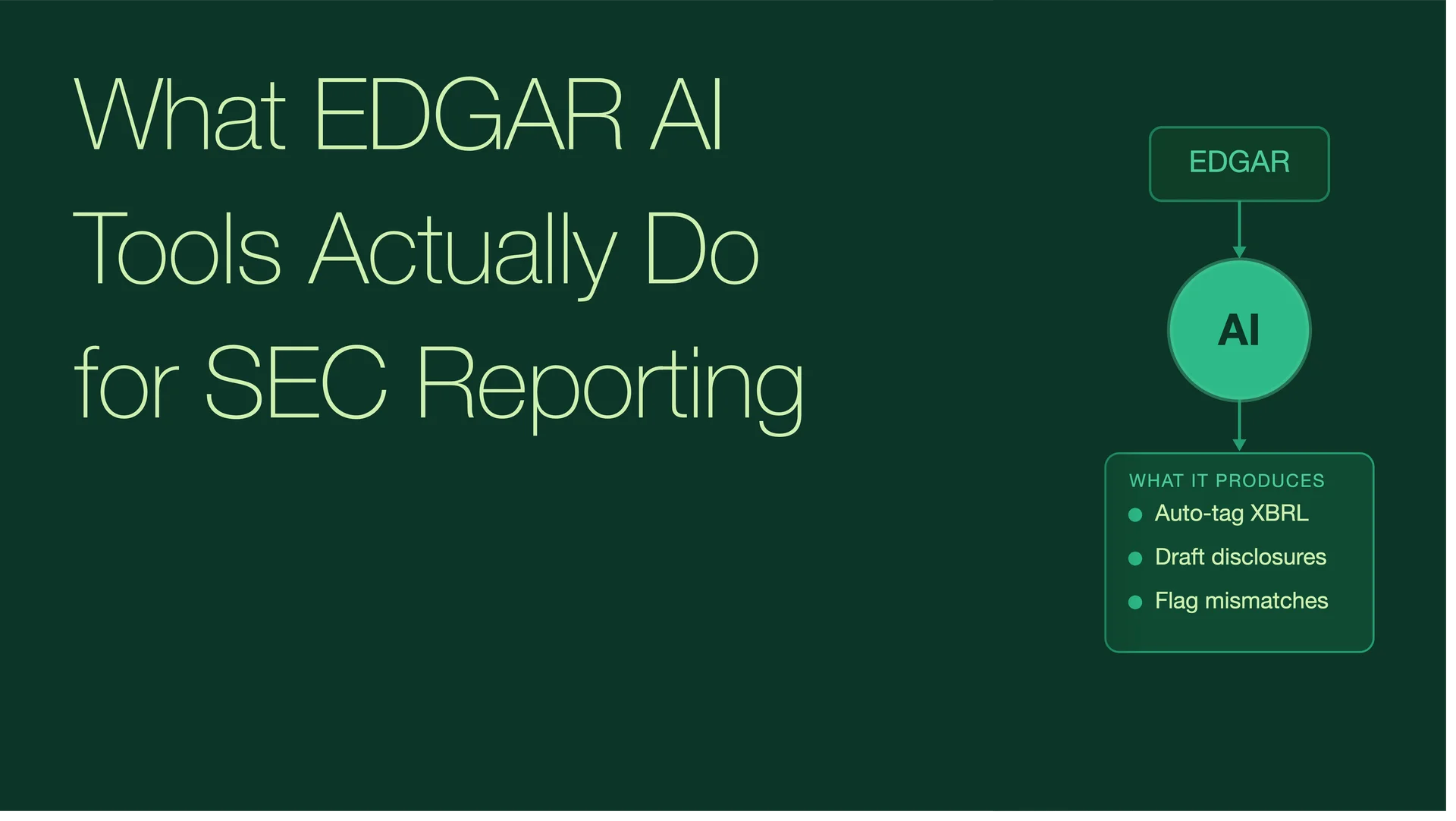
EDGAR contains more than 10 million filings going back to 1993. Every 10-K, 10-Q, 8-K, proxy statement, S-1, S-4, comment letter, and registrant response is there, publicly searchable. The database is free.
The problem is not access. It is time. Manually searching for peer disclosure language across 15 comparable companies, or pulling comment letter patterns for a specific form type and topic, can take a disclosure team a full day. AI tools that sit on top of EDGAR promise to compress that work from hours to minutes.
Whether they deliver depends on what you need the tool to do. This post maps what AI-powered EDGAR tools actually do today, where each category of tool adds genuine value, what the governance requirements are when AI output touches SEC filings, and what questions to ask when evaluating a tool for your team.
What Do AI-Powered EDGAR Tools Actually Do for SEC Reporting Teams?
The term "EDGAR AI tool" covers at least four distinct types of capability, and each type is useful for different workflows. Treating them as a single category leads to mismatched expectations.
Type 1: AI-powered filing search and retrieval. The most common category. These tools replace or extend keyword search on EDGAR with semantic search that can find filings by concept rather than by exact phrase. Instead of searching for "revenue recognition performance obligation" as a literal string, a semantic search can find filings that discuss the topic even when using different terminology. Intelligize+ AI, which launched its conversational Protégé module built on top of its existing EDGAR filing library, works in this way. The tool allows multi-turn conversational queries across SEC filings, accounting standards, and comment letters, and is designed for disclosure, reporting, compliance, and legal professionals in regulated environments.
The practical value here is speed and coverage. A search that would have required five or six separate EDGAR keyword queries and manual review of 30 filings can be done in one query with cited results. The limitation is that these tools still require the user to evaluate the relevance and quality of the retrieved filings. The AI surfaces results. The Controller decides which ones to use.
Type 2: AI-powered disclosure benchmarking. A step beyond search. These tools extract specific disclosure sections from retrieved filings and present them in a structured comparison format: how ten peer companies disclosed their revenue disaggregation, or how five comparable companies structured their ASU 2023-07 segment reporting footnote. The benchmarking output reduces the time from "I need to know what peers are disclosing" to a usable reference set from days to hours.
The important distinction is between tools that retrieve and display peer language for reference and tools that generate new language by synthesising peer disclosures. The former is well within established practice. The latter requires careful governance: AI-generated disclosure language must be reviewed by a qualified human before it enters any SEC filing, and the source filings underlying any generated language must be verifiable.
Type 3: AI-powered accounting research. Deloitte's DARTbot is the clearest example in this category. Launched in October 2023 and initially deployed to Deloitte's approximately 18,000 US Audit and Assurance professionals, DARTbot is a generative AI chatbot built on top of the DART platform's library of Deloitte publications, US GAAP guidance, and SEC rules and regulations. It allows users to ask complex accounting questions in conversational language and receive cited responses drawn from DART's content library.
DARTbot was subsequently made available to external DART subscribers with active US GAAP licences. It is designed to help subscribers navigate complex accounting questions more efficiently, drawing on Deloitte's interpretive guidance alongside the primary standards. The built-in parameters restrict responses to queries related to the accounting content within DART, preventing the tool from generating responses based on general model training data that may not reflect current standards.
The governance point Deloitte has been explicit about: DARTbot is an accelerator for human research, not a replacement for professional judgment. Chris Griffin, Managing Partner of Deloitte's US Audit and Assurance Transformation and Technology Practice, characterised it as helping professionals focus on applying professional objectivity, skepticism, and evaluating bias rather than on time-consuming manual research tasks.
Type 4: AI-powered filing draft generation. The highest-stakes category. Tools that generate first-draft disclosure language from source data, prompt-defined parameters, and peer filing context. This category requires the most rigorous governance because the output goes directly into a document that will be certified by the CFO and CEO and filed with the SEC. COSO's February 2026 guidance is explicit on the governance requirements for this category: any AI use case whose output can affect a material amount or disclosure is HIGH tier, requires named human reviewer sign-off, validation against source data, and full logging of the prompt, model version, inputs, output, and reviewer identity.
What Are the Governance Requirements When AI Output Touches an SEC Filing?
This is the question most tool evaluations skip, and it is the one that matters most for an SEC reporting team.
COSO's February 23, 2026 guidance on generative AI in internal control establishes a tiering framework based on materiality impact. An AI use case is HIGH tier when its output can affect a material amount or a disclosure in the financial statements. Any AI tool used in the preparation of an SEC filing is HIGH tier by definition.
For HIGH-tier use cases, COSO requires three minimum controls regardless of the tool used:
Human sign-off. A named human reviewer must confirm the AI output before it enters the filing. This is not a skim. It is a documented review that the reviewer can reconstruct if the external auditor asks how the disclosure was prepared. The reviewer's name and date must be logged.
Source validation. Every figure, citation, and peer reference in the AI output must be traceable to a specific, verifiable source. An AI-generated peer disclosure comparison that cannot be traced back to the specific EDGAR filing, filing date, and section from which each peer example was drawn is not usable in a filing context. The tool must either provide that traceability or the user must build it manually from the tool's output.
Full audit trail. The final prompt, model name and version, inputs provided, raw output, reviewer edits, and reviewer identity must all be retained. This is the evidence that satisfies PCAOB AS 2301's requirement that the external auditor be able to evaluate the reliability of technology-assisted processes affecting financial reporting. It also satisfies FINRA's 2026 guidance on log retention for AI touching financial reporting.
The practical implication for tool evaluation: if a tool cannot tell you which specific filing each result came from, it cannot satisfy the source validation requirement for SEC filing use. If a tool has no logging capability, it cannot satisfy the audit trail requirement. These are not nice-to-have features. They are the minimum conditions for using AI output in a certified filing.
How Do AI Tools Handle Peer Disclosure Comparison for 10-K and 10-Q Research?
Peer disclosure comparison is the highest-frequency workflow where EDGAR AI tools deliver measurable return for SEC reporting teams. The manual version of this task requires the user to identify a peer group, retrieve each peer's most recent filing, find the relevant disclosure section in each filing, and read across all of them to identify the disclosure patterns. For a typical benchmarking exercise across ten peers and five disclosure topics, this takes a full day.
AI tools compress this in two ways. First, semantic search finds relevant sections across multiple filings faster than keyword search, particularly for disclosure topics where the specific terminology varies across companies. Second, structured extraction pulls the specific section (revenue disaggregation table, segment footnote, non-GAAP reconciliation) from each retrieved filing and presents the results in a format that allows side-by-side comparison without requiring the user to read each full filing.
The quality check that matters for this workflow is citation accuracy: does the tool correctly attribute each retrieved disclosure to the specific company, form type, and filing date? An AI-generated comparison of peer revenue disaggregation disclosures that attributes language to Company X when it actually came from Company Y's filing is worse than no comparison at all, because it introduces incorrect peer attribution into the disclosure preparation process.
For teams evaluating AI benchmarking tools, the practical test is: take three specific disclosures you know from recent EDGAR filings and ask the tool to find comparable language. Then verify that the tool's citations are correct by going directly to the source filings on EDGAR. Tools that cite accurately under this spot check are useful. Tools that hallucinate citations or misattribute language are not, regardless of how relevant the retrieved text looks.
The EDGAR Full-Text Search tool at efts.sec.gov, while not an AI tool in the generative sense, remains the most reliable source for citation-accurate peer research because it retrieves the actual filing content without any AI-mediated paraphrasing or synthesis. Many experienced SEC reporting teams use EDGAR's full-text search for citation accuracy and use AI tools for speed and structured comparison, treating the two as complementary rather than substitutes.
What Can AI Tools Do for SEC Comment Letter Research?
Comment letter research is the second workflow where EDGAR AI tools add clear value. As covered in the previous post in this series, comment letters and registrant responses are publicly available on EDGAR under filing types UPLOAD and CORRESP. Manually searching comment letters for patterns across a specific topic, form type, and industry is time-consuming. AI tools that index the EDGAR comment letter database and allow topic-based search with structured results compress this significantly.
The specific value-add from AI in comment letter research is pattern synthesis: rather than reading twenty individual comment letters on revenue recognition and forming your own view of what the staff is consistently asking, an AI tool can identify the recurring question patterns across all twenty and summarise them with citations. This is the use case that produces the clearest return for a pre-filing comment letter review.
The governance constraint is the same as for peer disclosure research: every pattern the tool identifies must be traceable to a specific comment letter on EDGAR. A pattern that cannot be sourced to a specific UPLOAD filing and a specific issuer is not defensible if the staff questions your disclosure approach and asks you to explain why you made a specific drafting choice.
The EY analysis of SEC staff comment letters for the period ended June 30, 2025 identifies MD&A and non-GAAP measures as the top two comment categories, followed by segment reporting and revenue recognition. An AI tool that indexes comment letters and allows query-based retrieval of the staff's specific comments in each category can compress the research that would otherwise require manually reading dozens of individual UPLOAD filings on EDGAR.
The one thing AI comment letter tools cannot do is tell you whether the staff's comment was resolved in the registrant's favour or required a disclosure revision. For that, you need to read the CORRESP filing, the subsequent UPLOAD if there was a second comment round, and the amended filing if one was required. AI tools that surface comment patterns without context about how those comments were resolved can give a false picture of what "the staff expects" versus what the staff asks and sometimes accepts a different answer to.
What Should SEC Reporting Teams Look for When Evaluating an EDGAR AI Tool?
If your team is evaluating AI tools for EDGAR research and disclosure preparation, five questions produce the most useful answers.
Does the tool cite specific EDGAR filings for every result? This is non-negotiable for filing preparation use. The tool should tell you the company name, form type, filing date, and section for every disclosure example it returns. If the tool synthesises across multiple filings without citing individual sources, the output is useful for orientation but not for filing preparation.
Is the tool's content library current? EDGAR receives new filings continuously. An AI tool whose training data cuts off at a specific date will miss filings from the most recent quarters, which are typically the most relevant for benchmarking because they reflect current SEC enforcement climate and recent standard changes. Ask the vendor specifically when the tool's content was last updated and how frequently it updates.
Does the tool cover comment letters as well as company filings? For pre-filing comment letter research, a tool that covers only company filings and not comment letters is missing the most valuable research source. The Intelligize+ AI platform specifically links SEC filings with comment letters and SEC staff interpretations in the same query environment.
What logging and audit trail capability does the tool provide? Any tool used for SEC filing preparation needs to produce a retrievable record of what was queried, what was returned, and what was reviewed. Ask the vendor whether the tool logs queries and outputs and whether those logs are retrievable for audit purposes.
How does the tool handle the boundary between research and generation? Tools that retrieve and display peer language for reference are lower-governance-burden than tools that generate new disclosure language. Understand clearly which category the tool falls into, because COSO's HIGH-tier governance requirements apply to generation tools but not to retrieval tools used purely for research orientation.
Frequently Asked Questions
What is an EDGAR AI tool and how does it differ from EDGAR's built-in search?
EDGAR's built-in search at efts.sec.gov is a keyword and Boolean full-text search tool. It returns filings containing specific terms but does not synthesise, rank by relevance beyond basic scoring, or extract specific sections. AI tools built on top of EDGAR add semantic search (finding filings by concept rather than exact keyword), structured section extraction, disclosure comparison across multiple filings, and in some cases conversational query interfaces that allow multi-turn research. The free EDGAR tools remain valuable for citation-accurate research. AI tools add speed and structure for high-volume benchmarking workflows.
What is Intelligize+ AI and what does it do for SEC reporting teams?
Intelligize+ AI is a platform that combines proprietary deep tagging of SEC filings, accounting standards, and business information with AI-powered research capabilities delivered through its Protégé module. The platform supports semantic search, disclosure benchmarking, comment letter research, and multi-turn conversational analysis across SEC filings and related content. It is designed for disclosure, reporting, compliance, and legal professionals working in regulated environments.
What is DARTbot and who can use it?
DARTbot is Deloitte's generative AI chatbot built on top of the DART platform. It was initially deployed internally to approximately 18,000 Deloitte US Audit and Assurance professionals in October 2023 and was subsequently made available to external DART subscribers with active US GAAP licences. It draws on Deloitte publications, US GAAP guidance, and SEC rules and regulations to answer complex accounting questions conversationally. Built-in parameters restrict responses to the accounting content within DART. Deloitte characterises it as an accelerator for research efficiency, not a replacement for professional judgment.
What governance controls does COSO require when using AI tools for SEC filing preparation?
Under COSO's February 2026 guidance on generative AI in internal control, any AI use case whose output can affect a material amount or SEC filing disclosure is HIGH tier. HIGH-tier requirements are: a named human reviewer must sign off on every output before it enters a filing, every figure and citation must be traceable to a verifiable source, and the full audit trail (prompt, model version, inputs, raw output, reviewer identity and date) must be retained. These requirements apply regardless of which tool is used.
Can an AI tool replace the human review step in SEC filing preparation?
No. Under COSO's February 2026 guidance, AI output that touches a material disclosure must be reviewed and confirmed by a named human reviewer before it enters the filing. This is not a workaround or an optional control. It is the minimum standard for AI use in financial reporting. The AI tool compresses the research and drafting time. The Controller or SEC Reporting Manager owns every disclosure conclusion. That division of responsibility is the design of the workflow, not a limitation of current technology.
What is the biggest risk when using AI tools for EDGAR research?
Citation accuracy. An AI tool that retrieves peer disclosure language but misattributes it to the wrong company, misidentifies the form type, or presents a paraphrased version of the original without noting that it is paraphrased introduces incorrect information into the disclosure preparation process. The spot-check approach described above, verifying specific citations against the source EDGAR filing, is the most practical control for managing this risk in a research workflow.
Key Takeaways
- AI-powered EDGAR tools fall into four categories: filing search and retrieval, disclosure benchmarking, accounting research, and filing draft generation. Each category has different governance requirements and a different risk profile for SEC reporting use.
- The free EDGAR Full-Text Search tool at efts.sec.gov remains the most citation-accurate research tool for peer disclosure and comment letter research. AI tools add speed and structured comparison. The two are best used as complements.
- Deloitte's DARTbot is a generative AI chatbot built on the DART platform for accounting research, available to external subscribers with active US GAAP licences. It draws only on DART's content library, not on general model training data, and is designed as a research accelerator rather than a professional judgment substitute.
- Intelligize+ AI combines deep-tagged SEC filing content with conversational AI research through its Protégé module, covering filings, comment letters, and accounting standards in a single query environment.
- COSO's February 2026 guidance classifies any AI use case affecting a material SEC filing disclosure as HIGH tier, requiring named human reviewer sign-off, source-traceable citations, and a full retained audit trail. These controls apply regardless of which AI tool is used.
- When evaluating AI tools for SEC reporting use, the five critical questions are: does it cite specific EDGAR filings for every result, is the content current, does it cover comment letters, does it log queries and outputs, and does it clearly distinguish retrieval from generation?