This post covers what is confirmed, what is pending, and what employers can do right now without waiting for additional IRS guidance.
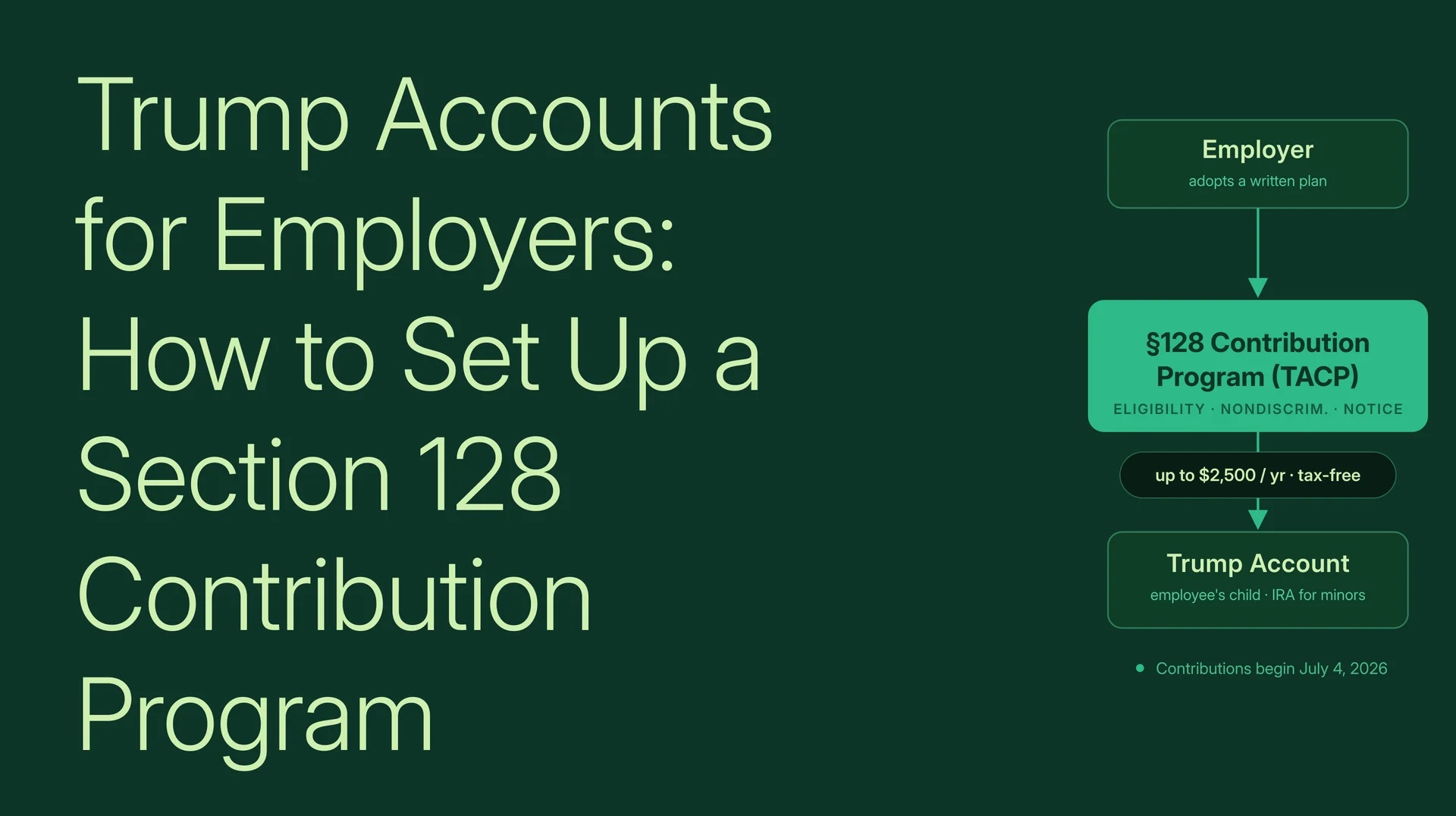
The key facts first. Under IRC Section 530A, Trump Accounts are a new type of IRA established for the exclusive benefit of children (individuals under age 18 at the end of the calendar year in which an election is made). Under IRC Section 128, employers may contribute up to $2,500 per employee per year to the Trump Accounts of eligible dependents of that employee, excluding those contributions from the employee's gross income. Section 128 contributions must be made pursuant to a separate written Trump Account Contribution Program. The $2,500 employer limit is per employee, not per dependent. Section 128 contributions count toward the $5,000 annual aggregate contribution limit per account during the growth period.
As of today, contributions are permitted. Trustees are open. The government's one-time $1,000 pilot program contribution for eligible children is being made. And employers can make their first Section 128 contributions to employee dependents' Trump Accounts starting now.
What cannot be done yet: employees cannot make pre-tax salary reduction contributions to their own or a dependent's Trump Account through a cafeteria plan, because the IRS has not yet issued the regulations under Section 125 needed to implement that integration. Those regulations have been promised but not delivered as of this date. Employers can make outright employer contributions under a TACP today. The cafeteria plan salary reduction option is pending.
What Is a Trump Account and Why Should Employers Care?
A Trump Account is a tax-advantaged savings account for children under 18, created by Section 530A of the Internal Revenue Code as added by OBBBA Section 70204 of Public Law 119-21, signed July 4, 2025. The account operates as a traditional IRA during the growth period (from account establishment through the calendar year the child turns 18), at which point it converts to a standard traditional IRA.
During the growth period, the account has special rules. Contributions may be made by parents, family members, employers, or the government. Distributions are restricted. The account grows tax-deferred. Unlike a traditional IRA, there is no requirement that the beneficiary have earned income to receive contributions during the growth period. The government provides a one-time $1,000 pilot program contribution for eligible children born between 2025 and 2028 who are US citizens with a Social Security number.
Employers care about Trump Accounts for the same reasons they care about any other tax-favored employee benefit: they can provide a meaningful benefit to employees with young children at a cost that is deductible to the employer, and employees can receive the benefit free of federal income tax under Section 128.
The employer's Section 128 contribution is excluded from the employee's gross income. It is deductible to the employer. It does not count as wages for the employee. The contribution goes directly to the Trump Account of the employee's eligible dependent, where it grows tax-deferred until the child turns 18.
From a talent and benefits perspective, employers with large employee populations that have or may have children under 18 have an opportunity to offer a new benefit that is genuinely novel, that has received significant public and media attention, and that is administratively similar to existing dependent care programmes.
What Is the Section 128 Employer Contribution and How Much Can You Contribute?
IRC Section 128, added by the OBBBA alongside Section 530A, is the provision that allows employers to make tax-favoured contributions to Trump Accounts on behalf of employees. The key mechanics:
The employer contribution limit is $2,500 per employee per year, not per dependent. An employee with three eligible dependents receives a maximum of $2,500 from the employer across all three accounts combined, not $2,500 per child.
The $2,500 limit is scheduled to be adjusted for cost-of-living after 2027, so it will index going forward.
The $2,500 employer limit counts toward the $5,000 aggregate annual contribution limit per Trump Account. The $5,000 limit is the maximum aggregate contributions to a single account from all non-exempt sources (parents, family, employer, and other private sources). Pilot program contributions from the government do not count toward the $5,000 limit.
A practical example: an employee has one child with a Trump Account. The government has made the $1,000 pilot program contribution (exempt from the $5,000 limit). The employer wants to contribute $2,500. The family wants to contribute as well. The family's contributions would be limited to $2,500 (the remaining room in the $5,000 non-exempt limit after the employer's $2,500), because the employer contribution and family contributions together cannot exceed $5,000. The family's $2,500 would be non-deductible contributions creating basis in the account.
The exclusion from the employee's gross income applies to the full $2,500 employer contribution under Section 128 when made through a qualified TACP. The contribution does not appear on the W-2 as taxable wages. It is reported in Box 12 using code TA (as established in the draft 2026 Form W-2 released January 9, 2026).
Employers must affirmatively designate contributions as Section 128 employer contributions when remitting funds to the account trustee, per IRS Notice 2025-68. This requires coordination with the trustee to ensure the contribution is classified correctly in the account records (because the trustee is required to report contribution type for basis tracking purposes).
Step 1: Decide Whether to Offer Trump Accounts as an Employer Benefit
Before drafting any plan document, three questions determine whether to offer the benefit at all.
Does your workforce include employees with eligible dependents? An eligible dependent for Section 128 purposes is a child who has not turned 18 before the end of the calendar year in which an election to open a Trump Account is made, and who has been issued a Social Security number. If your workforce skews older or does not include employees with young children, the benefit has limited uptake potential and the administrative cost of setting up and maintaining the TACP may outweigh the benefit.
Can you afford to wait for the ERISA guidance? The most significant unresolved compliance question for employers is whether a TACP constitutes an ERISA-covered plan. IRS Notice 2025-68 specifically flags that the Department of Labor and Treasury anticipate issuing guidance on how to structure a TACP to avoid ERISA coverage. If the TACP is treated as an ERISA plan, employers would face fiduciary, reporting, and disclosure obligations including Form 5500 filing, ERISA bond, and plan document requirements beyond the Section 128 TACP document itself. The Verrill Law analysis from May 2026 confirms: no guidance has been issued on this point, so the ERISA question remains open. Employers that are risk-averse on this point may want to wait for the DOL guidance before launching.
Are you prepared to implement the Section 128 written plan and nondiscrimination testing now? Starting a TACP requires a written plan, employee notices, nondiscrimination testing similar to Section 129, and annual written statements to employees. These administrative requirements are not overwhelming, but they need to be built into the benefits administration infrastructure before contributions are made.
Employers that decide to proceed can implement the employer-contribution-only TACP today. The salary reduction component through a cafeteria plan should wait for the Section 125 regulations the IRS has promised.
Step 2: Draft a Written Trump Account Contribution Program (TACP)
Section 128(c) requires that a TACP be a separate written plan established for the exclusive benefit of providing contributions to Section 530A accounts of employees or their dependent children. The written plan is not optional. Without it, employer contributions cannot qualify for the Section 128 income exclusion.
IRS Notice 2025-68 confirms that TACP requirements are similar to those imposed on Section 129 dependent care assistance programmes, covering discrimination rules, eligibility, notification, statements, and benefits. Employers that already have Section 129 DCAPs (dependent care FSAs) have a close analogue to draw from for the TACP document structure.
The TACP written plan must include, at minimum:
A description of eligible participants (employees with eligible dependents under age 18 with a Social Security number).
The maximum employer contribution per employee per year ($2,500 for 2026 and 2027).
The nondiscrimination requirements (the programme may not discriminate in favour of highly compensated employees in eligibility or benefits).
The notification requirements (the employer must communicate the availability and terms of the TACP to eligible participants).
The annual statement obligation (the employer must provide each employee a written statement by January 31 of each year showing the amount contributed to the Trump Account of the employee's dependent in the prior year).
The requirement that the employer notify the trustee that each contribution is a Section 128 employer contribution excludable from gross income.
No model TACP plan document has been issued by the IRS as of today, July 4, 2026. The DLA Piper analysis confirms this as one of the outstanding questions: what level of detail will be required in a TACP plan document and whether a model TACP will be issued. Employers drafting their TACP today should use Section 129 DCAP document language as the closest available model, adapted for the Trump Account context, and confirm the document with employee benefits counsel.
The Morgan Lewis BeneBits analysis recommends that plan sponsors contemplating a TACP use Section 129 dependent care assistance programme plan documents as a starting point, with modifications for the Trump Account context.
Step 3: Add Trump Accounts to Your Section 125 Cafeteria Plan (If Offering Salary Reduction)
Stop here. Employee salary reduction contributions to Trump Accounts through a Section 125 cafeteria plan are not available today.
IRS Notice 2025-68 acknowledged that a TACP may be a qualified benefit under a cafeteria plan, but specifically noted that the IRS and Treasury intend to issue regulations on this integration and those regulations have not been published as of July 4, 2026. The Morgan Lewis analysis from February 2026 specifically advises that plan sponsors should wait until additional guidance is issued before implementing the cafeteria plan salary reduction component.
There is also an important structural limitation: employee contributions to fund the employee's own Trump Account are not permitted through a cafeteria plan, because that would constitute impermissible deferred compensation under Section 125. The cafeteria plan salary reduction option, when it becomes available, will be limited to employee contributions directed to the Trump Account of an eligible dependent child of the employee, not to the employee's own account.
For employers who want to move forward today on the employer-contribution-only side, the cafeteria plan amendment step is simply deferred. The TACP document can be structured to contemplate a future cafeteria plan salary reduction option, with an effective date contingent on the issuance of the relevant IRS guidance.
Step 4: Coordinate With Your Payroll Provider for W-2 Box 12 Code TA Reporting
The IRS draft 2026 Form W-2 released January 9, 2026 established Box 12 code TA for reporting employer contributions to Trump Accounts. Code TA is used to report Section 128 employer contributions made during the year. Like other Box 12 codes, it is reported on the employee's W-2 but is not included in taxable wages (not added to Box 1, Box 3, or Box 5).
The reporting mechanics are the same as other tax-favoured fringe benefits reported in Box 12. The employer's payroll system must be configured to code Trump Account contributions as code TA and exclude them from taxable wages. Payroll providers that have updated their systems for the 2026 W-2 should have code TA available. Employers should confirm with their payroll provider that code TA is correctly configured before making the first contribution.
In addition to W-2 reporting, the employer must notify the Trump Account trustee at the time of each contribution that the contribution is a Section 128 employer contribution. The trustee uses this designation to track contribution type for basis reporting purposes under Section 530A(i). The notice to the trustee is a separate communication from the payroll reporting and must be coordinated explicitly.
The annual written statement to the employee (required by January 31 of the following year) is a separate document from the W-2. It shows the amount contributed to the Trump Account of the employee's dependent in the prior year. This statement is analogous to the annual Section 129 DCAP statement that many employers already provide.
Step 5: Apply Nondiscrimination Rules Similar to Section 129 Dependent Care
Section 128 requires that TACPs satisfy nondiscrimination requirements similar to Section 129 dependent care assistance programmes. The practical content of these requirements under the Trump Account context is:
The programme must be available to employees on a non-discriminatory basis. Eligibility cannot be limited to highly compensated employees or their dependents.
Benefits must be available on a non-discriminatory basis. The $2,500 per employee contribution limit must apply uniformly.
An IRS representative has informally indicated (according to the Verrill Law analysis) that the IRS intends to issue rules addressing nondiscrimination testing for TACPs specifically, including potentially adding the average benefits test used for qualified retirement plans as an additional compliance method. That guidance has not been issued.
Until specific TACP nondiscrimination guidance is issued, employers should apply the Section 129 nondiscrimination framework as the closest available model. The Section 129 rules require that the programme not discriminate in favour of highly compensated employees in either eligibility or benefits, and require the average benefits test or a percentage test similar to those used for retirement plans.
The practical implication for employer design: an employer that wants to offer a TACP exclusively to executives or to a specific tier of employees will not satisfy the nondiscrimination requirement. The programme must be broadly available.
What Is the Per-Employee Contribution Limit and Why It's Not Per Child?
This is the point that most produces confusion among HR directors and benefit plan administrators reading the Trump Account rules for the first time.
The $2,500 Section 128 employer contribution limit is per employee, not per dependent. An employee with four eligible children under 18 receives a maximum of $2,500 from the employer across all four accounts. The $2,500 does not multiply by the number of children.
The $5,000 annual aggregate contribution limit, by contrast, is per Trump Account (per child). Each child's account can receive up to $5,000 per year from non-exempt sources (employer, parents, family, and others combined). So a family with two children under 18 can have two Trump Accounts each receiving up to $5,000 per year, but the employer's Section 128 contribution across both accounts combined is capped at $2,500 for that employee.
For employees with multiple eligible dependents, the employer contribution can be split across accounts in any way the employee directs, up to the $2,500 total. An employee with two children might direct $1,250 to each account, or $2,500 to one account and nothing to the other, subject to the account-level $5,000 cap.
The Hancock Law analysis confirms: employer contributions are $2,500 per calendar year per employee, not per dependent.
For employers modelling the programme cost, the maximum annual liability for a Trump Account TACP is $2,500 multiplied by the number of participating employees (not by the number of their children). That is a finite and predictable liability that makes budgeting straightforward.
What Happens at Year-End: Trustee Reporting and IRS Deadlines
Section 530A(i) establishes reporting requirements for Trump Account trustees during the growth period. These differ from standard IRA reporting under Section 408(i). The trustee must report the amount of contributions and, critically, the source of each contribution (whether it is a pilot programme contribution, a Section 128 employer contribution, a qualified general contribution, a qualified rollover, or a non-exempt contribution from other sources). This source tracking is essential for basis calculations when distributions are eventually made.
For employers, the year-end obligations are:
Confirm with the Trump Account trustee the total contributions made in 2026 and their classification as Section 128 employer contributions.
Provide each employee with a written annual statement by January 31, 2027, showing the amount contributed to the Trump Account of their dependent in 2026.
Report the total contributions on the employee's 2026 W-2 in Box 12 using code TA.
There is no separate employer-level tax return or information return for the TACP beyond the W-2 code TA reporting. The trustee handles the account-level reporting under Section 530A(i).
Contributions made in 2026 cannot be retroactively applied to any prior year. IRS Notice 2025-68 is explicit: for any taxable year ending during the growth period, a contribution to a Trump Account is counted for the year in which it is made. A January 2027 contribution counts for 2027, not for 2026.
What Open Questions Remain (ERISA Status, State Tax, Model Plan Document)
Employers setting up a TACP today should be aware of five areas where guidance is pending and where the answer could require plan amendments.
ERISA status. The most significant open question. If a TACP is treated as an ERISA-covered employee welfare benefit plan, employers face fiduciary obligations, Form 5500 annual reporting, ERISA bond requirements, and claims and appeals procedures. The DOL and Treasury have promised guidance on how to structure a TACP to avoid ERISA coverage, but that guidance has not arrived. Most employer benefit attorneys recommend structuring the TACP as narrowly as possible (employer contributions only, no pooling of assets) to maximise the chance of ERISA non-coverage, but this remains a legal judgment call in the absence of official guidance.
Cafeteria plan salary reduction. The Section 125 regulations needed to implement employee pre-tax salary reduction contributions to Trump Accounts have not been issued. This component of the programme cannot be launched until those regulations arrive.
State income tax. The federal income exclusion under Section 128 is a federal rule. States that do not conform to federal law or that have fixed-date conformity may treat the employer contribution as taxable income at the state level. State conformity analysis is needed for each state where the employer has employees, and state tax treatment will vary significantly.
Model plan document. No model TACP document has been issued by the IRS. Employers must draft their own TACP using Section 129 DCAP documents as the closest analogue, confirmed with employee benefits counsel.
Nondiscrimination testing methodology. The specific testing rules for TACPs have not been finalised. Employers should apply Section 129 testing as the closest available model until specific TACP nondiscrimination guidance is issued.
Frequently Asked Questions
Can employers contribute to Trump Accounts starting July 4, 2026?
Yes. Section 530A of the Internal Revenue Code prohibits contributions to Trump Accounts before July 4, 2026. That date has now arrived. Employers may make Section 128 contributions to the Trump Accounts of eligible dependents of employees starting today, provided the employer has a written TACP in place.
What is a Section 128 Trump Account Contribution Program?
A TACP is the separate written plan that employers must establish to make tax-favoured contributions to Trump Accounts under IRC Section 128. Contributions made under a qualifying TACP are excluded from the employee's gross income, deductible to the employer, and not treated as wages. The TACP must satisfy nondiscrimination, eligibility, notification, and annual statement requirements similar to those applicable to Section 129 dependent care assistance programmes.
How much can an employer contribute to a Trump Account?
Up to $2,500 per employee per year, not per dependent. This limit applies for 2026 and 2027 and will be adjusted for cost-of-living after 2027. The $2,500 employer contribution counts toward the $5,000 annual aggregate contribution limit per Trump Account. The government's $1,000 pilot programme contribution does not count toward the $5,000 limit.
Can employees make pre-tax contributions via a cafeteria plan?
Not yet. IRS Notice 2025-68 indicated the IRS intends to issue regulations on how TACPs integrate with Section 125 cafeteria plans, but those regulations have not been published as of July 4, 2026. Employee salary reduction contributions to Trump Accounts through a cafeteria plan cannot be implemented until those regulations are available.
How do employers report Trump Account contributions on the W-2?
Using W-2 Box 12 Code TA, established in the draft 2026 Form W-2 released January 9, 2026. Code TA reports the total Section 128 employer contribution for the year. The amount is excluded from taxable wages and is not included in Box 1, Box 3, or Box 5. The employer must also provide each employee a separate written annual statement by January 31 of the following year showing the contributions made.
Key Takeaways
- Trump Account contributions are permitted starting July 4, 2026, under IRC Section 530A. Employers may make Section 128 contributions up to $2,500 per employee per year (not per dependent) to the Trump Accounts of eligible dependent children of employees.
- Section 128 employer contributions must be made pursuant to a separate written Trump Account Contribution Program (TACP). Without the written plan, contributions do not qualify for the income exclusion. The TACP must satisfy nondiscrimination, eligibility, notification, and annual statement requirements similar to Section 129 dependent care assistance programmes.
- Employee salary reduction contributions through a Section 125 cafeteria plan are not yet available. The IRS has promised Section 125 regulations for TACP integration, but they have not been issued as of today.
- The $2,500 employer limit is per employee, not per child. It counts toward the $5,000 annual aggregate contribution limit per Trump Account. The government's $1,000 pilot programme contribution is exempt from the $5,000 limit.
- Employer contributions are reported in W-2 Box 12 Code TA. Employers must also notify the trustee that each contribution is a Section 128 employer contribution, and must provide employees with an annual written statement by January 31 of the following year.
- Five areas of guidance are still pending: ERISA status of the TACP, cafeteria plan salary reduction regulations, state tax conformity, model plan document, and specific nondiscrimination testing methodology. Employers setting up a TACP today should monitor for guidance in each of these areas and be prepared to amend the plan document when final guidance arrives.