
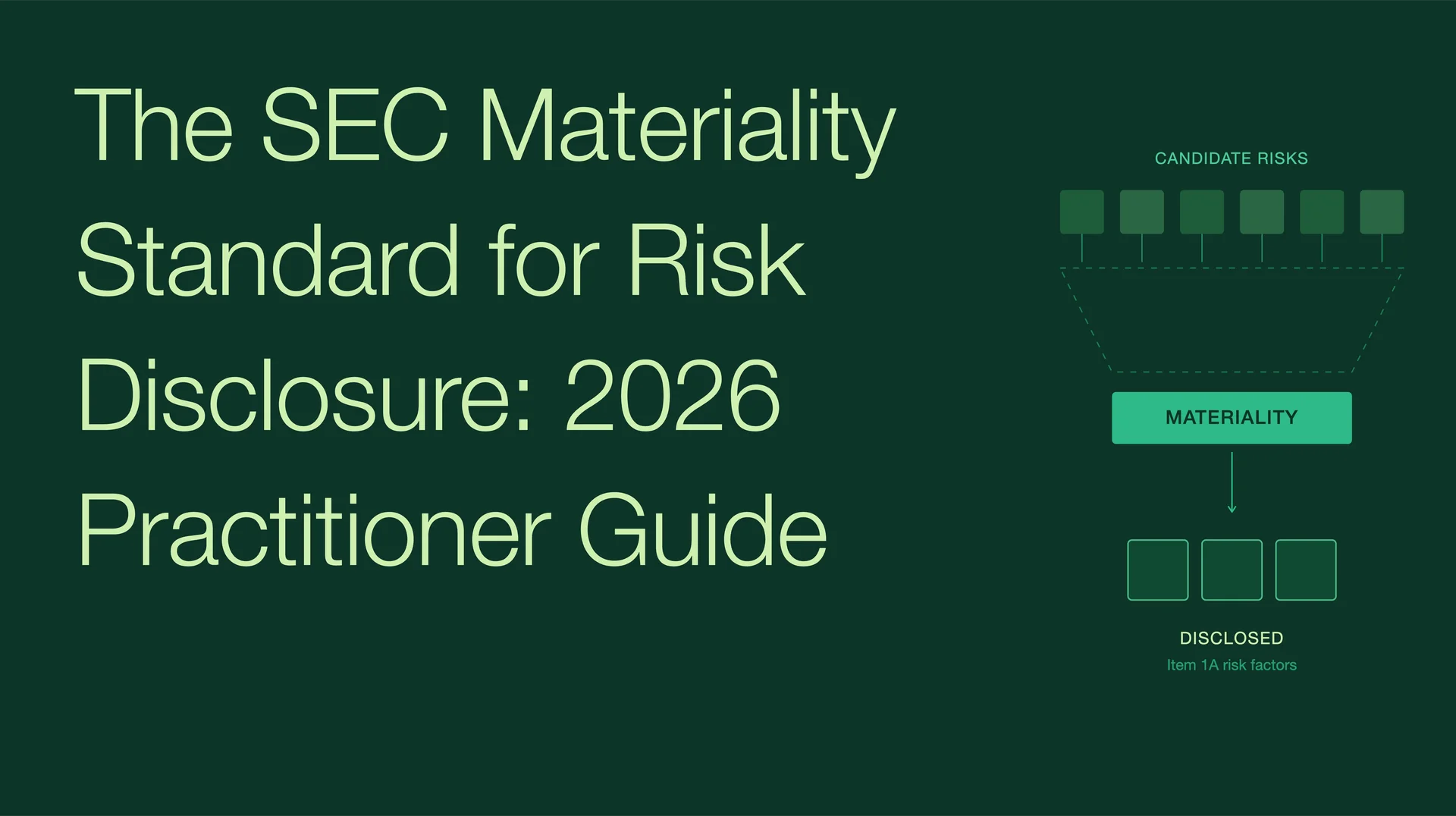
The SEC Materiality Standard for Risk Disclosure: 2026 Practitioner Guide
If you are deciding whether to disclose a cybersecurity incident, a climate exposure, or a litigation contingency in your SEC filings, one legal standard governs every call: the materiality standard. Get it wrong in either direction and you face SEC enforcement, securities litigation, or a restatement. This guide explains exactly what the standard requires, how to apply it, and what has changed in 2026.
Key takeaway: Materiality is not a 5% rule. It is a legal standard rooted in Supreme Court precedent, operationalized through SEC Staff Accounting Bulletin No. 99, and enforced with real consequences. Every disclosure decision your team makes should trace back to this framework.
What Is the SEC Materiality Standard?
The SEC materiality standard asks whether there is a substantial likelihood that a reasonable investor would consider the information important in making an investment or voting decision. The operative definition comes from the Supreme Court's 1976 decision in TSC Industries, Inc. v. Northway, Inc., which held that a fact is material if "there is a substantial likelihood that the disclosure of the omitted fact would have been viewed by the reasonable investor as having significantly altered the 'total mix' of information made available."
The SEC codified this standard in two rules: Rule 405 under the Securities Act of 1933 and Rule 12b-2 under the Securities Exchange Act of 1934. Both define "material" as information "to which there is a substantial likelihood that a reasonable investor would attach importance in determining whether to purchase the security registered."
For forward-looking disclosures, such as merger negotiations, litigation contingencies, or regulatory investigations, Basic Inc. v. Levinson (1988) extended the standard to contingent events. Materiality there depends on a probability/magnitude balancing test: the probability the event will occur multiplied by the magnitude of the event if it does. A low-probability but catastrophic risk can be material; a high-probability but trivial one may not be.
FASB ASC 105-10-05-6 adopts a consistent definition for GAAP purposes, and FASB has explicitly deferred to the SEC and the legal system on materiality rather than defining it independently.
Who Is the "Reasonable Investor"?
The reasonable investor is the legal construct at the center of every materiality determination, and the standard is deliberately objective, not tied to any specific investor's actual reaction.
As Professor Amanda Rose has observed, "the 'reasonable investor' is at best a shadowy figure, described only generically in judicial opinions" and identified case-by-case by the fact-finder. Rose argues that "the identity of the reasonable investor is a policy choice that should be made by the SEC in rulemaking or by Congress in legislation, so that companies understand how to think about their disclosure obligations."
Two practical points follow from this:
- Stock price movement is not the test. Information can be material even if it does not move the stock price, and a price move does not automatically make information material.
- The standard is objective. The SEC assesses materiality from the perspective of a hypothetical reasonable investor, not from management's subjective view of what investors care about.
The "total mix" concept adds one more wrinkle: information already publicly available from other sources, such as news reports or analyst research, can reduce but does not eliminate a company's own disclosure obligation. Courts have held that companies cannot assume public information makes their own disclosure unnecessary, particularly when the company holds superior or confirmatory information.
How to Apply the Materiality Standard: The SAB 99 Two-Step
SEC Staff Accounting Bulletin No. 99 (SAB 99) is the primary SEC staff guidance for applying materiality to financial reporting, and it explicitly rejects purely quantitative thresholds.
SAB 99 states directly: "The staff has no objection to a registrant using a percentage as a numerical threshold, such as 5%, as a starting point in assessing materiality. But the staff reminds registrants that exclusive reliance on this or any percentage or numerical threshold has no basis in the accounting literature or the law."
The correct approach is a two-step analysis.
Step 1: Quantitative Assessment
Quantify the item as a percentage of a relevant benchmark, typically pre-tax income, net income, revenue, or total assets depending on context. The 5% of pre-tax income threshold is the most commonly used starting point, but it is a staff rule of thumb only, with no basis in SEC rules or GAAP. Items below 5% can be material; items above 5% are presumptively material.
Step 2: Qualitative Assessment
SAB 99 lists specific qualitative factors that can make a quantitatively small item material. An item may be material regardless of its size if it:
- Masks a change in earnings or other trends
- Hides a failure to meet analysts' consensus expectations
- Changes a loss into income or vice versa
- Concerns a segment identified as playing a significant role in operations or profitability
- Involves concealment of an unlawful transaction
- Affects management's compensation by satisfying bonus thresholds
- Affects compliance with regulatory requirements or loan covenants
The reverse argument, that qualitative factors can make a quantitatively large error immaterial, is far harder to sustain. SEC Chief Accountant Paul Munter stated in his March 2022 OCA statement: "As the quantitative magnitude of the error increases, it becomes increasingly difficult for qualitative factors to overcome the quantitative significance of the error."
Big R vs. Little r Restatements: How Materiality Determines Which Applies
The materiality determination is the gating question for whether a financial error requires a full restatement or a quieter revision, and the stakes are high.
| Restatement Type | Trigger | Mechanism | Consequences |
|---|---|---|---|
| Big R (Reissuance) | Error is material to previously-issued financial statements | Prior-period statements must be reissued; SEC filing required | Potential clawbacks, share price impact, increased regulatory scrutiny, litigation |
| Little r (Revision) | Error is not material to prior periods, but correcting or leaving it uncorrected would be material to the current period | Correct in current-period comparative statements with disclosure | Less disruptive, but still constitutes a restatement under GAAP |
Both types are restatements under U.S. GAAP. The distinction matters enormously for executive compensation clawbacks, D&O insurance, and investor relations, which is precisely why OCA has flagged bias risk in this area.
Munter's 2022 statement was explicit: a materiality assessment influenced by the desire to avoid a Big R restatement, reputational harm, a share price decline, or executive compensation clawbacks "would not be objective and would be inconsistent with the concept of materiality." The SEC treats a biased assessment as itself a compliance failure, not just a judgment call that went wrong.
Materiality in Specific Risk Categories
Cybersecurity Incidents
The SEC's cybersecurity disclosure rules (adopted July 2023, effective December 2023) apply the TSC Industries/Basic standard directly to cyber incident disclosure. A company must file Form 8-K within four business days of determining that a cybersecurity incident is material. The four-day clock starts from the materiality determination, not the discovery of the incident.
The annual Form 10-K must also disclose material cybersecurity risks and the company's processes for assessing, identifying, and managing them. This parallel materiality obligation has generated significant SEC comment letter activity in 2024 and 2025 as companies navigate what "material" means for cyber risk in practice. For a deeper look at how the SEC is challenging these determinations in comment letters, see SEC Comment Letter Trends: Seven Issues and Three New Focus Areas.
Climate and ESG Risks
The SEC's climate disclosure rule (Release No. 33-11275, adopted March 6, 2024) made materiality its central organizing principle, with over 1,000 references to "material" or "materiality" throughout the rule. It required disclosure of climate-related risks only when they "have materially impacted or are reasonably likely to have a material impact on the registrant, including on its strategy, results of operations, and financial condition."
The rule was stayed by the Eighth Circuit in April 2024 and voluntarily stayed by the SEC under the current administration in February 2025. As of mid-2026, the rule remains on hold. This means climate disclosure obligations revert to the pre-existing framework: companies must disclose climate risks only if they are material under the general SEC standard as applied through Regulation S-K Item 303 (MD&A) and Item 105 (Risk Factors).
The practical implication: the materiality standard is now the de facto gatekeeper for all ESG disclosure. Companies that voluntarily disclose ESG metrics should frame them carefully to avoid creating implied materiality representations that could be challenged later.
Key takeaway: With the climate rule stayed, there is no separate mandatory climate disclosure regime for most U.S. registrants in 2026. The general SEC materiality standard, applied through Items 303 and 105, determines what you must say about climate and ESG risks.
Litigation Contingencies and Supply Chain Disruptions
For contingent events, the Basic probability/magnitude test applies. A litigation contingency is material if the probability of an adverse outcome multiplied by the magnitude of the potential loss would be important to a reasonable investor. A supply chain disruption that is reasonably likely to have a material effect on results of operations must be disclosed in MD&A under Item 303, even if the disruption has not yet caused a quantifiable loss.
For more on how to allocate these disclosures between risk factors and MD&A, see Risk Factor vs. MD&A Disclosure Requirements: What Goes Where in 2026.
The Item 303 vs. Item 105 Threshold Distinction
A frequently misunderstood point: the materiality threshold is not identical across all parts of the 10-K.
| Disclosure Location | Standard | Trigger |
|---|---|---|
| Item 105 (Risk Factors) | Material | Factors that make an investment speculative or risky, specific to the company |
| Item 303 (MD&A) | Reasonably likely to have a material effect | Known trends, events, or uncertainties management actually knows about |
Item 303's "reasonably likely" threshold is lower than "probable" but higher than "remote." It captures risks that management knows about and that have a reasonable possibility of materializing, even if they have not yet done so. Item 105 requires disclosure of risks that are already material to the company's situation, and the SEC's 2020 amendments require those risks to be company-specific, not generic boilerplate that applies equally to every company in the industry.
The Dual-Framework Challenge: SEC vs. CSRD Double Materiality
For companies subject to both SEC reporting and the EU's Corporate Sustainability Reporting Directive (CSRD), the materiality frameworks are fundamentally different and there is no harmonization mechanism in place.
| Framework | Materiality Standard | Scope |
|---|---|---|
| SEC (Rules 405, 12b-2) | Single-axis financial materiality | Impact on the company's financial performance and condition |
| CSRD/ESRS | Double materiality | Financial materiality PLUS impact materiality (company's impact on people and environment) |
| IFRS (IAS 1.7) | Influence on primary users' decisions | Closer to SEC standard but with IASB Practice Statement 2 process |
The ESRS 1 framework requires disclosure of both financial materiality and impact materiality. A company might conclude that its Scope 3 emissions are not financially material under the SEC standard but are impact-material under CSRD, requiring disclosure in its European sustainability report but not in its Form 10-K. Managing these two assessments separately, with separate documentation, is essential. Conflating them creates legal exposure in both jurisdictions.
For a detailed walkthrough of Scope 3 methodology under both frameworks, see Scope 3 Emissions Disclosure Methodology: 2026 Practitioner's Guide.
How Loper Bright Changes the Legal Landscape
The Supreme Court's June 2024 decision in Loper Bright Enterprises v. Raimondo overturned Chevron deference. Federal courts will no longer defer to the SEC's interpretation of ambiguous statutory terms, including how the SEC defines or extends "materiality" in rulemaking.
The practical consequence for companies: SEC rules that stretch the materiality concept to cover non-traditional disclosures, such as ESG metrics or political contributions, now face a higher bar for judicial survival. Courts will conduct independent statutory interpretation rather than deferring to the agency's reading. This raises legal uncertainty about any future SEC rulemaking that relies on an expansive definition of what a reasonable investor considers material.
For compliance teams, Loper Bright also means that SEC comment letter positions on materiality carry less automatic legal weight than they once did. A well-documented, objective materiality assessment grounded in TSC Industries, Basic, and SAB 99 is more defensible than ever.
A Five-Step Materiality Assessment Process
PwC's guidance on SEC materiality assessments recommends a structured, documented process. The SEC staff scrutinizes the process, not just the conclusion. Here is a practical framework:
- Identify the potential misstatement or omission. Define the item precisely: what is it, which period does it affect, and which financial statement line items does it touch?
- Quantify the item. Calculate the dollar amount and express it as a percentage of relevant benchmarks (pre-tax income, net income, revenue, total assets). Flag whether it crosses the 5% rule-of-thumb threshold.
- Apply the SAB 99 qualitative factors. Work through each factor systematically. Does the item mask a trend? Does it affect management compensation? Does it involve concealment of an unlawful act? Document your analysis of each factor, not just your conclusion.
- Assess the total mix of information. Consider what a reasonable investor already knows from public sources and whether your disclosure adds confirmatory or superior information that would alter the total mix.
- Document the conclusion with supporting rationale. Write a memo that shows the quantitative analysis, the qualitative factor analysis, the total mix assessment, and the final conclusion. This memo is what the SEC staff will ask for in a comment letter, and what a court will examine in litigation.
Key takeaway: If your materiality conclusion cannot be explained in a written memo that a reasonable investor would find objective and complete, the assessment is not finished.
SEC Enforcement and Comment Letter Risk
The SEC's enforcement record shows that materiality misjudgments are a leading cause of enforcement actions and restatements. Companies that have argued items were immaterial to avoid restatements, and been found wrong by the SEC, have faced fraud charges, not just accounting violations, because the biased assessment itself can constitute a misrepresentation.
The Division of Corporation Finance issues comment letters challenging materiality determinations in MD&A, risk factors, and segment reporting. These letters are publicly available on EDGAR. In 2024 and 2025, comment letter volume on climate risk materiality determinations increased significantly as companies navigated the stayed climate rule. The SEC staff has also challenged boilerplate risk factors under Item 105 as failing the materiality standard: if a risk factor applies equally to every company in an industry, it may not be material to the specific registrant and should be tailored or omitted.
For a detailed look at how the SEC uses hypothetical risk factor language as an enforcement trigger, see Hypothetical Risk Factor SEC Enforcement: The Disclosure Trap Catching Public Companies in 2026.
FAQ
What is the SEC's definition of materiality? A fact is material if there is a substantial likelihood that a reasonable investor would view its disclosure as having significantly altered the total mix of information available. This comes from TSC Industries v. Northway (1976), codified in SEC Rules 405 and 12b-2.
Is the 5% threshold a safe harbor for materiality? No. SAB 99 explicitly states that exclusive reliance on any percentage threshold "has no basis in the accounting literature or the law." The 5% figure is a starting point for quantitative analysis only. A 3% misstatement can be material; a 7% misstatement might not automatically require a Big R restatement if strong qualitative evidence supports immateriality, though OCA has signaled skepticism about such arguments for large errors.
What is the difference between Big R and little r restatements? A Big R restatement is required when an error is material to previously-issued financial statements and requires reissuance of those statements. A little r restatement corrects an error that is not material to prior periods but would be material if left uncorrected in the current period. Both are restatements under GAAP. The materiality determination is the gating question for which applies.
Does the SEC materiality standard apply to ESG and climate risks? Yes. With the SEC's climate disclosure rule stayed as of mid-2026, climate and ESG risks must be disclosed under the general materiality standard through Items 303 and 105 of Regulation S-K. There is no separate mandatory ESG disclosure regime for most U.S. registrants right now.
How does Loper Bright affect SEC materiality rules? Loper Bright (2024) overturned Chevron deference, meaning courts will no longer defer to the SEC's interpretation of ambiguous statutory terms. SEC rules that extend materiality to non-traditional disclosures now face independent judicial review, raising the legal risk for expansive materiality-based rulemaking.
What triggers a Form 8-K for a cybersecurity incident? A company must file Form 8-K within four business days of determining that a cybersecurity incident is material under the TSC Industries/Basic standard. The clock starts from the materiality determination, not the date of discovery.
How is SEC materiality different from CSRD double materiality? The SEC standard is single-axis: it asks only whether information is material to the company's financial performance and condition. CSRD's double materiality standard also requires disclosure of impact materiality, meaning the company's impact on people and the environment, regardless of financial effect. Companies subject to both frameworks must manage separate materiality assessments with separate documentation.