The confidential registration statement process is one of the most practically valuable tools available to a company going public, and one of the least precisely understood by the finance teams who use it. Most pre-IPO CFOs know the process exists. Fewer know exactly who qualifies, what the timing rules are, what you can omit from the initial submission, and what changed in March 2025.
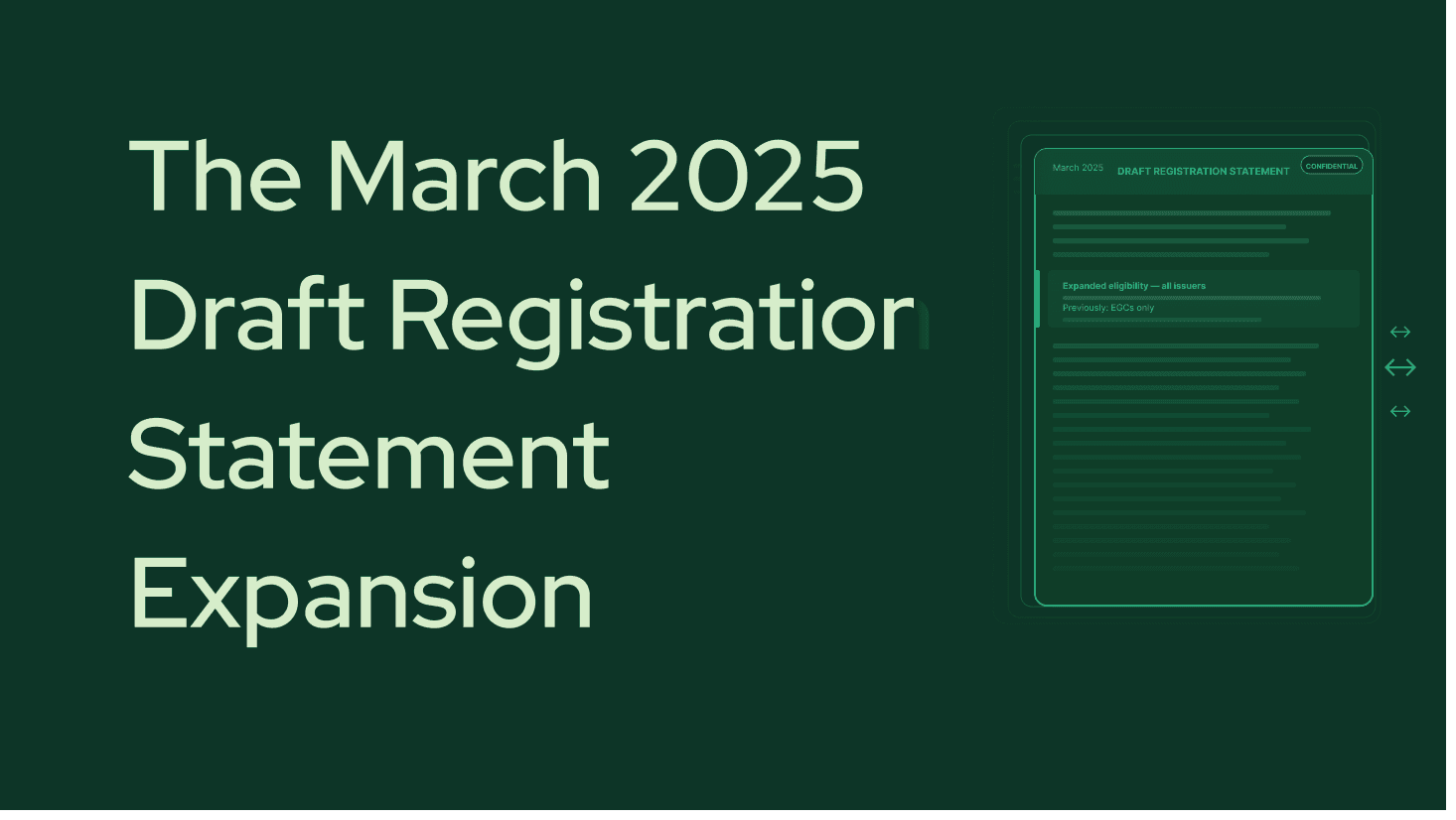
On March 3, 2025, the Division of Corporation Finance published an update to its draft registration statement processing procedures, expanding the accommodations available for nonpublic review beyond what the 2017 expansion had established. The source document is the SEC's Enhanced Accommodations for Issuers Submitting Draft Registration Statements, published on the Corp Fin section of SEC.gov. This post maps every change in that document in the sequence your team will encounter the questions.
What Is the Draft Registration Statement Process and Who Has Always Been Eligible?
The draft registration statement (DRS) process allows a company to submit its registration statement to the SEC's Division of Corporation Finance for nonpublic review before making it public. The SEC staff reviews the draft, issues comment letters, and the company responds and revises all without the submission appearing on EDGAR or becoming available to the public.
The DRS process originated with the Jumpstart Our Business Startups Act of 2012, which permitted Emerging Growth Companies to submit a draft registration statement for an initial public offering for confidential, nonpublic staff review. In 2017, the Division expanded the process to all issuers voluntarily, not just EGCs. From 2017 through March 2025, any issuer could use the DRS process for an IPO, regardless of EGC status.
The March 2025 changes build on the 2017 expansion. They do not replace or limit the EGC process, which continues to operate as it always has. They add four specific new accommodations on top of the existing framework.
What Are the Four Specific Changes the Division Made in March 2025?
The March 3, 2025 Corp Fin staff position identifies four discrete changes to the DRS accommodations. Each is distinct and applies to a different set of companies or transaction types.
Change 1: Exchange Act Section 12(g) registrations are now eligible for nonpublic review.
Before March 2025, the expanded DRS accommodations covered initial registrations of a class of securities under Exchange Act Section 12(b) exchange-listed securities. Exchange Act Section 12(g) registrations, which apply to companies that become reporting companies by crossing the shareholder count threshold rather than by listing on an exchange, were not eligible.
The March 2025 expansion adds Section 12(g) registrations to the eligible categories. An issuer may now submit for nonpublic review the initial registration of a class of securities on Forms 10, 20-F, or 40-F under either Exchange Act Section 12(b) or Exchange Act Section 12(g). This means a company that triggers Exchange Act reporting obligations through shareholder count rather than through a listing can now use the DRS process to go through SEC review before its registration statement becomes public.
Change 2: The 12-month limit on subsequent DRS submissions is eliminated.
Before March 2025, the nonpublic review process for subsequent Securities Act offerings was limited to draft registration statements submitted within 12 months of the effective date of the issuer's initial registration statement. A company that had been public for two years and wanted to file a shelf registration statement could not use the DRS process for nonpublic review.
The March 2025 expansion removes that time limit entirely. A subsequent draft registration statement for any Securities Act offering or Exchange Act registration may now be submitted for nonpublic review regardless of how much time has passed since the issuer became subject to Exchange Act reporting. This means a company that went public five years ago and is now preparing a secondary offering can use the DRS process to receive nonpublic staff review before filing publicly.
Change 3: De-SPAC transactions in the SPAC-on-top structure are eligible when the target qualifies.
The SPAC rules that became effective in July 2024 introduced co-registration requirements for certain de-SPAC transactions where the SPAC survives as the public company. The target may be required to be a co-registrant in those structures, which created uncertainty about whether the DRS process applied.
The March 2025 expansion addresses this directly. An issuer may now submit a registration statement for a de-SPAC transaction for nonpublic review as if it were an initial Securities Act registration statement the functional equivalent of an IPO, as the Commission stated in the adopting release for the 2024 SPAC rules where the co-registrant target would otherwise independently be eligible to submit a draft registration statement. The eligibility test is the target's eligibility, not the SPAC's.
Change 4: Underwriter names may be omitted from the initial draft submission.
Before March 2025, Items 501 and 508 of Regulation S-K require an issuer to include the name of the underwriter in its registration statement. The DRS process did not previously provide an accommodation to omit that information from the initial draft.
The March 2025 expansion permits issuers to omit the name of the underwriter or underwriters from their initial draft registration statement submissions. The underwriter name must be included in subsequent submissions and in the public filing. This accommodation is specifically useful when the underwriting arrangement is still being finalised at the time of the initial draft submission, or when the company wants to go through the first round of SEC review before the banking relationship is disclosed.
What Are the Timing Rules for IPOs and Initial Exchange Act Registrations?
The timing rules for initial public offerings and initial Exchange Act registrations under the DRS process are unchanged from the pre-March 2025 framework. They are worth stating precisely because the consequences of missing them are significant.
For a Securities Act IPO or initial Exchange Act Section 12(b) or 12(g) registration, the issuer must confirm in a cover letter to the nonpublic draft submission that it will publicly file its registration statement and all nonpublic draft submissions at least 15 days prior to any road show or, in the absence of a road show, at least 15 days prior to the requested effective date of the registration statement.
This 15-day rule is a public availability requirement, not a staff processing requirement. The submission becomes public 15 days before the road show begins, which is the moment the company begins marketing to institutional investors. The staff does not impose this; the issuer commits to it in the cover letter to the draft submission.
The staff comment letters and issuer responses to those letters will be released publicly on EDGAR no earlier than 20 business days following the effective date of the registration statement.
These two timing rules 15 days before road show for the public filing, 20 business days after effectiveness for the comment letter release frame the entire IPO timeline. A company that files its initial draft in Week 1, receives and responds to SEC comments over the following six to eight weeks, and is ready to launch a road show in Week 10 must have its registration statement and all draft submissions publicly available by Week 8.
What Are the Timing Rules for Subsequent Offerings?
The timing rules for subsequent Securities Act offerings and Exchange Act registrations under the DRS process differ from the IPO rules and reflect the different risk profile of a company that is already a public reporting company.
For a subsequent draft registration statement submitted for nonpublic review, the issuer must confirm in its cover letter that it will file its registration statement and nonpublic draft submission such that they are publicly available on the EDGAR system at least two business days prior to any requested effective time and date.
The two-business-day rule is substantially shorter than the 15-day rule for IPOs. This reflects the fact that the issuer is already a reporting company with an established public disclosure record, and investors have access to its prior filings.
Two additional procedural points apply to subsequent submissions that do not apply to IPO submissions.
First, the staff will limit its nonpublic review to the initial submission of the subsequent draft registration statement. An issuer responding to staff comments on a subsequent draft registration statement must do so with a public filing, not with a revised draft registration statement. Any further review follows normal public filing procedures.
Second, Exchange Act registration statements on Forms 10, 20-F, and 40-F must be publicly filed so that the full 30-day or 60-day period, as applicable, will run prior to effectiveness. The two-business-day rule does not override the statutory effectiveness period for Exchange Act registrations.
What Can the Division Omit From an Initial Draft Submission?
The March 2025 expansion confirms that while an issuer should take all steps to ensure its draft registration statement is substantially complete when submitted, the Division will not delay processing if the issuer reasonably believes omitted financial information will not be required at the time the registration statement is publicly filed.
The specific omission accommodation added by March 2025 is the underwriter name. Items 501 and 508 of Regulation S-K require the underwriter's name in a registration statement. The initial DRS submission may now omit this information provided the name is included in subsequent draft submissions and in the public filing.
Beyond the underwriter name, the Division will consider an issuer's specific facts and circumstances in connection with any request under Rule 3-13 of Regulation S-X, which addresses waivers of financial statement requirements. This is not a new accommodation from March 2025, but it applies in the DRS context.
The Division also encourages issuers and their advisers to review transaction timing with the staff assigned to the filing review and will consider reasonable requests to expedite processing.
Questions about eligibility can be submitted to the Division directly at CFDraftPolicy@sec.gov.
How Does This Affect a De-SPAC Transaction Specifically?
The de-SPAC accommodation deserves a separate explanation because the 2024 SPAC rules created co-registration complexity that the March 2025 expansion addresses specifically.
Under the 2024 SPAC rules, where a SPAC survives a business combination as the public company (the SPAC-on-top structure), the target may be required to be a co-registrant on the registration statement. Before March 2025, this co-registration requirement created uncertainty about whether the target's participation in the registration statement as a co-registrant rather than as the primary registrant affected DRS eligibility.
The March 2025 position resolves this. The registration statement for a de-SPAC transaction in this structure may be submitted for nonpublic review as if it were an initial Securities Act registration statement meaning the same 15-day-before-road-show timing rule and the same comment letter confidentiality applies provided the co-registrant target would otherwise be independently eligible to submit a draft registration statement.
The Commission's own characterisation in the 2024 SPAC rule adopting release is that the de-SPAC transaction is the functional equivalent of the target's IPO. The March 2025 accommodation formalises the consequence of that characterisation for the DRS process.
Frequently Asked Questions
What is the draft registration statement process and why does it matter?
The DRS process allows a company to submit its registration statement to the SEC for nonpublic staff review before making it public. The staff reviews the draft, issues comment letters, and the company responds and revises before the filing appears on EDGAR. This allows companies to address SEC staff concerns before public scrutiny and market pressure, and ensures the public filing is a more complete document. The process was created for EGCs by the JOBS Act in 2012 and extended to all issuers in 2017. The March 2025 expansion added four specific new accommodations.
Who is eligible to use the DRS process after the March 2025 expansion?
All issuers are eligible for the DRS process. The March 2025 expansion specifically added: companies registering a class of securities under Exchange Act Section 12(g) on Forms 10, 20-F, or 40-F; companies submitting subsequent Securities Act offering registration statements more than 12 months after their initial registration became effective; and de-SPAC transactions in the SPAC-on-top structure where the co-registrant target would independently qualify for DRS submission. EGC accommodations continue to apply separately and are not affected by the expansion.
What is the 15-day rule for IPO draft registration statements?
An issuer using the DRS process for an IPO must confirm in its cover letter that it will publicly file its registration statement and all prior nonpublic draft submissions at least 15 days before any road show begins, or at least 15 days before the requested effective date if there is no road show. This is a commitment made by the issuer to the Division in the cover letter accompanying the draft submission.
What is the 2-business-day rule for subsequent offerings?
An issuer using the DRS process for a subsequent Securities Act offering must confirm that its registration statement and nonpublic draft submission will be publicly available on EDGAR at least two business days before any requested effective time and date. Staff review for subsequent submissions is limited to the initial draft. Responses to staff comments must be made through public filings, not revised draft submissions.
Can a company omit its underwriter's name from an initial DRS submission?
Yes, under the March 2025 expansion. Items 501 and 508 of Regulation S-K ordinarily require the underwriter's name in a registration statement. The March 2025 accommodation permits issuers to omit the underwriter name from the initial draft submission, provided the name is included in all subsequent draft submissions and in the public filing.
What changed for de-SPAC transactions in the March 2025 expansion?
The March 2025 expansion permits submission of a registration statement for a de-SPAC transaction in a SPAC-on-top structure for nonpublic review, treated as if it were an initial Securities Act registration statement, when the co-registrant target would independently be eligible to submit a draft registration statement. This resolves the uncertainty created by the 2024 SPAC rules' co-registration requirements and is consistent with the Commission's characterisation of a de-SPAC as the functional equivalent of the target's IPO.
Key Takeaways
- The March 2025 expansion adds four accommodations to the existing DRS process: Exchange Act Section 12(g) registrations are now eligible; the 12-month limit on subsequent DRS submissions is eliminated; de-SPAC transactions in SPAC-on-top structures qualify when the target is independently eligible; and underwriter names may be omitted from initial draft submissions.
- The 15-day rule remains unchanged for IPOs: the public filing and all nonpublic drafts must be available on EDGAR at least 15 days before the road show or, absent a road show, 15 days before the requested effective date.
- The 2-business-day rule applies to subsequent offerings: the registration statement and nonpublic draft must be publicly available at least two business days before the requested effective date. Staff review for subsequent submissions is limited to the initial draft only.
- The EGC confidential submission process under the JOBS Act is not affected by any of the March 2025 changes and continues to operate separately.
- Questions about eligibility can be directed to the Division at CFDraftPolicy@sec.gov.