Going public does not immediately subject every newly listed company to the full set of SEC disclosure and compliance requirements.
Under the JOBS Act, many IPO companies qualify as Emerging Growth Companies (EGCs). EGC status provides a phased compliance framework that reduces disclosure, auditing, and governance requirements during the first years after an IPO.
For CFOs building an IPO readiness plan, understanding exactly how the EGC on-ramp works is critical. The cost difference between retaining EGC status and becoming subject to the full public company framework can be substantial.
What Is an Emerging Growth Company (EGC)?
An Emerging Growth Company is a category of issuer created by the Jumpstart Our Business Startups (JOBS) Act of 2012.
A company generally qualifies as an EGC when it completes an IPO and has annual gross revenues below the statutory threshold established under Section 2(a)(19) of the Securities Act.
The purpose of the EGC framework is to reduce the regulatory burden of becoming a public company while still providing investors with material information.
For qualifying issuers, EGC status creates a temporary transition period during which certain disclosure, governance, and auditing requirements are reduced.
Why Does EGC Status Matter After an IPO?
EGC status matters because it directly affects the cost and complexity of being public.
The largest benefits typically include:
- Reduced historical financial statement requirements
- Delayed adoption of certain accounting standards
- Exemption from auditor attestation under Section 404(b) of the Sarbanes-Oxley Act
- Reduced executive compensation disclosures
- Reduced shareholder advisory vote requirements
- Lower external advisory and compliance costs
For many newly public companies, these exemptions represent one of the most significant cost-saving mechanisms available during the first years after listing.
What Disclosure Relief Does an EGC Receive?
An EGC does not receive relief from core reporting obligations such as filing annual reports, quarterly reports, proxy statements, or maintaining disclosure controls.
However, it receives targeted relief in several areas.
Financial Statement Presentation
An EGC may generally provide:
- Two years of audited financial statements in an IPO registration statement rather than three years
- Reduced selected financial data requirements
- Reduced historical disclosure requirements in certain circumstances
Executive Compensation Disclosure
An EGC may use scaled executive compensation disclosures similar to those available to smaller reporting companies.
These requirements are less extensive than the disclosures required of larger public companies.
Sarbanes-Oxley Section 404(b)
An EGC is exempt from the auditor attestation requirement under Section 404(b).
Management must still assess internal control over financial reporting, but the external auditor is not required to provide a separate attestation report.
This exemption is often one of the most significant compliance cost reductions available to newly public companies.
Say-on-Pay Requirements
EGCs are generally exempt from:
- Say-on-pay votes
- Say-on-frequency votes
- Certain golden parachute vote requirements
until EGC status is lost.
How Does the Five-Year EGC On-Ramp Work?
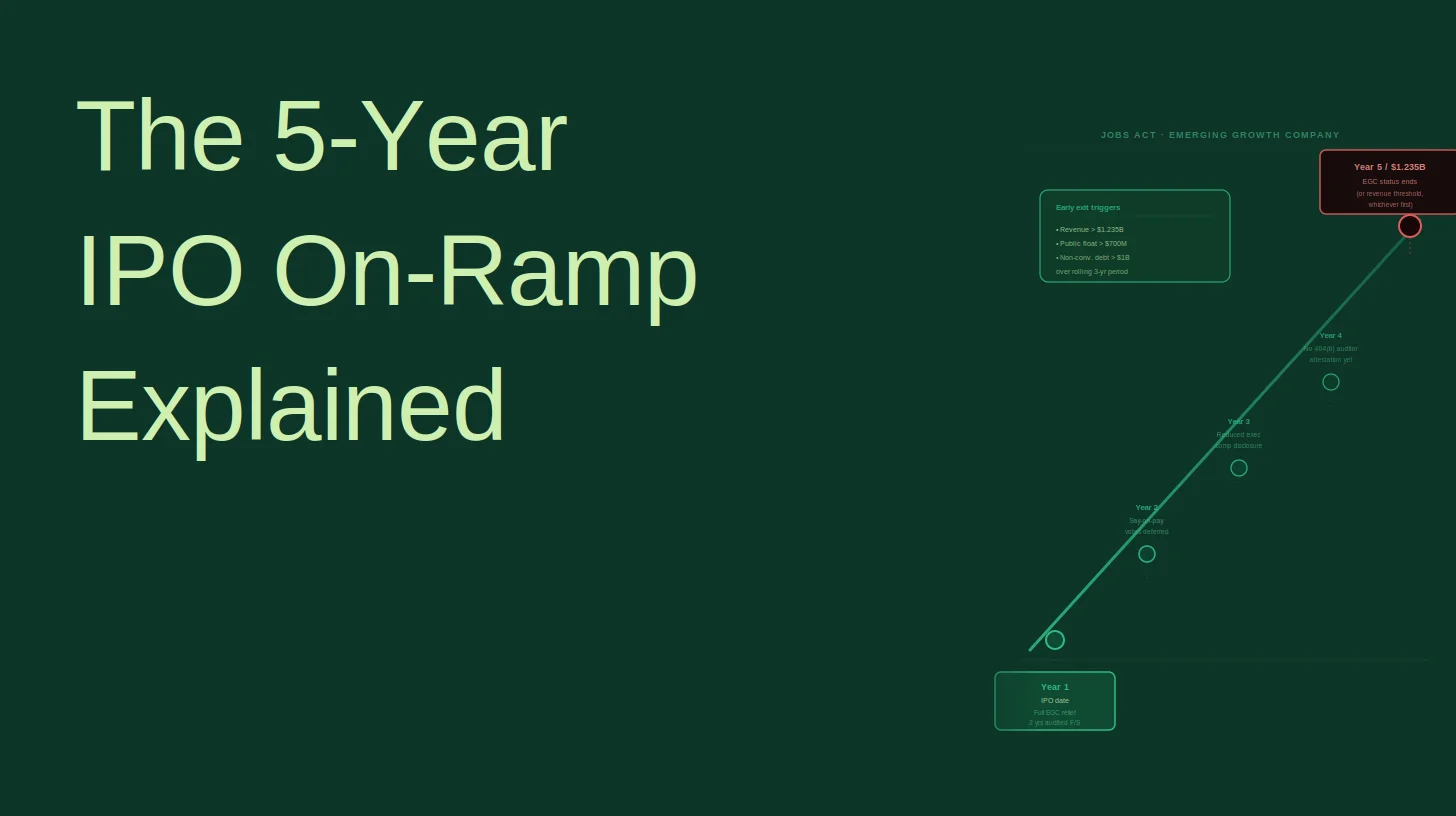
The JOBS Act effectively creates a phased transition period lasting up to five years after an IPO.
Contrary to common assumptions, the SEC does not impose a different regulatory regime each year.
Instead, the company generally retains EGC accommodations throughout the eligibility period unless an earlier disqualification trigger occurs.
The practical impact is that companies gain time to:
- Build internal controls
- Expand finance teams
- Mature disclosure processes
- Prepare for eventual full public company compliance
The transition period can last:
- Until the fifth anniversary of the IPO, or
- Until the company loses EGC eligibility earlier
whichever occurs first.
What Does Disclosure Look Like During Each Year of the On-Ramp?
Year 1: IPO Year
The company begins life as a public company under the EGC framework.
Key benefits include:
- Reduced IPO disclosure requirements
- Reduced executive compensation disclosures
- Section 404(b) exemption
- Extended accounting transition options where elected
The primary focus is establishing public company reporting processes.
Year 2
Reporting obligations become routine.
Companies continue to receive EGC accommodations while improving:
- Disclosure controls
- Earnings reporting processes
- Internal control documentation
- Audit committee oversight
Most compliance spending during this period is directed toward infrastructure rather than new SEC requirements.
Year 3
Finance organizations typically begin preparing for eventual loss of EGC status.
Many companies:
- Expand technical accounting capabilities
- Conduct internal readiness assessments
- Begin evaluating Section 404(b) requirements
Although EGC relief remains available, planning horizons become longer.
Year 4
The transition toward full public company compliance accelerates.
Management often focuses on:
- Internal control maturity
- Governance enhancements
- Expanded disclosure procedures
- Audit readiness programs
The objective is avoiding a compliance shock if EGC status ends.
Year 5
The final year generally represents the last period of guaranteed EGC eligibility under the current framework.
Companies approaching the fifth anniversary of their IPO often complete readiness projects designed to support the transition to the next reporting status.
When Does a Company Lose EGC Status Early?
Many companies never reach the fifth anniversary because they trigger an earlier disqualification event.
An issuer ceases to be an EGC if it:
Exceeds the Revenue Threshold
The company surpasses the statutory annual gross revenue limit established by the SEC.
This is one of the most common disqualification triggers.
Becomes a Large Accelerated Filer
A company may lose EGC status if it grows sufficiently in public float and satisfies the conditions associated with large accelerated filer status.
Issues Significant Non-Convertible Debt
A company can lose EGC status if it issues more than the statutory threshold of non-convertible debt during a rolling three-year period.
Reaches the Fifth IPO Anniversary
Even if none of the other triggers occur, EGC status automatically expires at the end of the five-year period.
What Happens After a Company Loses EGC Status?
Once EGC status ends, the company becomes subject to the disclosure and compliance requirements applicable to its filer category.
The most significant changes often include:
Auditor Attestation Under SOX 404(b)
Companies may become subject to auditor attestation requirements depending on filer status.
This typically increases:
- Audit effort
- Internal control testing
- External advisory costs
Expanded Executive Compensation Disclosures
Proxy statement disclosures generally become more comprehensive.
Additional Governance Requirements
Companies may become subject to requirements from which EGCs were previously exempt.
Increased Compliance Costs
Organizations frequently experience higher spending on:
- External auditors
- Internal controls
- Technical accounting
- SEC reporting personnel
- Governance support
For many issuers, the compliance transition requires planning several years in advance.
What Is the SEC's Proposed 60-Month Floor?
As part of its May 2026 capital formation reform agenda, the SEC proposed exploring a framework that would provide newly public companies with a guaranteed 60-month period of scaled disclosure treatment regardless of early public float growth.
The proposal is intended to address concerns that rapidly growing companies can lose scaled disclosure accommodations sooner than expected, creating compliance costs that were not anticipated during IPO planning.
The proposal remains separate from the existing EGC framework and would require rulemaking before becoming effective.
How Could a Guaranteed 60-Month Floor Change IPO Planning?
If adopted, a guaranteed 60-month floor would make post-IPO compliance costs more predictable.
Potential implications include:
- Greater certainty in IPO budgeting
- Lower risk of unexpected compliance acceleration
- Longer timelines for internal control buildouts
- More flexibility in finance team scaling
- Improved visibility for board-level planning
The proposal would be particularly relevant for companies expected to experience rapid market capitalization growth shortly after going public.
For IPO candidates and private-equity-backed issuers, predictability can be as valuable as the disclosure relief itself.
Key Takeaways
The JOBS Act EGC framework creates a phased transition into public company life by reducing disclosure and compliance requirements for up to five years after an IPO.
The most important points for finance leaders are:
- EGC status provides meaningful disclosure and governance accommodations.
- The largest compliance benefit is often the Section 404(b) auditor attestation exemption.
- EGC status can end before five years if revenue, debt, or filer-status thresholds are exceeded.
- Companies should begin preparing for post-EGC compliance well before eligibility expires.
- The SEC's proposed 60-month floor would make post-IPO compliance costs more predictable if adopted.