TCFD vs IFRS S2: The 2026 Transition Gap Analysis
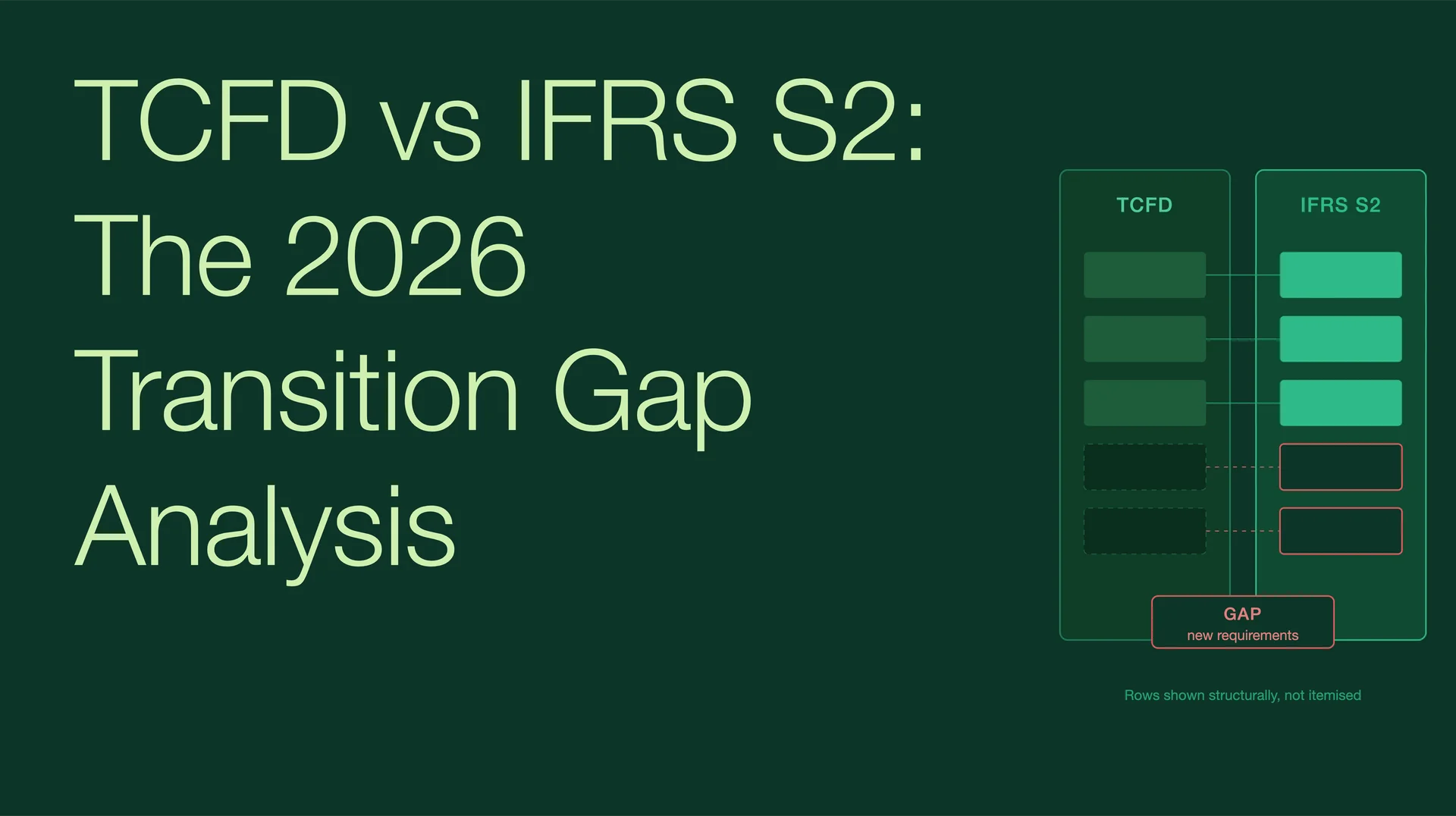
If your team has spent years building a mature TCFD disclosure, there is a trap waiting for you: the assumption that strong TCFD alignment means near-compliance with IFRS S2. ISS-Corporate's cross-standard analysis shows that even industry-leading TCFD reporters, large, listed multinationals with several years of alignment, achieve only just over 50% alignment with IFRS S2's cross-industry disclosure requirements. The frameworks share the same four pillars and eleven recommended disclosures. The resemblance ends there.
This article is for CFOs, ESG leads, and sustainability controllers who already know TCFD and need to understand precisely what IFRS S2 demands on top of it, which jurisdictions have mandated it, and how to close the gap without rebuilding from scratch.
Key takeaway: More than 50% of IFRS S2's approximately 100 cross-industry disclosure requirements are entirely new relative to TCFD, and a further 26% represent substantial advancements. Only around 23% of requirements are the same across both frameworks.
Has TCFD Been Disbanded? What Happened in October 2023
Yes, TCFD was formally disbanded in October 2023. The Financial Stability Board transferred responsibility for monitoring climate-related disclosure progress to the IFRS Foundation, which now oversees IFRS S2 as the global successor framework. The TCFD's annual status reports, which tracked adoption across thousands of companies, stopped with its disbandment.
The numbers behind TCFD's reach explain why the transition matters at scale: according to ISS data, 78% of S&P 500 companies, 82% of STOXX 600 companies, and 98% of FTSE 100 companies provided climate disclosures informed by TCFD. That is an enormous installed base of reporting infrastructure that now needs upgrading, not replacing.
For UK-listed companies and large UK private companies, TCFD was mandatory under FCA and FRC rules before disbandment. The UK government has been assessing IFRS S1 and S2 for adoption as UK Sustainability Reporting Standards (UK SRS). Until the FCA formally mandates UK SRS, existing TCFD disclosures remain the operative requirement for in-scope UK entities, but the direction of travel is clear. Companies in that position should treat TCFD compliance as the floor, not the ceiling.
What Is IFRS S2 and How Does It Relate to TCFD?
IFRS S2 Climate-related Disclosures is the ISSB standard published in June 2023, effective for annual reporting periods beginning on or after January 1, 2024. It is built on the same four-pillar architecture as TCFD: Governance, Strategy, Risk Management, and Metrics and Targets. The IFRS Foundation states that "the requirements in IFRS S2 are consistent with the four core recommendations and eleven recommended disclosures published by TCFD."
That consistency is real but limited. The ISSB was established in 2021 and built IFRS S1 and S2 on four predecessor frameworks: Integrated Reporting, CDSB, SASB, and TCFD. TCFD is one input, not the whole foundation. The SASB industry-specific metrics, for instance, are entirely absent from TCFD and represent a substantial new data collection burden for most companies.
One structural point that catches teams off guard: IFRS S2 cannot be applied in isolation. It must be applied alongside IFRS S1, which establishes the definitions of value chain, materiality, and commercial sensitivity that govern how S2 requirements are interpreted. A TCFD crosswalk that ignores S1's materiality definition is incomplete by design.
TCFD vs IFRS S2: Framework Comparison
| Feature | TCFD | IFRS S2 |
|---|---|---|
| Status | Disbanded October 2023 | Effective January 1, 2024 |
| Issuing body | FSB Task Force | ISSB (IFRS Foundation) |
| Nature | Voluntary recommendations | Standard (mandatory where adopted) |
| Pillars | 4 (Governance, Strategy, Risk Mgmt, Metrics) | Same 4 pillars |
| Recommended disclosures | 11 | ~100 cross-industry requirements |
| Industry-specific metrics | None | SASB-derived, required |
| Scenario analysis | Recommended | Required (1.5°C or 2°C scenario specified) |
| Financial statement connectivity | Not required | Required |
| Financed emissions (financial institutions) | Not required | Required |
| Carbon credit disclosure | Not required | Required |
| Third-party target validation | Not required | Required to disclose whether validated |
| Assurance requirement | None | Jurisdictionally mandated in some markets |
| Overlap with TCFD requirements | 100% (TCFD is the base) | ~23% identical; ~26% substantially advanced; ~50%+ entirely new |
Pillar-by-Pillar: Where IFRS S2 Goes Further Than TCFD
The gap is not evenly distributed. ISS-Corporate found that both Governance and Risk Management show reasonable TCFD-to-IFRS S2 alignment, while Strategy and Metrics and Targets are where the largest gaps sit. Here is what that means in practice.
Governance: Specific Role Descriptions Required
TCFD asked companies to describe board oversight of climate-related risks and opportunities. IFRS S2 goes further: it requires disclosure of how the board's responsibilities for climate-related risks and opportunities are embedded in terms of reference, role descriptions, and related policies. A generic statement that "the board oversees climate risk" does not satisfy this. The disclosure must show the structural mechanism, not just the assertion.
Strategy: Financial Quantification and Scenario Analysis
This is the pillar with the largest gap. TCFD recommended that companies describe the impact of climate risks and opportunities on strategy and financial planning. IFRS S2 requires companies to specify when quantitative and qualitative information must be disclosed about the current and anticipated financial effects of those risks and opportunities, connected to the financial statements.
That connectivity requirement is new and significant for finance teams. Climate risks must be traceable to asset impairment assessments, provisions, capex decisions, and financial planning assumptions. A narrative description of transition risk that does not connect to the balance sheet does not meet the standard.
On scenario analysis, TCFD recommended it. IFRS S2 requires it, and specifies that companies must use a scenario consistent with a 1.5°C or 2°C pathway alongside a scenario consistent with their own business planning. The methodological bar is substantially higher. For a detailed walkthrough of what IFRS S2 paragraphs 22-23 and B1-B13 require for scenario analysis, see Finrep's climate scenario analysis practitioner guide.
IFRS S2 also requires companies to identify areas within their business model and value chain where climate-related risks and opportunities are most concentrated, and to disclose the data sources used to identify those risks and the extent of operations covered. Neither of these was required under TCFD.
Risk Management: Opportunities Now Explicitly Required
TCFD focused primarily on risks. IFRS S2 requires disclosure of processes for identifying, assessing, prioritizing, and monitoring climate-related opportunities as a distinct category, not just risks. For companies whose TCFD disclosures treat opportunity disclosure as optional or cursory, this is a gap that needs closing.
Metrics and Targets: The Largest New Data Collection Burden
This is where most companies will spend the most time and money. The new requirements relative to TCFD include:
- SASB industry-specific metrics: IFRS S2 requires companies to apply the SASB-derived disclosure topics and metrics relevant to their industry. These are entirely absent from TCFD. A pharmaceutical company, for example, must apply SASB's Health Care sector standards; a bank must apply SASB's Commercial Banks standards. The IFRS Foundation has published industry-based guidance covering 68 industries.
- GHG emissions boundary: IFRS S2 requires separate reporting of GHG emissions for the consolidated accounting group and for associates, joint ventures, and unconsolidated subsidiaries or affiliates. TCFD did not specify this boundary treatment.
- Scope 3 detail: IFRS S2 requires disclosure of Scope 3 categories, methods, inputs, assumptions, and data quality. TCFD treated Scope 3 as "if appropriate." Note that IFRS S2 provides transition relief: companies are not required to disclose Scope 3 GHG emissions in the first year of application.
- Financed emissions for financial institutions: Banks, asset managers, and insurers must disclose financed emissions under IFRS S2, typically referencing PCAF methodology. This is a substantial new requirement with no TCFD equivalent.
- Carbon credit disclosure: Companies must disclose the use of carbon credits in meeting climate targets, including the type, quantity, and quality of credits used.
- Third-party target validation: Companies must disclose whether their climate targets have been validated by a third party. TCFD required no such disclosure.
- Transition plans: IFRS S2 requires disclosure of transition plans, including strategies to meet climate-related targets. TCFD did not require this.
Is IFRS S2 Compulsory? Jurisdictional Adoption Status in 2026
IFRS S2 is mandatory where a jurisdiction has formally adopted it. As of mid-2026, the standard has garnered support from 64 jurisdictions, with 19 national regulators having consulted on adoption under jurisdictional law. Several markets have moved from consultation to near-final or final rules.
| Jurisdiction | Status (mid-2026) | Notes |
|---|---|---|
| Australia | Final rules | AASB adopted IFRS S1 and S2 with modifications; phased effective dates |
| Canada | Near-final | CSA consulting; IFRS S2 basis for proposed rules |
| Singapore | Final rules | SGX-listed companies; phased by market cap |
| Japan | Consulting | FSA-led; SSBJ standards based on IFRS S1 and S2 |
| New Zealand | Near-final | Mandatory climate reporting law; IFRS S2 basis |
| UK | Consulting | FCA assessing UK SRS based on IFRS S1 and S2; TCFD remains operative pending adoption |
| EU | Separate regime | CSRD/ESRS applies; IFRS S2 not directly mandated but interoperable |
| US | Separate regime | SEC climate rules rescinded in 2026; California SB 253/SB 261 apply independently |
For multinationals operating across these jurisdictions, the practical question is not whether IFRS S2 applies in aggregate but when it applies in each market and at what scope threshold. The IFRS Foundation's jurisdictional adoption tracker is the authoritative source for current status.
IFRS S2 and CSRD: Do You Have to Do Both?
For most multinationals with EU operations, yes, both CSRD and IFRS S2 will apply, but they are not fully duplicative. The ESRS and IFRS S2 share significant conceptual overlap, particularly on climate disclosures, because both draw on TCFD architecture. However, they diverge in two important ways.
First, CSRD uses double materiality: companies must assess both financial materiality (impact on the company) and impact materiality (the company's impact on people and the environment). IFRS S2 uses investor-focused financial materiality only, aligned with IFRS S1's definition. A disclosure that is material under CSRD may not be material under IFRS S2, and vice versa. For a detailed comparison of the two materiality approaches, see Finrep's guide on whether double materiality is required under IFRS sustainability standards.
Second, CSRD covers a broader sustainability agenda (social, governance, biodiversity, and more) through the full ESRS suite. IFRS S2 is climate-specific. A company cannot satisfy IFRS S2 by pointing to its CSRD report without checking that the climate disclosures meet IFRS S2's specific requirements, including SASB industry metrics and financial statement connectivity.
The practical approach for dual reporters: use CSRD's climate disclosures as the starting point, then run a gap check against IFRS S2's specific requirements, particularly on SASB metrics, financed emissions, and financial statement linkage. The ESRS-ISSB alignment guide for preparers covers this interoperability in detail.
The Assurance Gap: A New Operational Requirement TCFD Never Had
TCFD had no assurance requirement. IFRS S2 does not mandate assurance at the standard level, but several jurisdictions adopting it are requiring limited or reasonable assurance on climate disclosures as part of their implementing rules. Australia's mandatory climate reporting regime, for instance, includes a phased assurance requirement. The EU's CSRD requires limited assurance from the first reporting year, moving toward reasonable assurance.
For CFOs and audit committees, this means the transition from TCFD to IFRS S2 is not just a disclosure exercise. It is an internal controls exercise. Climate data needs to flow through a controlled process that an external assurer can test, with documented data sources, calculation methodologies, and sign-off chains. Companies that wait for a formal mandate before building those controls will face a compressed timeline. For a practitioner walkthrough of how ICFR intersects with climate disclosure controls, see Finrep's ICFR and climate disclosure audit guide.
Transition Relief: What IFRS S2 Allows in Year One
IFRS S2 includes two transition reliefs that are critical for first-year reporters and often missed in generic comparisons:
- Scope 3 relief: Companies are not required to disclose Scope 3 GHG emissions in the first annual reporting period in which they apply IFRS S2. This is a meaningful concession given the data collection complexity of Scope 3, but it is a one-year reprieve, not a permanent exemption.
- Comparative information relief: Companies are not required to provide comparative information in the first annual reporting period of application. This matters for the transition year because it means the first IFRS S2 report does not need to restate prior TCFD disclosures as comparative periods.
Neither of these reliefs eliminates the underlying data collection work. Companies that use the Scope 3 relief in year one should be building their Scope 3 inventory in parallel so that year two disclosure is achievable. For methodology guidance, see Finrep's Scope 3 emissions disclosure methodology guide.
TCFD to IFRS S2 Gap Assessment: Priority Actions
ISS-Corporate recommends a structured transition approach. Based on the cross-standard analysis and the specific gaps identified above, here are the highest-priority actions for a company moving from TCFD to IFRS S2:
- Run an organisational mapping. Determine when your entity will be captured under IFRS S2 in each jurisdiction where you operate. Effective dates and scope thresholds vary. Do this before allocating resources.
- Perform a data-point gap analysis, not a pillar-level crosswalk. The real gaps sit at the metric, method, and boundary level, not at the heading level. Map your existing TCFD disclosures against IFRS S2's approximately 100 cross-industry requirements using the IFRS Foundation's official comparison document.
- Identify your SASB industry standards. Locate the SASB-derived industry guidance applicable to your business model. For diversified companies, this may span multiple industry standards. Build a data collection plan for the metrics you do not currently track.
- Connect climate disclosures to the financial statements. Work with the finance team to trace material climate risks to asset impairment assessments, provisions, capex, and financial planning assumptions. This is the single biggest structural change from TCFD.
- Assess financed emissions obligations. If you are a bank, asset manager, or insurer, financed emissions disclosure is a new and significant requirement. Engage with PCAF methodology early and assess data availability across your portfolio.
- Review governance documentation. Update board and management role descriptions and terms of reference to reflect climate responsibilities explicitly, not just in narrative form.
- Engage assurance providers early. Even if assurance is not yet mandated in your jurisdiction, building auditable controls now avoids a compressed timeline when the mandate arrives.
Key takeaway: As ISS-Corporate's Jacob McKeeman and Erica Chiorazzi put it, "Companies that currently align their climate disclosures to TCFD, and that expect to report under the IFRS Sustainability Disclosure Standards soon, should prioritize reviewing their existing disclosures to understand the additional effort required to transition from TCFD to IFRS S2."
FAQ
Has TCFD been disbanded? Yes. TCFD was formally disbanded in October 2023. The FSB transferred responsibility for monitoring climate-related disclosure progress to the IFRS Foundation, which oversees IFRS S2 as the global successor. TCFD disclosures remain operative in jurisdictions that have not yet adopted IFRS S2, including the UK pending FCA adoption of UK SRS.
What does IFRS S2 mean? IFRS S2 Climate-related Disclosures is the climate-specific standard published by the ISSB in June 2023, effective January 1, 2024. It requires companies to disclose climate-related risks and opportunities across four pillars: Governance, Strategy, Risk Management, and Metrics and Targets. It must be applied alongside IFRS S1, which sets the overarching materiality and reporting framework.
Is IFRS S2 compulsory? IFRS S2 is mandatory where a jurisdiction has adopted it into law or regulation. As of mid-2026, 64 jurisdictions support the standard and 19 national regulators have consulted on adoption. Australia, Singapore, and New Zealand have moved to final or near-final rules. The EU applies CSRD/ESRS rather than IFRS S2 directly. The US SEC rescinded its climate rules in 2026, leaving California's SB 253 and SB 261 as the primary US climate disclosure mandates.
Is TCFD reporting still mandatory anywhere? In jurisdictions that have not yet adopted IFRS S2, TCFD-based requirements may still apply. The UK is the most significant example: FCA-mandated TCFD reporting for listed companies and large private companies remains operative while the UK assesses adoption of UK SRS. Companies in those jurisdictions should continue TCFD reporting while preparing for the IFRS S2 transition.
How do IFRS S1 and S2 work together? IFRS S1 establishes the foundational requirements for all sustainability-related financial disclosures: definitions of value chain, materiality, and commercial sensitivity. IFRS S2 applies those foundations specifically to climate. You cannot apply IFRS S2 correctly without applying IFRS S1's materiality and reporting-entity requirements. The two standards must be adopted together.
What are the biggest data gaps when transitioning from TCFD to IFRS S2? The highest-effort gaps are: SASB industry-specific metrics (entirely new), Scope 3 GHG emissions detail (boundary, categories, methods), financed emissions for financial institutions, financial statement connectivity (linking climate risks to impairment, provisions, and capex), and carbon credit and transition plan disclosures. Governance documentation also needs updating to show structural accountability, not just narrative oversight.