Tariff Refund Accounting Treatment: US GAAP and IFRS Decision Framework (2026)
The Supreme Court's 6-3 ruling on 20 February 2026 invalidated IEEPA tariffs collected since April 2025, and left every importer with the same urgent question: can we book a receivable now, or must we wait for cash? The tariff refund accounting treatment is genuinely unsettled, no single authoritative source has resolved it, and the two permissible models produce materially different balance sheets.
This guide walks through every recognition decision you face, the GAAP-vs-IFRS divergence that multinationals are navigating right now, the Deloitte sub-question that almost no one has fully unpacked, and what actual EDGAR filings show companies doing in practice.
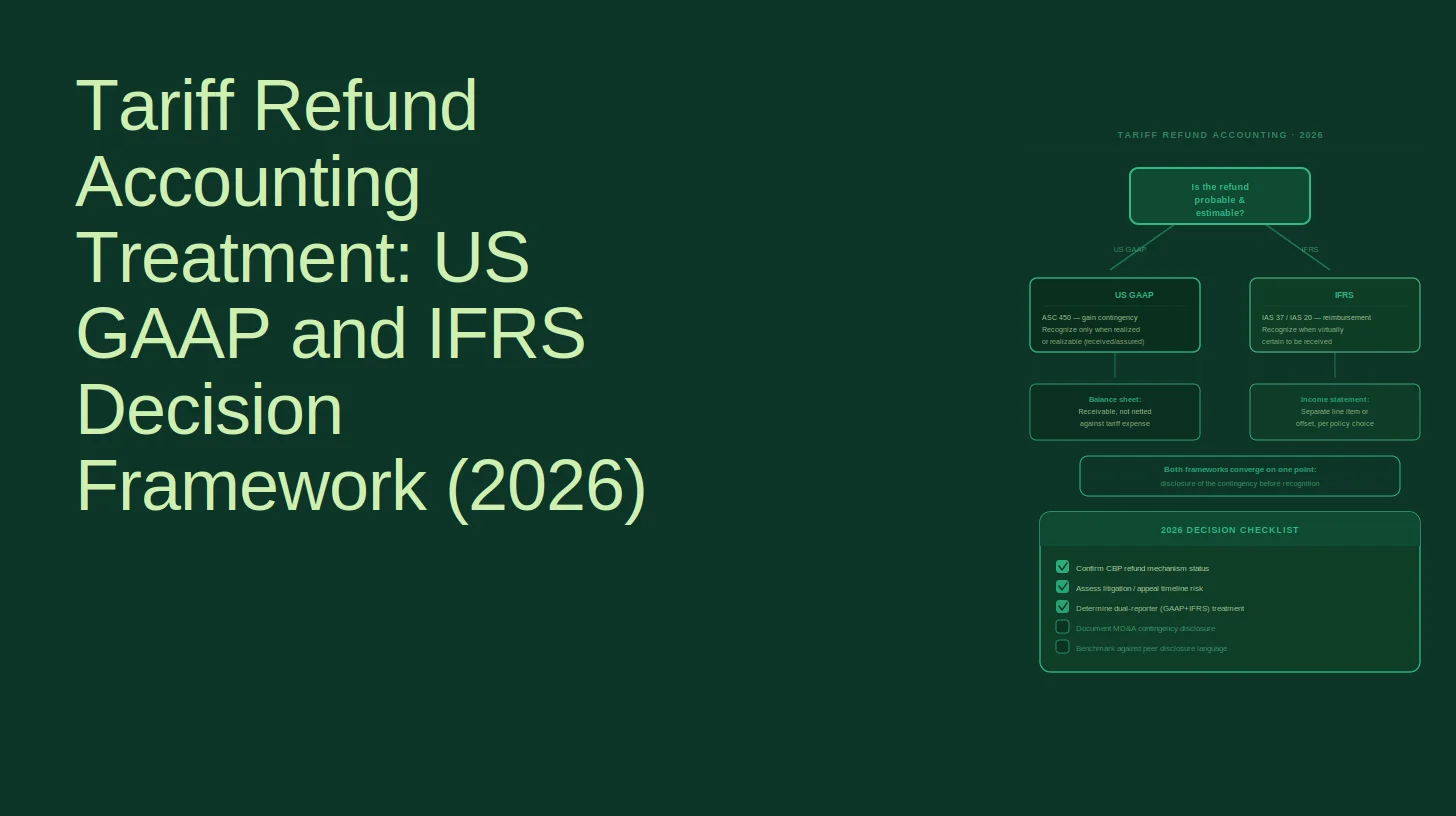
Key takeaway: Two models are permissible under US GAAP. The loss recovery model (ASC 410-30 by analogy) allows recognition when receipt is probable. The gain contingency model (ASC 450-30) defers recognition until cash is effectively in hand. Under IFRS, IAS 37's "virtually certain" threshold is materially higher than GAAP's "probable" standard, meaning most IFRS reporters will stay in disclosure-only territory for now.
What Triggered the Tariff Refund Accounting Question?
The SCOTUS ruling on 20 February 2026 invalidated IEEPA-based tariffs, but said nothing about how or whether refunds must be paid. The Court of International Trade (CIT) filled part of that gap on 4 March 2026, ordering CBP to progress with refunds and stating that "all importers of record whose entries were subject to IEEPA duties are entitled to the benefit" of the ruling.
CBP's Executive Director for Trade Programs responded on 6 March 2026 with a sworn declaration acknowledging that immediate, sweeping reliquidation "without regard to IEEPA duties" is operationally infeasible, and described a new Automated Commercial Environment (ACE) refund process targeted for deployment within 45 days. That 45-day window implied an operational target of approximately mid-April 2026, but the government has not waived its right to appeal the CIT order, keeping the legal landscape uncertain.
Three things are clear from the outset:
- Section 232 and Section 301 tariffs are unaffected. The SCOTUS ruling applies only to IEEPA. Tariffs under Section 232 of the Trade Expansion Act of 1962 and Section 301 of the Trade Act of 1974 remain in force. The 10% global tariffs reimposed after the ruling fall under Section 122 of the Trade Act of 1974.
- This is legally novel. Unlike ordinary customs overpayments, no pre-existing administrative refund process existed for IEEPA tariffs. The situation involves a judicial invalidation of tariffs, not an administrative error.
- The refund and liability assessments are independent. As KPMG notes, a company performs its assessment of tariff refunds to be received separately from its assessment of any outstanding liabilities for tariffs unpaid at the ruling date.
What Is the Accounting Treatment for Tariffs Already Paid?
Tariff obligations are legal obligations under ASC 405, not contingencies. Grant Thornton is explicit: "Tariffs imposed by executive order and actively enforced by USCBP are, in our view, legal obligations in the scope of ASC 405 and are not contingent obligations in the scope of ASC 450-20." They are recognised when legally owed and derecognised when paid or when the entity is legally released from the obligation.
Derecognition of unpaid IEEPA tariff liabilities occurs in the reporting period when CBP formally releases the entity from its obligation to remit payment, per EY's guidance. The SCOTUS ruling date (20 February 2026) is the change-in-law event, consistent with how ASC 740 treats enacted judicial changes, but legal release from CBP is the derecognition trigger for the liability itself.
ASC 410-30 Loss Recovery vs. ASC 450-30 Gain Contingency: Which Model Applies?
Both models are permissible under US GAAP. The choice is an accounting policy decision that should be applied consistently and disclosed. Here is how they differ:
FeatureLoss Recovery Model (ASC 410-30 by analogy)Gain Contingency Model (ASC 450-30)Recognition triggerReceipt is "probable" (likely to occur)All contingencies resolved; gain realised or realisablePost-period developmentsTreated as evidence of conditions at balance sheet date; asset recognised as of period-end (ASC 855)Not recognised after balance sheet date; rarely recognised before issuance (ASC 855-10-15-5(c))Asset capLimited to previously recognised tariff costs (at minimum)N/A; no asset until receiptIncome statement offsetCost of sales, depreciation, or relevant expenseRecognised when receivedComparability riskHigher; requires probability judgement that differs by companyLower; defers until certaintyReal-world exampleVF Corp: recorded $149.7M receivable after CIT rulingFlowers Foods, e.l.f. Beauty: no recognition pending resolution
The loss recovery model draws on ASC 410-30, which directly addresses environmental liability recoveries but is commonly applied by analogy to other loss recovery situations such as casualty insurance. The application to IEEPA tariff refunds is an analogy, not a direct application, which is a nuance that affects how defensible the policy choice is if challenged.
The gain contingency model rests on ASC 450-30-25-1, which states that "a contingency that might result in a gain usually should not be reflected in the financial statements because to do so might be to recognize revenue before its realization." Deloitte notes that ASC 855-10-15-5(c) reinforces this: gain contingencies "are rarely recognized after the balance sheet date but before the financial statements are issued or are available to be issued."
For a deeper dive into the recognition criteria under each model, see our earlier analysis of IEEPA tariff refunds: ASC 450 vs. 410 accounting.
The Deloitte Sub-Question: Can the Asset Include Costs Still in Inventory or PP&E?
This is the most consequential unresolved question for manufacturers and importers with significant inventory, and it is almost entirely absent from published guidance.
Under the loss recovery model, Grant Thornton caps the asset at previously recognised tariff costs, meaning costs already expensed. If tariff costs were capitalised into inventory or PP&E and have not yet flowed through the income statement, Grant Thornton's view is that no asset can be recognised for that portion.
Deloitte takes a broader view. It presents two sub-approaches within the loss recovery model as potentially permissible:
- Expensed costs only. Recognise an asset only for tariff costs already recognised in earnings, with an equivalent offset to the relevant expense line (cost of sales, depreciation).
- Expensed plus capitalised costs. Also recognise an asset for tariff costs not yet in earnings (still sitting in inventory or fixed assets), with an equivalent reduction to the relevant balance sheet item (inventory or PP&E).
The balance sheet and income statement mechanics differ materially between the two sub-approaches:
Tariff cost locationAsset recognised?Offset entryAlready expensed (COGS, depreciation)Yes, under both sub-approachesReduction of cost of sales or depreciation expenseStill in inventoryYes, under Deloitte's broader sub-approach onlyReduction of inventory carrying valueStill in PP&EYes, under Deloitte's broader sub-approach onlyReduction of fixed asset carrying value
Why does this matter? A manufacturer that capitalised $50 million of IEEPA tariffs into inventory at year-end could recognise a $50 million asset under Deloitte's broader approach but nothing under Grant Thornton's narrower reading. That is a material difference, and no authoritative guidance has resolved it. Companies adopting the broader sub-approach should document the policy choice carefully and expect auditor scrutiny.
VF Corp's Q1 2026 10-K disclosure illustrates the split in practice: the company recorded $93.8 million as a reduction to cost of goods sold (expensed costs) and left $55.9 million in inventory to be recognised as inventory is sold, consistent with the narrower sub-approach for the capitalised portion.
How Does the "Probable" Standard Compare to IFRS "Virtually Certain"?
This is the sharpest divergence for multinationals reporting under both frameworks, and it is under-covered in every existing piece.
Under US GAAP, ASC 410-30's "probable" standard means "likely to occur." Under IAS 37, a contingent asset is only recognised when the inflow of economic benefits is "virtually certain." IAS 37 defines a contingent asset as "a possible asset that arises from past events and whose existence will be confirmed only by the occurrence or non-occurrence of one or more uncertain future events not wholly within the control of the company."
FrameworkRecognition thresholdDisclosure thresholdPractical outcome (mid-2026)US GAAP (ASC 410-30)Probable (likely to occur)N/ARecognition possible if facts support probabilityUS GAAP (ASC 450-30)Realised or realisableN/ADefer until receiptIFRS (IAS 37)Virtually certainProbable inflowMost reporters: disclosure only
KPMG states that "judgement is required to determine whether it is virtually certain at the reporting date that a refund will be received and can be recognised. Clear and transparent disclosures about potential future refunds are critical."
The practical consequence: a multinational that concludes receipt is probable under US GAAP may still be unable to recognise any asset in its IFRS consolidated statements. The same underlying facts produce different balance sheets. This is not a theoretical problem; it affects the reported net assets and earnings of any dual-reporter.
Critically, IFRS reporters who cannot meet "virtually certain" must still disclose if inflow is probable. IAS 37 requires disclosure of the nature of the contingent asset and an estimate of its financial effect when a probable inflow exists. Silence is not an option once the probability threshold is crossed, even if recognition is not.
When Is the SCOTUS Ruling a Subsequent Event, and What Must You Disclose?
The ruling is a Type II (non-recognised) subsequent event for periods ending before 20 February 2026. Both EY and Grant Thornton treat the ruling as a change in law, consistent with ASC 740's principle that judicial changes are recognised in the period when they occur.
Here is the decision tree:
- Period ends on or after 20 February 2026: Account for the ruling in the current period. Assess probability or virtual certainty as of the period-end date.
- Period ends before 20 February 2026, financial statements not yet issued: Type II subsequent event. No recognition, but disclosure is required under ASC 855 if omission would make the statements misleading. Disclose the nature of the ruling and an estimate of the financial effect (or state that no estimate can be made).
- Period ends before 20 February 2026, financial statements already issued: No restatement required. Consider whether subsequent filings (MD&A, risk factors) need updating.
For loss recovery model adopters, Deloitte adds a nuance: post-period developments (such as the CIT's 4 March 2026 order) represent additional evidence about conditions existing at the balance sheet date, meaning they can support recognition as of period-end under ASC 855. This is a meaningful distinction from the gain contingency model, where the same post-period facts cannot accelerate recognition.
How Should You Assess Probability When the Refund Process Is Still Being Built?
This is where most companies get stuck. The ACE refund portal exists but is not fully operational, and the government has not waived its appeal rights. Deloitte identifies three factors that may preclude a "probable" conclusion:
- Process complexity. Even where a formal process exists, recovery may require filing protests, petitions, and supporting documentation within prescribed timeframes. "A currently unclear refund process may preclude a conclusion that recovery is probable (i.e., an entity would seemingly be unable to assert that compliance with an unknown process is probable)."
- Management intent. If management has evaluated the cost, timing, and operational burden of pursuing a refund and decided not to pursue it, or to discontinue efforts, probability cannot be asserted.
- Eligibility uncertainty. Eligibility criteria may narrow the population entitled to a refund, and legal counsel may need to evaluate the entity's specific position.
Grant Thornton adds that companies should consider the government's current posture toward paying refunds, the outcome of court cases with similar facts, and whether a clear administrative process has been established.
One practical point KPMG raises that most guidance glosses over: if a company made multiple tariff payments, it may need to perform the probability assessment separately for different populations. Unliquidated tariff entries (where CBP has not yet finalised the duty amount) and liquidated entries (where the duty has been formally assessed and is final) carry different legal characteristics and different probability profiles. A single blended assessment may not be defensible.
Where Does Tariff Refund Income Appear on the Income Statement?
This is an open question with no definitive guidance, and the presentation choice has real consequences for gross margin, EBIT, and non-GAAP metrics.
KPMG flags that companies need to determine the appropriate line item for presenting recovery of tariffs when they recognise a related asset. The options in practice are:
- Cost of sales offset. Reduces COGS in the period of recognition, improving gross margin. This is the most common approach for companies using the loss recovery model where the original cost hit COGS (VF Corp recognised $93.8 million this way).
- Other operating income. Keeps COGS clean but inflates operating income with a non-recurring item. May attract SEC comment if not clearly labelled.
- Below-the-line / other income. Treats the refund as non-operating, which most practitioners view as inappropriate given the tariff's original classification as a cost of goods.
The symmetry principle argues for presenting the refund in the same line where the original cost was recognised. If tariffs hit COGS, the recovery should reduce COGS or appear as a COGS offset. If tariffs were capitalised into PP&E, the recovery reduces the asset's carrying value rather than hitting the income statement immediately. Consistency with the original treatment is the most defensible position and aligns with how Deloitte describes the offset entries.
Do You Have a Refund Obligation to Customers?
If you passed tariff costs on to customers through price surcharges or escalation clauses, the refund may create a liability back to them. This is the ASC 606 / IFRS 15 dimension that most guidance mentions but does not develop.
KPMG notes that companies must consider whether they have refund obligations to customers for tariff-related amounts, or whether they will choose to provide refunds voluntarily. Changes in tariff costs may also affect the measure of progress for revenue recognised over time.
The interaction is complex. If a contractual pass-through clause requires the company to refund tariff-related surcharges when tariffs are reversed, the company faces a variable consideration adjustment under ASC 606. The refund asset (from CBP) and the refund liability (to customers) must be assessed and presented independently. VF Corp disclosed a $37.6 million liability for amounts it committed to reimburse certain vendors and partners once the refunds arrive, illustrating that this is a live issue in actual filings.
How Do Tariff Monetisation Transactions Work?
Tariff monetisation is a real market practice that is almost entirely absent from accounting guidance. Some companies are selling their refund rights to third-party funders on a non-recourse basis in exchange for immediate cash.
Grant Thornton is the only Big-4 firm to address this directly, and its position is clear: "proceeds received from monetization transactions are not considered a refund of tariffs paid." The transaction is accounted for separately from the potential tariff refund. Key accounting questions include:
- Whether the transfer of the refund right constitutes a derecognition of a financial asset (once the refund right has been reduced to a fixed payment schedule and meets the financial asset definition).
- Whether the proceeds represent a borrowing (if the arrangement has recourse features) or a sale (if truly non-recourse).
- How to present the gain or loss on transfer, and whether any retained interest in excess refunds must be recognised.
Grant Thornton also notes that a tariff refund asset will not meet the definition of a financial asset until it is "reduced to a fixed payment schedule." Until that point, the refund right is not a financial asset under ASC 310 or IFRS 9, which affects measurement, impairment, and the derecognition analysis for any monetisation transaction.
Disclosure Checklist for 2026 Filings
Whether you recognise an asset or not, disclosure requirements are high. The following items should appear in your notes and MD&A:
- Accounting policy choice. State whether you are applying the loss recovery model (ASC 410-30 by analogy) or the gain contingency model (ASC 450-30), and whether you are using the narrower or broader sub-approach for capitalised costs.
- Nature and amount of IEEPA tariffs paid. Quantify the total paid since April 2025, broken down by liquidated and unliquidated entries where material.
- Probability / virtual certainty assessment. Describe the factors considered and the conclusion reached. If probability has not been met, say so and explain why.
- Recognised asset. If recognised, state the amount, the line item, and the income statement offset.
- Customer refund obligations. Disclose any liability recognised for amounts owed to customers.
- Subsequent events. For periods ending before 20 February 2026, include a Type II subsequent event disclosure with an estimate of financial effect or a statement that no estimate can be made.
- Contingent asset disclosure (IFRS). Under IAS 37, disclose the nature and estimated financial effect of the contingent asset if inflow is probable, even if recognition is not yet appropriate.
- Legal and process uncertainty. Note the government's retained right to appeal, the status of the CBP refund process, and any company-specific eligibility questions.
For guidance on what the SEC expects in terms of disclosure specificity and MD&A treatment, see our analysis of SEC tariff accounting guidance and practitioner interpretation.
FAQ
Is a tariff refund taxable?Generally yes, if the original tariff cost generated a tax deduction (reducing taxable income), the refund is taxable income in the year received. If tariffs were capitalised and did not generate an immediate deduction, the refund may reduce the asset's tax basis rather than create immediate income. The ASC 740 implications are non-trivial: recognising a tariff refund asset creates a temporary difference between book and tax basis, potentially requiring a deferred tax liability. Companies should assess this alongside the recognition decision.
Under GAAP, what threshold must be met before a company can record a tariff refund receivable?Under the loss recovery model (ASC 410-30 by analogy), receipt must be "probable," meaning likely to occur. Under the gain contingency model (ASC 450-30), no receivable is recorded until all contingencies are resolved and the gain is realised or realisable. The threshold that applies depends on which model the company has adopted as its accounting policy.
Do Section 232 or Section 301 tariffs create any refund accounting issues?The SCOTUS ruling applies only to IEEPA tariffs. Section 232 and Section 301 tariffs remain in force and are not subject to the same judicial invalidation. Companies that have filed protests or exclusion requests under Section 301 face a well-established administrative refund process through CBP, which is legally and procedurally distinct from the novel IEEPA situation. The probability assessment for Section 301 refund claims is therefore different, and typically more straightforward, than for IEEPA claims.
What have companies actually disclosed in recent filings?Filing practice varies. John Deere disclosed in a May 2026 8-K that it recorded a $272 million recovery for refund claims filed and accepted by CBP, providing a concrete basis for recognition under the loss recovery model. VF Corp recorded $149.7 million as a receivable after the CIT's March 2026 ruling, splitting the recognition between a $93.8 million COGS reduction and $55.9 million remaining in inventory. Flowers Foods and e.l.f. Beauty both adopted the gain contingency model and recognised nothing, citing unresolved uncertainty about government appeals and CBP process mechanics.
When does a tariff refund right become a financial asset?As Grant Thornton notes, a tariff refund asset does not meet the definition of a financial asset under ASC 310 (or IFRS 9) until it is reduced to a fixed payment schedule. Until CBP establishes a definitive payment timeline for a specific company's claim, the asset is not a financial instrument, which affects measurement, impairment testing, and the accounting for any monetisation transaction.
What if we entered into a tariff monetisation transaction before recognising the refund asset?The monetisation proceeds are not a tariff refund and must be accounted for separately. If the arrangement is truly non-recourse, the transaction may qualify as a sale of the refund right, with gain or loss recognised on transfer. If recourse features exist, the proceeds are more likely a borrowing. Either way, the accounting is independent of whether the underlying refund would have been recognised under ASC 410-30 or ASC 450-30.