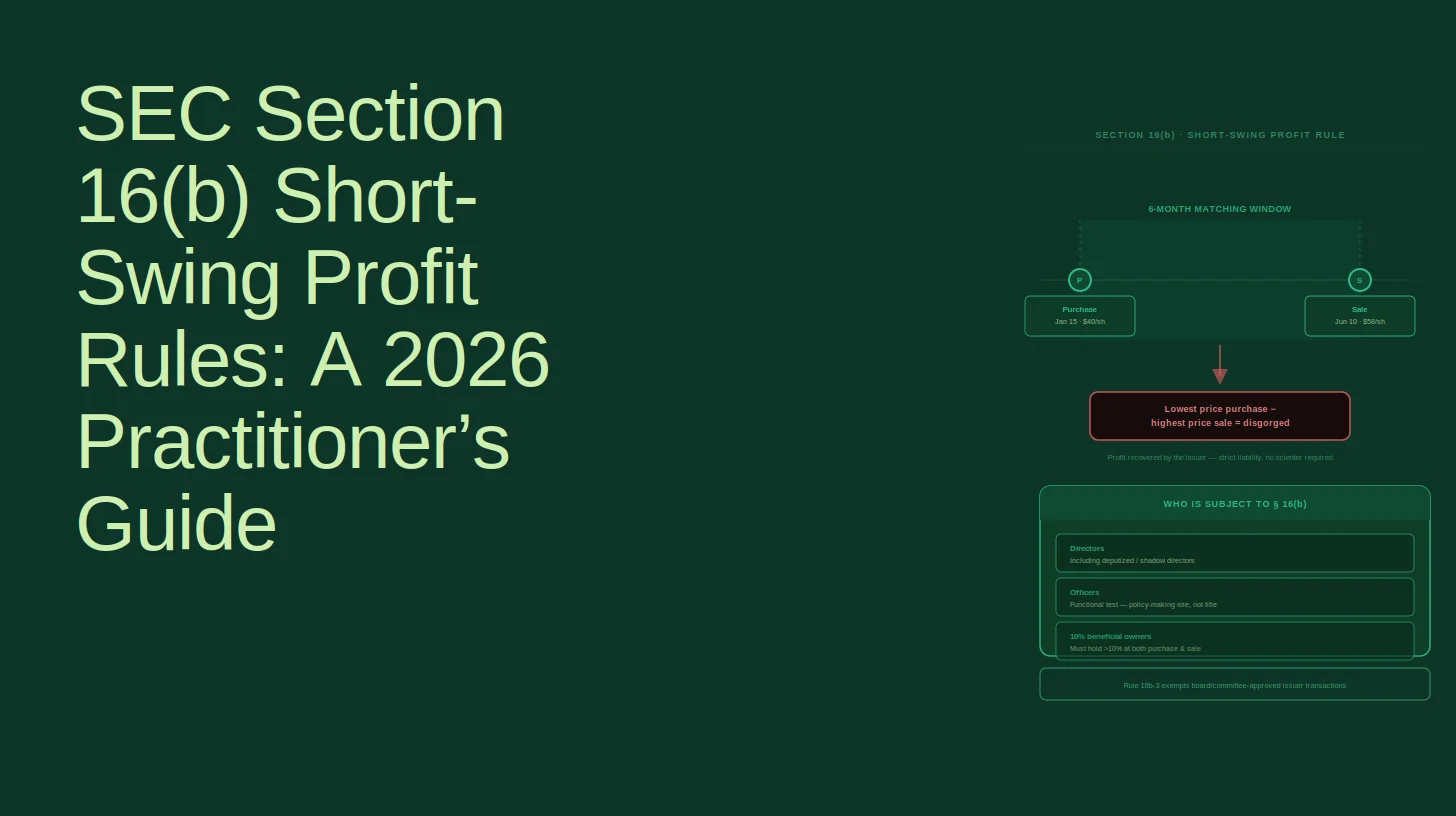
SEC Section 16(b) Short-Swing Profit Rules: A 2026 Practitioner's Guide
If your company has a director who sold shares in June and bought them back in October, you may already have a Section 16(b) problem, even if that director had no inside information and followed every Rule 10b-5 protocol to the letter. That is the point. Section 16(b) of the Securities Exchange Act of 1934 is a strict-liability disgorgement rule, and it catches insiders who never intended to profit from nonpublic information.
This guide is written for CFOs, general counsel, corporate secretaries, and compliance officers who need to understand exactly how short-swing profit liability works, how the profit is calculated, which transactions are exempt, and how to build controls that stop violations before plaintiff law firms find them on EDGAR first.
Key takeaway: Section 16(b) does not require proof of insider trading intent. Any purchase and sale, or sale and purchase, of issuer equity securities within six months by a covered insider triggers automatic disgorgement liability, calculated using the most punishing method available.
What Are SEC Section 16 Short-Swing Profit Rules?
Section 16(b) requires corporate insiders to disgorge to the issuer any profit realized from a purchase and sale, or sale and purchase, of the issuer's equity securities within any period of less than six months. The statute covers officers, directors, and beneficial owners of more than 10% of any class of equity security registered under Section 12 of the Exchange Act.
The SEC has been explicit about the rule's character: "Section 16(b) operates strictly, providing a private right of action to recover short-swing profits by insiders, on the theory that short-swing transactions present a sufficient likelihood of involving abuse of inside information that a strict liability prophylactic approach is appropriate." The statute's own drafters called it a "crude rule of thumb" in 1934 Senate testimony, and that description has aged well.
Three things make Section 16(b) different from every other insider trading rule a compliance officer manages:
- No intent required. Unlike Rule 10b-5, Section 16(b) operates "without consideration of whether an insider actually was aware of material non-public information."
- Both directions trigger liability. A purchase followed by a sale within six months is matchable. So is a sale followed by a purchase within six months. Most insiders know the first scenario; far fewer know the second.
- The profit calculation is not based on actual gain. Courts use a methodology specifically designed to maximize disgorgement, which means the amount owed can exceed what the insider actually made.
Who Is a Section 16 Insider?
The three categories of insiders subject to Section 16(b) are directors, officers, and beneficial owners of more than 10% of a registered equity class.
The officer definition under Rule 16a-1(f) is broader than most companies intuitively apply. It covers any person performing significant policy-making functions, regardless of title. That includes the CEO, CFO, principal accounting officer or controller, vice presidents in charge of a principal business unit or division, and any other person who performs a comparable policy-making function for the issuer or a parent or subsidiary. A senior vice president running a major product line may qualify even without an "executive officer" designation in the proxy.
For 10% holders, the rule applies to persons who are insiders at the time of either the purchase or the sale, not necessarily both. A person who crosses the 10% threshold upon a purchase and then sells within six months is subject to Section 16(b) for that pair. However, a 10% holder who falls below 10% before a subsequent transaction may not be subject to Section 16(b) for that later transaction, per Release No. 33-8600.
How the Six-Month Window Works
The six-month period runs in both directions. Any sale must be tested against purchases within six months before or after the sale date, and any purchase must be tested against sales within six months before or after the purchase date.
This bidirectional matching is the most commonly misunderstood aspect of the rule. An insider who sells in June and buys back in November has a problem just as much as one who buys in June and sells in November. The Comm Bancorp case is a clean real-world illustration: director Joseph P. Moore Jr. sold 2,000 shares at $37.25 per share on June 23, 2009, then purchased 2,000 shares at $26.00 per share on December 16, 2009. That is a sale-before-purchase sequence, completed within six months. The company demanded disgorgement of $22,500 (the difference in aggregate prices) plus 6% simple interest, for a total of $22,629.45. Moore executed a formal Short-Swing Profit Disgorgement Agreement and Release.
The statute of limitations is two years from the date the profit was realized, meaning the date of the transaction that completes the matchable pair. Courts interpret this as running from the later of the purchase and sale, not from the date the violation was discovered. That gives plaintiff law firms a substantial window to act after identifying a matchable pair on EDGAR.
How Short-Swing Profits Are Calculated: The Lowest-In, Highest-Out Method
Section 16(b) profit is not calculated on the basis of actual economic gain. Courts use the "lowest-in, highest-out" matching method, which matches the lowest purchase price against the highest sale price within any six-month window, regardless of the actual chronological order of trades. The result can exceed the insider's real profit.
Here is a worked example that illustrates the gap between actual gain and Section 16(b) liability:
TransactionDateSharesPriceAggregatePurchase AJan 101,000$40$40,000Purchase BMar 51,000$55$55,000Sale CJun 201,000$50$50,000Sale DJun 251,000$60$60,000
The insider's actual economic result: bought 2,000 shares for $95,000 total, sold 2,000 shares for $110,000 total, actual gain of $15,000.
The Section 16(b) calculation matches lowest purchase against highest sale first:
- Match Purchase A ($40) against Sale D ($60): 1,000 shares x $20 = $20,000
- Match Purchase B ($55) against Sale C ($50): no profit (purchase price exceeds sale price, so this pair contributes $0, not a negative offset)
Section 16(b) disgorgement: $20,000. Actual gain: $15,000. The insider owes $5,000 more than they made.
This is not an edge case. The methodology is designed to maximize recovery, and courts will not allow losing pairs to offset winning pairs. As the Latham and Watkins Section 16 desktop reference notes, "this formula can result in deemed profits, even if the Insider lost money on the transactions."
The Derivative Securities Trap Under Rule 16b-6
Options, warrants, convertible securities, and stock appreciation rights are all equity securities for Section 16(b) purposes, and the grant date of an option can be a matchable "purchase" even if the option has never been exercised.
Under Rule 16b-6, the acquisition of a derivative security (establishing or increasing a call equivalent position) is treated as a purchase of the underlying equity security. The disposition of a derivative security (establishing or increasing a put equivalent position) is treated as a sale. This means:
- An option grant on March 1 is a "purchase" for Section 16(b) purposes.
- If the same insider sells shares in the open market on August 15, those two events are more than six months apart and do not match.
- But if the insider sells shares on July 30, the grant and the sale are within six months, and the option grant price (typically zero or a nominal amount for an at-the-money grant) will be matched against the sale price, generating a large calculated profit.
The exemption in Rule 16b-6(b) provides that the closing of a derivative security position through exercise or conversion is itself exempt from Section 16(b). But the acquisition of the underlying shares upon exercise is a new purchase that can be matched against subsequent sales. So the exercise of an option and the sale of the resulting shares within six months creates a fresh matchable pair.
One important nuance: the acquisition of underlying securities from the exercise of an out-of-the-money option is not exempt under Rule 16b-6(b) unless the exercise is required by the sequential exercise provisions of the Internal Revenue Code. Compliance officers designing equity award calendars need to track option grant dates, not just exercise dates, as the start of a potential six-month matching window.
Does a 10b5-1 Trading Plan Protect Against Section 16(b)?
No. A 10b5-1 trading plan provides no protection whatsoever against Section 16(b) short-swing profit liability.
This is one of the most consequential misconceptions in insider trading compliance. A properly adopted 10b5-1 plan gives an insider an affirmative defense to Rule 10b-5 claims by establishing that the trading decision was made before the insider possessed material nonpublic information. But Section 16(b) does not care about intent or pre-planning. It is a strict liability statute. Transactions executed under a 10b5-1 plan are still matchable against other purchases or sales within six months, per Release No. 33-8600.
An insider who adopts a 10b5-1 plan in January scheduling monthly share sales, and who also receives an RSU grant in March that is not exempt under Rule 16b-3, may have a Section 16(b) problem even though every trade was pre-planned and fully disclosed. The pre-clearance and 10b5-1 analysis and the Section 16(b) six-month window analysis must run in parallel, not as substitutes for each other.
Rule 16b-3: The Exemption for Compensatory Transactions
Rule 16b-3 exempts acquisitions and dispositions of issuer equity securities between an issuer and its officers or directors from short-swing profit recovery, provided specific approval conditions are met. The rule was comprehensively overhauled effective August 15, 1996 (Release No. 34-37260), replacing the prior six-month holding period requirement with a board or committee approval mechanism.
Rule 16b-3(d): Acquisitions from the Issuer
Grants, awards, and other acquisitions from the issuer (option grants, RSU awards, ESPP purchases) are exempt if any one of three alternative conditions is satisfied:
- The transaction is approved by the board of directors or a committee composed solely of two or more non-employee directors.
- The transaction is approved or ratified by holders of the issuer's equity securities in compliance with applicable state law.
- The insider holds the securities acquired for at least six months following the date of acquisition.
For stock options, condition 3 means the ultimate sale of the underlying shares must occur at least six months after the grant date, not the exercise date.
Rule 16b-3(e): Dispositions to the Issuer
Dispositions to the issuer are exempt if approved by the board, a committee of non-employee directors, or shareholders. This is the primary exemption for:
- Share withholding to satisfy tax obligations upon RSU vesting
- Share surrender upon option exercise to cover the exercise price
- Cash-settled SAR exercises
- Cancellations, replacements, and surrenders of outstanding awards
- Company buybacks of outstanding awards in a merger context
The Non-Employee Director Approval Mechanics
The approving committee must be composed solely of two or more non-employee directors. A non-employee director is generally one who does not receive compensation from the company other than for board service and does not have a business relationship with the company that would disqualify them under the rule's definition.
Approval must be specific to the transaction, not just to the plan as a whole. Board or committee approval of the equity plan itself does not satisfy Rule 16b-3(d) unless all terms and conditions of the individual transactions are fixed in advance in the plan. If the terms of subsequent transactions are approved as part of the initial transaction, each subsequent transaction does not need additional approval. Retroactive ratification does not cure a defective approval for purposes of Rule 16b-3(d)(1), though it may satisfy condition (d)(2) if completed before the next annual shareholder meeting.
The 2005 amendments (Release No. 33-8600) confirmed, following the Third Circuit's Levy v. Sterling Holding Company decision, that the exemptive conditions in Rule 16b-3 are exclusive: transactions satisfying those conditions are not subject to short-swing profit recovery regardless of whether they might otherwise be deemed purchases or sales.
Other Key Exemptions: Rules 16b-5 and 16b-7
RuleWhat It CoversKey ConditionRule 16b-3(d)Acquisitions from issuer (option grants, RSUs, ESPP)Board/committee approval, shareholder approval, or 6-month holdRule 16b-3(e)Dispositions to issuer (share withholding, SAR cash settlement)Board/committee or shareholder approvalRule 16b-5Bona fide gifts and inheritancesMust be a genuine gift or inheritance, not a disguised saleRule 16b-6Derivative securitiesExercise/conversion exempt; grant date is a purchaseRule 16b-7Mergers, reclassifications, consolidationsAcquiring company must own at least 85% of acquired company's securities before the transaction
Rule 16b-7's 85% threshold was clarified by the 2005 amendments following Levy v. Sterling. The exemption covers transactions in connection with mergers where the acquiring company already controls the target, on the theory that such transactions do not present the speculative short-swing trading risk Section 16(b) was designed to address.
Who Can Sue, and How Does the Process Work?
The right to recover short-swing profits belongs to the issuer, not to the SEC and not directly to shareholders. But if the issuer fails or refuses to bring suit within 60 days after written demand by a shareholder, any shareholder may bring a derivative action on the issuer's behalf, per SEC guidance.
This is how the enforcement ecosystem actually functions in practice. Plaintiff law firms systematically scan EDGAR Form 4 filings to identify matchable purchase-sale pairs within six months. When they find one, they send a written demand letter to the issuer. The 60-day clock starts running. The issuer must then decide:
- Whether the transactions are actually matchable (accounting for exemptions)
- Whether the calculated disgorgement amount justifies litigation
- Whether to pursue the insider directly, negotiate a disgorgement agreement, or contest the claim
The issuer cannot simply waive its right to recover short-swing profits. If the board declines to act and the shareholder brings a derivative suit, the issuer faces the reputational and governance cost of having a director or officer publicly identified as having violated Section 16(b).
The Comm Bancorp disgorgement agreement is a useful template for what resolution looks like: a formal written agreement in which the insider acknowledges the violation, agrees to pay the disgorgement amount plus interest, and releases the company from further claims. That agreement was filed as an exhibit on EDGAR, making the violation permanently part of the public record.
The statute of limitations is two years from the date the profit was realized. A compliance officer who identifies a potential violation should calculate the two-year window from the date of the later transaction in the matchable pair, not from the date of discovery.
The 2026 FPI Development: Reporting Yes, Disgorgement No
The Holding Foreign Insiders Accountable Act (HFIAA), signed December 18, 2025 as part of the FY2026 NDAA, subjects FPI officers and directors to Section 16(a) beneficial ownership reporting for the first time. But it expressly does not extend Section 16(b) short-swing profit liability to FPI insiders.
The SEC adopted final implementing rules on February 27, 2026, and issued an exemptive order on March 5, 2026 covering insiders in six qualifying jurisdictions: Canada, Chile, the European Economic Area (all 27 EU member states plus Iceland, Liechtenstein, and Norway), the Republic of Korea, Switzerland, and the United Kingdom. Insiders in those jurisdictions can satisfy their Section 16(a) obligations by reporting under their local regime, provided reports are publicly available in English within two business days.
As Cleary Gottlieb noted in their Harvard Law School Forum analysis: "While FPI officers and directors will become subject to initial and ongoing beneficial ownership disclosure obligations, they will remain exempt from both the short-swing profit recovery provisions of Section 16(b) and the short-sale prohibitions of Section 16(c)."
Simpson Thacher confirmed the same point: "FPI directors and officers are now subject to the Section 16(a) filing requirements but not Section 16(b) of the Exchange Act (the short swing profit rules) or Section 16(c) of the Exchange Act (the prohibition on short sales)."
The compliance asymmetry this creates is significant. FPI insider trades will now appear on EDGAR in Form 4 filings, and plaintiff law firms will scan them. But those firms cannot bring Section 16(b) claims against FPI insiders, because the HFIAA amended only Section 16(a)(1) and expressly limited its application to reporting purposes. FPI compliance officers should understand this distinction clearly: the Form 4 filing obligation is real and enforceable; the disgorgement exposure is not.
Note also that the HFIAA does not subject 10%+ beneficial owners of FPI securities to Section 16(a) reporting. The legislation's amendment covers only officers and directors.
For a detailed breakdown of the FPI reporting deadlines and exemptive order conditions, see Finrep's dedicated guide: March 18, 2026: The Section 16 Deadline Every Foreign Private Issuer Director Must Know.
Building Internal Controls to Prevent Section 16(b) Violations
Plaintiff law firms are faster at scanning EDGAR than most compliance teams are at reviewing their own insider transaction records. The only reliable defense is catching potential violations before they complete.
A practical compliance framework should include:
1. Maintain a rolling six-month transaction calendar for each insider.Track every purchase and sale, including option grants, RSU vesting dates, ESPP purchase dates, and open-market trades. Flag any upcoming transaction that would fall within six months of a prior transaction in the opposite direction.
2. Integrate Section 16(b) analysis into the pre-clearance workflow.Pre-clearance requests should trigger a Section 16(b) check alongside the standard Rule 10b-5 and blackout period review. The two analyses are independent; passing one does not satisfy the other.
3. Verify Rule 16b-3 approval mechanics before each compensatory transaction.Confirm that the approving committee meets the non-employee director composition requirement, that approval is specific to the transaction (not just the plan), and that the approval is obtained in advance, not after the fact.
4. Track option grant dates as purchase dates.Do not wait for exercise. The grant date opens a six-month matching window against any share sales. Calendar alerts should fire at the grant date, not the exercise date.
5. Do not assume 10b5-1 plan coverage extends to Section 16(b).Document separately that each planned trade under a 10b5-1 plan has been reviewed for six-month matching exposure.
6. Monitor Form 4 filings on EDGAR systematically.The same data plaintiff law firms use is publicly available. A compliance officer who reviews the company's EDGAR filings for matchable pairs on a regular basis will identify problems before a demand letter arrives.
7. Establish a response protocol for demand letters.Know in advance who evaluates a shareholder demand, what the 60-day clock means for board action, and what a disgorgement agreement should contain. The Comm Bancorp agreement on EDGAR is a useful reference document.
For a full map of which transactions require Form 4 reporting and which are exempt from Section 16(b) in the first place, see Section 16 Exemptions: Which Transactions Do Not Require a Form 4 and Why.
FAQ
What is the time frame for short-swing profits under Section 16(b)?Any purchase and sale, or sale and purchase, within any period of less than six months. The six-month window runs in both directions: a sale followed by a purchase within six months triggers liability just as a purchase followed by a sale does.
What is the Rule 16b-3 exemption?Rule 16b-3 exempts transactions between an issuer and its officers or directors from short-swing profit recovery. Acquisitions (option grants, RSU awards) are exempt if approved by a committee of at least two non-employee directors, approved by shareholders, or held for at least six months. Dispositions to the issuer (share withholding, SAR settlements) are exempt if approved by the board, a qualifying committee, or shareholders.
Does Rule 144 define short-swing profits?No. Rule 144 governs the resale of restricted and control securities and has no role in defining or calculating short-swing profits. Section 16(b) and its implementing rules are the exclusive framework for short-swing profit liability.
Does a 10b5-1 plan provide a safe harbor from Section 16(b)?No. A 10b5-1 plan is an affirmative defense to Rule 10b-5 insider trading claims only. Section 16(b) is strict liability and does not consider intent or pre-planned trading arrangements. Transactions under a 10b5-1 plan are fully matchable for Section 16(b) purposes.
Are FPI directors and officers subject to Section 16(b) after the HFIAA?No. The HFIAA, effective March 18, 2026, subjects FPI officers and directors to Section 16(a) reporting for the first time, but expressly does not extend Section 16(b) disgorgement liability or Section 16(c) short-sale prohibitions to FPI insiders.
What is the statute of limitations for a Section 16(b) claim?Two years from the date the profit was realized, meaning the date of the transaction that completes the matchable pair (the later of the purchase and sale).
Can the issuer waive the right to recover short-swing profits?No. The issuer cannot waive its right to recover. If the issuer fails to sue within 60 days of a written shareholder demand, any shareholder may bring a derivative action on the issuer's behalf to recover the profits.