
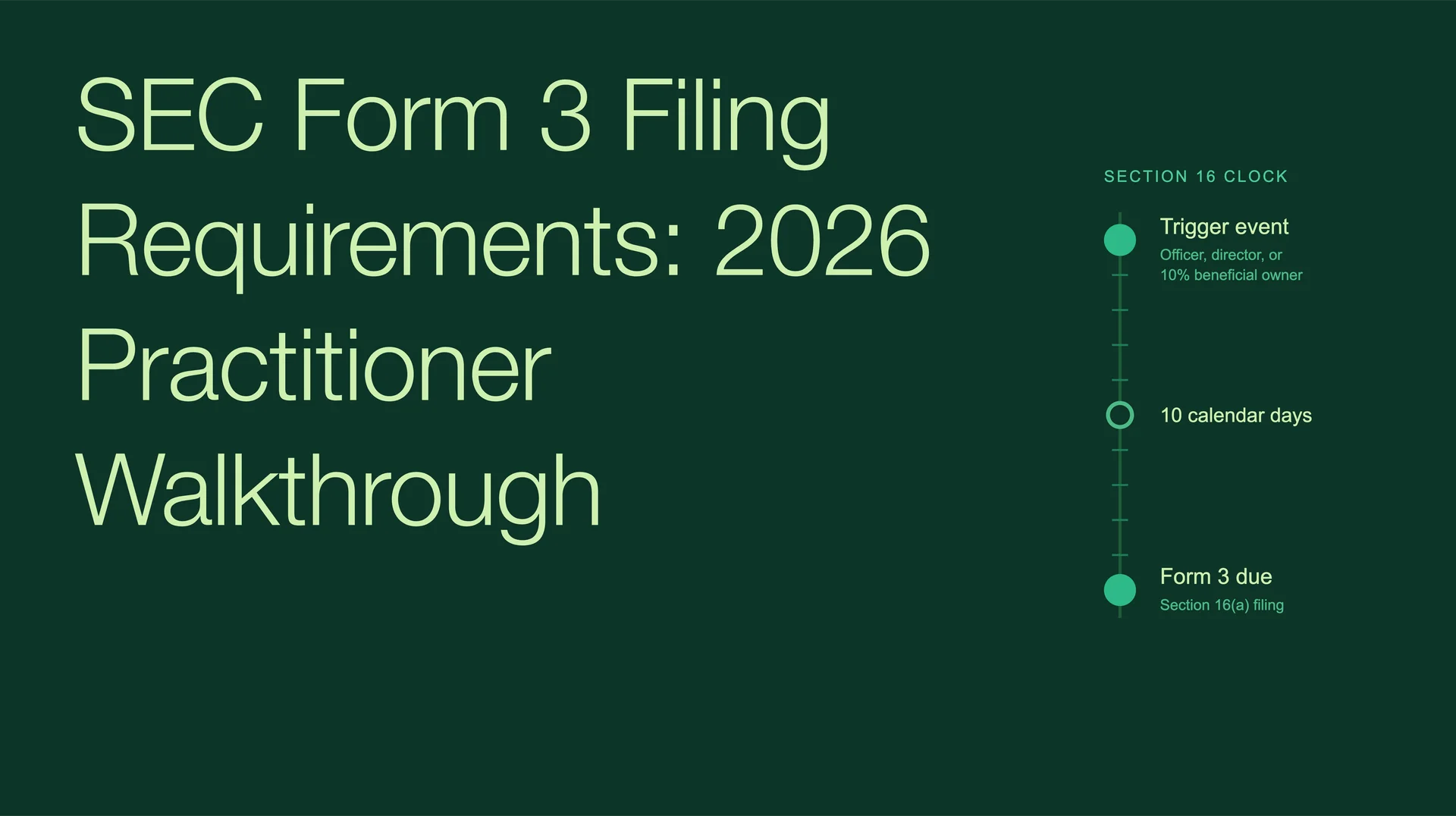
SEC Form 3 Filing Requirements: 2026 Practitioner Walkthrough
If you've just been appointed a director, named a principal officer, or crossed the 10% ownership threshold in a public company, you have 10 calendar days to file SEC Form 3 on EDGAR. Miss that window and the delinquency goes on the public record, shows up in your proxy statement, and can draw SEC enforcement. This guide walks through every step: who must file, what to disclose, how to actually submit on EDGAR, and the biggest traps compliance teams miss.
Quick disambiguation: If you searched for "Form 3" and landed here looking for a shelf registration form, you want Form S-3, which is a Securities Act of 1933 registration statement with entirely different eligibility rules and an estimated 114.71-hour filing burden. Section 16's Form 3 is a short insider ownership disclosure. They share three letters and nothing else.
What Is SEC Form 3 and Who Must File It?
Form 3 is the "Initial Statement of Beneficial Ownership of Securities" required under Section 16(a) of the Securities Exchange Act of 1934. It captures a snapshot of every equity security you hold at the moment you become a Section 16 insider. The form is public the instant it hits EDGAR.
Three categories of people must file, per the Federal Reserve's FR H-1 description (which mirrors the SEC's own instructions):
- Directors and officers of any issuer with a class of equity securities registered under Exchange Act Section 12.
- Beneficial owners of more than 10% of any registered class of equity securities, as determined by voting or investment control under Rule 16a-1(a)(1).
- Trusts, trustees, beneficiaries, and settlors required to report under Rule 16a-8.
The "Officer" Definition Is Narrower Than You Think
This is where companies routinely over-file or under-file. The Section 16 definition of "officer" under Rule 16a-1(f) is not your internal officer list. It covers:
-
The president
-
The principal financial officer
-
The principal accounting officer
-
Any vice president in charge of a principal business unit, division, or function
-
Any other officer who performs a policy-making function
-
Any person who performs similar policy-making functions, regardless of title
A VP of Sales at a mid-cap who sets pricing strategy for the company's largest segment is likely a Section 16 officer. A Senior Vice President with a ceremonial title and no policy-making role probably is not. Get legal counsel to map your internal titles against Rule 16a-1(f) before each appointment cycle.
The 10-Day Filing Deadline: How the Clock Runs
The deadline is 10 calendar days from the triggering event, not from when you receive notice of it. NASPP's practitioner guide is explicit: "When an individual becomes an officer, director, or 10% beneficial owner, they must file Form 3 within 10 calendar days of becoming subject to Section 16."
The triggering events are:
- Appointment as officer or director: the clock starts on the effective date of appointment, not the board meeting date or the date you sign the offer letter.
- Crossing the 10% threshold: the clock starts on the date the acquisition closes and you cross the line, not on the settlement date or the date you calculate your percentage.
- IPO or Section 12 registration: when a company's securities first become registered, all existing insiders must file Form 3 simultaneously.
Two worked examples from the NASPP guide:
- Jane Doe is appointed CFO on July 1, 2026. Her Form 3 is due by July 11, 2026.
- Mary Johnson acquires 12% of a public company's common stock on September 1, 2026. Her Form 3 is due by September 11, 2026.
Note that Form 4, which covers subsequent transactions, carries a much tighter 2-business-day deadline. The 10-day window for Form 3 is the most generous deadline in the Section 16 system.
The Nil-Filing Rule: File Even If You Own Nothing
Key takeaway: Form 3 is mandatory even if you hold zero reportable securities. There is no exemption for a new insider with no shares.
NASPP states this plainly: "All insiders must file a Form 3, even if they do not beneficially own any reportable securities. In that case, the form is filed without any holdings reported on it."
This catches newly appointed independent directors constantly. They join the board before receiving any equity grant, assume no filing is needed because they own nothing, and miss the 10-day window. The SEC does not treat a nil holding as an exemption. File the form with blank tables and move on.
What to Disclose on Form 3
The form has two tables. You must complete both for any securities you hold.
Table I: Non-Derivative Securities
For each class of common stock, restricted stock, or other non-derivative equity security, report:
- Security title and class (e.g., "Common Stock")
- Amount beneficially owned (number of shares)
- Nature of ownership: direct ("D") or indirect ("I")
Table II: Derivative Securities
For stock options, warrants, convertible preferred stock, convertible notes, and any other security that converts into or is exercisable for equity, report:
-
Title of the derivative security
-
Conversion or exercise price
-
Date exercisable and expiration date
-
Title and amount of underlying securities
-
Nature of ownership (direct or indirect)
Indirect Ownership: The Disclosure Trap
Indirect ownership is where Form 3 errors concentrate. You must report securities held through:
- A spouse or domestic partner (if you share investment control)
- A revocable trust where you are the settlor or trustee
- A family limited partnership or LLC you control
- A corporation in which you hold a controlling interest
The test is whether you have voting power or investment control over the securities, per Rule 16a-1(a)(1). If you do, they go on the form. In the "Nature of Ownership" column, identify the indirect relationship (e.g., "By spouse," "By trust," "By LLC"). Omitting these is one of the most common Form 3 errors and the one most likely to surface in an SEC comment letter or enforcement sweep.
For the full mechanics of what counts as beneficial ownership across complex structures, see Finrep's Section 16 insider reporting compliance guide.
How to File Form 3 on EDGAR: Step-by-Step
None of the top-ranking articles on this topic explain the actual filing mechanics. Here is the process.
-
Obtain EDGAR access credentials. The reporting person (or their filing agent) needs an EDGAR CIK (Central Index Key) and access codes. If the insider is new to EDGAR, apply for a CIK at SEC EDGAR. Allow at least 24-48 hours for credentials to be issued, which eats into your 10-day window.
-
Gather all holding data before you start. Pull the full list of securities: common shares (direct and indirect), restricted stock, options, warrants, convertible instruments. Confirm exercise prices and expiration dates for derivatives. Identify every indirect holding and the relationship that creates it.
-
Choose your filing method. You can file directly through EDGAR's online form interface, or use a third-party filing agent (law firms and services like Donnelley Financial Solutions offer this). For a newly appointed insider with complex holdings, a filing agent reduces error risk materially. For a nil return, the online form is straightforward.
-
Complete the form. The SEC's official Form 3 instructions walk through each field. Enter the issuer's name and CIK, your name and address, your relationship to the issuer, and the effective date of your becoming subject to Section 16. Complete Table I and Table II for all holdings, or leave both blank for a nil return.
-
Submit and confirm. After submission, EDGAR generates an accession number. Save it. Confirm the filing appears in the issuer's EDGAR filing history within a few hours. The filing is immediately public.
-
Calendar your Form 4 obligations. From the moment Form 3 is filed, every subsequent transaction in the issuer's equity securities (purchases, sales, grants, exercises, dispositions) triggers a Form 4 due within 2 business days. Build that into your compliance calendar now.
If You File Late or Need to Amend
A late Form 3 should still be filed as soon as possible. File it as a standard Form 3 (not an amendment), and note in a footnote that the filing is delinquent. The company must then disclose the delinquency in its annual proxy statement under Item 405 of Regulation S-K, which requires companies to identify any Section 16 reporting persons who failed to file on time.
If you filed on time but with an error or omission (a missing indirect holding, a wrong share count), file a Form 3/A amendment. The amendment replaces the original in its entirety, so restate all holdings correctly, not just the corrected line.
For a full breakdown of enforcement consequences and penalty ranges, see Finrep's guide to SEC late filing penalties for Section 16.
The 2026 NDAA Change: Foreign Private Issuers Now In Scope
This is the biggest development in Form 3 compliance in decades, and most published guides have not caught up.
The 2026 National Defense Authorization Act eliminated the long-standing exemption from Section 16(a) reporting that previously applied to foreign private issuers (FPIs). As NASPP notes, the statutory change is clear: FPI insiders are now subject to Section 16(a), including the Form 3 initial filing obligation.
What remains unsettled as of mid-2026:
- 10% owner applicability: Whether Section 16(a) applies to 10% beneficial owners of FPIs, or only to officers and directors, is pending SEC guidance.
- Section 16(b) exposure: Whether FPI insiders will also become subject to the short-swing profit recovery provision (which requires disgorgement of profits from matched purchases and sales within six months) has not been confirmed by the SEC.
For FPI compliance teams, the practical implication is immediate. If your company is a foreign private issuer and you have not yet built a Section 16 compliance infrastructure, you need to:
- Identify all directors and officers who are now reporting persons.
- Obtain EDGAR CIKs and access credentials for each.
- File Form 3 for each reporting person (the initial deadline has already passed for most FPIs; late filings should be made promptly).
- Implement a Form 4 monitoring process for all future transactions.
- Watch for SEC guidance on the 10% owner and Section 16(b) questions.
Meredith Erskine's analysis on TheCorporateCounsel.net ("All Aboard: Section 16(a) Goes Global") is the most detailed practitioner treatment of the FPI transition available.
Form 3 vs. Form 4 vs. Form 5: The Deadlines at a Glance
For the full side-by-side comparison of all three forms, see Finrep's Form 3 vs Form 4 vs Form 5 guide. The quick reference:
FormPurposeDeadlineForm 3Initial holdings snapshot on becoming a Section 16 insider10 calendar days after triggering eventForm 4Report each subsequent transaction in issuer equity securities2 business days after the transactionForm 5Annual catch-up for deferred or previously unreported transactions45 calendar days after fiscal year-end
Form 3 establishes the baseline from which Section 16(b) short-swing profit calculations run. Holdings you disclose on Form 3 are the starting point for any matched purchase/sale analysis. A new insider who held shares before appointment and then sells within six months of a subsequent purchase may face Section 16(b) liability calculated from that Form 3 baseline. For a deep dive on short-swing profit mechanics, see Finrep's Section 16 short-swing profit rules guide.
Form 3 Compliance Checklist
Use this as your internal workflow from the moment a triggering event occurs.
- [ ] Day 0: Confirm the triggering event date (appointment effective date or date 10% threshold crossed).
- [ ] Day 0-1: Determine whether the individual meets the Rule 16a-1(f) officer definition or the 10% beneficial ownership test.
- [ ] Day 1-2: Verify EDGAR CIK and access codes exist; apply if not (allow 24-48 hours).
- [ ] Day 1-3: Collect all equity holdings: direct shares, restricted stock, options, warrants, convertible instruments, and all indirect holdings (spouse, trusts, controlled entities).
- [ ] Day 3-7: Prepare Form 3 tables. Have counsel review indirect ownership disclosures and derivative security entries.
- [ ] Day 7-9: File on EDGAR. Confirm accession number and public availability.
- [ ] Day 10: Hard deadline. Filing must be submitted by end of day.
- [ ] Post-filing: Calendar Form 4 obligations for all future transactions. Brief the insider on the 2-business-day Form 4 deadline.
- [ ] Annual: Confirm whether a Form 5 is needed within 45 days of fiscal year-end.
FAQ
Do I have to file Form 3 if I own no shares in the company?Yes. The nil-filing rule is absolute. File Form 3 with blank tables within 10 calendar days of becoming subject to Section 16. There is no exemption for zero holdings.
What is the difference between Form 3 and Form S-3?They are entirely different forms under different statutes. Form 3 is a Section 16 insider ownership disclosure under the Securities Exchange Act of 1934. Form S-3 is a shelf registration statement under the Securities Act of 1933, used by seasoned issuers to register securities for public sale. Searching for one and reading about the other is a common and costly mistake.
Does the 10-day deadline run from calendar days or business days?Calendar days. Weekends and holidays count. If day 10 falls on a weekend or federal holiday, file the preceding business day to be safe.
Who counts as an "officer" for Form 3 purposes?Not every person with an officer title. Rule 16a-1(f) covers the president, principal financial officer, principal accounting officer, VPs in charge of principal business units or functions, and anyone who performs a policy-making function. Map your internal titles against this definition with counsel before each appointment.
What happens if I miss the Form 3 deadline?File immediately. The company must disclose the delinquency in its proxy statement under Item 405 of Regulation S-K. The SEC can also bring enforcement action. Late filings do not erase the obligation; they just add a public record of non-compliance. See Finrep's Section 16 late filing penalties guide for enforcement history and penalty ranges.
Do foreign private issuers need to file Form 3 after the 2026 NDAA?Yes. The 2026 NDAA eliminated the FPI exemption from Section 16(a). FPI directors and officers are now required to file Form 3. Whether the 10% beneficial owner obligation and Section 16(b) short-swing profit exposure also apply to FPI insiders remains subject to pending SEC guidance.
What is a Form 3/A?A Form 3/A is an amendment to a previously filed Form 3. File one if you discover an error or omission after the original submission. The amendment replaces the original in full, so restate all holdings correctly, not just the corrected item.