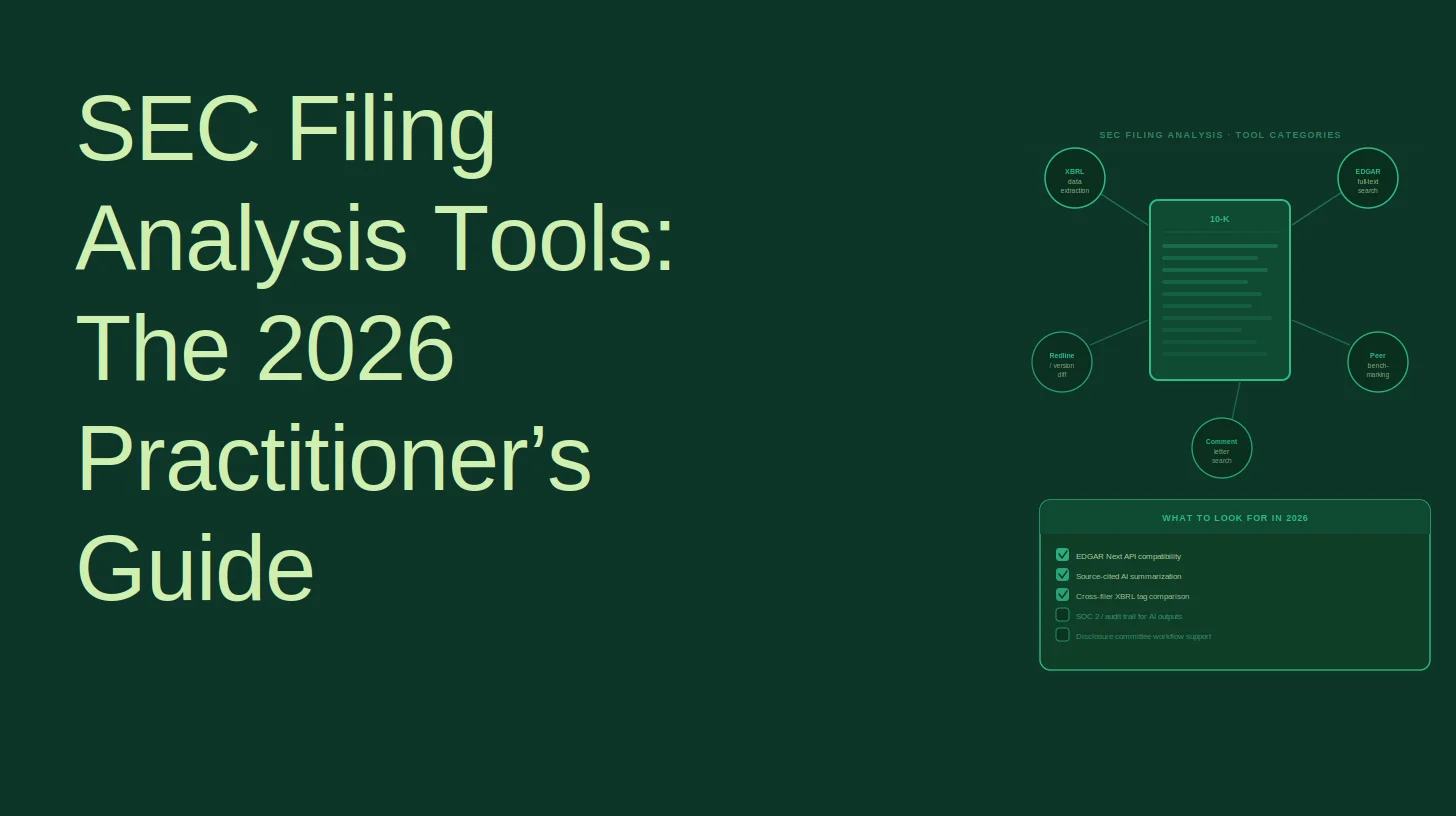
SEC Filing Analysis Tools: The 2026 Practitioner's Guide
If your team is evaluating SEC filing analysis tools, the first question is not which paid platform to buy. It is whether you have exhausted what EDGAR already gives you for free. The answer, for most teams, is no.
This guide maps the full tool landscape to the analytical tasks that actually matter: peer benchmarking, red-flag detection, M&A due diligence, ESG disclosure comparison, insider signal extraction, and real-time monitoring. It covers EDGAR's native capabilities first, then the third-party layer, and then the AI validation problem that almost no other guide addresses.
Key takeaway: All SEC filing analysis tools, paid or free, source their data from EDGAR. Understanding EDGAR's own infrastructure tells you exactly what you are paying third parties to repackage, and where they add genuine value.
What EDGAR Actually Gives You for Free
EDGAR is not just a filing repository. It is a structured data platform that most practitioners use at about 10% of its capacity.
EDGAR processes approximately 4,700 filings per day and serves 3,000 terabytes of data to the public annually, accommodating around 40,000 new filers per year. Every third-party tool in this space ultimately sources from it.
Here is what the native toolset actually includes:
- Full-Text Search (efts.sec.gov): keyword and phrase search across more than 20 years of EDGAR filings, with filters for date range, company, person, filing category, and SIC code. This rivals many paid platforms for text-based research and costs nothing.
- XBRL Financial Data APIs (SEC Data Resources): RESTful endpoints covering submissions history by filer and XBRL-structured financial data from 10-K, 10-Q, 8-K, 20-F, 40-F, 6-K, and their variants. Free, programmatic, no scraping required.
- RSS Feeds and Structured Disclosure RSS: real-time submission feeds by form type, enabling monitoring without a paid alert service.
- CORRESP Filing Type: the actual SEC comment letters and company responses, fully searchable via Full-Text Search. This is the primary source for understanding what the SEC flags in filings, and it is almost never mentioned in tool guides.
- DERA Data Library: aggregated quantitative data from public filings, maintained by the SEC's Division of Economic and Risk Analysis. Used by quant researchers; largely unknown to practitioners.
- Federal Register API (agency code 466): programmatic discovery of SEC rulemaking, proposed rules, and final rules as they affect disclosure requirements.
- SIC Code Filtering: filter Full-Text Search results by Standard Industrial Classification code to build a peer group for benchmarking, entirely free.
- Investment Adviser Public Disclosure: integrates with FINRA's BrokerCheck for counterparty due diligence.
- IM Analytics Office: data and statistics on the asset management industry, relevant for teams analyzing fund filings (N-CEN, NPORT-P, N-CSR).
One operational detail that affects real-time workflows: EDGAR accepts filings from 6 a.m. to 10 p.m. ET on weekdays (excluding federal holidays). A filing submitted at 9:55 p.m. ET may not appear in search results until the following morning.
The 2025 to 2026 EDGAR Infrastructure Changes You Need to Know
Two EDGAR infrastructure changes in the past year have directly affected how tools interact with filing data, and neither has received adequate coverage.
First, compliance with EDGAR's new filer access and account management system became mandatory on September 15, 2025. This changed how filers and third-party tools authenticate with EDGAR. Some integrations broke or required re-authentication, and teams relying on automated data pulls should verify their connections are current.
Second, the SEC cancelled its planned June 2026 EDGAR Release (announced June 1, 2026), following a preview of planned Release 26.2 on May 15, 2026. This signals ongoing infrastructure evolution that affects tool developers and data consumers who rely on EDGAR's technical specifications. If your data team has built pipelines against EDGAR endpoints, tracking the EDGAR release schedule is not optional.
The mandatory Inline XBRL (iXBRL) rollout for most filers also continues to enrich the structured data layer. Tools that parse XBRL tags are getting better raw material, but XBRL tagging quality remains uneven. Custom extension elements and non-standard tags introduce errors that flow downstream into any tool relying on structured data. As Meta Platforms' own 2024 Form 10-K notes about non-GAAP metrics: "FCF has limitations as an analytical tool, and you should not consider it in isolation or as a substitute for analysis of other GAAP financial measures." The same caution applies to any normalized figure extracted by a tool rather than read directly from the filing.
Filing Analysis vs. Filing Preparation: Two Different Tool Categories
The most common tool-selection mistake is conflating filing analysis (reading and extracting from completed filings) with filing preparation (drafting, reviewing, and submitting filings). These require entirely different platforms.
| Category | Purpose | Representative Tools |
|---|---|---|
| Filing analysis | Extract, search, benchmark, and monitor completed filings | EDGAR Full-Text Search, XBRL APIs, Calcbench, Intrinio, AlphaSense, Bloomberg, FactSet, Capital IQ |
| Filing preparation | Draft, tag, review, and submit filings to EDGAR | Workiva, Toppan Merrill Bridge, DFIN (Donnelley Financial Solutions), EDGAR Online Forms |
| AI-native analysis | Semantic search, NL Q&A, summarization across filing corpora | AlphaSense, Hebbia, Kensho, Tegus, Luminance, LLM-based assistants |
| Compliance pre-audit | Benchmark your own disclosures against SEC comment letter patterns | PwC Viewpoint CORRESP tools, EDGAR Full-Text Search on CORRESP filings |
A disclosure team at a public company needs Workiva or Toppan Merrill Bridge for preparation, and EDGAR Full-Text Search plus a comment letter tool for pre-audit review. A buy-side analyst needs Calcbench or a Bloomberg terminal for structured data and an AI tool for semantic search. These are different jobs.
Matching Tools to Analytical Use Cases
Peer Benchmarking and Competitive Intelligence
Start with EDGAR's SIC code filter before opening a paid platform. Filter Full-Text Search by SIC code to pull all 10-K filings for a peer group, then search for specific disclosure language. For structured financial comparisons at scale, Calcbench and Intrinio parse XBRL tags into queryable datasets. Bloomberg, FactSet, and S&P Capital IQ normalize cross-company financials but carry enterprise pricing that is often prohibitive for smaller teams.
For ESG disclosure benchmarking specifically, the workflow in Finrep's ESG benchmarking guide applies directly: use EDGAR Full-Text Search to pull peer filings, then map disclosure language to ISSB S1/S2 or ESRS requirements. No paid tool currently does this cross-framework mapping automatically, which means manual extraction remains part of the workflow.
Red Flag Detection and Accounting Anomaly Identification
The free baseline is EDGAR Full-Text Search on CORRESP filings. Search for a company's filing review correspondence to see exactly what the SEC has flagged in prior reviews. As PwC's comment letter guidance notes, "the identified reviewer of the filing concentrates on critical disclosures that appear to conflict with SEC rules or the applicable accounting standards." Reading the actual CORRESP documents tells you more about a company's disclosure risk than most paid tools.
For systematic anomaly detection, AI-native tools like AlphaSense and Hebbia can flag year-over-year language changes in risk factors and MD&A. WRDS SEC Analytics Suite (subscription required) provides readability and sentiment analysis across filing corpora. Finrep's red flags guide covers the specific disclosure patterns worth screening for.
Real-Time Filing Monitoring
EDGAR's Public Dissemination Service (PDS) is the authoritative feed behind every third-party alert tool. Bloomberg, FactSet, and dedicated monitoring services all source from PDS. If a vendor claims real-time filing alerts, they are pulling from PDS with varying latency. For teams that need the raw feed, PDS offers a direct subscription. For most teams, EDGAR's RSS feeds by form type provide free near-real-time monitoring without a paid intermediary.
For 8-K monitoring specifically, filtering EDGAR RSS by form type 8-K gives you every material event disclosure as it hits. Pair this with Full-Text Search to screen for specific trigger language.
Insider Trading Signal Extraction
Forms 3, 4, and 5 are the data source; EDGAR Full-Text Search is the free extraction layer. Filter by the "Insider equity awards, transactions, and ownership" category to pull Section 16 filings for a specific company or individual. For systematic signal extraction across a portfolio, WRDS SEC Analytics Suite parses Forms 3, 4, and 5 programmatically. Combining this with market data requires a separate data source, as EDGAR does not carry price data.
Finrep's guides on Form 4 triggers and Section 16 insider signals cover the analytical logic in detail.
M&A Due Diligence
For M&A work, the relevant filing types span 10-K, 10-Q, 8-K (Item 1.01 for material agreements), DEF 14A (proxy), SC 13D/G (beneficial ownership changes), and CORRESP (prior SEC scrutiny). EDGAR Full-Text Search handles all of these. For cross-referencing financial data at speed, Bloomberg or Capital IQ adds value. Finrep's M&A comment letter guide covers how to use CORRESP filings to anticipate SEC review of deal disclosures.
Structured Financial Data Extraction at Scale
EDGAR's XBRL APIs are the right starting point for teams with data engineering capacity. The submissions history endpoint and the XBRL financial data endpoint are free, RESTful, and documented at SEC Data Resources. They cover 10-K, 10-Q, 8-K, 20-F, 40-F, and 6-K variants.
The catch: XBRL data quality depends entirely on filer tagging accuracy. Extension elements and custom tags introduce errors that are invisible unless you cross-check against the primary filing. Tools like Calcbench add a normalization and quality-control layer on top of raw XBRL, which is where their value lies.
The AI Validation Problem
This is the gap no competitor guide covers, and it is the most operationally important issue for teams adopting LLM-based filing analysis.
AI tools can now summarize a 10-K, extract segment data, compare MD&A language year-over-year, and answer natural-language questions about a filing. The speed gain is real. The hallucination risk is also real, and the SEC is watching: comment letters increasingly probe AI-generated disclosures, as covered in Finrep's AI risks in SEC filings guide.
A practical validation workflow for AI-generated filing analysis:
- Anchor every extracted figure to a specific filing section and page. Any AI tool worth using will cite the source chunk. If it does not, treat the output as unverified.
- Cross-check numerical outputs against EDGAR's XBRL API. If the AI extracts revenue of $X and the XBRL tag shows a different figure, the XBRL data (or the primary filing) governs.
- Re-read the footnotes for any figure the AI surfaces. Footnotes contain the accounting policy context that changes what a number means. AI tools frequently miss or mischaracterize footnote qualifications.
- For non-GAAP metrics, go back to the reconciliation table in the filing. Companies define non-GAAP figures inconsistently. A tool normalizing "adjusted EBITDA" across peers may be comparing figures calculated on different bases.
- Run a CORRESP search before trusting an AI summary of risk factors. If the SEC has previously challenged a company's risk factor disclosures, the AI summary will not flag that history unless it has been trained on CORRESP data.
For teams building repeatable AI workflows, Finrep's EDGAR research with AI guide covers the architecture in detail.
Tool Stack by User Type
| User Type | Core Need | Recommended Stack |
|---|---|---|
| Buy-side analyst | Structured financials, semantic search, real-time alerts | EDGAR XBRL APIs + AlphaSense or Hebbia + EDGAR RSS |
| Disclosure counsel / SEC reporting team | Peer benchmarking, comment letter pre-audit, filing prep | EDGAR Full-Text Search (CORRESP) + PwC Viewpoint + Workiva or Toppan Merrill Bridge |
| ESG / sustainability team | Disclosure comparison, framework mapping | EDGAR Full-Text Search (SIC filter) + manual ISSB/ESRS mapping |
| Compliance officer | Monitoring, insider filings, adviser due diligence | EDGAR RSS + Section 16 search + Investment Adviser Public Disclosure |
| Quant / data team | Programmatic extraction, large-scale analysis | EDGAR XBRL APIs + DERA Data Library + WRDS SEC Analytics Suite |
| M&A / deal team | Due diligence, ownership changes, prior SEC scrutiny | EDGAR Full-Text Search (all categories) + Bloomberg or Capital IQ |
Foreign Private Issuers and Form 20-F
Most tool guides focus entirely on domestic filers. For institutional investors and ESG teams that analyze both U.S. and international companies, Form 20-F is the annual report equivalent for foreign private issuers, and it carries different disclosure requirements than Form 10-K. EDGAR Full-Text Search covers 20-F filings, and the XBRL APIs include 20-F variants. PwC's Form 20-F guidance (SEC 8100) is the most comprehensive reference for understanding what a 20-F must contain, which matters when configuring extraction tools or building analysis checklists.
Note also that new SEC Section 16 reporting requirements for foreign private issuers took effect March 18, 2026, adding a new category of insider filings to monitor for FPI-heavy portfolios.
FAQ
What is the best free tool for searching SEC filings by keyword? EDGAR Full-Text Search at sec.gov/edgar/search covers more than 20 years of filings with filters for date, company, filing category, and location. It is free, authoritative, and more capable than most practitioners realize.
How do I extract structured financial data from 10-Ks at scale without manual copy-paste? Use EDGAR's free XBRL Financial Data APIs, documented at SEC Data Resources. For a normalized, quality-controlled layer on top of raw XBRL, Calcbench and Intrinio are the leading third-party options.
How do I find SEC comment letters for a specific company? Search EDGAR Full-Text Search, filter by the "Filing review correspondence" category, and enter the company name or CIK. The CORRESP filing type contains the actual letters and company responses.
What changed in EDGAR in 2025 that affects third-party tools? New filer access and account management rules became mandatory on September 15, 2025, requiring re-authentication for some third-party integrations. The SEC also cancelled its planned June 2026 EDGAR release, signaling continued infrastructure change.
Can I use EDGAR to benchmark ESG disclosures against peers? Yes. Filter Full-Text Search by SIC code to pull peer filings, then search for specific ESG disclosure language. No tool currently automates the mapping to ISSB S1/S2 or ESRS frameworks, so cross-framework comparison still requires manual review.
How do I validate AI-generated summaries of SEC filings? Anchor every figure to a specific filing section, cross-check numerical outputs against EDGAR's XBRL API, re-read the relevant footnotes, and run a CORRESP search to surface any prior SEC scrutiny of the disclosures in question.