Understanding the SEC's 2026 Two-Category Filer System
On May 19, 2026, the SEC proposed the most significant restructuring of the public company reporting framework in more than two decades. Five overlapping filer categories collapse into two. The large accelerated filer threshold triples. And roughly 81% of all public companies stand to gain scaled disclosure accommodations they've never had before.
This article is for CFOs, controllers, disclosure counsel, and audit committee members who need to know exactly how the proposed rules change their company's obligations, not just the headline numbers.
Key takeaway: These are proposed rules, not final ones. As of June 4, 2026, both proposals are in a 60-day public comment period. The smart move is to model your new status now and begin planning, not to wait.
What the SEC Actually Proposed on May 19, 2026
The SEC released two companion rulemakings on the same day:
- Filer Status Proposal (File No. S7-2026-18): "Enhancement of Emerging Growth Company Accommodations and Simplification of Filer Status for Reporting Companies"
- Registered Offering Reform (File No. S7-2026-17, Release No. 33-11418): sweeping changes to shelf registration, WKSI benefits, and Form S-1
Both carry a 60-day public comment window after Federal Register publication. Comments on the Registered Offering Reform are due by July 27, 2026.
Chairman Paul S. Atkins framed the package plainly: "The current public company regulatory framework is in dire need of a comprehensive overhaul. Over the past twenty-five years, layers upon layers of legislative changes and SEC rules have created many different categories of public companies with complex, overlapping requirements and benefits."
From Five Categories to Two: What Gets Eliminated
The current framework has five partially overlapping designations:
- Large accelerated filer
- Accelerated filer
- Non-accelerated filer
- Smaller reporting company (SRC)
- Emerging growth company (EGC)
The overlap is genuinely painful in practice. A company can simultaneously be an SRC and an accelerated filer, requiring two separate annual compliance analyses. An EGC that crosses the large accelerated filer threshold loses its EGC status entirely, a rule Skadden describes as a "counterproductive phase-out."
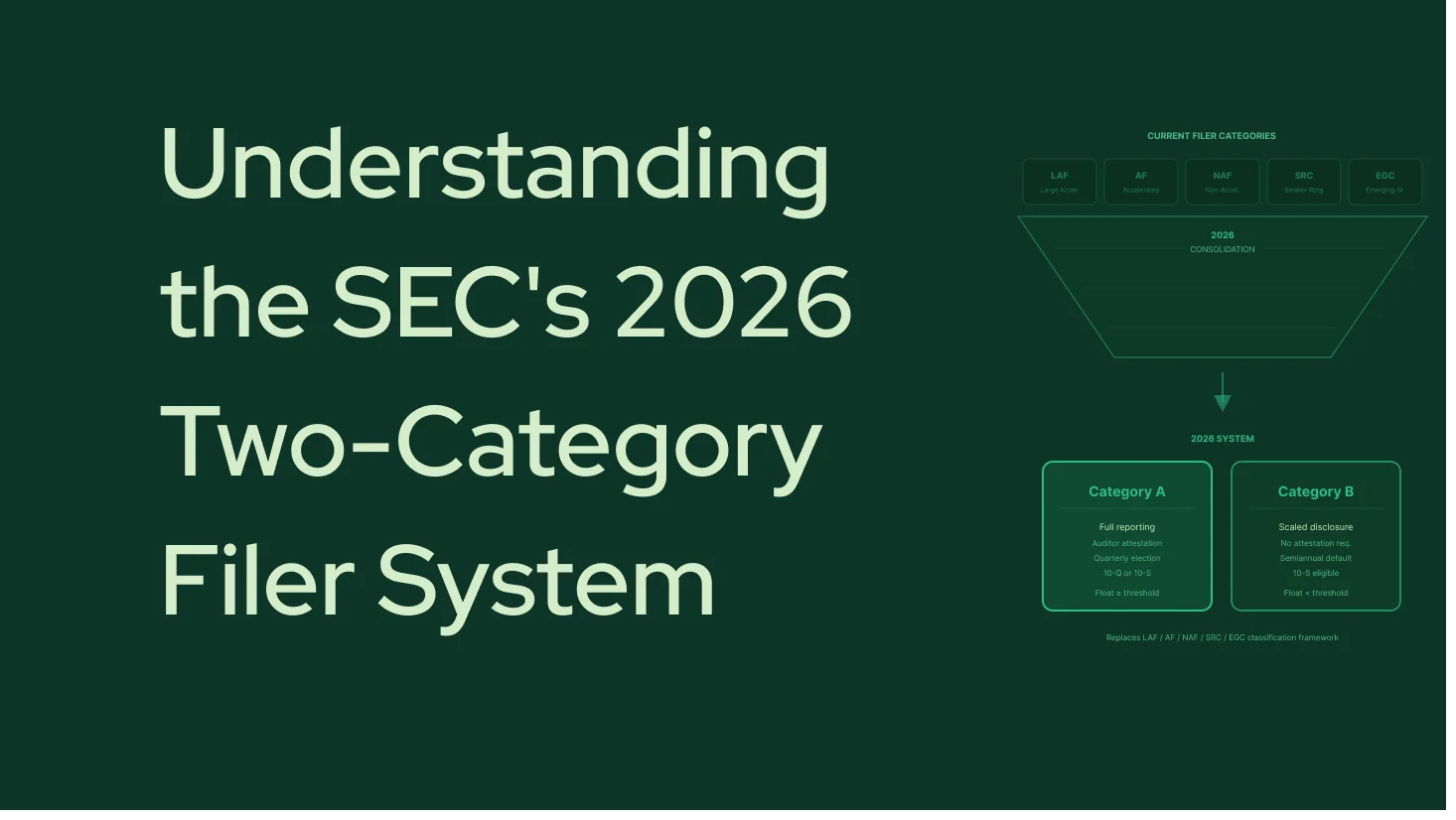
Under the proposal, this collapses to two:
- Large accelerated filer (LAF): companies with $2 billion or more in public float, after 60 months of Exchange Act reporting
- Non-accelerated filer (NAF): everyone else
The accelerated filer and SRC categories are eliminated entirely. The EGC category is subsumed into the NAF framework. The SRC revenue-based test, which currently allows companies with less than $100 million in annual revenues and less than $700 million in public float to use scaled disclosures, disappears. Those companies simply become non-accelerated filers under the new framework.
PwC summarises it cleanly: "The SEC proposed rule changes that would simplify the determination of filer status, resulting in only two primary filer categories: large accelerated and non-accelerated."
The New $2 Billion Threshold: How It's Calculated
The large accelerated filer public float threshold rises from $700 million to $2 billion, a 186% increase. The current $700 million threshold has not been updated since 2005.
But the dollar amount is only part of the change. The calculation methodology shifts too, and that matters operationally.
Current method: closing price on the last business day of the second fiscal quarter, multiplied by non-affiliate shares outstanding.
Proposed method: average closing price over the last 10 trading days of the second fiscal quarter, multiplied by non-affiliate shares outstanding as of the last day of that quarter.
The 10-trading-day average is designed to prevent a single volatile session from flipping a company's filer status. As Skadden notes, this "is intended to minimize the risk of a single day's market volatility resulting in an unexpected change to a company's filer status."
What this means for your process: companies currently tracking float on a single date need to build a 10-day rolling average calculation into their Q2 close procedures. If your float oscillates around $2 billion during the measurement window, the average, not the peak or trough, determines your status. The annual assessment date remains the last day of the fiscal year, consistent with current practice.
The Two-Consecutive-Year Stability Rule
A company must meet or fail to meet the $2 billion threshold for two consecutive annual assessments before its filer status changes. This applies symmetrically to both entry and exit. There is no separate, lower exit threshold under the proposed rules, unlike the current framework where a large accelerated filer can drop out at a lower float level.
The practical effect: once you enter LAF status, you stay there for at least two years even if your float drops below $2 billion in year one. Conversely, a company that crosses $2 billion in year one does not become a large accelerated filer until it crosses again in year two.
The 60-Month Seasoning Rule and the IPO On-Ramp
No newly public company can become a large accelerated filer for at least 60 consecutive months after its IPO, regardless of public float size. A company that goes public and immediately reaches a $5 billion float still spends five years as a non-accelerated filer.
This is a structural change. The current seasoning requirement is just 12 calendar months. The proposed extension to 60 months creates a genuine IPO on-ramp, one that applies to every new registrant without exception.
Chairman Atkins was direct: "The opportunity to become a public company should not be reserved for 'unicorns.'" The 60-month rule is the mechanism that delivers on that framing.
For companies currently weighing IPO timing, this interacts directly with the optional semiannual Form 10-S reporting framework the SEC proposed on May 5, 2026. Non-accelerated filers are the primary intended beneficiaries of that proposal too. The two proposals work as a package: the filer status overhaul defines who gets the accommodations; the semiannual reporting proposal defines one of the most significant accommodations available.
What a Non-Accelerated Filer Actually Gains
This is where most coverage stops at the headline and misses the operational detail. Here is a precise mapping of what NAF status delivers under the proposal.
AccommodationCurrent availabilityUnder proposed rulesExempt from SOX 404(b) auditor ICFR attestationSRCs and EGCs onlyAll non-accelerated filersTwo years of audited financial statements (vs. three)SRCs onlyAll non-accelerated filersScaled executive compensation disclosureSRCs and EGCsAll non-accelerated filersExempt from say-on-pay and say-on-frequency votesEGCs onlyAll non-accelerated filersExempt from pay-versus-performance disclosure (Item 402(v))EGCs onlyAll non-accelerated filersThree named executive officers (vs. five) in comp tablesSRCs onlyAll non-accelerated filersTwo years of MD&A (vs. three)SRCs onlyAll non-accelerated filersScaled risk factor disclosure (Item 105)SRCs onlyAll non-accelerated filersExempt from quantitative market risk disclosures (Item 305)SRCs onlyAll non-accelerated filersForm 10-K filing deadline: 90 daysCurrent NAFsAll non-accelerated filersForm 10-Q filing deadline: 45 daysCurrent NAFsAll non-accelerated filers
Sources: SEC press release; Deloitte IAS Plus Heads Up; PwC Viewpoint
The SOX 404(b) Exemption: The Biggest Dollar Impact
The expansion of the SOX Section 404(b) auditor attestation exemption to all non-accelerated filers is the single most financially significant change in the proposal. EY calls it "a significant expansion of the exemption from providing an attestation report on internal control over financial reporting."
For companies currently between $700 million and $2 billion in public float, this means the end of a mandatory external auditor opinion on ICFR. That is a material audit fee line item. Audit committees at these companies should be asking two questions now:
- What portion of our current audit fee is attributable to the 404(b) attestation work?
- Should we voluntarily retain 404(b) attestation even if it's no longer required, given the governance signal it sends to institutional investors?
The SEC acknowledged in the proposal that registrants may nonetheless decide to voluntarily obtain an auditor attestation. Management's responsibility to assess ICFR effectiveness under SOX 404(a) remains unchanged for all companies.
The $700M to $2B Cohort: The Group Nobody Is Talking About
The companies with the most to gain from this proposal are those currently sitting between $700 million and $2 billion in public float. These companies are today's large accelerated filers. Under the proposal, they become non-accelerated filers overnight.
They gain:
- Elimination of the 404(b) auditor attestation requirement
- A shift from 60-day to 90-day Form 10-K filing deadlines
- A shift from 40-day to 45-day Form 10-Q filing deadlines
- Reduction from three to two years of required audited financial statements
- Exemption from say-on-pay votes, pay-versus-performance tables, and full CD&A
This cohort includes a significant number of mid-cap companies across technology, healthcare, industrials, and consumer sectors. The SEC estimates that under the proposed rules, 19.2% of current reporting companies would be large accelerated filers and 80.8% would be non-accelerated filers, compared to approximately 52% benefiting from some form of scaling today.
Companies that recently crossed the $700 million threshold and became large accelerated filers for the first time are asking whether they can revert. The answer under the proposal: yes, but only after two consecutive years below $2 billion, and only once the rules are final.
Small Non-Accelerated Filers: The Extended Deadline Subcategory
A subset of non-accelerated filers gets additional time. Small non-accelerated filers are defined as NAFs with total assets of $35 million or less as of the end of each of the two most recent second fiscal quarters.
Their filing deadlines under the proposal:
- Form 10-K: 120 days (30 additional days beyond the standard NAF 90-day deadline)
- Form 10-Q: 50 days (5 additional days beyond the standard NAF 45-day deadline)
This subcategory represents the smallest 18% of public companies by assets. Note that the $35 million asset test must be met for two consecutive second fiscal quarters, not just one, adding a stability requirement parallel to the LAF float test. If you're close to this threshold, you need to track total assets at Q2 close for two consecutive years before relying on the extended deadlines.
For companies already using Form 12b-25 to manage tight filing windows, the extension mechanics remain available in parallel.
The Registered Offering Reform: Shelf Access for Almost Everyone
The companion Registered Offering Reform (File No. S7-2026-17) is equally significant for capital markets planning. Key changes:
- Form S-3 shelf eligibility would no longer require a minimum public float ($75 million) or a 12-month Exchange Act reporting history. Eligibility would depend primarily on timely SEC report filing.
- WKSI-equivalent benefits (automatic shelf registration, free writing prospectus flexibility, broader communication rights) would extend to a new category of "eligible listed issuers" and "seasoned eligible listed issuers," not just companies with $700 million+ float.
- Form S-1 incorporation by reference would be permitted, reducing the document preparation burden for first-time registrants.
- Blue sky preemption: state securities law registration and qualification requirements would be preempted for all registered offerings. This eliminates multi-state blue sky compliance in registered deals, a significant cost reduction for capital markets counsel that has received almost no standalone analysis in existing coverage.
For companies currently locked out of shelf registration because of float or seasoning requirements, this proposal opens the door to faster, cheaper capital raises. The interaction with the filer status proposal is direct: a company that becomes a non-accelerated filer under the filer status overhaul may simultaneously gain shelf access under the offering reform.
The Investor-Protection Counterargument
Critics of the proposal will note that extending scaled disclosures to 81% of public companies means fewer companies providing full executive compensation tables, three-year financial histories, and auditor ICFR opinions.
The SEC's answer is the 93.5% figure. As Chairman Atkins stated: "The remaining companies subject to the most extensive disclosure requirements account for approximately 93.5 percent of total public market float." In other words, the companies that represent almost all investable market cap remain subject to full disclosure requirements.
The counterargument worth watching in comment letters: retail investors in the 81% of companies with reduced obligations may have materially less information on executive pay, ICFR quality, and historical financial trends. Whether the 93.5% float concentration argument adequately addresses that concern is likely to be the most contested question in the comment period.
For ESG-focused teams, there is an additional implication. Non-accelerated filers already carry reduced ESG disclosure obligations under existing rules. Expanding that category to 81% of companies could further shrink the universe subject to any future mandatory sustainability disclosure requirements. This is a significant angle for teams tracking the intersection of filer status and ESG reporting obligations, and one worth monitoring as the SEC's broader disclosure reform agenda develops.
What to Do Right Now (Before the Rules Are Final)
These are proposed rules. Final rules require a full rulemaking process, and the timeline to effectiveness is uncertain. That said, Skadden advises that companies should already be determining their filer status under the proposed rules and evaluating necessary changes to disclosure controls and procedures.
Here is a practical action list:
1. Model your new filer status.Apply the proposed $2 billion threshold to your 10-trading-day average float at the end of your most recent second fiscal quarter. Determine whether you would be a large accelerated filer, a non-accelerated filer, or a small non-accelerated filer under the proposal.
2. Build the new float calculation into your Q2 close process.Set up a 10-trading-day average tracking mechanism now. This is a process change regardless of where your float sits, because the methodology applies to all companies assessing LAF status.
3. Quantify the 404(b) impact.Ask your external auditor to estimate the fee component attributable to ICFR attestation work. Then have the audit committee discuss whether voluntary retention makes sense given your investor base and governance posture.
4. Map your disclosure changes.Using the table above, identify which specific Regulation S-K and S-X items you would no longer be required to provide. Brief your disclosure committee and board on the scope of potential changes.
5. Assess shelf registration eligibility.If you are currently ineligible for Form S-3, model whether you would qualify under the Registered Offering Reform proposal. Factor this into your capital markets planning for 2027 and beyond.
6. Consider a comment letter.The 60-day comment window is open. The most contested aspects are likely to be the $2 billion threshold level, the elimination of the SRC revenue test, and the 60-month seasoning period. If any of these affect your company materially, a comment letter is worth the investment.
7. Do not update your disclosure controls and procedures yet.Wait for final rules before making formal changes to your ICFR documentation or DCP framework. Document your analysis and planning, but don't restructure your controls around proposed, not final, requirements.
Key takeaway: The transition mechanics matter. PwC notes that as proposed, all registrants would perform an initial assessment as of the end of their fiscal year preceding effectiveness of the final rules, without consideration of historical filer status. That means the two-consecutive-year rule starts fresh from the effective date, not retroactively.
FAQ
Are the SRC and EGC categories completely eliminated?Yes, under the proposal. The SRC category, including the revenue-based test for companies with less than $100 million in revenues, would be eliminated. The EGC category would also be eliminated as a distinct designation. All companies below the $2 billion LAF threshold would simply be non-accelerated filers and would inherit the accommodations currently reserved for SRCs and EGCs.
Does the 60-month seasoning rule apply to companies already public?No. The seasoning requirement applies to newly public companies going forward. Companies already subject to Exchange Act reporting requirements would not need to re-satisfy a 60-month period. The rule prevents new registrants from becoming large accelerated filers for at least five years post-IPO.
What happens to companies that currently use the SRC revenue pathway?They become non-accelerated filers under the proposed framework. The revenue-based test disappears entirely. These companies do not face a different or more complex analysis; they simply fall into the NAF category by default.
Does the proposal apply to foreign private issuers filing on Form 20-F?Not directly. PwC confirms that the proposed changes are applicable only to registrants filing on domestic forms. The SEC indicated that changes for foreign private issuers filing on FPI forms would be addressed in a separate FPI project. The Registered Offering Reform does amend Form F-3 and Form F-4, but the filer status restructuring itself does not extend to FPIs at this stage.
When could the final rules take effect?No effective date has been proposed. The comment period closes approximately 60 days after Federal Register publication. After that, the SEC must review comments, prepare a final rule, and publish it with an effective date. A realistic timeline for effectiveness is late 2026 at the earliest, more likely 2027. Companies should plan accordingly but not restructure compliance programs around an uncertain timeline.
How does this interact with the Form 10-S semiannual reporting proposal?The two proposals are designed as a package. The Form 10-S proposal allows companies to replace quarterly 10-Q filings with a single semiannual report. Non-accelerated filers are the primary intended beneficiaries of that optionality. If both proposals are finalised, a company that becomes a NAF under the filer status overhaul would simultaneously gain the option to move to semiannual reporting, a significant combined reduction in reporting burden.
The full picture of where the SEC's public company reform agenda is heading, including the IPO on-ramp mechanics and the registered offering changes, is covered in IPO Reform 2026: Easier to File, Harder to List. The filer status overhaul is the most operationally immediate piece of that agenda for companies already public.