SEC EGC Accommodations and Filer Status Simplification 2026: Who Moves, What Changes, and How to Prepare Now
If your company is a current accelerated filer, an EGC approaching its five-year cliff, or a pre-IPO company planning a 2026 or 2027 listing, the SEC's May 19, 2026 proposal is the most consequential regulatory development in your compliance calendar this year. Release No. 33-11419 (S7-2026-18) collapses five overlapping filer categories into two, raises the Large Accelerated Filer threshold nearly threefold, and hands Section 404(b) relief to the vast majority of public companies. The comment period closed July 20, 2026.
Most coverage explains what the proposal says. This piece maps what it means for your specific situation and what your finance and legal teams should be doing right now.
Key takeaway: Under the proposal, approximately 81% of all public companies would benefit from some form of disclosure scaling, up from roughly 52% today. The remaining 19% (LAFs) still account for about 93.5% of total public market float.
What the SEC EGC and Filer Status Simplification Proposal Actually Changes
The current five-category taxonomy disappears. Today, a company can simultaneously be an accelerated filer, a smaller reporting company, and an emerging growth company, each with its own thresholds, accommodations, and transition mechanics. That overlap is not a feature; it is a compliance trap that catches CFOs and controllers at smaller public companies with surprising frequency.
The SEC's proposed rule replaces this with two primary categories:
- Large Accelerated Filers (LAFs): Companies with a public float of $2 billion or more (up from $700 million, a threshold set in 2005 and never updated) AND at least 60 consecutive calendar months of Exchange Act reporting.
- Non-Accelerated Filers (NAFs): Every other reporting company. NAF becomes the default status for most public companies.
- Small Non-Accelerated Filers (SNFs): A subcategory within NAFs for companies with $35 million or less in total assets as of the end of each of their two most recent second fiscal quarters.
EGC status, created by the JOBS Act and therefore statutory, is not eliminated. But as Mayer Brown notes, "many of the accommodations available to EGCs will be available to all NAFs, thereby possibly diminishing the significance of EGC status in many respects."
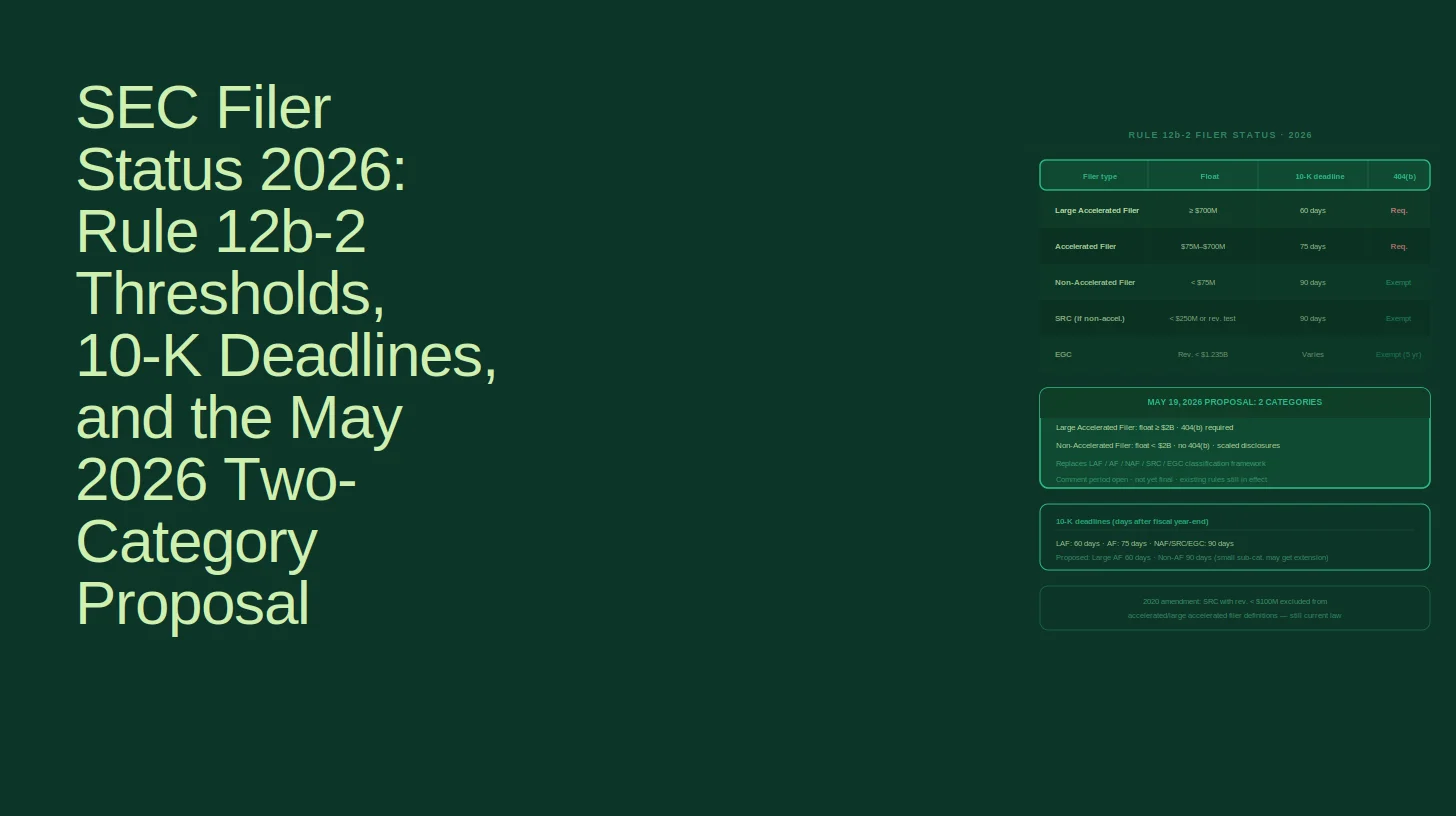
| Category | Current Float Threshold | Proposed Float Threshold | 404(b) Required? |
|---|---|---|---|
| Large Accelerated Filer | $700M+ | $2B+ | Yes |
| Accelerated Filer | $75M to $700M | Eliminated | N/A |
| Non-Accelerated Filer | Under $75M | Under $2B (default) | No |
| Smaller Reporting Company | Under $250M float or revenue test | Subsumed into NAF | No |
| Emerging Growth Company | Statutory (JOBS Act) | Unchanged (less significant) | No |
Who Actually Moves: A Company-by-Company Decision Map
Current accelerated filers (public float $75M to $700M)
This is the largest single group affected. Every company currently in the accelerated filer band becomes an NAF under the proposal, gaining the 404(b) exemption and full access to scaled disclosures. The entire accelerated filer category is eliminated.
For a mid-cap company currently paying for a Section 404(b) ICFR auditor attestation, this is the most financially significant change in the proposal. As Davis Polk notes, "the elimination of the ICFR auditor attestation requirement alone could yield meaningful compliance cost savings" for companies transitioning from accelerated filer to NAF status. ICFR attestation fees for a mid-sized company typically run in the hundreds of thousands of dollars annually, and in some cases exceed $1 million when integrated audit scope is factored in.
Current LAFs with float between $700M and $2B
These companies would drop from LAF to NAF status, but only after meeting the two-consecutive-year test below the new $2 billion threshold. They gain the 404(b) exemption, scaled executive compensation disclosure (no Compensation Discussion and Analysis requirement, fewer named executive officers in the Summary Compensation Table), two years of MD&A instead of three, and reduced financial statement periods.
As Chairman Atkins stated: "The public float threshold to be considered a 'large' company subject to the most extensive SEC disclosure requirements has not been updated since it was established in 2005."
Current EGCs approaching the five-year cliff
Under current rules, EGC status expires at the end of the fiscal year following the fifth anniversary of an IPO (or earlier upon crossing revenue or debt thresholds). Companies approaching that cliff face a sudden jump in compliance obligations with no transition period.
Under the proposal, that cliff largely disappears. Because NAFs receive nearly all EGC accommodations, an EGC that graduates out of statutory EGC status simply remains an NAF with the same practical benefits. The 60-month seasoning requirement also means no newly public company can become an LAF for at least five years regardless of float size, so the on-ramp is now structural rather than dependent on EGC eligibility.
Pre-IPO companies planning a 2026 or 2027 listing
A company that goes public after the rule is finalized would be an NAF for a minimum of five years, regardless of how large its float is on day one. A company with a $5 billion public float at IPO would still be an NAF for 60 consecutive calendar months. That means no 404(b) obligation, no accelerated filing deadlines, and access to scaled disclosures for the entire early public life of the company.
Combined with the companion Registered Offering Reform proposal (S7-2026-17), which would expand shelf registration eligibility by eliminating seasoning and public float requirements, a newly public biotech or growth company could be immediately eligible for Form S-3 shelf offerings. Davis Polk specifically highlights that a company a year out from its IPO could file an automatically effective shelf, and if there is an open market window in early March before audited financials are available, the company could still conduct an offering since audited financials would no longer be required that early for an NAF.
deSPAC companies
The proposal removes deSPAC companies' "ineligible issuer" status under Securities Act Rule 405, making them eligible to use Form S-3 shelf registration like traditional IPO companies. That is a meaningful improvement. But the proposals do not amend Rule 144(i) (the rolling 12-month current public information requirement for resales) or Rule 145 (statutory underwriter status for deSPAC parties), so deSPAC companies continue to be treated differently in those two respects. The relief is real but partial.
Small Non-Accelerated Filers (SNFs)
Companies with $35 million or less in total assets as of the end of each of their two most recent second fiscal quarters qualify as SNFs. This represents the smallest 18% of public companies by assets. SNFs get an additional 30 days to file Form 10-K (120 days total after fiscal year-end) and an additional 5 days to file Form 10-Q (50 days total after quarter-end). A company exits SNF status only when it becomes an LAF or reports more than $35 million in total assets as of the end of each of its two most recent second fiscal quarters.
How the New Mechanics Work: Float Calculation, Seasoning, and the Two-Year Rule
The 10-trading-day average replaces the single-day snapshot
Under current rules, public float for LAF determination is measured using the closing price on the last business day of the second fiscal quarter. One bad trading day in late June can change a company's filer status, filing deadlines, and 404(b) obligations for the following year.
The proposal replaces this with a 10-trading-day average price over the last 10 trading days of the second fiscal quarter, multiplied by non-affiliate shares as of the last day of that quarter. This smooths out single-day volatility and gives companies more predictability in status planning.
The 60-month seasoning requirement
The current seasoning threshold to become an LAF is 12 calendar months. The proposal increases this to 60 consecutive calendar months, a fivefold increase. No newly public company can become an LAF for at least five years after its IPO, regardless of float size. This applies to all companies, not just those that qualify as EGCs.
The two-consecutive-year rule: how it works in both directions
A company must exceed the $2 billion public float threshold for two consecutive years to become an LAF. It must remain below that threshold for two consecutive years to exit LAF status. The current separate exit threshold of $560 million is eliminated; the same $2 billion test applies in both directions.
This creates stability, but it also creates lag. KPMG flags the practical drawback: "filer status may lag recent changes in a registrant's public float, requiring some companies to comply with requirements that do not reflect more current conditions."
Consider the scenario: a company's float crosses $2 billion in year one, then falls back to $1.8 billion in year two. It never becomes an LAF. But if it crosses $2 billion in both year one and year two, it becomes an LAF at the start of year three. Audit committee planning cycles need to account for this two-year visibility window.
Mayer Brown also notes a comparability concern: companies with similar public floats may be subject to different disclosure requirements depending on whether their floats have fluctuated around the $2 billion threshold, creating a period of non-comparability between similarly-sized companies.
What Scaled Disclosures Do NAFs Actually Get?
All NAFs under the proposal would receive the accommodations currently reserved for EGCs and SRCs. The key ones:
- Section 404(b) exemption: No ICFR auditor attestation requirement. This is the single most financially significant accommodation for current accelerated filers.
- Scaled executive compensation disclosure: Summary Compensation Table with fewer named executive officers; no Compensation Discussion and Analysis (CD&A) requirement; no pay-versus-performance (PVP) disclosure; no say-on-pay or say-when-on-pay shareholder advisory votes.
- Reduced financial statement periods: Two years of audited financial statements for many issuers instead of three; two years of MD&A instead of three.
- Other Regulation S-K scaled items: Scaled business disclosure and other reduced presentation requirements.
For a company currently filing as an accelerated filer, the shift to NAF status effectively resets its disclosure obligations to those of a much smaller company, while its investor base and market presence remain unchanged. That asymmetry is intentional: the SEC's position is that these companies are not large enough to justify the full LAF burden.
The Evidence Base: What the Research Actually Says
Most coverage of this proposal frames the benefits as compliance cost savings. That framing is incomplete.
Peer-reviewed research by Dambra and Gustafson (2021, Management Science), cited directly in a July 6, 2026 comment letter on S7-2026-18, finds something more significant: firms receiving JOBS Act de-burdening provisions invest more, and more efficiently, after going public than comparable untreated firms, with the effect concentrated in innovative investment.
As Professor Michael Dambra of the University at Buffalo states in his comment letter: "Reductions in the regulatory burdens of being public produce real and beneficial effects on corporate investment, not merely savings in compliance costs." Because the JOBS Act accommodations being extended to NAFs include the 404(b) exemption, the research provides direct empirical support for the proposal's likely effect on investment behavior.
There is an important nuance here that CFOs evaluating IPO timing should note. Dambra is explicit: "I do not expect the regulation to increase IPO activity in the United States." The 25% IPO volume increase following the JOBS Act was driven by de-risking provisions (confidential submission, testing-the-waters), not by de-burdening accommodations like the 404(b) exemption. The filer status proposal will not materially move IPO volume, but it will improve the investment efficiency of companies that are already public or plan to go public.
Dambra also raises a design caution worth noting: "The gains from deregulation are maximized when relief is designed so as not to amplify discrete, well-identified conflicts of interest." The one adverse consequence identified in JOBS Act research came from allowing conflicted analysts back into the IPO process, not from reduced disclosure. The filer status proposal does not touch analyst-involvement provisions, so that specific risk is not amplified here.
What to Do Before the Rule Is Finalized
The rule is still a proposal. Companies need a plan for two possible futures: adoption roughly as proposed, or a modified version that emerges from the comment process. Here is what finance and legal teams should be doing now.
1. Map your current and projected filer status
Run the analysis for your company under both the current rules and the proposed framework:
- What is your public float as of June 30, 2026 (end of Q2)? Under the proposal, would a 10-day average calculation change that number materially?
- If your float is between $700 million and $2 billion, you would become an NAF. When would the two-consecutive-year test be satisfied?
- If you are currently an EGC, when does your statutory EGC status expire? Under the proposal, does it matter?
- Do you qualify as an SNF ($35 million or less in total assets)?
2. Quantify the 404(b) savings for budget planning
Do not wait for the rule to be final to model the compliance cost impact. Work with your external auditors now to estimate the annual cost of the ICFR attestation engagement. For most accelerated filers, this is a meaningful line item. Budget scenarios should include a version where the rule is adopted in 2027 and 404(b) obligations end at the next annual assessment.
3. Brief your audit committee and board
Audit committees need to understand two things: (a) the proposal exists and could materially change the company's compliance obligations, and (b) the two-consecutive-year rule means any status change will be visible at least one year in advance. Frame this as a planning opportunity, not a surprise. External auditors should be part of this conversation.
4. Assess the interaction with the Registered Offering Reform proposal
If your company raises capital through public offerings, the companion S7-2026-17 proposal matters as much as the filer status changes. The combined effect of NAF status plus shelf registration eligibility is more powerful than either proposal alone, particularly for growth companies and biotechs that need frequent capital market access. Model your capital-raising strategy under both the current and proposed frameworks.
5. Consider the semiannual reporting interaction
The SEC's separately proposed semiannual reporting option is part of the same Atkins agenda and is designed to work alongside the filer status changes. Companies evaluating whether to opt into semiannual reporting need to understand how that choice interacts with their filer status and filing deadlines under the new framework. See our analysis of what the semiannual reporting proposal changes for 10-Q filers.
6. Decide on a comment letter
The comment period closed July 20, 2026. If your company did not submit a comment, monitor the comment file on EDGAR for themes that may shape the final rule, particularly around the $2 billion threshold (the SEC specifically asked whether an inflation-adjusted figure from the 2005 baseline would be preferable) and the two-consecutive-year lag concern.
7. Update disclosure controls documentation
If the rule is adopted, companies transitioning from accelerated filer to NAF status will need to update their disclosure controls and procedures documentation to reflect the changed obligations. Start drafting the framework for that update now, so the transition is a matter of execution rather than design when the final rule drops.
FAQ
Does the proposal affect foreign private issuers? The proposal applies to domestic Exchange Act reporting companies filing on domestic forms. Foreign private issuers (FPIs) filing on Form 20-F or Form 40-F operate under a separate framework and are not directly affected by the filer status changes in Release No. 33-11419.
What happens to our EGC status if we are already an EGC? Statutory EGC status is unchanged. But because NAFs will receive nearly all EGC accommodations under the proposal, the practical significance of EGC status is substantially reduced. An EGC that graduates out of statutory status simply continues as an NAF with the same practical benefits.
If our float crosses $2 billion for one year and then drops back, do we become an LAF? No. The two-consecutive-year requirement means a company must exceed $2 billion for two consecutive years to become an LAF. A single year above the threshold followed by a year below it leaves the company as an NAF.
When does the 60-month seasoning clock start for a deSPAC company? The proposal does not provide specific guidance distinguishing deSPAC seasoning from traditional IPO seasoning. The clock would run from the date the company became subject to Exchange Act reporting requirements. Given the partial nature of deSPAC relief in this proposal (Rule 405 ineligible issuer status removed, but Rules 144(i) and 145 unchanged), companies in this situation should obtain specific legal advice on their seasoning calculation.
What scaled disclosures can we drop if we become an NAF? The most significant: Section 404(b) ICFR auditor attestation, Compensation Discussion and Analysis, pay-versus-performance disclosure, say-on-pay votes, and the third year of audited financial statements and MD&A. These are not automatic upon the rule's adoption; they apply once a company's status formally changes under the new framework.
Is the $2 billion threshold final? No. The SEC specifically asked commenters whether the threshold should instead be set based on an inflation adjustment from the 2005 $700 million baseline. The final threshold could differ from the proposed $2 billion. Monitor the comment file and the SEC's final rulemaking for any adjustment.
For the full mechanics of the current framework that this proposal would replace, see our SEC filer status 2026 thresholds and deadlines guide. For the compliance transition steps after adoption, see the SEC filer status rulemaking 2026 compliance transition playbook.