SEC Climate Rule Rescission 2026: What the Proposal Means for Registrants Right Now
If your team has been waiting for a clear answer on the SEC climate disclosure rule status in 2026, here it is: the rule is not yet rescinded, but it is effectively dead as a compliance mandate. On May 29, 2026, the SEC voted 3-2 to formally propose rescission of the 2024 climate rules in their entirety under Release No. 33-11421. The public comment period closes August 3, 2026. Until a final rescission rule is adopted after that process, the 2024 rules technically remain in the Code of Federal Regulations, stayed, unenforceable, and never once operative.
The practical question for CFOs and ESG teams has shifted. It is no longer "when do we comply with the SEC climate rule?" It is "what climate disclosures do we still owe, and how do we manage the gap between a rescinding US rule and accelerating international mandates?"
Key takeaway: The 2024 climate rules have been stayed since April 4, 2024 and have never required a single disclosure. But rescission is not yet final, the SEC's 2010 interpretive guidance remains operative, and multinational registrants face mandatory climate reporting under CSRD, ISSB, and California law regardless of what the SEC does.
The Four Legal States the Rule Has Passed Through
Most coverage conflates these stages. They are legally distinct and each carried different implications for compliance teams.
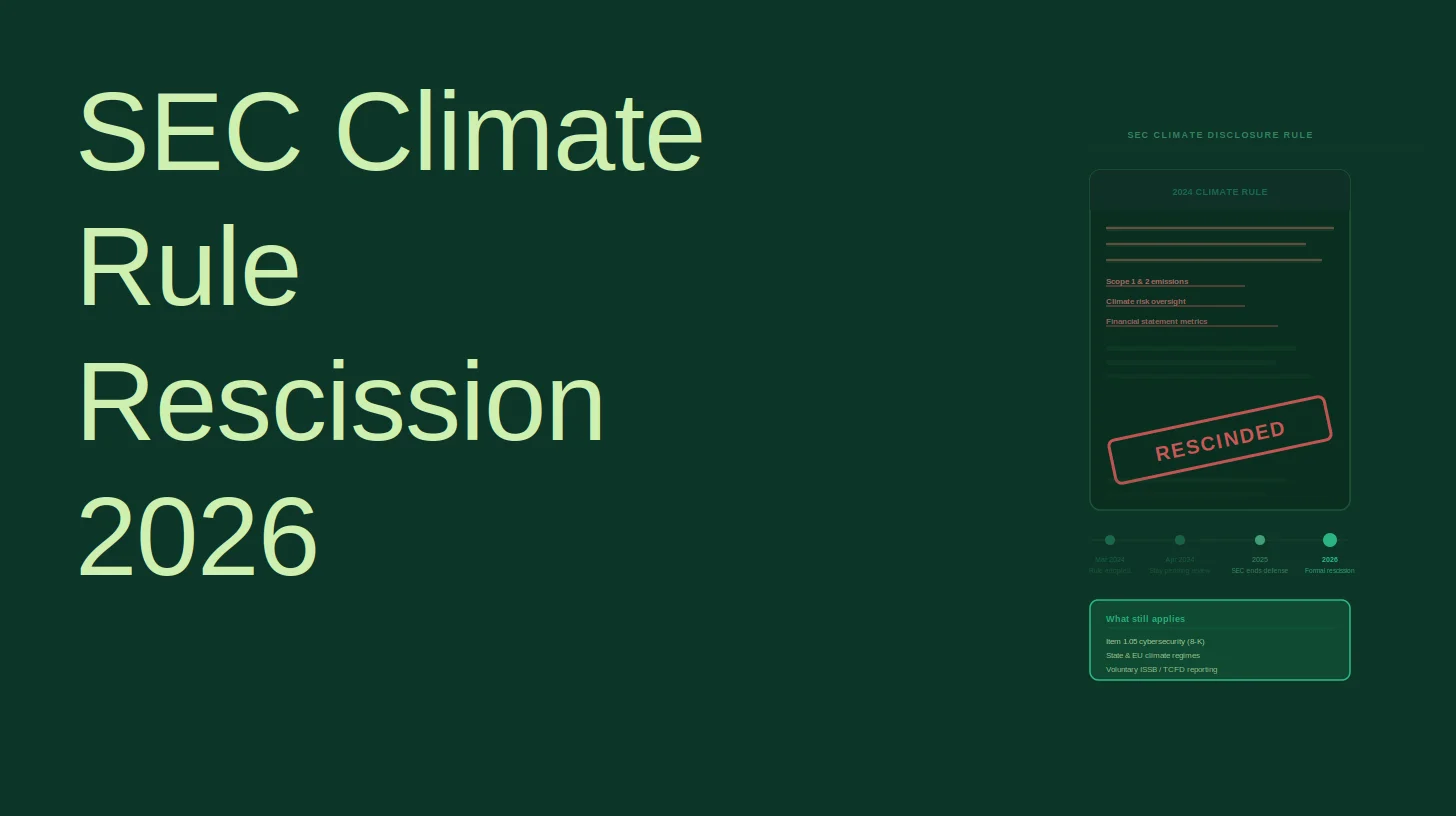
DateLegal StateCompliance ImplicationMarch 6, 2024Rules adopted (3-2 vote, Release No. 33-11275)Compliance timelines began running, theoreticallyApril 4, 2024Rules stayed by the Commission pending Eighth Circuit reviewNo compliance deadline ever became operativeMarch 27, 2025Commission voted to abandon defense in Iowa v. SEC, No. 24-1522Rules remained on the books; litigation continued without SEC defenseSeptember 12, 2025Eighth Circuit held petitions in abeyance pending SEC rulemaking or renewed defenseCourt effectively handed the decision back to the CommissionMay 29, 2026Commission proposed rescission in its entirety (Release No. 33-11421)Rules proposed for elimination; comment period open until August 3, 2026
The rules have been stayed for over 26 months as of June 2026. No compliance deadline has ever been operative. The tiered schedule, large accelerated filers first, then accelerated filers, then non-accelerated filers, was never triggered.
What the Rescission Proposal Actually Says
The rescission proposal rests on two independent grounds, and understanding both matters for predicting durability.
Ground 1: Statutory authority. The Commission argues the 2024 rules exceed the scope of its authority under the Securities Act and Exchange Act. Section III.B of the release invokes the major questions doctrine, the same doctrine the Supreme Court applied in West Virginia v. EPA, to argue that a rule of this economic and political significance required clear congressional authorization that was never given. This framing is deliberate: it is designed to make the rescission resistant to reversal by a future administration, which could not simply re-adopt the 2024 rules without a full new rulemaking and a credible answer to the authority question.
Ground 2: Independent policy reasons. Even if authority existed, the Commission argues the rules are unnecessary given existing materiality-based disclosure obligations, stray beyond securities law policy concerns, impose unjustified costs on public companies, and undermine capital formation objectives.
Chairman Paul Atkins framed the proposal as a return to first principles: "SEC disclosure obligations should comply with the Commission's statutory authority, be guided by materiality as the North Star, avoid the practical effect of dictating corporate behavior, and be imposed only when the expected benefits justify the likely costs and burdens."
Commissioner Mark Uyeda, who dissented from the 2024 adoption, was more direct: "The Climate Rule was, for all intents and purposes, a rule to influence how a business operates hidden under a cloak of disclosure."
A third, procedural ground appears in Commissioner Uyeda's statement: the Commission failed to re-propose the rule after significant deviations from the original 2022 proposal, raising Administrative Procedure Act notice-and-comment concerns. This is legally significant because it provides yet another independent basis for rescission, and signals that a future administration seeking to revive the 2024 rules would need to start the rulemaking process from scratch.
The rescission covers amendments across 17 CFR Parts 210, 229, 230, 232, 239, and 249, affecting at least 14 forms including Forms 10-K, 10-Q, S-1, S-3, S-4, 20-F, and others. It is proposed in its entirety, no partial preservation of any provision.
What Climate Disclosures Still Apply to SEC Registrants
This is where many teams are making a costly mistake: assuming that rescission of the 2024 rules means no climate disclosure obligations remain. That is wrong.
The SEC's 2010 interpretive guidance on climate-related disclosures (Release No. 33-9106) has never been rescinded and remains fully operative. It requires registrants to disclose material climate risks under existing Reg S-K items. The rescission proposal itself affirms this: the Commission states that "the concept of materiality, including climate change, is already well embedded in the SEC's disclosure obligations, whether in the description of the business, risk factor disclosure, management's discussion and analysis, financial statements, and notes to the financial statements."
In practical terms, the operative US federal climate disclosure framework post-rescission looks like this:
Disclosure AreaApplicable FrameworkWhat It RequiresBusiness descriptionReg S-K Item 101Material climate risks affecting the businessRisk factorsReg S-K Item 105Material climate-related risks, including physical and transition risksMD&AReg S-K Item 303Known trends and uncertainties from climate, including regulatory and physical risksLegal proceedingsReg S-K Item 103Material climate-related litigation or regulatory proceedingsFinancial statementsGAAP / ASC standardsMaterial financial impacts from climate events, impairments, contingenciesContingent liabilitiesSAB 74 (SAB 5-Z)Disclosure of anticipated compliance costs if material, see below
The 2010 guidance does not require GHG emissions disclosures, financial statement climate metrics, or assurance. But it does require disclosure of material climate risks, and the SEC's comment letter process, even under the current administration, has not formally suspended that obligation. EY's ESG reporting team notes that "material sustainability issues remain a strategic consideration and a source of compliance and legal risk" under the existing framework.
The SAB 74 Question: What to Do in Your Next 10-Q
Companies that had been preparing for the 2024 rules and disclosed anticipated compliance costs as contingent liabilities under SAB 74 (now codified as SAB 5-Z) face a specific filing question right now: how do you update those disclosures during the comment period, before rescission is final?
The answer is not to drop the disclosure entirely. The 2024 rules are technically still in the CFR. The comment period is open. A final rescission rule has not been adopted. For companies that previously disclosed material anticipated compliance costs, the appropriate approach is to update the disclosure to reflect the current legal status, proposed for rescission, comment period open until August 3, 2026, final outcome uncertain, rather than treating the obligation as extinguished.
For a detailed technical guide to drafting these disclosures, see Finrep's SEC Climate Rescission: Drafting SAB 74 Disclosures.
The International Compliance Gap: You Cannot Stand Down Entirely
For multinational registrants, the SEC's rescission proposal changes almost nothing about their actual disclosure workload. The international framework is accelerating, not retreating.
CSRD (EU Corporate Sustainability Reporting Directive): Applies to non-EU companies with EU-generated net turnover above EUR 150 million and at least one EU subsidiary or branch meeting size thresholds. For in-scope US-listed companies, CSRD reporting obligations are mandatory regardless of SEC action.
ISSB S1/S2: As of June 2025, 36 jurisdictions had adopted or were finalizing steps to implement ISSB standards. Companies reporting under these frameworks face climate disclosure requirements aligned with TCFD, including Scope 1 and Scope 2 GHG disclosures.
California SB 253 / SB 261: California's Climate Corporate Data Accountability Act (SB 253) requires companies with annual revenues over $1 billion that do business in California to disclose Scope 1 and Scope 2 GHG emissions starting in 2026, and Scope 3 emissions starting in 2027. SB 261 requires companies with revenues over $500 million to report climate-related financial risks annually. These apply to both public and private companies and are not affected by SEC action. According to Ceres, approximately half of the companies that would have been covered by the SEC rules will still face mandatory climate reporting under other jurisdictions.
FrameworkWho It CoversScope 3 RequiredEffectiveSEC 2024 Rule (rescission proposed)Virtually all US public companiesNo (removed from final rule)Never operativeSEC 2010 Guidance (operative)All SEC registrantsIf materialNowCSRDLarge non-EU companies with EU presenceYes (ESRS E1)Phased 2024-2026ISSB S1/S2Companies in adopting jurisdictionsIf materialJurisdiction-dependentCalifornia SB 253$1B+ revenue companies doing business in CAYes (from 2027)2026 (Scope 1/2)California SB 261$500M+ revenue companies doing business in CANo2026
For teams managing the divergence between a rescinding US rule and mandatory international frameworks, how SEC teams benchmark ESG disclosures against peers provides a structured process for maintaining defensible disclosures across frameworks.
What Your Team Should Do Right Now
The comment period closes August 3, 2026. Here is a concrete action list for CFOs, ESG teams, and disclosure committees.
Before August 3, 2026 (comment period open):
- Assess your SAB 74 exposure. If you disclosed anticipated compliance costs for the 2024 rules in prior filings, update the disclosure in your next 10-Q to reflect the proposed rescission status. Do not drop it without updating it.
- Audit your voluntary climate disclosures. Review what climate information currently appears in your 10-K under Items 101, 103, 105, and MD&A. Confirm each disclosure is grounded in a materiality determination under the 2010 guidance, not just carried forward from 2024 rule preparation.
- Consider submitting a comment letter. If your company built significant compliance infrastructure for the 2024 rules and faces sunk costs, the comment period is the appropriate venue to put that on the record. Comments can be submitted at sec.gov/comments/s7-2026-19 or by email to rule-comments@sec.gov with "File Number S7-2026-19" in the subject line. ESG-focused institutional investors who relied on the 2024 rule's data standardization should also consider commenting.
- Map your international obligations. Determine whether CSRD, ISSB, or California SB 253/261 applies to your business. If any of these frameworks apply, your climate data infrastructure remains necessary regardless of SEC action.
- Brief your board and audit committee. The key message: the SEC climate rule is proposed for rescission but not yet gone, the 2010 guidance still requires material climate risk disclosure, and international obligations are unaffected. Boards should not interpret the SEC's action as a green light to eliminate climate risk oversight.
After final rescission (expected late 2026 or 2027):
- Reassess your climate data program scope. If your only mandatory driver was the 2024 SEC rule and no international framework applies, you have genuine discretion to scale back. But document the decision and the materiality analysis behind it.
- Evaluate third-party assurance arrangements. Assurance providers engaged specifically for the 2024 rule's limited assurance requirements may no longer be necessary for SEC purposes. However, CSRD requires assurance, so do not terminate arrangements before confirming your international posture.
- Watch for enforcement posture shifts. The current SEC has reduced its use of comment letters to surface climate disclosure issues. But private plaintiff litigation and state attorney general enforcement remain live risks for companies that materially reduce voluntary disclosures without a documented materiality rationale.
Who the Rescission Applies To
The 2024 rules, had they taken effect, would have applied to virtually all domestic registrants and foreign private issuers, with two exceptions: Canadian issuers reporting under the Multijurisdictional Disclosure System and asset-backed security issuers. The rescission therefore has broad market impact, but so does the continuing obligation under the 2010 guidance, which applies to every SEC registrant.
For foreign private issuers specifically, the Form 20-F is included in the rescission proposal's scope. FPIs subject to CSRD or ISSB in their home jurisdictions face the international framework regardless.
FAQ
Has the SEC climate rule been rescinded?No. As of June 2026, the SEC has proposed rescission under Release No. 33-11421, but a final rescission rule has not been adopted. The 2024 rules technically remain in the CFR, though they have been stayed since April 4, 2024 and have never required any disclosure. The comment period closes August 3, 2026; final action will follow after the Commission reviews comments.
What is the difference between "stayed," "defense abandoned," and "proposed for rescission"?A stay (April 2024) suspended the rules' effectiveness pending litigation, they remained on the books but could not be enforced. Abandoning the litigation defense (March 2025) meant the Commission stopped arguing for the rules in court, but did not change their legal status. Proposing rescission (May 2026) is the formal administrative step to remove the rules from the CFR, but it requires completing the notice-and-comment process before it is final.
Do we still need to disclose climate risks in our 10-K?Yes, if those risks are material. The SEC's 2010 interpretive guidance (Release No. 33-9106) remains operative and requires disclosure of material climate risks under Reg S-K Items 101, 103, 105, and in MD&A. The rescission of the 2024 rules does not change this obligation.
When will the rescission be finalized?The comment period closes August 3, 2026. After reviewing comments, the Commission must adopt a final rescission rule. Given the current Commission's clear policy direction, final rescission is expected in late 2026 or early 2027, though no specific date has been announced.
Does the rescission affect our CSRD or California obligations?No. CSRD, ISSB S1/S2 in adopting jurisdictions, and California SB 253/261 are entirely independent of SEC action. If your company meets the thresholds for any of these frameworks, your climate reporting obligations are unaffected by the SEC's rescission proposal.
Should we continue building climate data infrastructure?If you are subject to CSRD, ISSB, or California law, yes, your infrastructure investment remains necessary. If the 2024 SEC rule was your only mandatory driver, you have more discretion after final rescission, but document your materiality analysis carefully and maintain the capacity to disclose material climate risks under the 2010 guidance.
The SEC climate disclosure rule spent five years in development, was adopted by a 3-2 vote, received over 4,500 unique comment letters, was stayed within 30 days of adoption, and has now been proposed for rescission two years later. The administrative process will conclude. But the underlying obligation to disclose material climate risks to investors never went away, and for companies with international operations, it is getting more demanding, not less.